
Amazon Competitor Analysis: How to Track Prices, Keywords, Listings and Sales Opportunities
 September 2, 2026
 Yashwardhan Singh
 0 Comments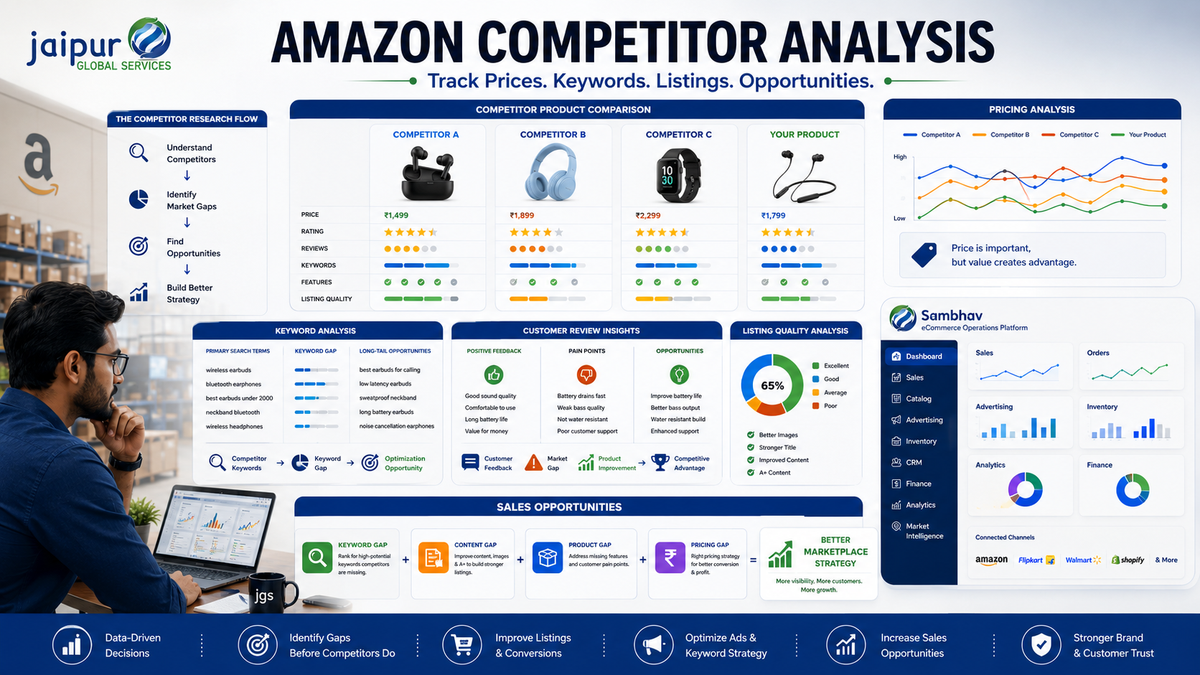
A seller launches a product, optimizes the listing, and starts running ads — and still watches competitors pull ahead with better pricing, more reviews, stronger images, sharper positioning, and more relevant keywords. It's a familiar pattern: you can't make strong marketplace decisions by looking only at your own listing. You also need to understand the competitive environment your product is selling into.
That's what Amazon Competitor Analysis is for. Done properly, it helps sellers see what competitors do well, where customers are dissatisfied, where pricing gaps exist, which search terms actually matter, and where real market opportunities sit — not by copying what's already out there, but by understanding it well enough to do something different.
What Is Amazon Competitor Analysis?
Amazon competitor analysis is the systematic process of researching competing products, sellers, listings, prices, keywords, reviews, promotions, and positioning within your category:
Competitor Products + Pricing + Keywords + Listings + Reviews + Advertising + Customer Needs → Competitive Insights → Business Opportunities
One distinction matters more than any other: competitor analysis is not copying competitors. Recreating a competitor's title or images doesn't build an advantage — it just makes you a slightly different version of them. The value is in understanding the market well enough to make better decisions about your own product, pricing, content, and positioning.
Why Amazon Seller Competitor Analysis Matters
Amazon seller competitor analysis helps sellers understand customer expectations, spot pricing pressure early, find keyword opportunities competitors haven't captured, and identify genuine product gaps. It also surfaces positioning, recurring complaints, and areas where differentiation could mean profitable growth.
This works best as an ongoing habit, not a one-time project — pricing, review counts, and listings all shift, so a snapshot from six months ago may no longer reflect today's market.
How to Identify Your Real Amazon Competitors
Not every product in your category is a meaningful competitor. Trying to track everything dilutes the analysis. Focus on products with a similar type, customer, price range, use case, keyword targets, and positioning to yours.
It helps to separate competitors into categories: a direct competitor targets the same customer with a near-identical product at a similar price. An indirect competitor solves the same problem differently. A category leader dominates visibility and reviews, setting pricing and positioning norms. An emerging competitor is newer, with fewer reviews, but may be gaining traction. Direct competitors and category leaders deserve the closest tracking; emerging competitors are worth watching for early signals.
Amazon Competitor Pricing Analysis
Pricing comparison should go beyond the listed price: selling price, discounts, coupons, lightning deals, bundles, size/quantity per unit, variation pricing, and how fulfillment method affects landed cost.
Responding to competitor pricing by simply cutting your own erodes margins and rarely wins long-term — there's usually someone willing to go lower. A more durable comparison looks at:
Price + Features + Quality + Reviews + Brand Positioning + Customer Value
The goal isn't being the cheapest — it's understanding the market's pricing structure and where your value proposition sits within it.
Amazon Competitor Keyword Research
Amazon competitor research into keywords starts with reading competitor titles, bullet points, and descriptions closely, along with backend search terms where visible, organic results, sponsored placements, and long-tail phrases. From this, sellers can identify which Amazon competitor keywords are targeted, which terms are genuinely relevant to their own product, useful intent variations, and gaps no competitor addresses.
Copying a competitor's keyword list won't improve rankings on its own — a keyword only helps if it's genuinely relevant and matches what your listing can honestly deliver.
Amazon Competitor Listing Analysis
Amazon listing analysis works best broken into parts. Does the product title communicate the product clearly at a glance? What does the main image communicate before a customer reads a word? Do secondary images explain features, benefits, dimensions, or use cases? Do bullet points focus on real benefits and differentiators, or just generic features? Where applicable, review A+ Content for storytelling, comparison tables, and product education.
The point is identifying what's missing in the category — not reproducing what a competitor has already built.
Analyze Competitor Reviews to Find Product Opportunities
This is often the most useful part of the process. Reading through 1-3 star reviews — alongside what repeats in positive reviews — reveals patterns pricing and listing data alone won't show:
Customer Complaint → Repeated Problem → Product/Listing Opportunity → Improvement → Competitive Advantage
Common examples might include poor packaging, sizing mismatches, difficult installation, weak durability, missing accessories, or confusing instructions — illustrative, not universal. What matters is finding complaints that repeat across multiple competitors, since a recurring pattern is far more reliable than one frustrated review.
Amazon Competitive Research for Advertising
Sellers can observe competitor advertising visibility directly in search results — where Sponsored Products, Sponsored Brands, and Sponsored Brand Video placements appear, and which products show up consistently. This helps identify which keywords appear commercially competitive and where competitors invest visibility.
What sellers cannot see is a competitor's actual ad budget, exact bids, or private campaign data — that isn't publicly available, and any tool claiming to show it precisely should be treated with caution.
Amazon Competitor Analysis Tools
Sellers researching competitors typically use a combination of Amazon's own publicly visible marketplace data, third-party keyword tools, product research platforms, pricing trackers, spreadsheet tracking, and analytics platforms. An amazon competitor analysis tool free tier can help with basic research — spotting pricing gaps or checking review counts — but free tiers often come with limited data depth, and availability changes over time, so check current pricing pages before relying on one.
It's worth being clear about the kind of data you're looking at: publicly observable data (prices, reviews, images, rankings visible on Amazon), estimated or third-party data (sales estimates and search volume modeled by external tools — approximations, not confirmed numbers), and private seller data (a competitor's actual sales, costs, or ad spend, inaccessible to outsiders). Treating estimates as confirmed numbers is one of the most common ways competitor research goes wrong.
Amazon Competitive Advantage Analysis
The goal of amazon competitive advantage analysis isn't just cataloging what competitors do — it's answering a sharper question: what can your business genuinely do better or differently? This can be examined through product quality, pricing, features, packaging, brand positioning, customer experience, content, fulfillment, service, or innovation.
Competitor Strength + Customer Pain Point + Your Capability = Potential Competitive Advantage
Not every gap is commercially worth pursuing — some require investment or capabilities that don't match your business, and chasing every observed weakness spreads resources too thin. The useful gaps are the ones your business can actually execute on profitably.
How to Turn Competitor Research Into Sales Opportunities
Research only has value once it turns into action. A few patterns to watch for: a keyword gap, where competitors target relevant terms your listing doesn't address. A content gap, where competitor listings fail to explain an important benefit. A product gap, where customers repeatedly mention an unmet need. A pricing gap, an underserved price-to-value segment. An experience gap, recurring complaints around packaging, instructions, or service. And a market gap, a product variation or customer segment that's currently underserved. Every opportunity should still be validated — checking demand, feasibility, and margin — before real investment follows.
Create an Amazon Competitor Analysis Spreadsheet
A simple tracking structure keeps this process consistent rather than ad hoc. Useful columns: Competitor, Product, ASIN, Price, Rating, Review Count, Main Keywords, Key Features, Main Image Quality, A+ Content, Promotions, Customer Complaints, Strengths, Weaknesses, Opportunity, and Last Checked. Reviewing this weekly or monthly, depending on how fast your category moves, keeps the data useful — prices, review counts, and promotions shift constantly, and a stale spreadsheet quickly becomes misleading.
Common Amazon Competitor Research Mistakes
Sellers commonly go wrong by copying competitors outright, competing purely on price, looking only at star ratings without reading the reviews behind them, and ignoring negative reviews that actually contain useful signal. Tracking too many competitors dilutes focus, while treating estimated sales data as exact figures leads to decisions built on shaky assumptions. Other common issues: ignoring customer intent behind a search term, focusing only on keywords while ignoring listing and review data, forgetting profitability when chasing an opportunity, and — most simply — never acting on what the research found. Research only pays off when insights lead to real decisions.
How JGS Helps Amazon Sellers With Marketplace Growth
JGS (Jaipur Global Services) is an ecommerce services and technology company supporting Amazon sellers with marketplace growth and operations. Competitor insights are only useful once acted on, and JGS works with sellers on account management, catalog and listing optimization, A+ content and enhanced brand content, and advertising — turning competitive gaps into actual listing and campaign changes.
How Sambhav Can Help Sellers Turn Ecommerce Data Into Action
Competitor research becomes more useful once weighed against your own performance data, not viewed in isolation. Sambhav, JGS's in-house SaaS platform, doesn't automatically perform Amazon competitor analysis, but it helps sellers manage the broader ecommerce data competitive insights need to be compared against: catalog management, advertising performance, CRM, real-time sales analytics, and finance and payment reconciliation, in one place.
Competitor Research + Market Intelligence + Sales Data + Advertising Data + Catalog Data + Inventory Data + Financial Data → Broader Ecommerce Business View → Better Decisions
A competitor's pricing gap or content weakness only matters commercially once checked against your own margins, inventory position, and advertising efficiency. Sambhav supports that broader view without claiming to automate the competitive research itself, guarantee rankings, or promise a specific ROAS outcome — those depend on far more than any single platform.
FAQ
1. What is Amazon Competitor Analysis?
The systematic process of researching competing products, sellers, prices, keywords, reviews, and positioning to understand the market and make better decisions — not to copy what competitors are doing.
2. How do I conduct Amazon seller competitor analysis?
Identify direct competitors, then compare pricing, keywords, listing content, reviews, and advertising visibility, looking specifically for gaps between what customers want and what competitors currently deliver.
3. What should I check when analyzing Amazon competitors?
Pricing and promotions, product titles and images, bullet points and A+ Content, review patterns (especially complaints), keyword targeting, and where they show up in sponsored placements.
4. What is an Amazon competitor analysis tool?
Software that helps sellers track competitor pricing, keywords, reviews, or estimated sales — ranging from spreadsheet-based manual tracking to dedicated research platforms.
5. Is there a free Amazon competitor analysis tool?
Some tools offer free tiers useful for basic research, though functionality and data depth are typically more limited than paid versions — check current pricing pages before relying on any specific tool.
6. How can competitor reviews reveal product opportunities?
Repeated complaints in 1-3 star reviews often point to real product or listing weaknesses — packaging, sizing, instructions, durability — that represent opportunities if you can genuinely solve them.
7. Can Amazon competitor research improve SEO and advertising?
Yes. It can surface relevant keywords and content gaps for listing optimization, and reveal where competitors are investing in advertising visibility — though it should inform, not replace, your own keyword relevance and testing.
8. How can JGS and Sambhav help Amazon sellers?
JGS manages account, catalog, content, and advertising execution so competitive findings turn into real listing and campaign changes, while Sambhav centralizes sales, catalog, and performance data so those findings can be weighed against your own business context.
Conclusion
Amazon competitor analysis isn't about copying the seller with the highest sales or the most reviews. It's about genuinely understanding pricing, keywords, listings, reviews, advertising, and customer expectations well enough to spot product gaps your competitors haven't addressed — and turning that research into measurable action rather than letting it sit in a spreadsheet.
JGS (Jaipur Global Services) helps sellers manage the marketplace operations that make competitor research actionable, while Sambhav supports a more centralized view of the ecommerce data that turns competitive insight into real decisions.
Need help turning Amazon competitor research into a stronger marketplace strategy? JGS (Jaipur Global Services) can help businesses manage their ecommerce operations and marketplace growth, while Sambhav can provide a centralized environment for managing relevant ecommerce data and workflows.