
Ecommerce Solution Provider Built for Scalable Growth
 June 1, 2026
 Yashwardhan Singh
 0 Comments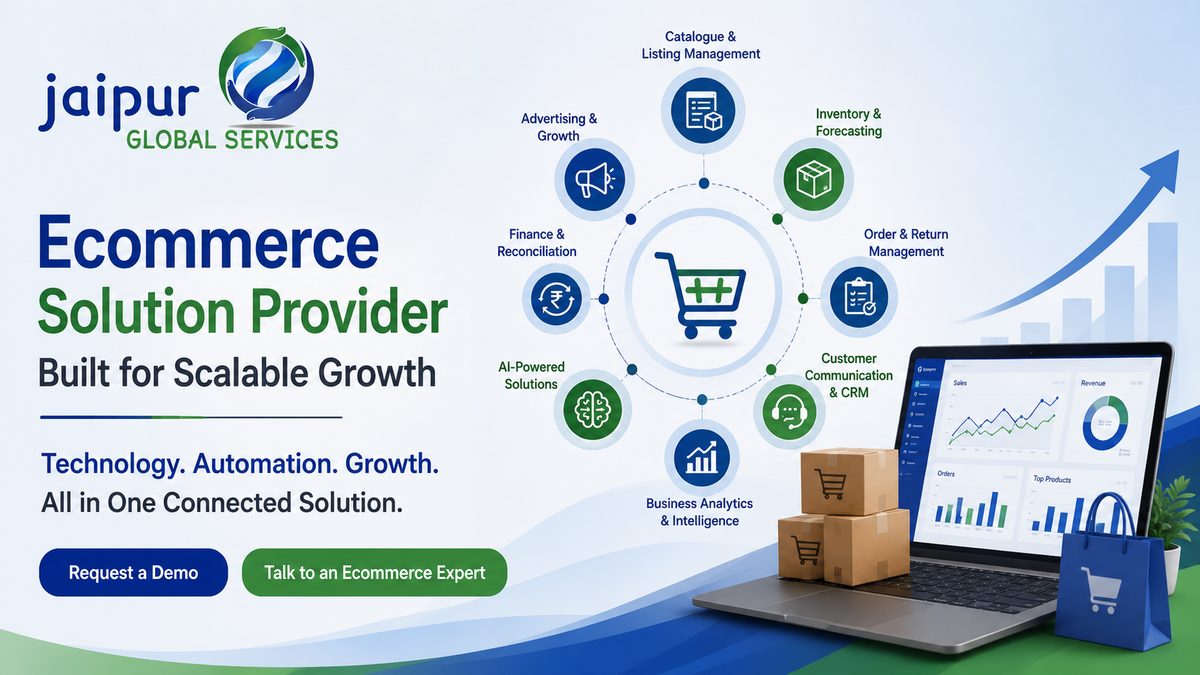
Running an ecommerce business rarely stays simple for long. What starts as one marketplace account and a spreadsheet turns into multiple channels, a growing catalogue, advertising campaigns that need daily attention, inventory that needs constant tracking, and customer messages that need fast responses — often spread across five or six different tools that don't talk to each other.
That's the gap an ecommerce solution provider is meant to close. Not another single-purpose tool, but a connected way of managing the parts of your ecommerce business that are supposed to work together in the first place.
JGS approaches this as a technology-first ecommerce growth partner — combining marketplace expertise with AI-powered analytics, automation, and operational support to help businesses manage complexity and build growth that can actually scale.
[Request a Demo] [Talk to an Ecommerce Expert]
What Is an Ecommerce Solution Provider?
An ecommerce solution provider helps businesses manage one or more parts of their online commerce ecosystem — rather than just one narrow task. Depending on the business, that can span:
- Product catalogue and listings
- Advertising and traffic
- Inventory and order management
- Fulfillment coordination
- Customer communication
- Marketplace management
- Analytics and reporting
- Pricing and financial reconciliation
- Overall growth strategy
Managing these functions separately — different tools, different logins, different spreadsheets — tends to create fragmented data and disconnected workflows. Connecting them instead leads to better visibility, better coordination between teams, more informed decisions, and operations that can actually handle growth instead of straining under it.
Why Ecommerce Businesses Outgrow Fragmented Systems
Picture a typical growing seller: one tool for advertising, another for catalogue management, a separate system for inventory, a different dashboard for each marketplace, spreadsheets for reporting, and customer queries handled manually across email and marketplace messaging.
This setup usually works — until it doesn't. As order volume grows, the cracks show up as duplicate work, inconsistent data across systems, reporting that takes hours to compile, decisions that lag behind what's actually happening, and operational errors that come from information sitting in the wrong place at the wrong time.
The underlying issue is rarely a lack of effort. It's usually a lack of connected systems.
What Makes a Scalable Ecommerce Solution?
A handful of characteristics separate a solution that scales with a business from one that just adds another dashboard:
- Centralized data — business information that's easy to access and interpret in one place
- Automation — repetitive processes handled automatically where it makes sense
- Marketplace connectivity — support across the channels a business actually sells on
- Analytics — data that surfaces trends and performance changes, not just raw numbers
- Operational visibility — a clear view of orders, inventory, and activity as it happens
- Flexibility — a system that can grow alongside the business, not one it outgrows in a year
- Human oversight — automation that supports decisions rather than replacing judgment entirely
The JGS Ecommerce Solution
JGS positions itself as a technology-first, AI-powered ecommerce growth partner, built around helping businesses manage and scale marketplace operations. That means combining marketplace expertise, automation, analytics, and hands-on operational support rather than offering a single point tool.
(The specific module names, feature availability, and exact current positioning language below should be checked against jgservices.in before publishing — I've kept descriptions general and non-specific to current plans, since I can't browse the live site to confirm exact current offerings.)
Catalogue & Category Management
Accurate, consistent product data is the foundation everything else builds on. This covers centralized catalogue information, category mapping, and listing content — titles, bullet points, descriptions, attributes, and search terms — kept consistent across platforms.
Accurate catalogue data can support better customer understanding, better discoverability, and better catalogue consistency across channels. It doesn't guarantee specific rankings or conversion outcomes — those depend on many factors beyond listing quality alone.
Advertising & Ecommerce Growth
Advertising support covers campaign management, performance analysis, and budget decisions informed by ASIN-level or product-level insight — tracking metrics like ROAS, ACOS, and ROI. The principle worth emphasizing: advertising decisions work better when they're connected to catalogue, inventory, and profitability data, rather than managed in isolation. No specific advertising outcome is guaranteed; results depend on the product, category, and market conditions.
Forecasting, Inventory & Pricing
Growth built on advertising alone runs into trouble without the operational side to match. This includes demand forecasting, inventory planning, reorder timing, and competitive pricing analysis. Selling more without understanding inventory levels tends to create stockouts or excess stock — the goal isn't simply more sales, it's growth that the business's inventory and cash flow can actually support.
Order & Return Management
Order processing, order tracking, returns handling, and refund workflows benefit from operational visibility that connects order status with inventory and customer communication — reducing manual reconciliation work and improving the customer's experience when something needs to be returned or resolved.
Customer Communication & CRM
Buyer-seller messaging, customer queries, feedback, and return or refund communication are treated as part of ecommerce operations, not a separate activity handled ad hoc. Centralizing customer information and response workflows helps ensure queries get handled consistently rather than falling through the cracks between marketplaces.
Business Analytics & Growth Intelligence
Sales, traffic, revenue, inventory, product performance, advertising performance, customer behavior, and pricing data are only useful if they lead somewhere. Dashboards matter less than the decisions they inform — the goal is analytics that a business can actually act on, not just observe.
AI-Powered Ecommerce Solutions
AI plays a role in supporting several of these areas — catalogue optimization, advertising insights, pattern recognition in performance data, and workflow automation are common applications in ecommerce technology today. AI is genuinely useful for faster analysis, spotting patterns humans might miss, and reducing repetitive manual work. It's not a substitute for human judgment on strategic decisions, and no ecommerce AI tool independently guarantees business outcomes — it supports the people making the decisions.
Finance & Payment Reconciliation
Revenue isn't the same as profit. Financial visibility — matching orders to payments, tracking marketplace fees, refunds, and other deductions — is what turns a sales number into a clear picture of actual business economics. This kind of reconciliation work is often the least visible part of ecommerce operations and one of the most error-prone when handled manually across multiple marketplaces.
Marketplace Solutions: Amazon, Flipkart & Walmart
Marketplace-specific knowledge matters because these platforms don't work identically. Amazon support typically spans catalogue, advertising, orders, customer communication, and marketplace-specific analytics. Flipkart and Walmart capabilities should be confirmed against JGS's current service offering, since feature availability and platform requirements differ by marketplace and can change over time.
[Explore JGS Solutions]
Why Businesses Choose JGS
- Technology-first approach — automation and technology integrated into day-to-day ecommerce management, not bolted on afterward
- Connected operations — catalogue, advertising, orders, and analytics managed through a more unified system rather than disconnected tools
- Data-driven decisions — analytics and insight used in place of purely manual reporting
- Marketplace expertise — a focus specifically on ecommerce marketplace operations
- Scalable infrastructure — built to support businesses as operational complexity grows, not just at their current size
- Operational efficiency — automation reduces repetitive manual work where it genuinely helps
- Business visibility — centralized reporting instead of scattered dashboards
Who Can Benefit From JGS Ecommerce Solutions
Small ecommerce sellers typically need help with marketplace setup, catalogue basics, advertising, and foundational operational support.
Growing brands usually need more sophisticated advertising management, inventory planning, deeper analytics, and support across multiple channels as complexity increases.
Established ecommerce businesses often need scalable systems, centralized data, advanced reporting, automation, and clearer profitability visibility across a larger operation.
Multichannel businesses need centralized catalogue management, coordinated marketplace operations, and unified order, inventory, and advertising data across every channel they sell on.
(Feature and service availability varies — worth confirming current plan details directly rather than assuming every capability applies to every business size.)
Connected Solution vs. Disconnected Tools
Fragmented Approach
Connected Ecommerce Solution
Multiple dashboards
Centralized visibility
Manual reporting
Automated reporting
Repetitive manual tasks
Workflow automation
Data spread across tools
Connected data
Reactive decisions
Data-supported decisions
Difficult to scale
Designed for operational growth
A connected solution reduces a lot of this friction — it doesn't eliminate every operational challenge a growing ecommerce business will face.
How JGS Ecommerce Solutions Work
- Understand the business — marketplaces, product range, current sales, operational complexity, and growth goals
- Identify relevant functions — catalogue, advertising, orders, inventory, customer communication, analytics, or finance, based on what the business actually needs
- Configure the relevant solution — not every business needs every module from day one
- Monitor performance — through dashboards and ongoing analytics
- Optimize — identify what needs improvement based on real performance data
- Scale — increase operational capacity as the business grows, rather than rebuilding systems from scratch later
When Should You Consider an Ecommerce Solution Provider?
A few signs it's worth the conversation:
- Marketplace operations are becoming difficult to manage across channels
- Reporting takes too much manual time to compile
- Your team relies on too many disconnected tools
- Catalogue updates are repetitive and time-consuming
- Advertising decisions lack clear visibility into what's actually working
- Inventory is hard to monitor accurately
- Order volume is increasing faster than your current process can handle
- Coordinating multiple marketplaces feels like running separate businesses
- Manual work is slowing the team down
- You lack centralized visibility into overall business performance
- You want to scale without proportionally scaling manual effort
Ecommerce Solution Provider vs. Consultant vs. Marketplace Management Company
These terms get used interchangeably, but they're not quite the same:
- Ecommerce solution provider — provides technology, systems, and integrated capabilities to manage ecommerce functions
- Ecommerce consultant — provides strategic guidance and recommendations, typically without direct execution
- Marketplace management company — manages marketplace-specific activities and day-to-day execution
Many growing businesses need a combination of these, depending on where their biggest gaps are. Jaipur Global Services positioning combines technology and execution — providing the systems along with the marketplace expertise to run them — rather than strategy recommendations alone.
Scalable Growth Requires More Than More Sales
More orders create more operational workload, more inventory requirements, more customer interactions, more data to track, more financial reconciliation, and more marketplace complexity to coordinate. Scaling revenue without scaling the systems behind it tends to create operational pressure rather than smooth growth. A scalable ecommerce solution is built to help a business absorb that growing complexity rather than be strained by it.
JGS's Technology-First Approach
The underlying philosophy: technology + marketplace expertise + automation + data + execution work together to support scalable ecommerce operations. This isn't a formula that guarantees a specific growth outcome — no combination of tools or services can promise that — but it's the structural approach JGS applies to helping ecommerce businesses manage growing complexity.
[Request a Demo]
Frequently Asked Questions
1. What is an ecommerce solution provider?
A company that helps businesses manage one or more parts of their online commerce operations — catalogue, advertising, orders, inventory, or analytics — often through connected technology and systems rather than a single-purpose tool.
2. What does an ecommerce solution provider do?
It typically combines technology, automation, and marketplace expertise to help manage the operational and growth-related functions of an ecommerce business.
3. How can an ecommerce solution provider help my business grow?
By reducing fragmented tools and manual work, improving visibility into performance data, and connecting functions like catalogue, advertising, and inventory so decisions can be made faster and with better information.
4. What is the difference between ecommerce solutions and ecommerce consulting?
Solutions typically involve technology and execution support; consulting typically involves strategic guidance and recommendations. Many businesses use a combination of both.
5. What ecommerce services does JGS provide?
JGS offers marketplace management, catalogue and listing support, advertising management, order and returns support, analytics, and related ecommerce operational services. (Exact current service list should be confirmed on jgservices.in.)
6. Does JGS support Amazon sellers?
Yes, Amazon is a core marketplace JGS supports across catalogue, advertising, orders, and analytics. (Specific service scope should be verified directly.)
7. Does JGS support Flipkart sellers?
JGS supports Flipkart-related ecommerce operations; specific capabilities should be confirmed against current offerings.
8. Does JGS support Walmart sellers?
JGS supports Walmart-related ecommerce operations; specific capabilities should be confirmed against current offerings.
9. Can JGS help manage ecommerce operations?
Yes — operational support spanning catalogue, orders, inventory coordination, and customer communication is part of JGS's ecommerce solution.
10. Does JGS use AI for ecommerce management?
Yes, AI supports areas like catalogue optimization, advertising insights, and analytics, working alongside human oversight rather than replacing it.
11. Is JGS suitable for growing ecommerce businesses?
JGS's approach is built to support businesses at different stages, from smaller sellers needing foundational support to larger, multichannel operations needing more advanced coordination and analytics.
12. How can I request a JGS demo?
Use the "Request a Demo" option on this page, or reach out directly to start a conversation with an ecommerce expert.
Ready to Build a More Scalable Ecommerce Operation?
Whether you're managing a growing marketplace business or expanding across multiple ecommerce channels, JGS can help bring more visibility, automation, and structure to your ecommerce operations.