
Amazon Advertising Services: A Complete Guide to Growing Sales with Amazon Ads
 June 1, 2026
 Yashwardhan Singh
 0 Comments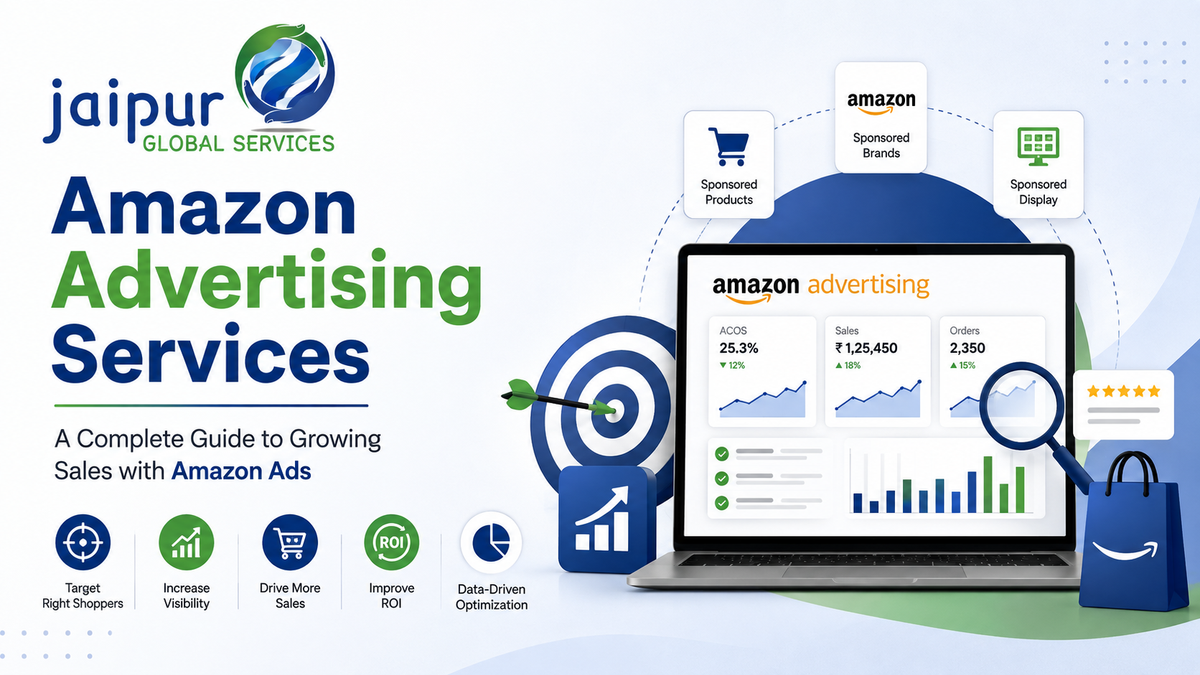
Having a good product on Amazon doesn't mean shoppers will actually find it. With millions of products competing for the same searches, even a well-optimized listing can sit on page three or four, invisible to most of the customers who'd genuinely want to buy it.
This is where paid advertising comes in. Amazon Advertising Services generally refer to the professional planning, creation, management, monitoring, and optimization of Amazon ad campaigns — helping sellers put relevant products in front of shoppers who are actively searching or browsing.
It's worth being upfront about something important right away: successful Amazon advertising isn't simply about spending more money. It depends on relevant targeting, sound campaign structure, appropriate bidding, a product listing that can actually convert the traffic being sent to it, ongoing optimization, disciplined budget control, and honest performance analysis. Get any of these wrong, and increased ad spend just means increased losses, faster.
This guide walks through how Amazon advertising actually works, the different ad formats available, how to structure and optimize campaigns, which metrics matter, and when it makes sense to bring in professional support.
What Are Amazon Advertising Services?
Amazon Advertising Services cover the practical work involved in running effective ad campaigns on Amazon. Depending on the provider and the seller's needs, this can include:
- Campaign strategy and planning
- Campaign setup and structure
- Keyword research
- Targeting selection
- Bid management
- Budget management and allocation
- Ongoing campaign optimization
- Search-term analysis
- Negative keyword and negative targeting management
- Performance monitoring
- Regular reporting
- ACOS and ROAS analysis
Amazon Advertising Management, in practice, is less about setting up a campaign once and more about the continuous cycle of monitoring, adjusting, and refining based on what the data actually shows. Amazon campaign management done well is an ongoing discipline, not a one-time task.
How Does Amazon Advertising Work?
At a basic level, the process looks like this:
Seller selects products to advertise → Campaign is created → Targeting is chosen → Budget and bids are set → Amazon serves ads to relevant shoppers → Shoppers click the ad → Shoppers land on the product page → Some shoppers purchase → Seller analyzes performance → Campaign gets optimized
That's the mechanical flow, but the outcome at each stage depends on several interacting factors:
- How relevant the targeting actually is to real shopper searches
- How competitive the product is within its category
- The overall quality of the product listing
- Price relative to similar products
- Review count and rating
- The specific keywords or audiences being targeted
- The bid amount relative to competition
- Available budget
- The listing's actual conversion rate once traffic arrives
None of these operate in isolation. A great bid on an irrelevant keyword wastes money just as easily as a relevant keyword paired with a weak product listing does.
What Is Amazon PPC?
Amazon PPC — pay-per-click — is the underlying model behind most Amazon advertising: the advertiser pays only when a shopper actually clicks the ad, not simply for it being shown (impressions are typically free; clicks are what cost money).
Sellers use Amazon PPC for a range of reasons:
- Increasing visibility for specific products
- Generating traffic to new or existing listings
- Supporting new product launches that don't yet have organic momentum
- Reaching shoppers actively searching for relevant terms
- Promoting priority products, such as new arrivals or higher-margin items
- Supporting broader sales growth alongside organic efforts
Amazon PPC Management is essentially the ongoing work of running this process well — and Amazon PPC Management Services exist because doing this consistently, across a growing catalogue, takes real time and expertise.
Types of Amazon Advertising
Amazon offers several distinct ad formats, each serving a different purpose. It's important not to treat these as interchangeable — they work differently and often serve different stages of the shopper journey.
1. Sponsored Products
This is product-level advertising, using keyword or product targeting, and it appears in search results and on relevant product pages. It's generally the most commonly used format, largely because it directly targets shoppers who are already searching with purchase intent.
2. Sponsored Brands
This format is brand-focused rather than single-product-focused, allowing brand-registered sellers to showcase multiple products together, often driving to a Brand Store where eligible. It's typically more useful for building brand visibility and cross-selling across a catalogue than for isolated product promotion.
3. Sponsored Display
This format uses audience and product targeting rather than purely keyword-based targeting, and can support product discovery and retargeting-style use cases, appearing in various placements both on and off Amazon depending on eligibility.
4. Amazon DSP
Amazon DSP (Demand-Side Platform) is Amazon's programmatic advertising offering, allowing for more advanced, automated audience targeting across a wider range of placements, both on Amazon and elsewhere. It works differently from the sponsored ad formats above and is generally more relevant for brands with specific programmatic advertising goals rather than a typical starting point for most sellers.
It's worth being clear that eligibility and availability for these formats vary by marketplace, seller type, brand registration status, and account standing. Not every seller automatically has access to every format — this is worth confirming directly in Amazon Ads documentation or your advertising console rather than assuming.
Why Amazon PPC Matters for Sellers
Increased product visibility. Ads can place eligible products directly in front of shoppers who are actively searching for related terms.
Product launches. New products with no sales history or reviews often struggle for organic visibility; advertising can help generate initial traffic while organic performance builds.
Keyword discovery. Search-term reports reveal actual language shoppers use, which can inform both advertising and broader listing strategy.
Competitive positioning. Ads let sellers compete for visibility on searches where organic ranking alone might not be sufficient.
Sales support. Advertising can generate meaningful additional traffic to a product page, supporting overall sales alongside organic channels.
Brand visibility. Sponsored Brands and other formats can support broader brand awareness where the seller is eligible.
One important clarification: Amazon advertising does not automatically improve organic search rankings. The two are related in the sense that increased sales velocity from advertising can indirectly support a product's broader marketplace performance over time, but running ads doesn't directly move organic rank — they're not interchangeable levers.
Amazon Advertising vs Amazon SEO
Amazon advertising is paid visibility — you're paying, directly or via bids, to appear in specific placements.
Amazon SEO is organic visibility, driven by listing relevance, keyword usage in titles and content, conversion history, and broader marketplace performance factors.
The strongest overall approach usually considers both together rather than treating them as separate strategies. Amazon PPC can drive traffic quickly, while Amazon SEO and solid Amazon product listing optimization build a foundation that continues generating visibility without ongoing ad spend. It's worth being direct here too: advertising cannot indefinitely compensate for a genuinely weak product listing. If the underlying page doesn't convert, more ad spend simply means paying more to reach the same conversion ceiling.
How to Structure Amazon PPC Campaigns
Campaign structure affects how easily you can control spend, analyze performance, and optimize over time. Key building blocks include:
- Automatic campaigns, where Amazon selects targeting based on listing content — useful for initial data gathering
- Manual campaigns, where the seller selects specific keywords or products to target, offering more control
- Match types for keyword targeting: broad match, phrase match, and exact match, each offering different levels of targeting precision
- Product targeting, aiming ads at specific competitor or complementary products
- Category targeting, where applicable, for broader category-level visibility
- Brand vs. non-brand targeting, separating campaigns aimed at your own brand searches from those targeting generic or competitor terms
- Campaign segmentation, organizing campaigns by product, goal, or match type rather than mixing everything together
This structure matters because it directly affects budget control, bid control, how clearly you can analyze search-term performance, how easily you can compare campaign results, and how efficiently you can optimize. There's no single correct structure that fits every seller — the right approach depends on the specific product, category, budget, search volume, competitive landscape, and business objectives.
Amazon Keyword Targeting Strategy
Keyword research is foundational to effective Amazon PPC, and it goes well beyond just picking obvious terms:
- Relevant search terms that genuinely match what shoppers are searching for
- High-intent keywords that signal a shopper close to purchase decision, not just browsing
- Long-tail keywords, which are often lower-volume but higher-converting due to specificity
- Branded keywords, capturing searches for your own brand name
- Generic keywords, capturing broader category-level searches
- Competitor or product targeting, placing ads against specific competing products
- Negative keywords, excluding irrelevant search terms that waste spend
A critical distinction worth internalizing: keyword relevance and keyword volume are not the same thing. A high-volume keyword that doesn't genuinely match your product's use case or that has low purchase intent can burn through budget without meaningful returns. A lower-volume but highly relevant keyword often performs better in terms of actual return, even if it generates fewer total clicks.
What Are ACOS, ROAS and TACOS?
These are core metrics for understanding Amazon advertising performance, and it's worth understanding each clearly.
ACOS (Advertising Cost of Sales) measures ad spend as a percentage of ad-attributed sales. A lower ACOS generally means you're spending less to generate each dollar of ad-driven sales.
ROAS (Return on Ad Spend) is essentially the inverse relationship, expressed as a ratio — how much sales revenue you're generating for each unit of ad spend.
TACOS (Total Advertising Cost of Sales) measures ad spend as a percentage of total sales (both ad-driven and organic), giving a broader picture of how advertising is affecting the business overall, rather than just the advertising campaigns in isolation.
It's important not to treat any of these as having one universal "good" number. What counts as acceptable performance depends heavily on:
- Product profit margin
- Selling price
- Specific business goals (growth vs. profitability, for instance)
- Where the product is in its lifecycle (new launch vs. mature listing)
- Category norms
- Broader brand strategy
- The proportion of sales coming from organic vs. paid channels
A new product launch might reasonably run a much higher ACOS than an established, high-margin bestseller — both can be "correct" depending on the underlying goal.
Other Amazon Advertising Metrics Sellers Should Track
Beyond ACOS, ROAS, and TACOS, several other metrics matter for a complete picture:
- Impressions — how often your ad was shown
- Clicks — how many shoppers clicked through
- CTR (Click-Through Rate) — the percentage of impressions that resulted in a click
- CPC (Cost Per Click) — the average cost each click
- Conversion rate — the percentage of clicks that resulted in a purchase
- Orders — total ad-attributed orders
- Ad-attributed sales — revenue directly tied to ad clicks
- Spend — total advertising cost
- New-to-brand metrics, where applicable, showing how many customers are new to your brand rather than repeat buyers
Looking at only one metric in isolation tends to produce poor decisions. A campaign with a low ACOS but very low overall sales volume might be technically "efficient" while contributing little to actual business growth. A full picture requires looking at several of these together.
How Amazon PPC Campaigns Are Optimized
Campaign optimization isn't a one-time setup task — it's continuous, ongoing work. Common optimization activities include:
- Adjusting bids based on actual performance data
- Adjusting budgets to reflect what's working and what isn't
- Analyzing search-term reports to find new opportunities or wasted spend
- Managing negative keywords to exclude irrelevant or poorly converting terms
- Expanding keyword targeting where performance data supports it
- Reducing spend on consistently underperforming targets
- Scaling budget toward genuinely high-performing targets
- Analyzing performance by placement (top of search vs. product pages, for instance)
- Restructuring campaigns when the current setup makes analysis or control difficult
- Reviewing performance at the individual product level, not just the campaign level
The core principle behind good Amazon bid optimization and Amazon ad campaign optimization is that decisions should be based on actual data, not assumptions or gut feeling about what "should" be working.
Common Amazon Advertising Mistakes
Some recurring mistakes limit performance across a lot of seller-managed campaigns:
- Targeting irrelevant keywords that generate clicks but rarely convert
- Using the same bid across every target, ignoring that different keywords and products perform very differently
- Ignoring search-term data, missing both opportunities and wasted spend
- Never adding negative keywords, letting irrelevant clicks accumulate indefinitely
- Spending heavily on poor-converting products, rather than reallocating toward what's working
- Sending paid traffic to weak listings, which wastes spend regardless of how well-targeted the campaign is
- Ignoring product margins, chasing sales volume without regard for actual profitability
- Focusing only on ACOS, sometimes at the expense of actual growth or overall business goals
- Setting up campaigns and never revisiting them, missing the ongoing optimization that drives real improvement
- Mixing different campaign goals together, making it hard to evaluate what's actually working
- Ignoring competitor activity, missing shifts in the competitive landscape that affect performance
- Failing to test different targeting approaches, settling for "good enough" rather than continuing to improve
Each of these mistakes tends to waste budget, limit growth, or both — often without the seller realizing exactly why performance isn't improving.
How Product Listings Affect Amazon Advertising Performance
This is one of the most overlooked connections in Amazon advertising: advertising brings traffic, but the product listing has to convert it.
The relationship looks like this: Ad → Click → Product Page → Product Understanding → Purchase Decision.
Everything on the product page after the click matters enormously to whether that click turns into a sale:
- The product title's clarity and relevance
- The main image's quality and appeal
- Supporting product images
- Bullet points that clearly communicate benefits
- A well-written product description
- A+ Content, where the brand has invested in it
- Genuine customer reviews and ratings
- Competitive pricing
- Consistent product availability
- Overall relevance to what the shopper was searching for
If a listing is weak in any of these areas, even well-targeted, well-optimized advertising will underperform — the traffic arrives, but the page fails to close the sale. This is why Amazon Product Listing Services and Amazon Catalogue Services are often discussed alongside advertising rather than as a completely separate topic. They're solving different parts of the same problem: getting the right shopper to the page, and then convincing that shopper once they arrive.
When Should You Hire an Amazon Advertising Agency?
Professional support tends to make practical sense when:
- Ad spend is increasing and needs tighter oversight
- Campaigns have grown complex enough to be difficult to manage internally
- ACOS performance is inconsistent without a clear explanation
- The business has a large number of SKUs to manage across campaigns
- The seller or internal team lacks specific Amazon PPC expertise
- Campaigns aren't being optimized regularly due to time constraints
- A product launch requires more structured advertising than the team can build alone
- The business wants to scale advertising across multiple marketplaces
- Internal teams simply don't have enough bandwidth for consistent campaign management
- Reporting and performance analysis have been inconsistent or unclear
It's worth being direct: hiring an agency doesn't guarantee better results. What it typically offers is more consistent attention, broader experience across accounts and categories, and dedicated time that an internal team juggling multiple responsibilities often can't match.
How to Choose the Right Amazon PPC Agency
A genuinely capable Amazon advertising agency should be able to clearly explain:
- Their overall campaign strategy approach
- How they conduct keyword research
- How they manage bids
- How they allocate and manage budget
- Their approach to negative targeting
- What kind of performance reporting you'll receive
- How they analyze ACOS and ROAS in context of your specific goals
- How they think about the relationship between advertising and listing optimization
- Their approach to testing and iteration
- How and how often they'll communicate with you
Watch for these red flags, which typically signal a provider worth avoiding:
- Guaranteed sales figures
- Guaranteed ACOS numbers
- Guaranteed organic ranking improvements
- No regular reporting
- No clear explanation of strategy
- One-size-fits-all campaign templates applied regardless of product or category
- Extremely aggressive, unrealistic promises
- General lack of transparency about what's actually being done
Amazon Advertising Services for Indian Sellers
For sellers based in India, Amazon advertising typically starts on Amazon.in, with many sellers eventually considering expansion to other Amazon marketplaces as their business grows.
Campaign strategy can vary meaningfully depending on:
- The specific marketplace being targeted
- Product category and typical competition levels within it
- Product price point relative to local purchasing behavior
- Customer search and shopping behavior, which can differ across marketplaces
- Search demand for relevant keywords in that market
- Available advertising budget
- Overall business goals and growth stage
Sellers exploring Amazon Advertising Agency India options, or broader Amazon PPC Services India support, should look for the same fundamentals covered throughout this guide — clear strategy, transparent reporting, and a genuine understanding of category-specific dynamics — rather than assuming any agency's general Amazon experience automatically translates to strong performance in every marketplace.
How Jaipur Global Services (JGS) Can Support Amazon Advertising
Amazon advertising works best as part of a broader, connected approach to marketplace management, rather than an isolated task disconnected from listing quality, catalogue management, or account health.
Jaipur Global Services (JGS) provides Amazon advertisement management that includes Sponsored Products, Sponsored Brands, and Sponsored Display campaigns — covering campaign creation and management, along with tracking of metrics such as ACOS and ROAS. This sits alongside Jaipur Global Services (JGS) broader Amazon marketplace services, including account management and product listing optimization.
The practical value of this connected approach is straightforward: since advertising performance depends heavily on listing quality, and listing quality depends on ongoing catalogue and account management, having these handled together — rather than by disconnected teams that don't communicate — tends to produce a more coherent strategy than treating advertising as a standalone service.
It's worth being clear: no advertising partner, including Jaipur Global Services (JGS), can guarantee specific sales figures, a particular ACOS or ROAS, guaranteed rankings, or guaranteed conversions. What a knowledgeable partner can offer is structured campaign management, ongoing optimization based on real performance data, and a strategy that connects advertising to the rest of your Amazon operations.
Amazon Advertising Checklist
Before launching campaigns:
- Product listing is complete and accurate
- Product is eligible for advertising
- Pricing is competitive within the category
- Sufficient inventory is available to support increased traffic
- Product images are strong and comply with Amazon's guidelines
- Keyword research has been conducted
- Campaign objectives are clearly defined
- A realistic budget has been established
- A bidding strategy has been selected
During campaigns:
- Monitor spend regularly against budget
- Review search-term reports for relevance and waste
- Adjust bids based on actual performance
- Add negative keywords or targets as needed
- Monitor conversion rate at the product level
- Track ACOS in context of margin and goals
- Track ROAS alongside ACOS for a fuller picture
- Review performance by individual product, not just campaign totals
- Adjust budgets to reflect what's actually working
- Continue testing new targeting approaches over time
Conclusion
Amazon advertising isn't simply about increasing spend and hoping for better results. Campaigns that actually perform well depend on relevant targeting, a genuinely strong product listing behind the ad, sound campaign structure, appropriate bidding, disciplined budget management, and continuous, data-driven optimization.
Amazon PPC works best as one part of a broader ecommerce strategy — one that also includes product listing optimization, competitive pricing, a strong review base, reliable inventory, organic visibility, and overall brand building. Treating advertising as separate from these other factors tends to produce inconsistent, frustrating results, regardless of how much is spent.
If you're currently running Amazon ads and want a clearer picture of whether your campaigns, listings, and broader account management are actually working together, it may be worth reviewing the full picture rather than just the ad dashboard. You're welcome to explore JGS's Amazon advertising and marketplace management services to see if that kind of connected approach fits what your business currently needs.