
Amazon Multi Seller Flex Warehouse: Fulfillment Solutions for Amazon Sellers
 March 17, 2026
 Yashwardhan Singh
 0 Comments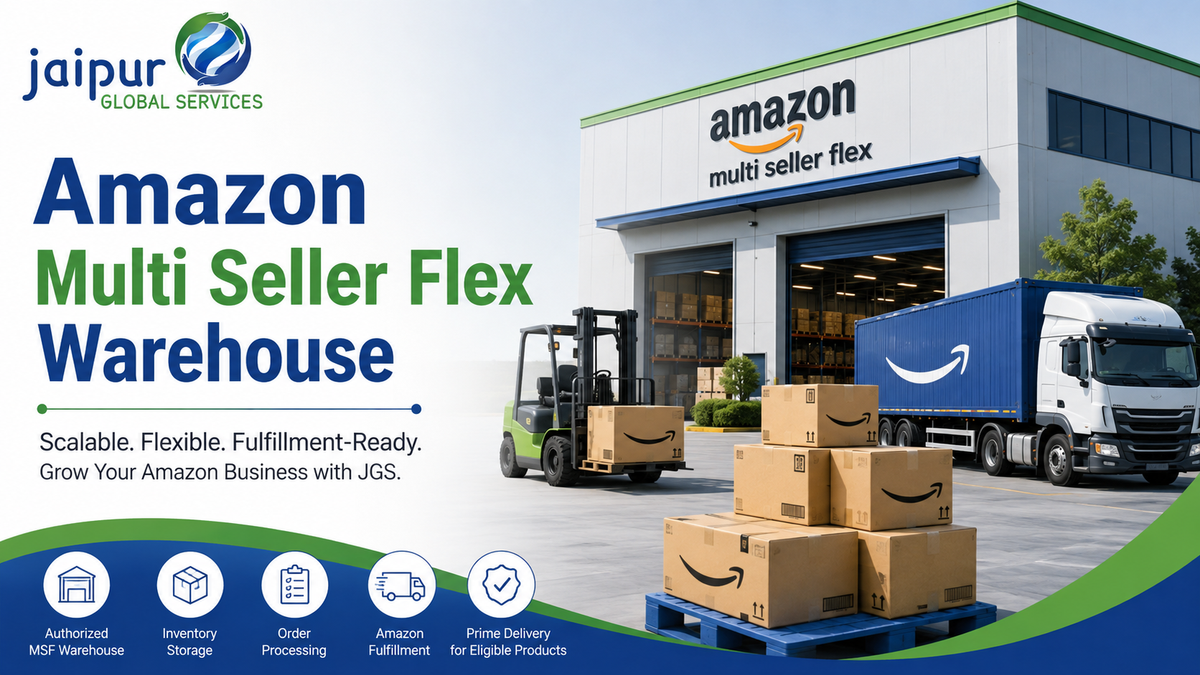
Order volumes climb, the product catalog grows, and at some point fulfillment stops being something a seller can manage from a back room. Growing inventory, multiple SKUs, limited internal warehouse capacity, rising fulfillment pressure, and customer expectations for faster delivery all compound at once — and getting fulfillment wrong at that stage costs real sales, not just operational headaches.
Amazon Multi-Seller Flex (MSF) is one fulfillment option worth understanding at this point — a program where eligible sellers can send inventory to a nearby facility operated by an authorized third-party service provider, subject to Amazon's current program requirements. It's worth being precise from the start: MSF is not simply "Amazon's warehouse." Amazon does not own or directly operate MSF sites — they're run by authorized third-party operators, with Amazon handling shipping, logistics and customer service around that.
What Is Amazon Multi-Seller Flex?
Amazon Multi-Seller Flex is a fulfillment program in which multiple sellers can use a facility operated by an Amazon-authorized third-party service provider. Per Amazon's own program announcement, MSF sites are fulfillment centers run by these authorized operators, who handle inventory storage and customer order processing, while Amazon provides shipping, logistics support and customer service around those orders.
The basic model: seller inventory → MSF warehouse → inventory storage → order received → pick & pack → Amazon's fulfillment/delivery process → customer.
Amazon has described the program as helping eligible products access Prime badge and Fulfilled by Amazon tagging — worth stating carefully: this applies to eligible products sent to MSF sites, not automatically to every product a seller lists, and sellers should confirm current eligibility for their specific products and account directly with Amazon.
How Does Amazon Multi Seller Flex Work?
Step 1 — Eligibility. The seller needs to meet Amazon's current applicable program requirements — this varies and should be confirmed directly through Seller Central rather than assumed.
Step 2 — Inventory sent to the MSF facility. The seller sends eligible inventory to their selected or nearest MSF location.
Step 3 — Storage. The MSF operator stores that inventory at the facility.
Step 4 — Order received. When a customer places an order, the fulfillment requirement routes to the warehouse through Amazon's relevant order-processing system.
Step 5 — Pick and pack. The warehouse team locates the correct SKU, picks the product, verifies quantity, packs the order, and prepares it for dispatch.
Step 6 — Handoff to Amazon's delivery network. Once packed, the order moves into Amazon's shipping and logistics process for last-mile delivery — this stage is Amazon's responsibility, not the MSF operator's.
Step 7 — Returns. Where applicable, the MSF operator handles return processing for eligible returned items.
Exact process details can vary and are subject to Amazon's current program requirements — sellers should confirm specifics with Amazon or their MSF partner before relying on any particular workflow assumption.
Amazon Multi Seller Flex vs. FBA
FBA (Fulfillment by Amazon) uses Amazon's own fulfillment centers, operated directly by Amazon. MSF uses facilities operated by authorized third-party service providers, not Amazon itself — a meaningful structural difference, not just a naming difference. It's inaccurate to describe MSF as simply "FBA outside Amazon's own network" — the operator, the day-to-day management, and the underlying facility relationship are genuinely different, even though both can result in Prime-eligible listings.
Both models shift storage, pick-and-pack and (where applicable) returns handling away from the seller's own operation. The practical difference for a seller often comes down to facility location relative to their own base, and which model they're actually eligible for.
Amazon Multi Seller Flex vs. Easy Ship
Easy Ship keeps inventory with the seller — the seller stores the product, prepares the order themselves, and Amazon picks it up and handles delivery according to Amazon's Easy Ship process. Multi-Seller Flex, by contrast, moves inventory into an MSF operator's facility, where storage, picking and packing all happen at that third-party site rather than at the seller's own location.
The distinction that matters: Easy Ship is fundamentally a self-fulfillment model with Amazon handling last-mile delivery; MSF hands storage and order processing to a third party as well. Exact current workflow details for either program should be confirmed with Amazon before a seller commits to one over the other.
Benefits of Amazon Multi Seller Flex
Access to fulfillment infrastructure. Sellers gain access to a professionally operated facility without building their own warehouse operation from scratch.
More structured operational processing. A dedicated fulfillment process can support more consistent order handling than a seller managing everything internally on an ad-hoc basis — though this doesn't translate to a specific promised delivery time, which depends on many factors outside the MSF operator's control.
Prime eligibility for eligible products. Products sent through MSF that meet Amazon's current eligibility criteria may receive Prime badge and Fulfilled by Amazon tagging — not an automatic outcome for every product, and something to confirm per listing.
Reduced internal warehouse burden. Sellers reduce (though don't necessarily eliminate) the need to manage every fulfillment task themselves.
Inventory storage off-site. Inventory sits at the MSF facility rather than requiring the seller's own storage space.
Pick and pack support. The MSF operator handles order picking and packing rather than the seller doing this manually.
Returns handling, where applicable. Return processing for MSF-fulfilled orders can be handled through the same operation, subject to program terms.
Scalability. A third-party facility can help absorb growing order volumes without a seller having to build an entirely new internal fulfillment setup for each stage of growth.
Who Should Consider Multi Seller Flex?
Growing Amazon sellers whose order volume has outpaced what internal fulfillment can comfortably handle. Manufacturers with large inventory volumes that need structured storage and processing. D2C brands expanding onto Amazon from their own website, who don't yet have Amazon-specific fulfillment infrastructure. Multi-SKU sellers whose growing catalog is creating warehouse complexity internally. Sellers with limited warehouse infrastructure who need professional storage and fulfillment support rather than building it themselves.
Sellers in Tier 2/Tier 3 markets were part of the program's original positioning when Amazon launched MSF — the program was specifically framed around helping sellers outside major metro areas access Prime badge eligibility through a nearby facility. Current program availability by specific city or region should be confirmed directly with Amazon or a prospective MSF operator rather than assumed.
When Multi Seller Flex May Not Be the Right Choice
MSF isn't automatically the right fit for every seller. It may not be ideal when order volume is extremely low (making shared-facility fulfillment less proportionate), inventory is difficult to store safely (oversized, hazardous, or requiring special handling), a seller isn't currently eligible under Amazon's program requirements, a seller specifically needs complete, direct control over every stage of warehousing, or the product category has special handling or compliance requirements the standard MSF process doesn't accommodate.
Fulfillment choice should ultimately depend on order volume, inventory size and type, product category, geography, operational requirements, cost, and actual current Amazon eligibility — not on which program sounds most sophisticated.
What Services Does an MSF Warehouse Typically Provide?
Inventory storage — secure storage and organized inventory placement. Receiving — processing inbound inventory as it arrives. Inventory management — tracking stock levels and SKUs on an ongoing basis. Pick & pack — processing customer orders as they come in. Dispatch preparation — preparing shipments per required processes ahead of handoff to Amazon's delivery network. Returns processing — handling returned products where applicable under program terms. Inventory reconciliation — keeping physical and system inventory records aligned. Operational reporting — giving sellers visibility into warehouse activity.
Not every MSF facility necessarily provides every one of these services at the same depth — sellers should confirm the specific service scope with their chosen operator, including JGS, before assuming a particular capability is included.
Inventory Management in a Multi Seller Flex Warehouse
Inventory accuracy in an MSF setting matters as much as it does in any warehouse — arguably more, given multiple sellers share the facility. This depends on accurate SKU mapping, consistent barcode management, regular stock reconciliation, careful inbound receiving, reliable outbound tracking, a defined process for damaged inventory, structured returns handling, and stock-level alerts that flag problems before they become stockouts.
Incorrect inventory in this environment can lead directly to lost sales, order cancellations, fulfillment delays, and real customer dissatisfaction — the exact problems a seller was trying to avoid by using a professional facility in the first place.
How MSF Can Support Amazon Sellers During Peak Seasons
Seasonal demand spikes — Prime Day, the festive season, Diwali, end-of-season sales, and category-specific peaks — put real pressure on fulfillment capacity. Managing this well depends on advance demand forecasting, deliberate inventory planning ahead of the peak, confirmed warehouse capacity for the expected volume, pick-and-pack readiness, and replenishment planning so stock doesn't run out mid-peak.
It's worth being direct: no fulfillment arrangement can guarantee specific peak-season performance outcomes. What structured planning and a professionally operated facility can do is reduce the operational risk of being caught unprepared — not eliminate the inherent unpredictability of peak demand.
Costs and Considerations
This article won't invent specific pricing — MSF and related fulfillment costs depend on storage volume, order volume, product dimensions and handling requirements, transportation, returns volume, program-specific charges set by Amazon, and any additional warehouse services used.
A useful way to frame the real cost: product cost + storage + handling + fulfillment + transportation + returns = total fulfillment cost. Evaluating only the storage rate in isolation misses the larger picture — a seller should look at total fulfillment cost per order, not a single line item, when comparing fulfillment options. Current Amazon program fees should always be confirmed directly through Seller Central rather than relied on from any third-party estimate, including this article.
How to Choose an Amazon Multi Seller Flex Warehouse
Worth evaluating: current Amazon authorization/status of the operator, facility location relative to the seller's needs, storage capacity, storage conditions appropriate to the product category, inventory management practices, pick-and-pack accuracy track record, technology and reporting visibility offered, returns handling process, ability to scale with the seller's growth, general operational process maturity, seller support responsiveness, facility security, transparency around SLAs and processes, and genuine experience specifically with Amazon seller operations rather than general warehousing alone.
Sellers should independently verify current program eligibility and requirements directly with Amazon before committing to any specific MSF operator.
Why Location Matters for Fulfillment
Warehouse location affects inventory movement time, inbound transportation cost and speed, general operational cost, delivery coverage, and how quickly a seller can replenish stock at the facility. A facility closer to a seller's own base, or well-positioned relative to their customer base, tends to reduce transportation friction — though this article won't claim that any specific facility, including a JGS one, guarantees faster delivery without evidence specific to that claim; actual delivery speed depends on Amazon's own logistics network as much as facility location.
Common Challenges Sellers Face Without Professional Fulfillment Support
Sellers managing fulfillment entirely in-house commonly run into inventory mismanagement, the wrong product being shipped, delayed order processing during volume spikes, warehouse capacity constraints as the catalog grows, poor visibility into actual stock levels, packaging errors, difficulty managing returns at scale, real pressure during peak seasons, and generally manual, error-prone processes that don't scale cleanly. Structured, professionally operated fulfillment is one way to address several of these at once — though it doesn't eliminate the need for good inventory planning and coordination on the seller's own side.
How JGS Supports Amazon Sellers Through Multi Seller Flex
JGS states on its own site that it is an Amazon Authorized Partner for providing MSF storage services to online sellers, operating MSF warehouse facilities under the codes RNNF (Ratangarh, Rajasthan), REOD (Bengaluru, Karnataka), and GNZN (a Heavy & Bulky warehouse, also at Ratangarh, Rajasthan) — supporting multi-packaging shipping across India. JGS's published fulfillment services cover inventory management, order processing, return handling and removal processing across sectors including FMCG, fashion and clothing, and electronics.
Through this MSF setup, JGS supports sellers with inventory storage, inventory management, order processing, pick and pack, returns processing where applicable, and operational reporting — coordinated with the Amazon program requirements that govern the MSF process itself.
We won't claim a guaranteed Prime badge, guaranteed Amazon approval, guaranteed delivery times, guaranteed sales growth, guaranteed ranking, guaranteed cost savings, guaranteed Buy Box performance, or guaranteed fulfillment outcomes — these depend on Amazon's own program rules and eligibility criteria, not on any fulfillment partner alone. What JGS can offer is Amazon-focused warehousing and fulfillment support designed to help eligible sellers manage inventory, process orders, and scale their marketplace operations through a structured Multi-Seller Flex environment.
Why Sellers May Choose JGS as Their Fulfillment Partner
Beyond the MSF facility itself, JGS brings Amazon-focused operational experience across account management, advertising and product listing — meaning fulfillment isn't handled in isolation from the rest of a seller's marketplace operations. Relevant, verifiable areas include Amazon-specific operational knowledge (not generic third-party logistics), multi-seller warehouse capability across the stated facility locations, structured inventory handling and order fulfillment processes, broader ecommerce catalog and marketplace expertise beyond just warehousing, operational reporting, and a track record of supporting sellers as their operations scale.
This article deliberately avoids unverifiable superlatives like "best warehouse," "number one," or "India's leading" — those claims aren't independently verifiable here and don't add real information for a seller evaluating fulfillment partners on operational fit.
Amazon Multi Seller Flex Fulfillment Process With JGS
- Seller onboarding (JGS)
- Inventory planning (JGS, in coordination with the seller)
- Inventory inbound (JGS)
- Storage & SKU management (JGS)
- Order received (Amazon's order system routes the requirement)
- Pick & pack (JGS)
- Dispatch / handoff to Amazon's fulfillment process (JGS prepares; Amazon's network takes over from here)
- Delivery (Amazon)
- Returns handling, where applicable (JGS, per program terms)
- Inventory reconciliation (JGS)
It's worth being explicit: JGS does not control Amazon's delivery network, and delivery itself is Amazon's responsibility once an order leaves the MSF facility — this process map keeps that boundary clear rather than implying JGS manages the full order lifecycle end to end.
Multi Seller Flex for Growing Ecommerce Businesses
Fulfillment infrastructure is one piece of a broader growth picture: more products lead to more inventory, which leads to more orders, which leads to more fulfillment complexity — at which point better warehouse infrastructure and operational control become genuinely necessary to sustain scalable growth rather than optional extras.
MSF fits into that picture alongside marketplace management, inventory management, catalog management, and advertising — it isn't, on its own, a driver of sales growth. Warehousing solves the operational side of scaling; it doesn't replace the listing quality, advertising, and pricing work that actually drives demand in the first place.
Frequently Asked Questions
What is Amazon Multi Seller Flex?
A fulfillment program where eligible sellers can use facilities operated by Amazon-authorized third-party service providers for inventory storage and order processing, with Amazon handling shipping and logistics.
What is an Amazon Multi Seller Flex warehouse?
A facility operated by an Amazon-authorized third-party service provider where multiple sellers can store inventory and have their Amazon orders picked, packed and prepared for Amazon's delivery network.
How does Multi Seller Flex work?
Eligible sellers send inventory to a nearby MSF facility, where it's stored and, when an order comes in, picked, packed and handed off to Amazon's logistics network for delivery, subject to Amazon's current program requirements.
What's the difference between Seller Flex and Multi Seller Flex?
Seller Flex keeps inventory at the seller's own facility, which they manage themselves. Multi-Seller Flex moves inventory to a shared facility operated by a third-party service provider, who handles storage and order processing.
What's the difference between FBA and Multi Seller Flex?
FBA uses Amazon's own directly operated fulfillment centers. MSF uses facilities run by Amazon-authorized third-party operators — a different underlying operator relationship, even though both can result in Prime-eligible listings.
Does Multi Seller Flex provide the Prime badge?
Amazon has described MSF as helping eligible products access the Prime badge and Fulfilled by Amazon tag — this applies to eligible products meeting current program criteria, not automatically to every listing, and should be confirmed per product.
Who is eligible for Amazon Multi Seller Flex?
Eligibility is set by Amazon and can change — sellers should confirm current requirements directly through Seller Central rather than assume eligibility based on general program descriptions.
Can multiple sellers use the same MSF warehouse?
Yes — that's the defining feature of the program, as distinct from Seller Flex, where a single seller's own facility is used.
What services does a Multi Seller Flex warehouse provide?
Typically inventory storage, receiving, inventory management, pick and pack, dispatch preparation, returns processing where applicable, reconciliation, and operational reporting — though the exact scope can vary by operator.
How does inventory management work in MSF?
Through SKU mapping, barcode management, stock reconciliation, inbound receiving and outbound tracking processes designed to keep physical and system inventory aligned across multiple sellers sharing the same facility.
Can JGS provide Multi Seller Flex warehouse services?
Yes — JGS states it is an Amazon Authorized Partner for MSF storage services, operating facilities in Ratangarh, Rajasthan and Bengaluru, Karnataka, including a dedicated Heavy & Bulky warehouse.
How can I get started with JGS?
Reach out to discuss your inventory, order volume, and fulfillment requirements — JGS can help assess whether MSF fits your current Amazon operations, subject to Amazon's eligibility requirements.
Conclusion
For growing Amazon sellers, fulfillment isn't just about where products sit before they ship — it directly affects inventory availability, order processing speed, customer experience, operational efficiency, and how well the business can scale without fulfillment becoming the bottleneck.
Amazon Multi-Seller Flex offers an additional fulfillment option for eligible sellers, through facilities operated by Amazon-authorized third-party service providers, with Amazon handling delivery and customer service around that. Whether it's the right fit depends on order volume, inventory type, geography, and actual current eligibility — worth working through deliberately rather than assuming.
Looking for an Amazon Multi Seller Flex warehouse for your growing business? Contact JGS to discuss your inventory, fulfillment and warehouse requirements and understand whether our Multi-Seller Flex solution is suitable for your Amazon operations.