
Amazon Buy Box: How It Works and How Sellers Can Win More Often
 August 25, 2026
 Yashwardhan Singh
 0 Comments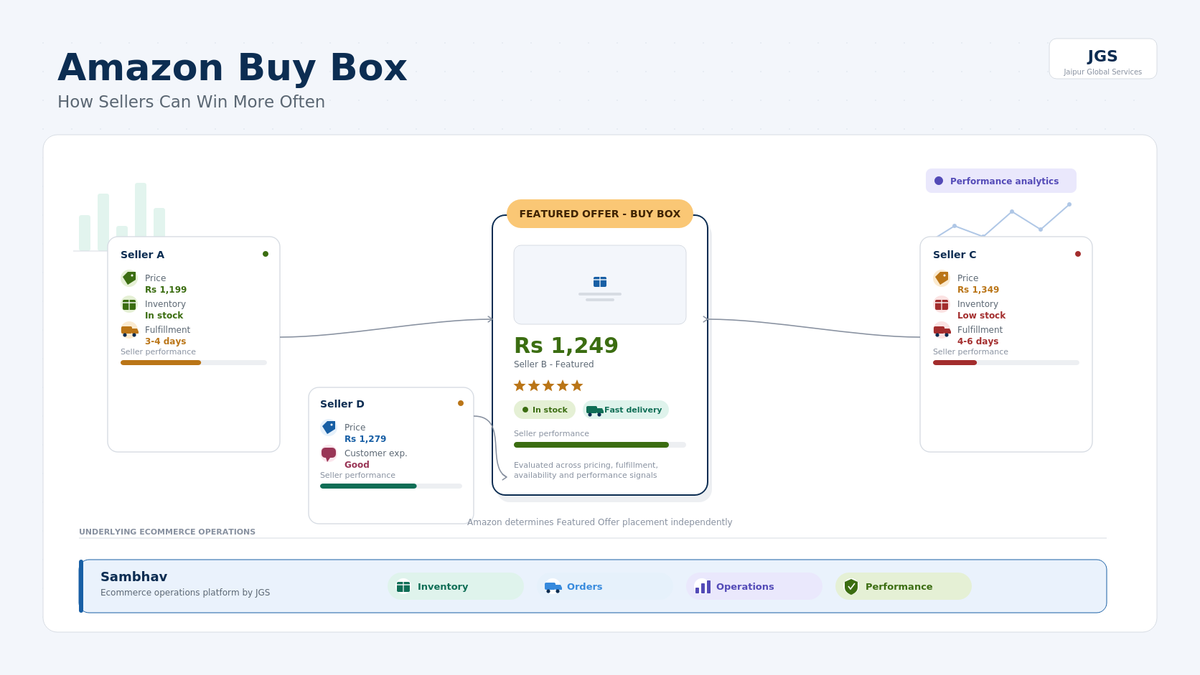
Search for almost any popular product on Amazon, and you'll usually find several sellers listing the exact same item. Yet most shoppers never scroll through the list of offers — they simply add the product to their cart from the prominent offer shown on the page and check out. That prominent offer is the Amazon Buy Box, and for the seller behind it, it often means the difference between a steady stream of orders and almost none at all.
A common misconception is that winning this placement is purely about setting the lowest price. In reality, Amazon weighs pricing alongside fulfillment, availability, and seller reliability before deciding which offer to feature. This guide covers what the Buy Box is, how it works, which factors influence it, common reasons sellers lose it, and practical steps to improve your chances — including how day-to-day ecommerce operations tie into this performance.
What Is the Amazon Buy Box?
The Amazon Buy Box is the section on a product detail page where customers can purchase an item directly, usually through the "Add to Cart" or "Buy Now" buttons. In current Amazon seller terminology, this placement is officially called the Featured Offer. Many sellers, tools, and industry resources still use "Buy Box" out of habit, and Amazon's own support channels use both terms, but "Featured Offer" is what you'll see inside Seller Central reporting today.
When more than one seller lists the same product under a single product listing (ASIN), each submits their own offer — price, fulfillment method, and availability. Amazon evaluates these competing offers and selects one to feature prominently. The rest appear in a secondary list, often labeled "Other Sellers on Amazon," which far fewer shoppers open.
It's worth being precise here: the Buy Box is not ownership of the product page. The page belongs to the ASIN, which can be shared by many sellers. The Buy Box is simply the currently featured offer on that shared page. A seller can win it today and lose it tomorrow if conditions change, without having done anything wrong.
How Does the Amazon Buy Box Work?
At a basic level: multiple sellers list the same product → Amazon groups these under one ASIN → each offer is evaluated → Amazon selects an eligible offer to feature → the customer checks out through that offer.
To even be considered, an offer generally needs to meet baseline eligibility requirements, which have historically included having a professional selling plan, keeping inventory in stock, and maintaining acceptable account health. Amazon has continued refining this process — in 2026, for instance, it began rolling out changes in some marketplaces to how seller-performance signals factor into Featured Offer eligibility, folding certain account-health metrics into a single ranking evaluation rather than a separate pass/fail step. Rollout details vary by marketplace, so sellers should check Seller Central directly for current eligibility criteria.
Beyond eligibility, Amazon evaluates the competitiveness of each qualifying offer using multiple signals together — not a single metric in isolation.
Amazon Buy Box Algorithm: What Sellers Should Understand
The phrase "Amazon Buy Box algorithm" gets used loosely. Amazon does not publish the exact formula or the precise weighting given to each factor. What Amazon does confirm, through its official seller documentation, is that it considers a combination of pricing, fulfillment, and customer-experience factors when deciding which offer to feature.
Rather than reverse-engineering an exact formula, sellers get more value from focusing on what they can control. Based on Amazon's own seller guidance, these commonly include:
- Competitive, landed pricing (item price plus shipping)
- Fulfillment method and delivery speed
- Product availability and inventory depth
- On-time shipping and delivery performance
- Order defect rate, cancellation rate, and related account health metrics
- Customer service responsiveness
- Overall consistency of the offer over time
Treat this as areas to manage well, not a checklist that guarantees a result.
Key Factors That Can Affect Amazon Buy Box Performance
1. Competitive Pricing
Price matters, but the lowest listed price does not automatically win. Amazon typically looks at the total landed price, weighed alongside fulfillment and performance signals — not price alone.
2. Fulfillment
How reliably an order gets picked, packed, and shipped affects the customer experience Amazon protects. FBA and other high-performing methods often make it easier to show consistent delivery, though other eligible methods can compete if operations are reliable.
3. Inventory Availability
A seller can't maintain a strong offer on a product that keeps going out of stock. Frequent stockouts interrupt the offer and can affect how Amazon views the seller's reliability on that listing going forward.
4. Shipping Performance
On-time delivery, accurate tracking, and dependable shipping speed all factor into the customer experience behind every featured offer.
5. Seller Performance
Account health indicators — order defect rate, late shipment rate, valid tracking rate — remain relevant to how Amazon evaluates sellers, even as eligibility mechanics continue to be refined.
6. Order and Customer Experience
Cancellations, returns, complaints, and slow service responses work against a seller's standing. Accurate order processing and quick issue resolution support a more stable offer.
7. Offer Competitiveness
Ultimately, Amazon looks for the offer that gives customers the best overall value and experience — not simply the cheapest one.
How to Win Amazon Buy Box More Often
Step 1: Maintain Competitive Pricing — Base pricing on real market conditions: competitor pricing, costs, margins, demand, and positioning, not a single competitor's move.
Step 2: Keep Products in Stock — Use inventory forecasting, reorder planning, and stock alerts so popular SKUs don't run out at the worst time.
Step 3: Improve Fulfillment Reliability — Prioritize fast, accurate order processing and dependable shipping, whichever fulfillment method you use.
Step 4: Monitor Seller Performance — Review your account health dashboard regularly so small issues get caught before they compound.
Step 5: Reduce Cancellations and Order Errors — Find the operational root causes — inventory sync issues, address errors, slow processing — and fix them at the source.
Step 6: Monitor Competing Offers — Track competitor pricing, seller count, and fulfillment methods using only Amazon-approved tools; avoid anything that violates Amazon's policies.
Step 7: Use Data Instead of Guesswork — Track pricing, inventory, and performance trends so decisions follow patterns, not one-off reactions.
Why Sellers Lose the Amazon Buy Box
Losing the Buy Box doesn't automatically mean a seller broke a rule. Common reasons include less competitive pricing, low stock, a dip in shipping performance, rising cancellations or complaints, or simply a competitor strengthening their offer. Status can shift several times a day, which is why consistent operational discipline matters more than any single fix.
Amazon Buy Box vs Lowest Price
Here's a simple, hypothetical example. Seller A lists a product at a lower price but has slower, less consistent fulfillment. Seller B lists the same product slightly higher, but offers reliable fulfillment, strong account health, and consistent availability. Amazon's evaluation weighs multiple factors together, so it's entirely possible for Seller B's offer to be considered more competitive overall — though this is illustrative, not a guarantee of outcome. The takeaway: price is one input among several, not the deciding factor on its own.
How Better Ecommerce Operations Can Support Buy Box Performance
Many of the factors above trace back to how well a seller's day-to-day operations run:
Inventory management → keeps products available Order management → reduces processing errors Fulfillment operations → supports reliable order handling Customer service → improves the buying experience Performance monitoring → helps catch problems early Pricing monitoring → keeps offers competitive
None of these pieces individually "wins" the Buy Box. But managed well, they support the conditions Amazon associates with a strong offer. Managed poorly, small gaps show up as stockouts, late shipments, or missed price changes — the issues that quietly erode performance.
How JGS and Sambhav Can Help Amazon Sellers
This is where operational tooling comes in. JG Services (JGS), also known as Jaipur Global Services Pvt. Ltd., is an Indian ecommerce solutions provider working with Amazon and other marketplace sellers on account management, advertising, cataloging, and broader operations. Alongside its services, JGS has built Sambhav, an ecommerce management platform bringing functions like order and shipment tracking, sales dashboards, catalogue and CRM data, and performance visibility into one connected environment instead of scattered spreadsheets.
For a seller juggling multiple SKUs, Sambhav is meant to make it easier to see what's happening across orders, shipments, and performance in real time, rather than reacting after a stockout or delivery delay has already hurt the offer.
It's important to be clear about what a platform like this does and doesn't do. Sambhav does not control or influence Amazon's Featured Offer algorithm, and it cannot guarantee that any seller wins the Buy Box — Amazon alone decides which offer gets featured. What Sambhav can support is the operational layer underneath a strong offer: better visibility into inventory and orders, fewer manual errors, and faster identification of problems.
Why JGS Can Be a Useful Ecommerce Growth Partner
Beyond Sambhav, JGS works with sellers on account management, advertising optimization, catalogue support, and broader ecommerce consulting across Amazon and Flipkart. For sellers who want operational support alongside strategic guidance — not just software — this combination is worth exploring as part of a marketplace growth plan.
FAQ
1. What is the Amazon Buy Box?
The Amazon Buy Box is the prominent offer on a product detail page that customers typically purchase through via "Add to Cart" or "Buy Now." It's currently referred to in Seller Central as the Featured Offer.
2. How does the Amazon Buy Box work?
When multiple sellers list the same product, Amazon evaluates each eligible offer using factors like pricing, fulfillment, and account performance, then features one offer prominently on the page.
3. How can I win the Amazon Buy Box?
Focus on competitive landed pricing, reliable inventory availability, strong fulfillment and shipping performance, healthy account metrics, and responsive customer service, since Amazon evaluates these together.
4. Does the lowest price always win the Amazon Buy Box?
No. Price is one factor among several. A seller with a slightly higher price but stronger fulfillment and account performance can be considered more competitive overall.
5. What factors affect Amazon Buy Box performance?
Known factors include pricing, fulfillment method, inventory availability, shipping performance, seller performance metrics, and order/customer experience.
6. What is Amazon Buy Box optimization?
It refers to the ongoing practice of managing pricing, inventory, fulfillment, and performance metrics to maintain a competitive, eligible offer over time, rather than a one-time fix.
7. Why do sellers lose the Amazon Buy Box?
Common reasons include less competitive pricing, stock shortages, slower fulfillment, dips in account performance, or a competitor's offer becoming stronger — not necessarily a policy violation.
8. Can ecommerce operations affect Buy Box performance?
Yes. Inventory management, order accuracy, fulfillment reliability, and customer service all influence the signals Amazon evaluates, so stronger day-to-day operations generally support a more consistent offer.
Conclusion
Winning the Amazon Buy Box isn't about chasing one number or one trick. It comes down to managing several parts of your Amazon business at the same time: pricing, inventory, fulfillment, shipping, seller performance, and customer experience. Sellers who monitor these areas consistently, rather than reacting only when something breaks, tend to hold a stronger, more stable offer over time.
JGS helps ecommerce businesses manage their marketplace and operational requirements, while Sambhav provides technology designed to bring important ecommerce workflows into a more centralized operating environment.
Want better control over your ecommerce operations? Explore Sambhav or connect with JGS to understand how its ecommerce solutions can support your Amazon business.