
Amazon Catalogue Services: A Complete Guide to Managing and Maintaining Your Amazon Catalogue
 November 4, 2026
 Yashwardhan Singh
 0 Comments
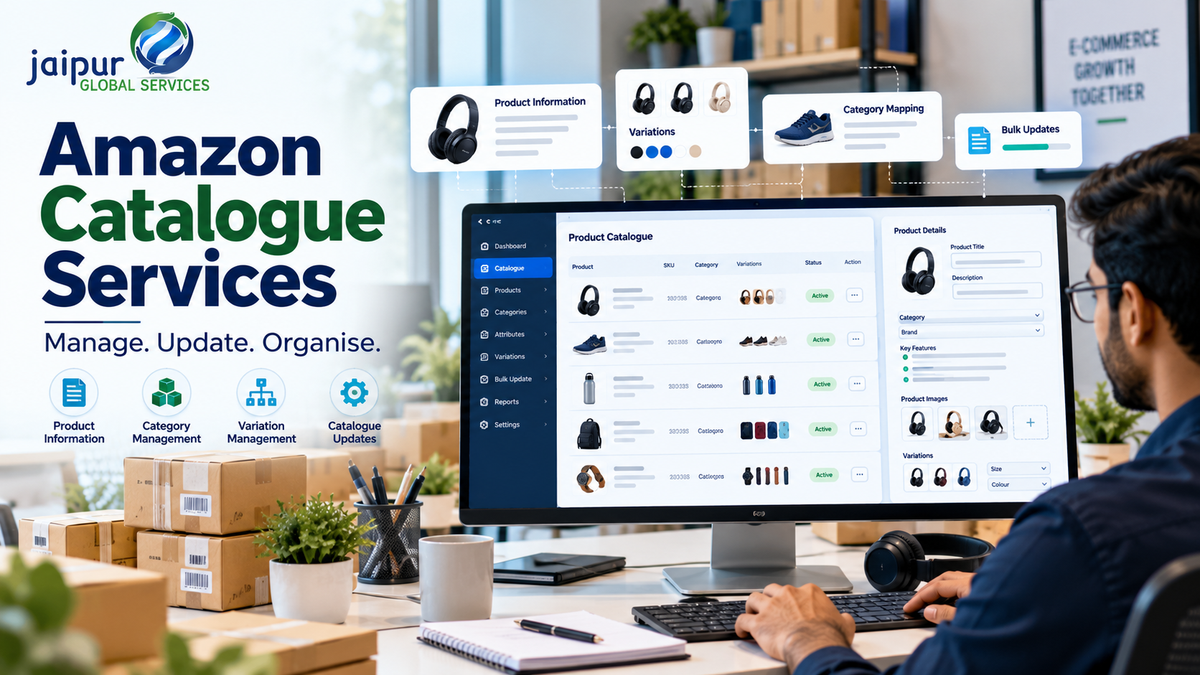
A seller has about 300 products on Amazon. Some titles still show last year's pack size. A few listings have no images. One colour variation sits outside its parent. Two products share almost the same details. Nobody planned it this way. It just happened as products were added and changed over time.
This is how most catalogues go wrong. Not in one big mistake, but through small gaps that pile up. Keeping an Amazon catalogue clean is not a one-time job. It needs regular attention, and that is where Amazon Catalogue Services come in.
What Is an Amazon Catalogue?
Your Amazon catalogue is the full set of product information for everything you sell. It is what shoppers read to understand and compare products. Each product usually has:
- A product title
- Images
- Bullet points
- A description
- Specifications, like size, colour, material, and quantity
- Variations
- Brand information
- Other product details
Behind each product sit a SKU, which is your own code, and an ASIN, which is Amazon's code. Keeping these matched and correct is a big part of catalogue work.
What Are Amazon Catalogue Services?
Amazon Catalogue Services mean getting professional help to build and maintain this product information. The work can include:
- Adding new product information
- Updating existing products
- Checking product details
- Managing variations
- Fixing catalogue errors
- Updating images
- Improving content
- Keeping product data tidy
Not every provider does all of this. Some focus on uploads. Others also handle content, images, and ongoing checks. Ask what is included.
JG Services (Jaipur Global Services) has a catalogue management service that covers bulk uploads, SKU-level management, and ongoing checks across Amazon and other marketplaces.
Why Amazon Catalogue Management Matters
Good Amazon catalog management helps in simple, practical ways:
- Shoppers get clear product information, so choosing is easier.
- Fewer mistakes reach the live page.
- Product data stays the same across all listings.
- The customer experience improves, because the product matches the page.
- Managing many products gets easier.
It will not guarantee higher rankings or sales. Many other things affect those, like price, reviews, stock, and ads. But a clean catalogue removes problems that can hold a product back.
Key Parts of an Amazon Catalogue
Product titles
A title should say clearly what the product is. Include the brand, product type, and key details like size or colour. Avoid stuffing it with repeated words. If a shopper cannot understand it in a few seconds, it needs work.
Product images
Images are what shoppers see first. Use clear photos from different angles, and show size where you can. Make sure they match the actual product. Old images after a packaging change can confuse buyers.
Bullet points
Bullet points let shoppers scan key features quickly. Keep each one short and useful. Put the most important point first.
Product description
A description should give extra detail, like how to use the product or what is in the box. It should not just repeat keywords. If you use A+ content, JG Services also offers A+ content and listing design help.
Product variations
Variations group related products, like one T-shirt in different sizes. There is a parent product, and each size or colour is a child. If a child is placed under the wrong parent, shoppers see mixed-up options. Variation themes also differ by category, so check Amazon's current rules.
Product details and specifications
Sizes, colours, materials, and pack counts must be right. Wrong details lead to returns and bad reviews. These small facts matter more than they seem.
Common Amazon Catalogue Problems
Sellers run into the same issues again and again:
- Wrong product information
- Missing details
- Outdated content
- Incorrect variations
- Duplicate product information
- Poor images
- Wrong categories
- Inconsistent data across products
- Errors shown in Seller Central
- Content that does not match the real product
Each one is worth fixing. A wrong category can make a product harder to find. A mismatch between page and product can lead to returns and complaints. Errors can also stop a listing from going live.
The best habit is to check regularly. Look at your catalogue every few weeks, and after any change in product, packaging, or supplier.
Amazon Catalogue Services vs Amazon Product Listing Services
People often mix these up. They overlap, but they are not the same.
Amazon Product Listing Services usually focus on creating and improving the content of individual listings, such as titles, bullet points, descriptions, and images. The goal is a strong page for each product.
Amazon Catalogue Services are broader. They cover ongoing management of product information across the whole catalogue, including updates, errors, variations, and data accuracy.
Think of it this way. Listing work makes each page good. Catalogue work keeps all the pages correct over time. Many sellers need both. On its Amazon page, JG Services describes its Amazon Product Listing Services around SEO-focused titles, keyword-based content, and images.
How Amazon Seller Services Support Catalogue Management
Amazon Seller Services is a wide term for professional support that sellers use for different jobs. It can cover:
- Product listings
- Catalogue work
- Account management
- Seller support
- Product data
- Daily ecommerce tasks
Sellers rarely need all of it. Most pick the areas where they are short on time or skill. If you want to understand the account side, this guide on what an Amazon account manager does is a good start.
JG Services lists its Amazon Seller Services on one page, including account management, advertising, and A+ content. It also has a wider account management service for ecommerce sellers.
Benefits of Professional Amazon Catalogue Management
For sellers with many products, outside help can:
- Save time. Bulk updates take hours by hand.
- Keep data organised. Everything follows one clear format.
- Reduce errors. A second pair of eyes catches mistakes.
- Make updates easier. Changes get applied across many products.
- Handle large catalogues. More products do not mean more chaos.
- Support better content. Clean data makes content work easier.
- Free up your time. You can focus on sourcing, stock, and customers.
None of these are promises of sales. They are about making the daily work easier to manage.
Some sellers also use tools alongside this. Sambhav, the JG Services seller platform at seller.jgservices.in, brings sales, inventory, and operations data together. You can read about it on the Sambhav page. It supports seller operations, and works next to catalogue work, not instead of it.
How to Choose Amazon Catalogue Services
Before you hire anyone, check these points:
- Experience. How long have they worked with Amazon sellers?
- Amazon knowledge. Do they understand categories, variations, and common errors?
- Catalogue work. Have they handled catalogues like yours, in size and type?
- Listing skills. Can they also write and improve content?
- Attention to detail. Ask how they check for mistakes.
- Communication. Will you get clear updates on what changed?
- Scope. What is included, and what costs extra?
- Volume. Can they handle many products at once?
- Amazon rules. Do they follow Amazon's current guidelines?
Be careful with promises of guaranteed rankings or sales. No provider can promise those. Ask to see sample work, and start small if you are unsure. Every business is different, so the best fit depends on your products and needs.
Final Thoughts
An Amazon catalogue is never finished. Products change, suppliers change, and Amazon updates its rules. A little regular care keeps problems from growing.
Start with a simple review. Check your titles, images, variations, and product details. Fix what is wrong, and set a schedule to check again. If the volume gets too big, professional Amazon Catalogue Services can take on the routine work. You can explore what JG Services offers, and see how it fits your own setup.