
Amazon vs Flipkart vs Walmart: Which Marketplace Is More Profitable for Sellers?
 August 27, 2026
 Yashwardhan Singh
 0 Comments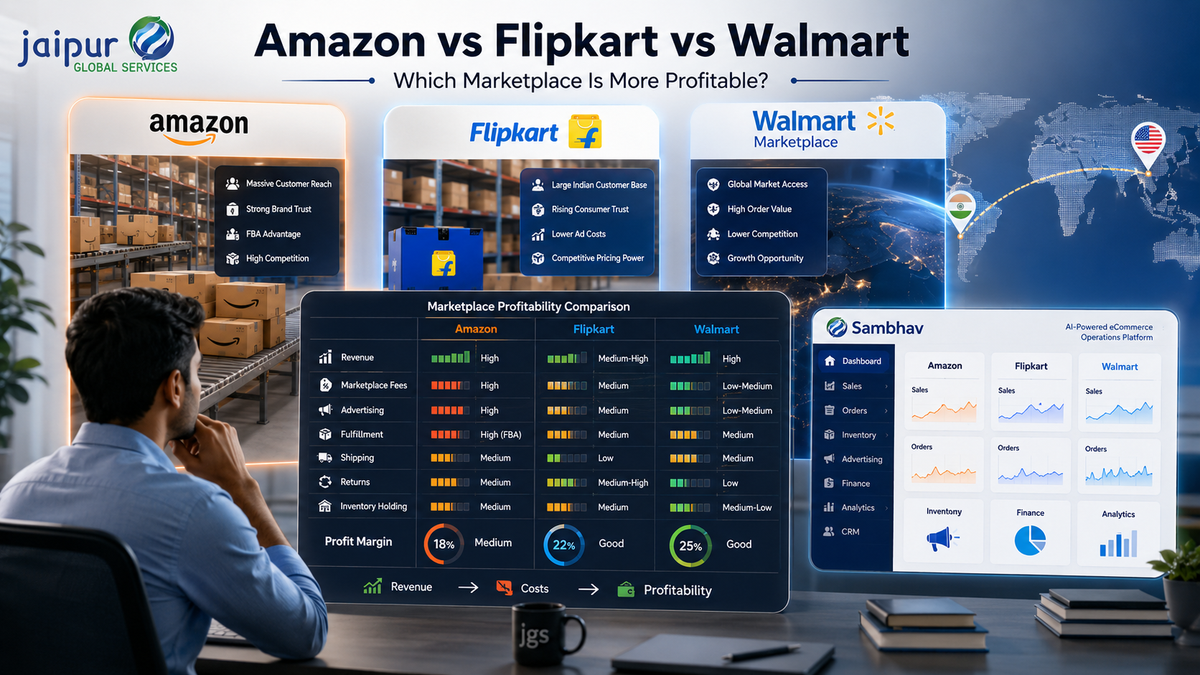
A seller doing well on Amazon often assumes that adding Flipkart, or eventually Walmart, will simply add more sales. Sometimes it does. But every new marketplace also brings new fees, advertising costs, fulfillment requirements, returns, a bigger catalog, and more operational workload.
More marketplaces do not automatically mean more profit. The real question isn't "which marketplace is best" — it's which marketplace gives your products the best combination of demand, cost, margin, and operational efficiency. This article walks through how to compare Amazon vs Flipkart vs Walmart properly, so expansion decisions are based on numbers rather than assumptions.
Why Marketplace Profitability Matters More Than Revenue
Revenue and profit are not the same thing, and it's easy to confuse the two when a new marketplace starts generating sales quickly. A simple way to think about marketplace-level profit is:
Marketplace Profit = Sales Revenue − Marketplace Fees − Fulfillment Costs − Shipping − Returns − Advertising − Discounts − Product Cost − Operational Costs − Other Applicable Expenses
A marketplace that generates higher revenue can still produce lower profit than one with smaller sales, if its fees, ad spend, returns, or fulfillment costs eat a larger share of each order. Comparing Amazon vs Flipkart vs Walmart on sales numbers alone tells only part of the story.
Amazon — Strengths, Costs and Profitability Considerations
Amazon offers broad category coverage, multiple fulfillment options, a mature advertising ecosystem, and brand-building opportunities, plus a path to international selling via Amazon Global Selling.
Costs include marketplace and referral fees, fulfillment, advertising spend, returns, and the operational cost of managing listings, pricing, and account health. Amazon isn't automatically the most profitable option for everyone — profitability depends on category, pricing, margin structure, and how efficiently Amazon account management is run. A seller with strong margins can do very well; one in a low-margin, highly competitive category may find the same fees and ad costs harder to absorb.
Flipkart — Strengths, Costs and Profitability Considerations
Flipkart is one of the most important marketplaces for Indian domestic demand, with strong reach in fashion, electronics, and home products. It works well alongside Amazon as part of a multi-marketplace strategy rather than a replacement for it.
Profitability considerations mirror Amazon's: fees, fulfillment and shipping costs, returns, discounts, advertising spend, and the operational workload of managing an additional platform. Seller performance requirements can also affect account standing and visibility. Fee structures change periodically, so verify current terms through Flipkart account management resources rather than older figures found elsewhere.
Walmart Marketplace — Strengths, Costs and Profitability Considerations
Walmart Marketplace sits in a different category from Amazon and Flipkart for an Indian seller. Amazon and Flipkart are mainly about reaching Indian customers; Walmart is US-based, so choosing it usually means considering international expansion, not just another domestic channel.
That distinction changes what expansion involves: access to US customers, cross-border fulfillment, international returns, currency considerations, and compliance requirements domestic selling doesn't raise. Walmart can be genuinely attractive for the right Indian brand — a different competitive environment and a way to diversify beyond one geography — but it requires more than uploading a catalog. Sellers need real US product-market fit, realistic shipping economics, and compliance groundwork. Whether Walmart Marketplace becomes profitable depends on whether the product and operations are genuinely ready — not on the platform alone.
Amazon vs Flipkart vs Walmart — Compare Marketplace Fees
Sellers often compare marketplaces on commission percentage alone. That's incomplete. A more accurate ecommerce marketplace fees comparison calculates the full cost stack:
Referral/Commission + Fulfillment + Shipping + Storage + Advertising + Returns + Discounts + Taxes/Compliance + Operational Cost
Two marketplaces with similar commission rates can produce very different profitability once fulfillment, ad competition, and overhead are factored in. What matters is the contribution margin left after all costs. Verify current numbers from Amazon Seller Central, Flipkart Seller Hub, or Walmart's official seller documentation before finalizing a decision.
Compare Your Product-Market Fit
Marketplace choice depends heavily on the product itself: price point, category, customer profile, demand, competition, margin, size and weight, repeat-purchase potential, and brand positioning.
A premium D2C skincare brand may perform very differently across these platforms than a mass-market kitchenware seller. Fashion behaves differently from electronics in returns and seasonality. Bulky products carry different fulfillment economics than lightweight ones — a factor that matters more once international shipping enters the picture with Walmart. The comparison has to happen at the product level, not the business level.
Compare Fulfillment and Operational Costs
Fulfillment directly affects profitability and is easy to underestimate. Evaluate warehousing, shipping, order processing, inventory, returns handling, delivery reliability, and support requirements for each marketplace.
A marketplace with strong demand can still turn unprofitable if fulfillment and returns consume too much margin — especially relevant when comparing domestic Flipkart to international Walmart, where logistics complexity differs fundamentally. Selling across multiple marketplaces also multiplies operational complexity: each platform has its own listing requirements, order flow, and support expectations, and running three well takes meaningfully more coordination than running one.
Compare Advertising Costs and Customer Acquisition
Track sponsored ad spend, cost per acquisition, ROAS, ACOS, advertising competition, organic traffic, and promotion costs. What matters is net contribution after advertising, not gross sales.
Consider two scenarios: Marketplace A generates higher sales but needs heavier ad spend to sustain them; Marketplace B generates lower sales with a stronger contribution margin. Marketplace B could well be more profitable, even though it looks smaller on a sales report. No marketplace has universally cheaper advertising — it varies by category and how well campaigns are managed.
Compare Competition and Opportunity
Competition differs by category, product, price range, brand strength, marketplace, and geography. Research competing product counts, competitor pricing, reviews, advertising presence, search demand, and bestseller positions before entering a new marketplace.
Lower competition doesn't automatically mean higher profitability — demand still has to exist. A category with little competition but also little search demand isn't a good opportunity; the goal is finding where demand and manageable competition intersect.
How to Calculate Marketplace Profitability Before Expanding
Build a simple, product-level model. For each marketplace, estimate monthly sales, selling price, product cost, marketplace fees, fulfillment, shipping, advertising spend, returns, discounts, operational costs, and taxes/compliance where applicable. Then calculate:
Gross Contribution = Revenue − Direct Marketplace Costs Net Marketplace Profit = Gross Contribution − Advertising − Operations − Other Applicable Costs
Use your own product-level data — landed cost, real return rates, real ad performance — rather than generic industry averages.
Should You Sell on Amazon, Flipkart and Walmart Together?
This depends on product demand across platforms, available capital, inventory capacity, operational resources, international readiness, margins, technology in place, and growth goals.
Selling across all three brings real advantages: diversified revenue, a larger combined customer base, new geographic markets through Walmart, and better inventory utilization. It also brings risks: inventory fragmentation, catalog duplication, complex order management, pricing conflicts, more advertising to manage, and harder financial reconciliation. For most growing sellers, expansion works best staged — proving profitability on one marketplace before adding the next.
How JGS Helps Sellers Manage Multi-Marketplace Growth
Comparing Amazon vs Flipkart vs Walmart and then operating across them are two different challenges. JGS works with sellers across Amazon, Flipkart, and Walmart, alongside Shopify and Blinkit, supporting account management, catalog and listing management, advertising, and account health monitoring. For international expansion, JGS also supports Amazon Global Selling and Walmart onboarding — market research, account setup and compliance, localized listings, international pricing, and cross-border operations.
How Sambhav Can Help Sellers Compare and Manage Multiple Marketplaces
Comparing marketplaces properly requires visibility into sales, orders, advertising, inventory, returns, and customer activity — data that's often scattered across separate dashboards once a business runs more than one platform.
Sambhav, JGS's in-house SaaS platform, brings these operations together: real-time sales data, order and inventory tracking, performance monitoring, CRM, and finance and payment reconciliation across marketplaces.
Marketplace 1 + Marketplace 2 + Marketplace 3 → Centralized Data & Operations → Better Visibility → Better Monitoring → More Efficient Workflows → Data-Driven Decisions
Sambhav doesn't automatically make any marketplace profitable, and it doesn't guarantee higher margins — no software can. What it can do is bring ecommerce data and workflows into a centralized operating environment, making it easier to monitor performance, manage operations, and identify where costs may be affecting profitability on each marketplace. That visibility is what makes an informed Amazon vs Flipkart vs Walmart comparison possible — decisions based on actual data rather than assumptions.
FAQ
1. Which is better: Amazon, Flipkart or Walmart?
There's no single "best" option. Amazon and Flipkart mainly serve Indian buyers, while Walmart Marketplace is a US platform relevant to sellers considering international expansion. The right choice depends on your product, margins, and business goals.
2. Is Walmart Marketplace suitable for Indian sellers?
It can be, for sellers with products suited to US demand and the readiness to manage cross-border fulfillment, compliance, and currency considerations. It's best approached as an international expansion decision rather than a simple extra sales channel.
3. Which marketplace is more profitable for sellers?
Profitability depends on product category, marketplace fees, fulfillment costs, advertising spend, and returns for that specific product — not on the marketplace's overall size or sales volume.
4. How should I compare Amazon and Flipkart seller fees?
Look at the full cost stack — referral or commission fees, fulfillment, shipping, storage, advertising, and returns — rather than commission percentage alone. Verify current fees from each platform's official seller documentation.
5. Is it better to sell on multiple marketplaces?
It can diversify revenue and reduce dependency on one channel, but it also increases operational complexity — inventory management, catalog duplication, and customer support all become more demanding.
6. How do I calculate marketplace profit margins?
Start with revenue and subtract marketplace fees, fulfillment, shipping, returns, advertising, discounts, product cost, and operational costs to arrive at net marketplace profit. Use your own product-level data rather than industry averages.
7. What costs should sellers consider before marketplace expansion?
Marketplace fees, fulfillment and shipping costs, advertising spend, return rates, discounts, inventory and operational capacity, and — for international marketplaces like Walmart — compliance and cross-border logistics.
8. How can JGS and Sambhav help with multi-marketplace ecommerce?
JGS manages account operations, catalog, and advertising across Amazon, Flipkart, and Walmart, including international expansion support. Sambhav centralizes sales, order, inventory, and performance data across marketplaces so sellers can monitor operations and make data-driven decisions.
Conclusion
There's no universally "best" marketplace between Amazon, Flipkart, and Walmart. Amazon may fit one business because of its category reach and ad ecosystem. Flipkart may work better for another because of how it connects with Indian domestic demand. Walmart may become attractive once a brand has the product-market fit and readiness for international expansion. The right decision depends on product, customer, margin, fees, fulfillment, advertising, returns, operational capacity, geography, and growth strategy — not which marketplace looks biggest from the outside.
Before expanding, calculate profitability at the product and marketplace level using real numbers. JGS helps ecommerce businesses manage marketplace growth across Amazon, Flipkart, and Walmart, while Sambhav brings ecommerce operations, analytics, and marketplace workflows into a centralized platform, making that comparison easier with data.
Planning to expand across Amazon, Flipkart, or Walmart? Connect with JGS to evaluate your ecommerce growth requirements and explore how Sambhav can help centralize your marketplace operations.