
Ecommerce Operations and Customer Reviews: Why Ads Don't Decide Ratings
 June 1, 2026
 Yashwardhan Singh
 0 Comments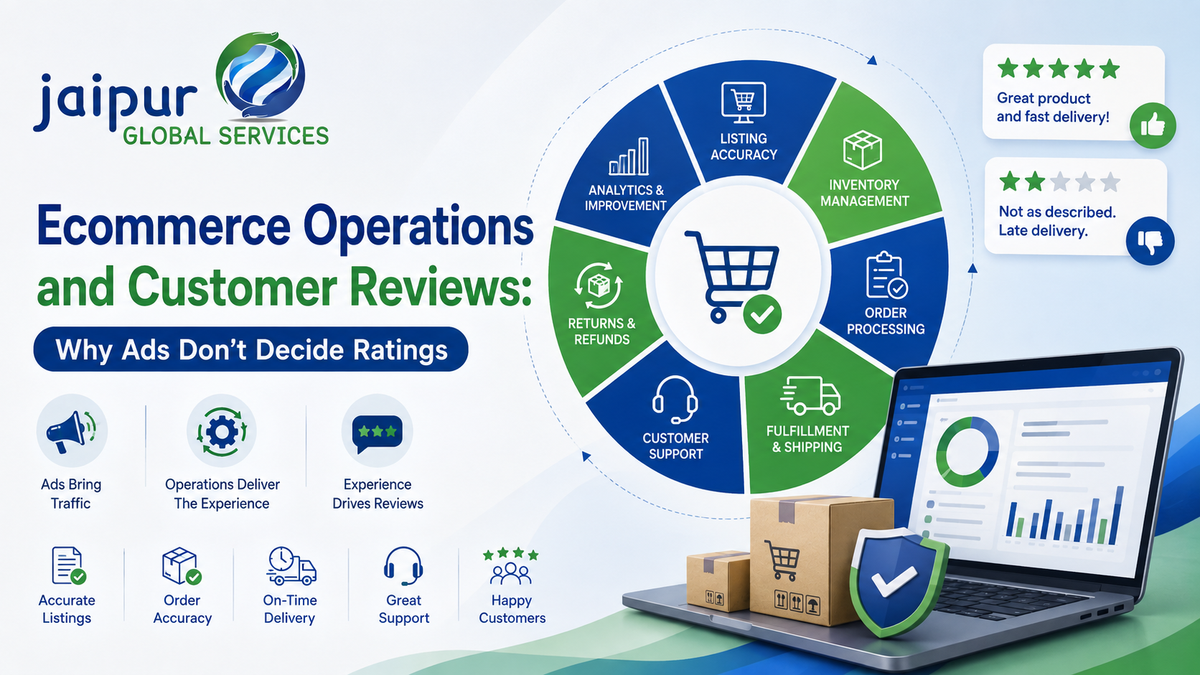
A brand increases its advertising budget. Traffic goes up. Orders go up. Then the ratings come in — and they haven't moved. In some cases, negative reviews actually increase.
It's tempting to blame the ads. But the ad campaign usually isn't the problem. The more likely explanation sits somewhere else: product expectations, listing accuracy, packaging, shipping, order accuracy, customer support, or the returns process.
Ads control who sees a product. They don't control what happens after someone clicks "buy." That gap — between visibility and experience — is where ecommerce operations live, and it's the reason ads don't decide ratings.
What Are Ecommerce Operations?
Ecommerce operations are the systems and processes that support online selling behind the scenes — everything that happens once a customer decides to buy. This includes:
- Product and catalogue management
- Inventory management
- Order processing
- Fulfillment and shipping
- Returns handling
- Customer service
- Marketplace management
- Pricing and promotions
- Product data accuracy
- Reporting and coordination across teams
Operations get more complex as order volume grows, SKU count increases, more marketplaces get added, geographic reach expands, and customer expectations rise. A process that worked fine at 50 orders a day can start breaking down at 500.
What Is Ecommerce Operations Management?
There's a difference between performing operational tasks and managing the operational system as a whole. Operations management means coordinating inventory, order processing, fulfillment, customer experience, performance monitoring, and issue resolution across channels — not just handling each task as it comes up.
Effective operations management should reduce friction, not just increase activity. A team that's constantly busy resolving order errors isn't necessarily managing operations well; a team that's prevented most of those errors from happening in the first place is.
Why Ads Don't Decide Customer Ratings
Advertising controls exposure. It can influence visibility, traffic, awareness, and product discovery. What it can't directly control is product quality, listing accuracy, packaging, shipping timing, order accuracy, the return experience, or customer support quality.
That means ad performance and customer ratings sit in different parts of the ecommerce system, shaped by different inputs. The path from an ad to a review looks something like this:
Ad → Customer clicks → Product page → Expectation formed → Purchase → Fulfillment → Delivery → Product experience → Customer support / returns (if needed) → Customer feedback
Ads only control the first two steps. Everything after that — the part that actually determines what a customer writes in a review — is operations.
What Actually Influences Ecommerce Reviews and Ratings?
Several factors shape the feedback a customer eventually leaves, and their relative weight varies by product category and individual customer:
- Product quality — does it deliver what was expected?
- Listing accuracy — did the description set realistic expectations?
- Product images — do they accurately represent the item?
- Product information — are specifications, dimensions, materials, and compatibility clear?
- Packaging — did the product arrive intact and presentable?
- Order accuracy — was the right item, in the right quantity, sent?
- Shipping and delivery — did it arrive on time and as promised?
- Customer support — how quickly and effectively were problems handled?
- Returns and refunds — was the process straightforward?
- Product expectations — even a genuinely good product can get a poor review if the customer expected something different.
Product Listings Set Customer Expectations
A listing isn't just a marketing asset — it's an expectation-setting tool. Titles, descriptions, bullet points, images, videos, specifications, size charts, compatibility notes, and FAQs all shape what a customer believes they're buying before it arrives.
Accurate listing → better customer understanding → more realistic purchase expectations → potentially fewer avoidable complaints. That last step isn't a guarantee — no listing eliminates all negative reviews — but a listing that overstates or misrepresents a product invites disappointment before the box is even opened.
Inventory and Order Accuracy
Inventory management is part of the customer experience, not a purely internal concern. Stock accuracy, SKU management, order processing, picking, packing, and order verification all determine whether a customer receives exactly what they ordered.
Common failure points include overselling, shipping the wrong SKU, missing items, delayed dispatch, and inventory mismatches between systems. Each of these turns an internal operational error into a customer-facing problem — and customer-facing problems are what end up in reviews.
Fulfillment and Delivery Experience
Warehouse operations, pick-and-pack accuracy, shipping, carrier coordination, delivery tracking, and handling of delays are mostly invisible to the customer when everything works. When something fails — a delayed shipment, a damaged package, a lost order — the customer experiences that failure directly and remembers it.
Returns and Refunds
Returns are an underrated customer touchpoint. A clear return policy, easy return initiation, accurate product information going in, transparent refund communication, and visible return tracking all shape whether a difficult moment (a customer wanting to send something back) becomes a manageable one.
Return data is also worth mining for patterns — a spike in returns for one product can point to a genuine quality issue, a sizing problem, a misleading description, packaging damage, or a gap between what customers expected and what they received.
Customer Support and Review Outcomes
Support quality — response speed, clarity, resolution effectiveness, and how refunds, replacements, or returns get handled — meaningfully shapes the overall experience. Good support doesn't erase a legitimate problem or guarantee a positive review; what it does is resolve the underlying issue and often prevent a bad experience from turning into a lasting negative impression.
Reviews Are Operational Feedback
It's worth reframing how reviews get used internally. They're not just a reputation score — they're a source of operational insight, if someone's reading them that way.
A few examples of what that looks like in practice:
- "Product is smaller than expected" → review dimensions and product images
- "Package arrived damaged" → review packaging and handling processes
- "Received the wrong variant" → review SKU identification and picking accuracy
- "Delivery took too long" → review fulfillment and logistics processes
- "Product works differently than expected" → improve product education and listing information
The pattern: review → insight → root-cause analysis → operational improvement → better customer experience. Treated this way, reviews become a free, ongoing source of diagnostic data rather than just a number to watch.
Amazon Product Reviews vs. Seller Feedback
These two get confused often, and the distinction matters. Product reviews evaluate the customer's experience with the item itself — quality, performance, whether it matched expectations. Seller feedback relates to the experience of buying from that specific seller — shipping speed, packaging, communication, and order accuracy.
Amazon has introduced tools like Customer Review Insights that help sellers analyze review themes and surface product or listing improvement opportunities — worth checking Amazon's current Seller Central documentation for the latest details, since platform tools and policies change.
Sellers shouldn't attempt to remove legitimate negative reviews or feedback. The appropriate path is addressing the underlying product or operational issue, and using Amazon's official reporting mechanisms only for feedback that genuinely violates platform policy — not for feedback the seller simply disagrees with.
How to Improve Ecommerce Reviews the Right Way
The sustainable approach is improving the experience that produces reviews, not managing the reviews themselves:
- Improve product quality
- Improve listing accuracy
- Set realistic expectations upfront
- Improve packaging
- Improve order accuracy
- Improve fulfillment speed and reliability
- Improve customer support responsiveness
- Simplify the returns process
- Analyze recurring complaints for patterns
- Feed customer feedback back into product and listing decisions
What this list deliberately excludes: fake reviews, paid reviews, review manipulation, prohibited incentivized reviews, and review suppression. These tactics violate marketplace policies and, more practically, don't fix the underlying problem generating the complaints.
How Ecommerce Operations Affect Customer Experience
Operational Area
Customer Impact
Inventory
Product availability
Catalogue
Product expectations
Order Management
Order accuracy
Fulfillment
Dispatch and delivery
Packaging
Product condition on arrival
Shipping
Delivery experience
Customer Support
Issue resolution
Returns
Post-purchase experience
Product Quality
Overall satisfaction
Data Analysis
Continuous improvement
Customer experience is, in large part, the visible surface of everything happening behind the scenes. Customers don't see the warehouse, the inventory system, or the support queue — they see the result.
Why Increasing Ad Spend Cannot Fix Operational Problems
A few scenarios illustrate this:
- Ads generate more traffic, but the product page is inaccurate. More people discover the product, but expectations remain misaligned — more traffic just means more people hitting the same mismatch.
- Ads increase orders, but inventory planning is weak. The result is more stockouts, not more satisfied customers.
- Ads increase order volume, but fulfillment capacity is limited. Dispatch and delivery issues increase along with the order count.
- Ads generate demand, but product quality hasn't improved. Higher sales volume doesn't resolve product dissatisfaction — it just surfaces it to more people.
Advertising amplifies demand. It doesn't replace operational quality, and it can't compensate for gaps the customer is going to encounter regardless of how they arrived.
The Relationship Between Ads, Operations, and Reviews
Advertising creates visibility → Listing creates expectations → Product delivers the core experience → Operations deliver the order → Fulfillment delivers the package → Customer support handles problems → Reviews reflect the customer's experience → Data reveals where to improve next.
Each stage feeds the next. Ecommerce performance is genuinely interconnected — a strong campaign can't compensate for a weak link three or four stages downstream.
Ecommerce Operations KPIs Worth Monitoring
- Order Accuracy Rate — how often the right item reaches the customer
- Order Processing Time — speed from order to dispatch
- Inventory Accuracy — how closely recorded stock matches actual stock
- Stockout Rate — how often popular items are unavailable
- Return Rate — a signal for product or listing issues
- Refund Processing Time — how quickly refunds are resolved
- On-Time Delivery Rate — reliability of the shipping promise
- Customer Complaint Rate — frequency of support escalations
- Customer Satisfaction — direct feedback on the experience
- Product Rating — the customer's assessment of the item itself
- Seller Feedback — the customer's assessment of the buying experience
- Repeat Purchase Rate — whether customers come back
- Fulfillment Cost — the cost efficiency of delivering orders
These are worth tracking as a set. A single strong or weak metric rarely tells the whole story on its own.
How to Build a Review-Driven Ecommerce Operations System
A practical framework for turning feedback into ongoing improvement:
- Collect customer feedback — reviews, ratings, returns, support tickets, and product questions
- Categorize complaints — product quality, product information, packaging, shipping, order accuracy, support
- Identify recurring issues — look for patterns rather than reacting to isolated comments
- Identify the operational root cause — ask what process allowed the issue to happen
- Fix the process — listing, packaging, inventory, fulfillment, product, or support, depending on the root cause
- Monitor the result — track whether the issue becomes less frequent
- Repeat — treat this as a continuous loop, not a one-time fix
Common Ecommerce Operations Mistakes That Hurt Customer Experience
- Inaccurate product listings
- Poor inventory visibility
- Shipping the wrong orders
- Weak or inadequate packaging
- Slow fulfillment
- Unclear return policies
- Poor customer communication
- Ignoring recurring review complaints
- Treating reviews only as a marketing metric, not an operational one
- Scaling advertising before operations are ready
- Using inconsistent product information across channels
- Keeping operations and marketing data disconnected from each other
Ecommerce Operations Across Multiple Marketplaces
Amazon, Flipkart, Walmart, Shopify, and other channels each have different listing requirements, customer expectations, fulfillment processes, and seller policies. That creates real challenges around inventory synchronization, order management, customer communication, and reporting.
Multichannel businesses generally do better with consistent operational processes across channels — the same product information, the same packaging standards, the same support response times — rather than treating each marketplace as its own separate operation with its own rules.
How JGS Can Help With Ecommerce Operations
Improving the experience behind a product — accurate listings, consistent catalogue data, and well-managed marketplace accounts — is where Jaipur Global Services JGS ecommerce and marketplace management work fits in. JGS can't control what a customer writes in a review, and doesn't claim to influence ratings directly. What it can help with is strengthening the operational pieces — listing accuracy, catalogue consistency, and marketplace account management — that shape the experience customers are actually rating.
(The specific services referenced here should be checked against the current jgservices.in service pages before publishing — I don't have a way to browse the live site to confirm exact names and URLs.)
Frequently Asked Questions
1. What are ecommerce operations? The systems and processes behind online selling — inventory, order processing, fulfillment, shipping, returns, customer service, and marketplace management.
2. Why are ecommerce operations important? Because they determine what customers actually experience after clicking "buy" — which directly shapes the reviews and ratings a business receives.
3. Do ads affect ecommerce ratings? Not directly. Ads control visibility and traffic, not product quality, order accuracy, delivery, or support — the factors that actually shape customer ratings.
4. What factors influence ecommerce product reviews? Product quality, listing accuracy, packaging, order accuracy, shipping and delivery, customer support, and the returns experience.
5. How can I improve ecommerce customer reviews? By improving the underlying experience — product quality, listing accuracy, packaging, fulfillment, and support — rather than trying to manage reviews directly.
6. What is the difference between an Amazon product review and seller feedback? Product reviews evaluate the item itself; seller feedback evaluates the buying experience with that seller, including shipping, packaging, and communication.
7. How does fulfillment affect customer experience? Fulfillment is often invisible when it works, but delays, damage, or errors during fulfillment become directly visible — and memorable — to the customer.
8. How can ecommerce businesses use customer feedback? By categorizing recurring complaints, tracing them to their operational root cause, and using that insight to fix the underlying process.
9. What ecommerce operations KPIs should businesses track? Order accuracy, inventory accuracy, stockout rate, return rate, on-time delivery rate, customer complaint rate, and repeat purchase rate, among others.
10. How can JGS help manage ecommerce operations? Through ecommerce and marketplace management services that support listing accuracy, catalogue consistency, and account management. (To be finalized against verified Jaipur Global Services JGS service pages.)
Conclusion
Ads can bring customers to a product. They can't control what those customers experience after the purchase. Ratings and reviews are the output of a much broader system — product, listing, inventory, order processing, fulfillment, delivery, support, returns, and the overall customer experience working together.
Treating reviews purely as a reputation number misses their real value. Read as feedback, recurring complaints point directly at the operational fixes worth making next. Businesses that close that loop tend to see steadier improvement in ratings than businesses that respond to a rating dip by simply spending more on ads.
If your ratings aren't moving the way your ad spend suggests they should, the answer is usually somewhere in operations — not in the campaign.