
Ecommerce Listing & Catalog Management Services
 March 17, 2026
 Yashwardhan Singh
 0 Comments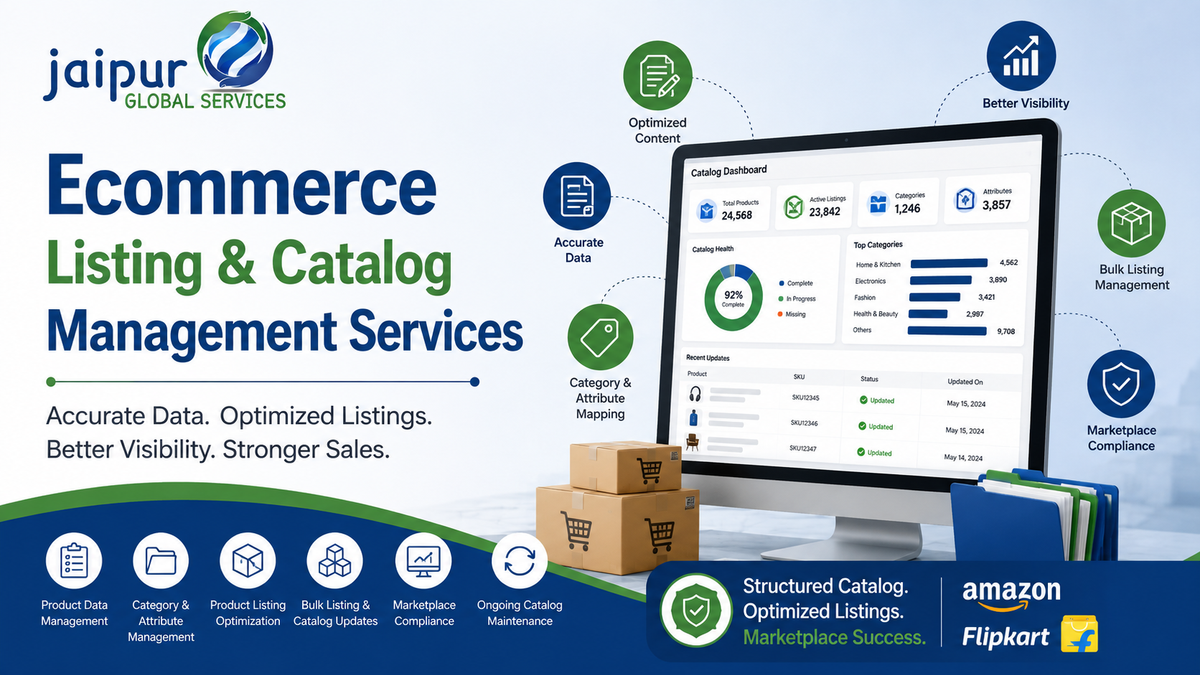
Uploading a product is not the same as listing it correctly. A business can have a thousand SKUs live on Amazon and Flipkart and still lose sales every day because a title is unclear, a product sits in the wrong category, an attribute field is empty, or three marketplaces show three different versions of the same product.
This is the part of ecommerce that rarely gets attention until it starts costing money — wrong categories that hide products from search, missing attributes that block filters, inconsistent titles across platforms, variations that don't map correctly, and descriptions nobody has touched since the listing went live.
A catalog is not a static upload. It's a live layer of data that customers, marketplace algorithms and compliance systems all read simultaneously. When that data is accurate and structured, products are easier to find, easier to understand and easier to buy. When it isn't, sellers spend more time fixing errors than growing the business.
JGS (Jaipur Global Services Pvt. Ltd.) works with ecommerce brands, D2C companies and marketplace sellers as an ecommerce catalog management services partner — helping organize, optimize and maintain product catalogs across Amazon, Flipkart, Shopify and other channels, so listings stay accurate as the catalog grows.
What Is Ecommerce Catalog Management?
Ecommerce catalog management is the ongoing process of creating, organizing, optimizing and maintaining product information across an online store or marketplace. It covers the full set of data behind every listing — titles, descriptions, bullet points, images, categories, attributes, variations, SKUs, pricing information, specifications, search terms and backend metadata.
The key word is ongoing. A catalog isn't finished once products go live — new SKUs get added, categories change, marketplace policies get updated, and existing listings need periodic review. Catalog management is the discipline that keeps all of this consistent instead of letting it drift.
Catalog Management vs. Product Listing Management
These two terms get used interchangeably, but they cover different layers of the same catalog.
Catalog management is about structure and data: product information, category mapping, attribute sets, variation groups, SKU architecture, and keeping that data consistent across the entire product range.
Product listing management is about the individual listing itself: creating it, writing and optimizing the title, bullets, description and keywords, adding marketplace-specific fields, and updating it over time.
In practice, the two work together. Catalog management gives every listing its correct data foundation — category, attributes, SKU, variation group. Listing management turns that foundation into content a customer actually reads and acts on. A well-optimized title means little if the product sits in the wrong category; a perfectly mapped category means little if the title doesn't tell a customer what they're buying.
Why Catalog Management Matters for an Ecommerce Business
Product discoverability. Structured titles, categories and attributes help products surface for relevant customer searches and marketplace filters.
Customer understanding. Accurate specifications, sizes and descriptions help customers know exactly what they're buying before they click "add to cart," which reduces confusion-driven returns and support tickets.
Conversion support. Clear, complete product content reduces the uncertainty that makes shoppers hesitate. It can help improve conversion opportunities — though no catalog management service can promise a specific increase in sales, and any claim that it can should be treated with caution.
Fewer catalog errors. Correctly filled attributes and consistent product data reduce the mistakes that lead to listing suppressions, customer complaints or wrong orders.
Marketplace compliance. Accurate category mapping and attribute data help a catalog stay aligned with platform requirements, which reduces the risk of listings getting flagged or restricted.
Easier scaling. A structured catalog with standardized templates makes it far easier to manage hundreds or thousands of SKUs without the process breaking down.
Brand consistency. Keeping product information aligned across Amazon, Flipkart, Shopify and other channels creates one coherent brand experience instead of a fragmented one.
What's Included in Ecommerce Catalog Management Services
A complete catalog management engagement typically covers:
- Product data management — names, specifications, dimensions, materials, features and technical details, kept accurate and current.
- Category management — mapping products to the correct category and sub-category so they're discoverable and compliant.
- Attribute management — maintaining fields like size, color, material, brand and compatibility so filters and search work correctly.
- Variation management — structuring parent-child relationships correctly for products that come in multiple sizes, colors or pack sizes.
- SKU management — consistent SKU and product identifier structures across the catalog.
- Product content management — titles, bullet points, descriptions, search terms and highlights.
- Image management — checking that product images meet marketplace specifications and represent the product accurately.
Product Listing Optimization
Listing optimization is where catalog data becomes customer-facing content.
Titles need to be clear, descriptive and marketplace-compliant, built around what a customer is actually searching for rather than stuffed with keywords.
Bullet points should communicate the product's main benefits, features, specifications and use cases — the information a customer scans before deciding to read further.
Descriptions should answer what the product is, who it's for, its key benefits and how it works, in language a buyer can actually use to make a decision.
Keywords should appear naturally, based on how customers search — not repeated mechanically. Where a marketplace supports backend search fields, relevant terms are added there too, though not every marketplace offers the same backend fields, and claims about specific backend mechanics should always be checked against current platform documentation.
Marketplace-Specific Catalog Management
Copying the same product content across every marketplace rarely works, because each platform sets its own rules for categories, attributes, titles, images and variations.
Amazon Product Listing Services
Amazon catalog and listing work can include listing creation, title and bullet point optimization, description writing, attribute management, browse-category mapping, variation management, image coordination, backend search terms where applicable, and A+ Content coordination for eligible brands. This does not translate into promises around page-one ranking, Buy Box ownership or guaranteed sales — no legitimate service provider can control those outcomes, only the inputs that influence them.
Flipkart Product Listing Services
Flipkart catalog work generally involves category mapping, attribute management, product content, image compliance, variation structuring and ongoing listing maintenance against Flipkart's seller catalog requirements.
Bulk Product Listing Services
Manufacturers, wholesalers, D2C brands and sellers launching many SKUs at once need a different workflow than a business updating a handful of listings. Bulk catalog work typically covers spreadsheet or template-based product uploads, attribute and category mapping at scale, SKU handling, duplicate-listing checks and coordinated catalog updates. The point of doing this in bulk isn't just speed — a bulk process still needs quality control built in, or errors get replicated across hundreds of listings instead of one.
Catalog Management for New Product Launches
A structured launch typically follows this sequence: product information collection, keyword research, category mapping, attribute mapping, content creation, image preparation, listing creation, quality check, marketplace upload, and then ongoing monitoring once the listing is live. Following this order — rather than uploading first and fixing data later — is what keeps a launch from creating catalog debt from day one.
Catalog Cleanup and Optimization
Catalogs that have been live for a while tend to accumulate the same problems: duplicate listings, missing attributes, incorrect category placement, outdated descriptions, inconsistent titles, missing or non-compliant images, mismatched variations and product data that no longer matches what's actually being sold. A catalog audit is how these issues get identified before they're addressed — reviewing existing listings against current product data, marketplace requirements and content standards.
Managing Large SKU Counts
The operational challenge of catalog management changes with scale. A business with 100 SKUs can often manage listings manually. At 1,000+ or 10,000+ SKUs, that same manual process breaks down — updates take too long, errors multiply, and consistency across the catalog becomes hard to maintain without a system behind it. Centralized data, standardized templates, structured bulk-update processes, version control and marketplace-specific mapping all become more important as SKU count grows.
How Catalog Errors Affect Ecommerce Performance
The relationship between catalog quality and business outcomes tends to follow a pattern: incorrect product data leads to poor customer understanding, which lowers trust and reduces the conversion opportunity, which in turn increases support questions and the likelihood of returns. Separately, an incorrect category leads to poor discoverability, and incomplete attributes reduce visibility in marketplace filters. These are reasonable, well-understood relationships — but they aren't the same as a guaranteed ranking penalty, and any specific ranking claim should be checked against what the marketplace itself documents.
Catalog Management and Ecommerce SEO
Titles, descriptions, search terms, attributes and category structure all feed into how discoverable a product is — but "SEO" means different things in different contexts. Marketplace SEO is about how Amazon's or Flipkart's own search and ranking systems interpret your catalog data. Google ecommerce SEO is a separate discipline tied to your own website's structure, content and technical setup. Optimizing keywords for a marketplace listing does not automatically translate into better Google rankings for a website — they're related disciplines, not the same one.
Catalog Management and Conversion Rate
Clear product information, accurate images, well-written specifications, FAQs, sizing details, compatibility information and — where eligible — A+ Content can all reduce the friction that makes a shopper hesitate before buying. This can help improve conversion opportunities and can reduce uncertainty at the point of purchase. It is not a guarantee of a specific conversion increase, and any provider promising a fixed percentage lift should be questioned on how they arrived at that number.
How JGS Provides Ecommerce Listing & Catalog Management Services
JGS positions catalog management as one connected layer within its broader ecommerce operations platform, Sambhav — rather than as an isolated task. The platform brings AI-supported category mapping, product tagging and centralized catalog data together with listing optimization (titles, bullet points, descriptions) and multi-platform content consistency, alongside the advertising, order management and operations tools JGS already runs for sellers.
The practical benefit of this is that catalog data doesn't sit in isolation from the rest of the account — the same product information that feeds a listing also feeds order processing, advertising targeting and account reporting, which reduces the number of places inconsistent data can hide.
JGS Ecommerce Catalog Management Process
- Catalog audit — reviewing existing listings, product data, categories, attributes, content, images and variations.
- Product data collection — gathering accurate specifications, brand details, images and SKUs from the seller.
- Keyword research — identifying the search terms customers actually use for the product category.
- Category and attribute mapping — placing each product correctly within the marketplace's structure.
- Listing content — creating or optimizing titles, bullets, descriptions and relevant fields.
- Quality control — checking accuracy, formatting, missing fields, duplication and compliance before anything goes live.
- Marketplace implementation — publishing new listings or pushing updates to existing ones.
- Ongoing maintenance — monitoring and updating product information, content, attributes and variations as the catalog evolves.
Why Work With JGS on Catalog Management
Ecommerce-focused expertise. JGS works specifically in marketplace operations — Amazon, Flipkart, Shopify and other channels — rather than treating catalog work as a generic data-entry task.
Technology-supported catalog management. Catalog and category workflows run through JGS's own Sambhav platform, which includes AI-supported category mapping and centralized catalog data rather than relying on manual spreadsheets alone.
Centralized catalog control. Because catalog, advertising, order management and account operations sit on the same platform, product data stays consistent across the functions that depend on it.
Marketplace-specific experience. JGS operates as an Amazon SPN partner and a Flipkart-recognized solution provider, working directly within the constraints each platform sets for catalog and listing data.
Built for scaling catalogs. The same audit-map-optimize-maintain process applies whether a seller is managing a few hundred SKUs or several thousand, with structure replacing manual, one-off fixes as the catalog grows.
We won't claim to be "the best" or "India's leading" catalog management provider — those are marketing lines, not facts we can verify for you. What we can point to is a company that has been operating in Amazon and Flipkart marketplace management for over a decade, and that runs catalog work as part of a connected operations platform rather than a one-off task.
When Should a Business Outsource Catalog Management?
It's usually worth considering professional support when:
- SKU count is growing faster than the internal team can keep up with
- The business sells across multiple marketplaces with different requirements
- Listings are getting rejected or flagged more often
- Product data is inconsistent across channels
- The team is spending too much time on manual uploads instead of growth work
- Existing listings are outdated and haven't been reviewed in a while
- Product variations are difficult to structure or maintain
- Marketplace expansion is planned
- Catalog errors keep recurring
- New product launches happen frequently
Common Ecommerce Catalog Management Mistakes
- Keyword stuffing in titles and descriptions
- Incorrect or outdated product information
- Missing attribute fields
- Wrong category mapping
- Duplicate listings for the same product
- Poor-quality or non-compliant images
- Inconsistent product data across marketplaces
- Ignoring platform-specific requirements
- Poorly structured variations
- Never revisiting or updating older listings
- Copying the same content across marketplaces without adapting it
- Skipping periodic catalog audits
Frequently Asked Questions
What is ecommerce catalog management?
It's the ongoing process of creating, organizing, optimizing and maintaining product information — titles, descriptions, categories, attributes, images and more — across an online store or marketplace.
What are ecommerce catalog management services?
Professional support for building and maintaining a product catalog, covering product data, category and attribute mapping, variation and SKU management, listing content and ongoing catalog updates.
What's the difference between catalog management and product listing management?
Catalog management covers the underlying data and structure — categories, attributes, variations, SKUs. Listing management covers the customer-facing content — titles, bullets, descriptions and keywords. They work together on the same catalog.
Why is product catalog management important?
Because catalog errors directly affect product discoverability, customer trust, conversion opportunity and marketplace compliance. An unmanaged catalog tends to accumulate errors over time.
What are ecommerce product listing services?
Services focused on creating and optimizing individual listings — titles, bullet points, descriptions, keywords and marketplace-specific fields.
Can catalog management improve product visibility?
Structured, accurate catalog data can help products surface correctly in marketplace search and filters. It doesn't guarantee a specific ranking or visibility outcome.
Do ecommerce catalog services include Amazon listings?
Yes — Amazon catalog and listing management, including titles, bullets, descriptions, category mapping and A+ Content coordination where eligible, is part of JGS's catalog services.
Can JGS manage bulk product listings?
Yes. JGS handles bulk product uploads and catalog updates with quality checks built into the process to avoid replicating errors at scale.
Can JGS manage Amazon and Flipkart catalogs together?
Yes — JGS works across both marketplaces, adapting catalog data to each platform's category structure and content requirements rather than copying one catalog onto both.
How often should an ecommerce catalog be updated?
This depends on product turnover and marketplace activity, but catalogs generally need periodic review rather than a one-time setup — new SKUs, policy changes and stale content all require ongoing attention.
Can catalog management help reduce listing errors?
Structured processes with built-in quality checks reduce the frequency of common errors like missing attributes, wrong categories and duplicate listings, though no process eliminates errors entirely.
How can I get started with JGS catalog management services?
Reach out through the contact form or the details below to discuss your current catalog, SKU count and marketplace mix — JGS can outline what a catalog audit and management plan would look like for your business.
Managing a Growing Product Catalog?
An ecommerce catalog isn't just a database of products — it's the foundation of how customers discover and evaluate what you sell. A catalog that's accurate, complete, correctly structured, marketplace-compliant and easy to maintain gives a business room to scale without the catalog itself becoming the bottleneck.
Managing hundreds or thousands of listings across marketplaces takes more than periodic fixes. JGS can help you organize, optimize and maintain your product catalog across Amazon, Flipkart, Shopify and other channels — talk to our ecommerce team about your current catalog and where it needs work.