
Ecommerce Marketplaces: How They Work and How to Choose the Right Platform
 September 1, 2026
 Yashwardhan Singh
 0 Comments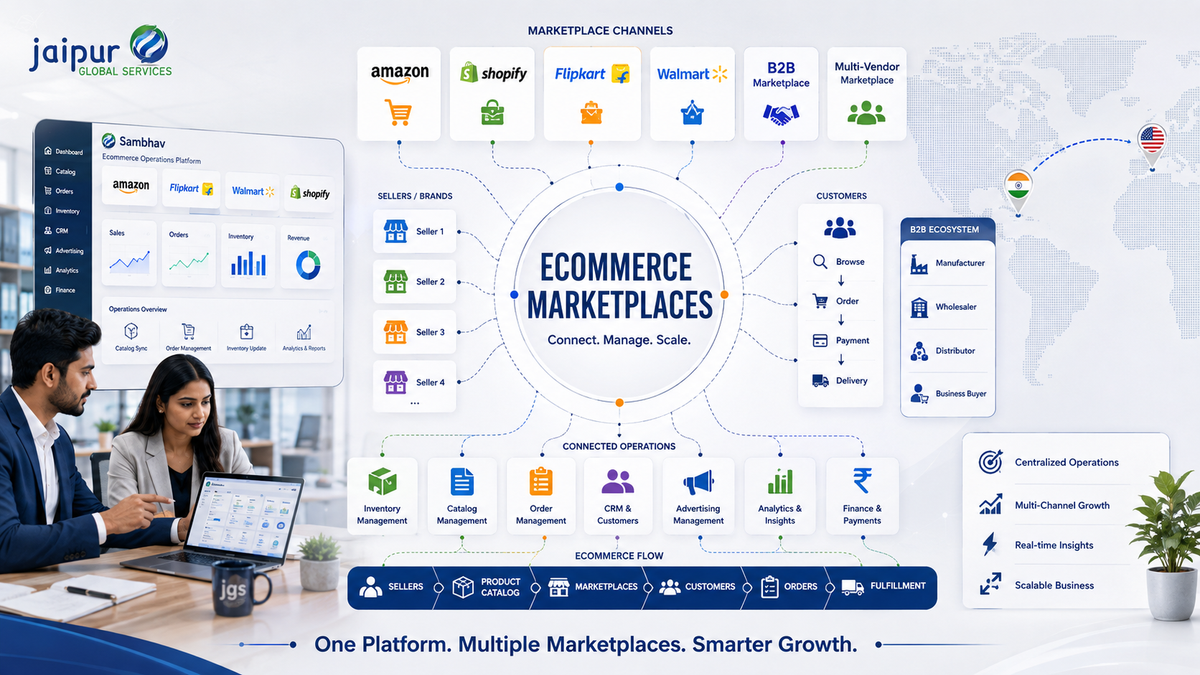
Customers no longer discover and buy products from a single brand website. They shop across Amazon, Flipkart, Walmart Marketplace, Shopify-based stores, multi-vendor marketplaces, B2B platforms, and social commerce channels — often comparing the same product across several before purchasing.
For businesses, this means ecommerce marketplaces now offer access to customers and ready-made digital infrastructure that would otherwise take years to build independently. But that access comes with real challenges: competition, fees, inventory syncing, catalog upkeep, order and advertising management, fulfillment, customer service, and marketplace-specific policies. Simply listing products on a marketplace isn't a strategy — understanding how these platforms work, and which one fits a given business, is what determines results.
What Are Ecommerce Marketplaces?
An ecommerce marketplace is a digital platform where multiple sellers or businesses offer products or services to customers through a shared storefront, rather than each seller running an independent website. The relationship generally works like this:
Marketplace Owner → Sellers → Products/Services → Customers
The marketplace owner (Amazon, Flipkart, Walmart, or a niche platform) builds and maintains the underlying technology, traffic, and customer trust. Sellers list and manage their own products within that shared environment, and customers browse, compare, and purchase across many sellers in one place.
This differs fundamentally from a single-brand ecommerce website, where one business controls the entire storefront and customer relationship but has to generate all of its own traffic. On a marketplace, sellers trade some of that control for access to an existing customer base and built-in infrastructure.
How Do Ecommerce Marketplaces Work?
While the exact process varies by platform, most marketplaces follow a similar flow:
Seller Registration → Product Listing → Catalog/Product Information → Customer Discovery → Order → Payment → Fulfillment → Delivery → Returns/Customer Support → Seller Settlement
Responsibilities are typically shared across four parties: the marketplace provides the platform, discovery, payment processing, and policy enforcement; the seller manages listings, pricing, inventory accuracy, and — depending on the fulfillment model — shipping and customer queries; the customer browses, orders, and returns under marketplace policies; and a fulfillment provider, whether the marketplace's own network or a third party, handles storage, packing, and delivery. Knowing where these responsibilities sit matters before listing on any new platform.
Types of Ecommerce Marketplaces
B2C Marketplaces
Business-to-consumer marketplaces, like Amazon and Flipkart, connect sellers directly with individual shoppers.
B2B Online Marketplaces
B2B online marketplaces connect businesses, manufacturers, wholesalers, distributors, and professional buyers, typically involving bulk orders, wholesale pricing, recurring purchasing, detailed catalogs, and direct negotiation — a different model from consumer-facing marketplaces.
C2C Marketplaces
Customer-to-customer marketplaces let individuals sell directly to each other, with the platform mainly facilitating discovery, payment, and trust.
Multi-Vendor Marketplaces
A multi vendor marketplace allows many independent sellers to list and sell on one shared platform, whether an established marketplace like Amazon or a custom-built platform designed for multiple vendors.
Niche Marketplaces
Niche marketplaces focus on a specific category or audience, trading broad reach for a more targeted, often less competitive segment.
Shopify Marketplace — What Does It Mean?
Shopify is primarily a platform for building an individual brand's online store — it is not itself a multi-vendor marketplace like Amazon. A Shopify marketplace generally refers to a Shopify store extended, through apps, integrations, or custom development, to support multiple vendors selling under one storefront.
In practice, businesses use Shopify as a single-brand store, as a store connected to external marketplaces like Amazon and Flipkart for order and inventory sync, or as the foundation for a custom-built multi-vendor marketplace. Which setup makes sense depends entirely on the business model — a single D2C brand has very different needs from a business trying to host other sellers on its own platform.
Shopify Multi Vendor and WooCommerce Multi Vendor
Businesses building their own marketplace often choose between Shopify multi vendor and WooCommerce multi vendor approaches. Shopify is hosted, so multi-vendor functionality is typically added through marketplace apps or custom development within its ecosystem. WooCommerce is a self-hosted WordPress plugin, so multi-vendor functionality usually involves marketplace plugins and more direct control over hosting and customization.
Benefits of Ecommerce Marketplaces for Sellers
Marketplaces offer wider customer reach, giving sellers access to an existing base of shoppers rather than building traffic from zero. They enable easier product discovery through the marketplace's own search and category browsing, and provide ready-made infrastructure for payments, order processing, shipping, reviews, and customer communication — systems a business would otherwise build itself. This supports an opportunity to scale product ranges without proportional technology investment, and enables multi-channel growth, reducing dependence on any single selling channel.
Challenges Sellers Face on Ecommerce Marketplaces
Alongside these benefits come real demands: marketplace fees, intense competition, advertising costs, price pressure on margins, inventory and catalog management, order management, returns, customer service, policy compliance, and financial reconciliation. More marketplaces increase reach, but they also increase operational complexity — each channel adds its own catalog, order flow, and support requirements.
Ecommerce and Marketplace — Why Operations Matter
Marketplace success depends on more than marketing and product quality. It depends on how well the underlying operations connect:
Product Listing → Inventory → Orders → Fulfillment → Customer Experience → Returns → Payments/Reconciliation → Analytics
When these systems are disconnected — inventory tracked in one place, orders processed manually, finance reconciled separately — businesses can struggle to maintain accurate information as volume grows. This is where ecommerce and marketplace management becomes as important as the marketplace choice itself.
How Businesses Can Choose the Right Ecommerce Marketplace Platform
Choosing among ecommerce marketplace platforms should be based on evaluation, not assumption: target customer, geography, product category fit, marketplace demand, competition, fees, fulfillment, advertising costs, seller requirements, technology integrations, reporting, scalability, and — most importantly — profitability.
Sellers should calculate actual product-level profitability on each platform, rather than assuming higher sales volume means a better outcome. A marketplace that looks impressive on a sales report can still be weaker once fees, fulfillment, and advertising costs are factored in.
What Sellers Should Look for in a Marketplace Management Setup
As sellers add channels, a few capabilities become increasingly important: centralized catalog management, inventory visibility, order management, customer management, advertising monitoring, marketplace analytics, finance and reconciliation, and multi-channel coordination. Managing these manually across multiple marketplaces gets progressively harder as product count, order volume, and channel count grow.
How JGS (Jaipur Global Services) Helps Ecommerce Businesses Manage Marketplace Growth
JGS (Jaipur Global Services) is an ecommerce services and technology company supporting businesses across marketplace growth and digital commerce operations. JGS (Jaipur Global Services) works with sellers across Amazon, Flipkart, Walmart Marketplace, and Shopify-based D2C stores, covering account management, catalog management, advertising, and account health monitoring, along with support for sellers expanding internationally.
How Sambhav Can Help Ecommerce Sellers
Running products across multiple marketplaces means dealing with multiple dashboards, separate order flows, and scattered performance data — unless that information is brought together.
Sambhav, JGS (Jaipur Global Services) in-house SaaS platform, simplifies ecommerce operations with real-time sales data, inventory tracking, order management, and performance monitoring in one place, along with CRM, catalog and advertising support, and finance and payment reconciliation. Conceptually:
Amazon + Flipkart + Walmart + Shopify + Other Channels → Centralized Ecommerce Operations → Catalog + Orders + Inventory + CRM + Analytics → Better Visibility → Better Decision-Making
Sambhav doesn't automatically increase sales or guarantee marketplace success, and it doesn't replace each marketplace's own seller systems. What it can do is bring important marketplace and operational workflows into a centralized environment, making it easier to monitor performance, manage operations, and decide based on actual data rather than assumptions.
Why Technology Becomes More Important as Sellers Scale
A business managing 10 products on one channel can often track everything manually. A business managing 500 products across four or five channels faces a different set of problems: data duplication, inventory synchronization, constant catalog updates, higher order volumes, more customer communication, advertising spread across channels, and more complex finance reconciliation. Technology can't replace good product or pricing decisions, but it can meaningfully reduce manual work and improve visibility as complexity grows.
FAQ
1. What are ecommerce marketplaces?
Ecommerce marketplaces are digital platforms where multiple sellers or businesses offer products or services to customers through a shared storefront, rather than each seller running an independent website.
2. How do ecommerce marketplaces work?
Generally through seller registration, product listing, customer discovery, ordering, payment, fulfillment, delivery, and returns — with responsibilities shared between the marketplace, seller, customer, and fulfillment provider.
3. What is a multi vendor marketplace?
A platform, whether an established marketplace or a custom-built site, where multiple independent sellers list and sell products under one shared platform.
4. What is a Shopify marketplace?
Shopify itself is a platform for building individual online stores. A "Shopify marketplace" refers to a Shopify store extended with apps or custom development to support multiple vendors.
5. Can Shopify be used to create a multi-vendor marketplace?
Yes, through suitable marketplace apps, integrations, or custom development — Shopify does not include multi-vendor functionality by default.
6. What is WooCommerce multi vendor?
A WooCommerce store extended with marketplace plugins or custom development to allow multiple independent sellers to list products, typically offering more technical customization than Shopify but requiring more hands-on management.
7. What are B2B online marketplaces?
Platforms that connect businesses — manufacturers, wholesalers, distributors, and professional buyers — for bulk orders, wholesale pricing, and recurring purchasing, rather than individual consumer transactions.
8. How can JGS (Jaipur Global Services) and Sambhav help ecommerce sellers?
JGS (Jaipur Global Services) manages marketplace operations across Amazon, Flipkart, Walmart, and Shopify, while Sambhav centralizes catalog, order, inventory, CRM, and performance data so sellers can monitor operations and make data-driven decisions.
Conclusion
Ecommerce marketplaces can give businesses access to customers, infrastructure, and growth opportunities that would otherwise take years to build independently. But marketplace success depends on far more than listing products — it requires evaluating customer reach, product fit, fees, competition, fulfillment, advertising, technology, and operations together, and calculating real profitability rather than chasing sales volume alone.
JGS (Jaipur Global Services) helps ecommerce businesses manage their marketplace and digital commerce requirements, while Sambhav provides a centralized technology environment for managing important ecommerce workflows and business data.
Looking to scale across ecommerce marketplaces without losing control of your operations? Explore Sambhav or connect with JGS (Jaipur Global Services) to discuss your ecommerce growth requirements.