
Global Ecommerce Expansion: A Complete Guide to Marketplace Localization and International Growth
 June 1, 2026
 Yashwardhan Singh
 0 Comments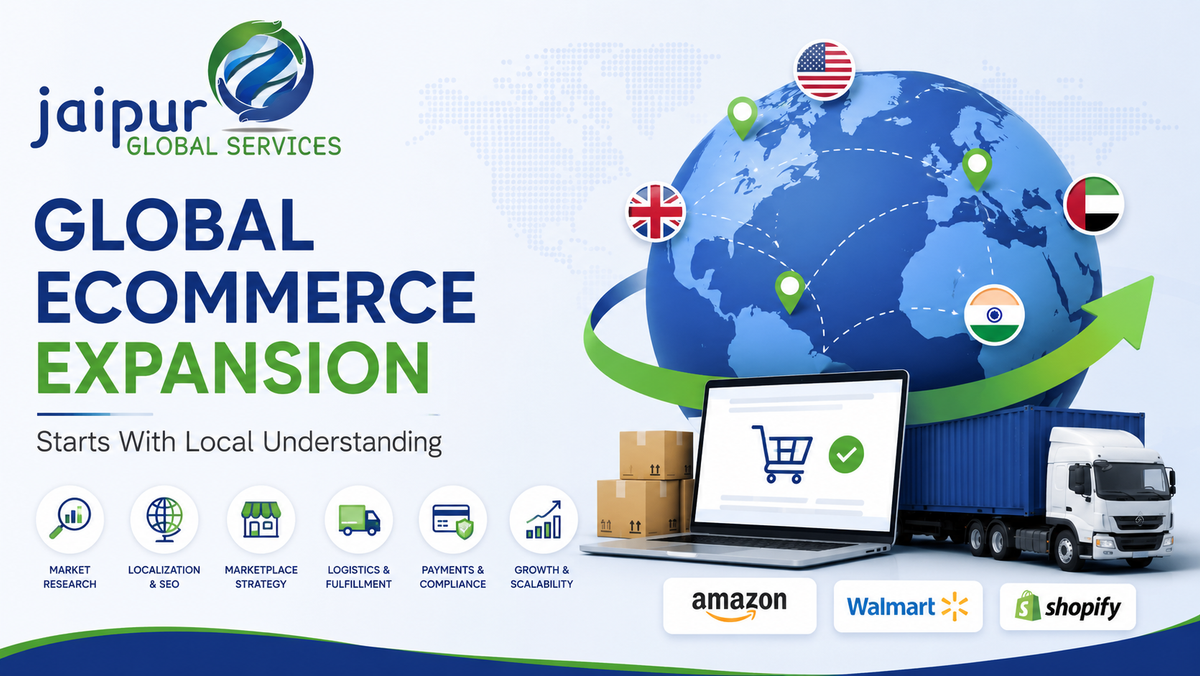
Expanding into international markets takes more than translating product listings. Businesses need the right markets, marketplaces, pricing, localization, logistics, SEO and operational strategy to compete effectively across borders.
An Indian brand has built a solid ecommerce business at home. Products sell well, reviews are strong, the operations team knows exactly how the business runs. Encouraged by that, the company decides to enter the US, UK or UAE. The team translates the product descriptions, uploads the listings, and starts running ads.
Sales don't follow the same pattern.
The reason is usually simple: international ecommerce isn't domestic ecommerce with a different country selected in a dropdown. Customers in a new market can have different search behavior, language, buying preferences, payment habits, price expectations, product requirements, delivery expectations and cultural context — none of which a straight translation accounts for.
Global expansion works best when a business combines a consistent brand with market-specific execution. That balance — global consistency plus local relevance — is what the rest of this guide is built around.
What Is Global Ecommerce Expansion?
Global ecommerce expansion means selling products or services to customers in markets outside a company's original domestic market — through a brand-owned website, third-party marketplaces (Amazon, Walmart, regional platforms), social commerce, or a combination of these.
It can take several operational forms: shipping cross-border directly from the home country, holding local inventory in the destination market, opening local marketplace seller accounts, setting up a local business entity, using third-party logistics providers, or running a fully localized website for that market. Most businesses use a mix of these depending on the market and the product.
What Is Ecommerce Localization?
Ecommerce localization is the process of adapting the complete shopping experience — not just the words on the page — to a specific target market. Current ecommerce guidance is consistent on this point: localization spans language, currency, pricing, product content, keywords, payment methods, shipping information, returns policy, taxes, customer support and cultural expectations, treating it as adaptation of the whole customer journey rather than translation alone.
Translation converts language. Localization adapts the entire shopping experience. A listing can be translated correctly, word for word, and still fail — because the keywords aren't what local shoppers actually search for, the price doesn't match local expectations, or the checkout doesn't offer a payment method customers trust.
Why Global Ecommerce Expansion Is Attractive
International markets offer real, tangible upside: access to new customers, revenue diversification, reduced dependence on a single market, longer product life cycles as demand shifts across regions, international brand awareness, new marketplace opportunities, and better use of product and operational capabilities a business has already built.
None of this is automatic. International expansion creates opportunity — it doesn't guarantee sales or revenue. The businesses that succeed treat a new market as a new business problem to solve, not a copy-paste of what already worked at home.
Why International Expansion Is Difficult
The challenges are real and compound quickly: different customer behavior, language and cultural differences, unfamiliar competition, different pricing dynamics, currency fluctuations, taxes and duties, regulatory requirements, product compliance, shipping and returns logistics, customer support across time zones, marketplace-specific rules, and advertising markets that behave nothing like the domestic one.
The more countries a business enters, the more of these variables it has to manage simultaneously — which is exactly why sequencing and prioritization matter more than speed.
How to Choose the Right International Market
A practical way to evaluate a candidate market:
- Demand — is there genuine demand for this product category?
- Competition — how crowded is the market, and who already owns it?
- Product-market fit — does the product solve a need the way local customers actually experience it?
- Purchasing power — can target customers realistically afford the product at a sustainable price?
- Logistics — can the business deliver economically and within acceptable timeframes?
- Regulations — can the product legally be sold there, as-is or with modification?
- Marketplace opportunity — are there suitable, accessible marketplaces or channels?
- Customer acquisition cost — what will advertising and competing for visibility actually require?
- Margin — after all local costs, does the economics still work?
- Operational complexity — can the business realistically support this market right now?
A simple scoring exercise — rating each market 1–5 against these criteria — turns "we should expand to the US" from a gut call into a comparable decision across two or three candidate markets.
Market Research Before Expansion
Before committing to a market, research search demand, marketplace demand, direct competitors, local pricing, existing reviews (what customers already complain about or ask for), product gaps, common customer questions, and advertising competition. Google Trends, Google Keyword Planner, marketplace search and ranking data, Google Search Console, website analytics and direct customer research (surveys, local partner conversations) are all useful inputs here.
No single tool predicts market success. The goal of this research is to reduce uncertainty before spending on inventory, listings and advertising — not to produce a guarantee.
Choosing the Right Global Marketplace
Marketplace choice depends on the target customer, product category, market demand, marketplace fees, fulfillment options, competitive density, seller requirements, available advertising formats, and how local customers actually prefer to shop. Amazon, Walmart Marketplace, eBay, regional marketplaces and a brand-owned Shopify storefront each fit different situations — none is universally right.
For Indian sellers specifically, Amazon's international selling programs are often a practical starting point because they extend an already-familiar seller experience into new geographies, but the right marketplace still depends on where the target customers actually shop and what that platform's fee and fulfillment structure looks like for the specific product category.
Localization Is More Than Translation
This deserves its own emphasis because it's the single most common mistake in international expansion: a literal, accurate translation can still produce a poor ecommerce experience.
Localization adapts product terminology, keywords, product benefits framing, measurements, product claims, images, pricing, offers, shipping information, returns policy and customer support — not just sentence-level language. A keyword that converts well in India may not be the term customers in the US or UK actually type into a search bar; the product might be functionally identical, but the way people search for it, describe it, and compare it can differ meaningfully. That's why market-specific keyword research — not translated keyword lists — needs to happen before listings go live.
Global Product Listing Localization
Practical areas to localize on any given listing:
- Product title — built around local search behavior, not a direct translation of the domestic title
- Bullet points — focused on the benefits and information local buyers actually care about
- Product description — written in natural local language, not machine-translated prose
- Images — reviewed for local context and expectations (packaging conventions, model representation, usage scenarios)
- A+ content / enhanced content — messaging adapted, not just copy-pasted with a new language layer
- Keywords — researched per market, not translated from the domestic keyword set
- Reviews — monitored per market, since local feedback often surfaces localization gaps quickly
- Product information — measurements, specifications and terminology converted and adapted correctly (metric vs. imperial, sizing conventions, local terminology for materials or features)
International SEO and Ecommerce Localization
International SEO matters most when a business relies on a brand-owned ecommerce website rather than (or alongside) marketplaces. It typically involves country-specific keyword research, genuinely localized content (not machine-translated pages), dedicated URLs or subdirectories per market, hreflang tags, localized metadata, local landing pages, and attention to local search engine behavior and backlink profiles.
Simply translating one page and adding a new language toggle does not create a strong international SEO strategy. Rankings take time and depend on many factors beyond localization — this article won't promise specific ranking outcomes, only that skipping proper international SEO groundwork makes strong organic performance in a new market considerably less likely.
Localizing Pricing and Currency
Pricing shouldn't simply be the domestic price run through today's exchange rate. A defensible international price accounts for local competition, taxes and duties, shipping cost, marketplace and payment fees, advertising cost in that market, what local customers are actually willing to pay, prevailing local price expectations for the category, and the margin the business needs to maintain.
It's entirely reasonable for the same product to carry a different price in different markets — the underlying market economics are genuinely different, and pricing should reflect that rather than forcing one global number everywhere.
Payment Methods and Checkout Localization
Payment expectations vary significantly by country. Depending on the market, this can include standard credit/debit cards, digital wallets, locally preferred payment methods, buy-now-pay-later options where relevant, or cash-on-delivery where it's still common. Currency display, visible tax treatment, and transparent shipping costs at checkout all affect trust. An unfamiliar or foreign-feeling checkout experience is a well-documented source of cart abandonment — offering the payment methods a market actually trusts is often a bigger lever than most sellers expect.
Shipping, Fulfillment and Returns
International fulfillment generally follows one of a few models:
- Cross-border shipping — fulfilling orders directly from the home country
- Local third-party logistics (3PL) — holding inventory in the destination market for faster, cheaper local delivery
- Marketplace fulfillment — using a marketplace's own fulfillment network where available in that market
- Hybrid model — combining approaches by product line, market maturity, or order volume
Each comes with trade-offs across delivery time, shipping cost, duties, returns handling and reverse logistics, and how inventory is positioned. No single model is right for every business — the right choice depends on order volume, product economics, and how established the business already is in that market.
Compliance and Market Requirements
Every market can carry different requirements around product safety, labelling, consumer protection law, tax registration, import documentation, data and privacy rules, environmental regulations, and category-specific rules (electronics, cosmetics, food, and children's products are common examples where requirements diverge sharply by country).
This article can outline the categories to check — it can't tell you what applies to your specific product in a specific country. Verify market-specific compliance, tax and legal requirements with qualified legal, tax and compliance professionals before launching in any new market.
Cultural Localization
Culture shapes far more of the buying decision than most sellers initially expect: imagery, color associations, messaging tone, product positioning, seasonal and holiday relevance, communication style, and general customer expectations around service and responsiveness. A campaign, offer structure, or even a product photo style that performs well in India won't necessarily land the same way in another market — the safer approach is researching how the target market's own successful brands communicate, rather than assuming universal appeal or leaning on stereotypes.
International Marketplace Advertising
Expansion usually requires localized advertising, not a copy of the domestic campaign structure. This spans marketplace PPC (sponsored products, sponsored brands), display advertising where available, search advertising, retargeting, and social advertising — each shaped by local keywords, local competitive intensity, local cost-per-click benchmarks, local conversion behavior, and how well the product actually fits that market.
Advertising should follow the market research, not replace it. Running a domestic campaign structure verbatim in a new market is one of the more reliable ways to overspend for underwhelming results.
Global Marketplace Operations
Running multiple international marketplaces adds real operational load: account management, catalog management, listings, inventory, orders, pricing, advertising, review monitoring, returns, customer support and performance reporting — multiplied across every market and channel.
A workable model combines centralized control (standardized processes, shared reporting, consistent brand governance) with market-specific execution (localized content, pricing, fulfillment and marketing per market). Running every marketplace manually and independently, without shared processes, is one of the fastest ways for expansion to outpace a team's actual operational capacity.
Global Expansion Strategy for Indian Ecommerce Sellers
A practical sequence many Indian sellers can follow — not a rigid rule every business must copy exactly:
Market research → select target country → validate demand → select marketplace → check compliance → localize listings → set pricing → plan fulfillment → launch → run localized advertising → measure performance → optimize → expand to the next market
The sequence matters less than the discipline behind it: validating before committing capital, and treating each new market as its own decision rather than an extension of the last one.
Common Global Expansion Mistakes
- Entering too many countries at once
- Choosing a market without real research behind it
- Translating listings instead of localizing them
- Copying domestic pricing directly
- Ignoring taxes and duties until they become a problem
- Underestimating local competition
- Using the same keyword list across every market
- Copying domestic advertising campaigns into a new market
- Ignoring local payment method preferences
- Underestimating returns volume and cost
- Treating customer support as an afterthought
- Launching without adequate inventory planning
- Skipping local compliance checks
- Managing every marketplace manually with no shared process
- Measuring only revenue, not profit contribution
- Expanding internationally before domestic product-market fit is actually proven
Building a Scalable Global Marketplace Strategy
A repeatable framework: research → prioritize → localize → launch → measure → optimize → standardize → automate → expand.
Each market needs its own localized customer experience, clear operational ownership, defined KPIs, market-specific pricing and content, appropriate fulfillment, and localized marketing. At the same time, the underlying business processes — reporting structure, brand governance, escalation paths — should be standardized wherever possible, so adding the fourth market doesn't require reinventing the operating model used for the first three.
KPIs to Track After Entering a New Market
Revenue, units sold, conversion rate, average order value, advertising spend, ROAS, customer acquisition cost, profit contribution, return rate, cancellation rate, inventory turnover, organic traffic, marketplace ranking, listing conversion rate, and customer review volume/sentiment.
Which of these matters most depends on the business's actual goals for that market — a market entered for brand-building purposes may prioritize traffic and reviews over immediate profit contribution, for example. This article won't set benchmark numbers for any of these, since they vary too much by category, market and business model to generalize responsibly.
When Should a Business Expand to Another Country?
Before committing to a new market, it's worth honestly evaluating: proven product-market fit at home, current market performance, operational capacity, available inventory and cash flow, team bandwidth, marketplace readiness, compliance groundwork, customer support capacity, and genuine ability to localize (not just translate) for that market.
There's no universal revenue threshold that says a business is "ready." A smaller business with strong operational discipline and a validated product can expand successfully; a larger business without that discipline can struggle in a new market regardless of its domestic scale.
Global Expansion vs. Localization
Global Expansion
Localization
Decides where to expand
Decides how to adapt
Market selection
Language
Marketplace selection
Pricing
Business/entry model
Currency
Fulfillment model
Product content
Operational planning
Payment methods
Growth strategy
Cultural adaptation
Performance measurement
Customer experience
Expansion chooses the market. Localization makes the brand relevant once it's there. Both are necessary — a well-chosen market executed generically underperforms, and excellent localization in the wrong market still fails.
How JGS Supports Global Ecommerce Expansion
Managing marketplace operations gets harder with every new country, channel and language a business adds — which is exactly where most growing sellers start losing operational control. JGS works across Amazon, Flipkart, Walmart, Shopify and Blinkit, combining account management, product listing and catalog management, marketplace advertising, and performance analytics into a structured, technology-supported operating model rather than a set of disconnected, manually-run accounts.
That combination is directly relevant to expansion: JGS can support market and marketplace evaluation, account setup and ongoing management, listing and catalog optimization market-by-market, advertising management tailored to each channel, and performance reporting that gives a business a consistent view across every market it operates in — rather than a patchwork of separate dashboards and processes per country.
We don't promise guaranteed international sales, revenue, rankings, ROAS, marketplace approval, or profitability — expansion outcomes depend on far more variables than any provider controls. What JGS can offer is a more structured, better-informed way to plan, execute, manage and optimize ecommerce operations as a business expands across markets and marketplaces.
CTA: Talk to an Ecommerce Expert
Planning to take your ecommerce business into international markets? JGS can help you evaluate marketplaces, manage ecommerce operations, and build a practical strategy for global growth.
Global Ecommerce Expansion Checklist
- Target market researched
- Demand validated
- Competitors analyzed
- Marketplace selected
- Compliance checked
- Product suitability confirmed
- Keywords researched locally
- Listings localized (not just translated)
- Pricing calculated for local economics
- Currency configured
- Payment methods reviewed against local preferences
- Shipping planned
- Fulfillment model selected
- Returns process planned
- Customer support prepared for the new market's time zone/language
- Advertising strategy localized
- SEO localized
- Inventory planned for launch
- KPIs defined for this specific market
- Performance monitoring established
Frequently Asked Questions
What is global ecommerce expansion?
Selling products or services to customers outside a business's original domestic market, through a brand-owned website, marketplaces, or a combination of channels.
What is ecommerce localization?
Adapting the complete shopping experience — language, pricing, currency, payment methods, content, SEO and support — to a specific target market, not just translating the text on a listing.
Why is localization important for international ecommerce?
Because a technically accurate translation doesn't guarantee the listing matches how local customers actually search, what they expect to pay, or how they prefer to pay and receive their order. Those gaps show up as lower conversion, even when the product itself is a good fit.
What's the difference between translation and localization?
Translation converts language. Localization adapts the entire customer journey — keywords, pricing, currency, payments, shipping expectations, support and cultural context — around that language.
How do I choose the right country for ecommerce expansion?
Evaluate demand, competition, product-market fit, local purchasing power, logistics feasibility, regulatory requirements, marketplace availability, likely customer acquisition cost, achievable margin, and your own operational capacity to support the market.
Which marketplaces are best for international ecommerce?
It depends on the target customer and product category — Amazon, Walmart, regional marketplaces and a brand-owned Shopify store each suit different situations. There's no universally "best" choice.
How do I localize Amazon product listings?
Rebuild the title, bullet points and description around locally researched keywords and buyer language, adapt images and A+ content to local context, and convert measurements, specifications and terminology accurately for that market.
How should I price products for international markets?
Start from local costs, taxes, duties, marketplace and payment fees, and advertising cost in that market — then weigh that against local competitor pricing and what customers are realistically willing to pay. Don't rely on a straight currency conversion of the domestic price.
How does international SEO work?
Through country-specific keyword research, genuinely localized (not machine-translated) content, dedicated URLs or subdirectories per market, hreflang implementation, and local metadata and landing pages — built for how that market's search engines and shoppers actually behave.
What are the biggest challenges of cross-border ecommerce?
Managing multiplying operational variables at once: different customer behavior, language and culture, currency and tax complexity, regulatory compliance, logistics, and running consistent operations across marketplaces that each have their own rules.
How can Indian sellers sell internationally?
By researching and validating a target market before committing, choosing a suitable marketplace (Amazon's international selling programs are a common starting point), meeting local compliance requirements, localizing listings and pricing properly, and building operations that can support the market rather than launching and hoping.
How can JGS help with global marketplace expansion?
JGS supports market and marketplace evaluation, account setup and management, listing and catalog localization, marketplace advertising, and cross-market performance reporting — built to bring structure to ecommerce operations as a business expands across countries and channels.
Conclusion
Global ecommerce expansion is not simply about entering more countries — it's about building the market research, marketplace selection, localization, pricing, logistics, compliance, SEO, advertising, operations and performance measurement that make a new market actually work.
The strategy that holds up is global consistency combined with local relevance — a recognizable brand executed with real attention to what each specific market needs.
Planning to take your ecommerce business into international markets? JGS can help you evaluate marketplaces, manage ecommerce operations and build a practical strategy for global growth.