
Why Content Writing Is Important for Business Growth
 June 1, 2026
 Yashwardhan Singh
 0 Comments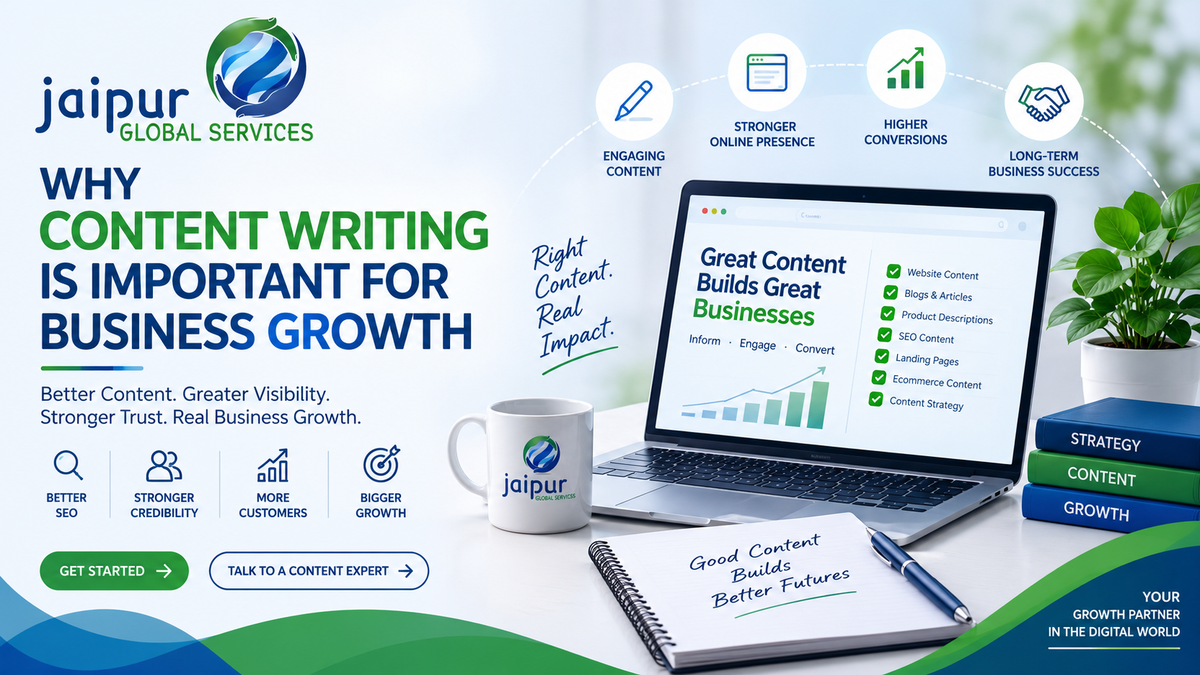
Content Writing That Helps Businesses Build Visibility and Trust
Professional content helps businesses communicate their value, answer customer questions, support SEO, and create stronger digital experiences.
Get Started Talk to a Content Expert
Having a website is no longer enough on its own. Visitors arrive with questions — what does this product actually do, why should I trust this business, how is this different from the alternative I saw yesterday — and if the content on the page doesn't answer those questions clearly, most visitors simply leave and find a competitor who does. Content is what does this work: explaining products and services, answering the questions customers actually have, targeting the searches that bring people to a site in the first place, building credibility, educating prospects before they're ready to buy, supporting SEO, generating enquiries, and — for online sellers — directly supporting sales.
Content writing has also moved well past the idea of publishing the occasional blog post. Modern business content spans website pages, blogs, product descriptions, landing pages, guides, case studies, FAQs, marketplace listing content, email content, and social content — each doing a different job across a customer's journey from first hearing about a business to actually buying from it. This page walks through why professional content writing services have become genuinely important for businesses, what different types of content actually do, how content connects to SEO without being a magic ranking switch, and what to look for if you're considering outsourcing content work.
What Is Content Writing?
Content writing is the process of researching, planning, writing, editing, and optimizing written material for a specific audience and a specific business objective. It's not simply putting words on a page — good content writing starts with understanding who's reading it and what they actually need from it.
It's worth distinguishing a few related terms that get used loosely:
- General writing covers writing for its own sake — no specific business objective attached.
- Business content writing is written specifically to serve a business goal — explaining a product, building trust, supporting a sale, answering a support question.
- SEO content writing is business content written with search intent, keyword relevance, and discoverability specifically factored into the approach (covered in more detail below).
- Content marketing is the broader activity that content writing feeds into — the strategy, distribution, and promotion around content, not just its creation.
Content writing services typically sit at the "creation" layer of this — producing the actual written material a business needs, whether that's a single landing page or an ongoing stream of blog content, product descriptions, and website copy.
Why Is Content Writing Important for Businesses?
1. Helps businesses explain what they offer. Clear, well-written content communicates products and services in a way visitors can actually understand and act on, rather than leaving them to guess.
2. Builds trust. Accurate, genuinely useful content demonstrates real knowledge and credibility — the opposite of vague, generic copy that could describe any business in the category.
3. Supports SEO. Relevant, well-structured content gives search engines useful information about what a page is actually about, which supports discoverability. It's worth being precise here: content alone doesn't guarantee rankings — it's one part of a broader set of factors search engines evaluate, alongside technical structure, backlinks, and competition.
4. Attracts relevant visitors. Content built around the actual questions and searches potential customers make tends to attract people genuinely interested in what a business offers, rather than just any traffic.
5. Supports lead generation. Useful content can guide visitors toward the next step — a contact form, a product page, a service page, booking a consultation, or making a purchase — rather than leaving them to figure out what to do next on their own.
6. Strengthens brand voice. Consistent tone and messaging across a website, blog, and marketing channels makes a business feel more coherent and trustworthy than one where every page reads like it was written by someone different.
7. Supports customer education. Guides, FAQs, and informational articles reduce uncertainty before a purchase decision, which tends to mean fewer support questions and more confident buyers afterward.
8. Supports ecommerce. Product and category content helps online shoppers understand exactly what they're buying — features, use cases, specifications — without needing to ask (covered in detail below).
Why Content Writing Is Becoming More Important
Rather than framing this as a passing trend, it's more accurate to describe a genuine, ongoing shift in how businesses need to compete online.
More businesses are competing for the same online attention than ever before, which means generic, thin content stands out less and less. Search competition has intensified in nearly every category. Customers increasingly research extensively before making a purchase decision, whether that's reading product details, comparing options, or checking reviews — and content is what they're actually reading during that research. Ecommerce specifically has grown considerably, which means more businesses need product and category content at real scale. Buyer journeys have gotten more complex, often spanning multiple touchpoints and pieces of content before a decision gets made. Search engines increasingly reward content that demonstrates genuine search intent alignment, not just keyword matching. And there's a general demand for trustworthy, useful information — search engines and readers alike are less tolerant of content that exists purely to fill a page.
Worth addressing directly: AI-assisted tools have changed how content gets researched and drafted, but they haven't removed the need for accurate, useful, audience-focused content — if anything, the businesses that stand out are the ones combining efficient production with genuine expertise, accuracy, and editorial judgment, not the ones publishing more generic content faster. AI has changed the production process; it hasn't eliminated what makes content actually useful to a reader.
Different Types of Content Writing Businesses Need
Website content — homepage copy, about pages, service pages, landing pages, and contact pages that together communicate who a business is and what it offers.
Blog writing — content that answers informational searches, builds topical authority over time, and gives a business a reason to show up in search results beyond its core service pages.
SEO content writing — content specifically built around search intent and keyword relevance, covered in detail in the next section.
Product description writing — the specific, detailed information customers need to understand and decide to buy a product, particularly important for ecommerce.
Category page content — content that helps both shoppers and search engines understand what a product category contains and how to navigate it.
Landing page copy — focused, conversion-oriented content built around a single specific action, often used for campaigns or specific offers.
Case studies — real accounts of how a business has helped a specific customer, which build credibility through demonstrated results rather than general claims.
Guides and long-form content — deeper educational resources that help a business demonstrate expertise and answer more complex customer questions.
FAQ content — direct answers to the questions customers ask repeatedly, reducing friction and support load at the same time.
Not every business needs every one of these — the right mix depends on the business model, the sales cycle, and where customers actually get stuck in their decision-making.
What Is SEO Content Writing?
SEO content writing combines several things working together: keyword research (understanding what people actually search for), search intent (understanding what they're actually trying to accomplish with that search), topic research (covering a subject with genuine depth), content structure (organizing information logically for both readers and search engines), natural keyword usage (fitting relevant terms in without forcing them), internal linking (connecting related content on a site), readability (making content genuinely easy to follow), helpful information (actually answering the reader's question), and on-page optimization (technical elements like headings, meta descriptions, and structure).
It's worth being equally clear about what SEO content writing is not. It's not keyword stuffing — repeating a phrase unnaturally throughout a page. It's not writing solely for search engines while ignoring the actual human reading it. It's not adding irrelevant keywords just because they have search volume. Good SEO content writing serves the reader first, structured in a way that also happens to help search engines understand and surface that content appropriately — not the other way around.
How Content Writing Supports SEO
The relationship between content and SEO runs through several connected factors:
- Search intent — content that genuinely matches what a searcher is trying to accomplish performs better than content that technically contains the right keywords but doesn't answer the actual question
- Keyword targeting — using terms that reflect real search behavior, placed naturally rather than forced
- Topical coverage — demonstrating genuine depth on a subject, rather than a single shallow page trying to cover everything
- Internal linking — connecting related content helps both users and search engines navigate and understand a site's structure
- Content structure — clear headings and logical organization make content easier to scan and understand
- Long-tail queries — more specific, longer search phrases that content can address more precisely than broad, highly competitive terms
- Freshness and content updates — keeping existing content accurate and current, rather than letting it go stale
- User experience — content that's genuinely easy to read and navigate supports the broader page experience search engines evaluate
- E-E-A-T-related considerations — demonstrating genuine expertise, experience, authoritativeness, and trustworthiness through accurate, well-informed content
It's worth repeating a point made earlier because it matters: content is one component of SEO, not the entire discipline. It doesn't work in isolation from technical SEO, site structure, backlinks, and overall competition in a given space. Strong content is necessary for good SEO performance, but it isn't sufficient on its own.
Content Writing and the Customer Journey
Different content serves different points in a customer's decision-making process, and publishing randomly — without thinking about which stage a piece of content is actually serving — tends to produce content that doesn't connect to real business outcomes.
Funnel Stage
User Need
Example Content
Awareness
Learn
Blog post / educational guide
Consideration
Compare
Comparison article / case study
Decision
Evaluate provider or product
Service page / product page
Conversion
Take action
Landing page / clear CTA
Retention
Get ongoing value
Guide / FAQ / email content
A business publishing only blog content, for instance, might be generating awareness-stage traffic that never converts, because there's nothing built for the decision or conversion stages to actually close the loop. Thinking about content across the full journey — not just the top of it — is what turns content into something that actually supports business outcomes rather than just traffic numbers.
Content Writing for Ecommerce Businesses
Ecommerce businesses have a particular, high-stakes need for content, since product and category content directly shapes whether a shopper actually understands — and buys — a product.
This spans product descriptions and titles that communicate what a product actually is, category content that helps shoppers navigate and understand a product range, buying guides that help customers choose between options, comparison articles for categories where customers are weighing alternatives, blog content that supports broader discovery and search visibility, FAQs that answer common pre-purchase questions, landing pages for specific campaigns or promotions, and marketplace-specific listing content for platforms like Amazon and Flipkart.
Good ecommerce content helps customers understand product features, real-world benefits, practical use cases, technical specifications, and how one product differs from another similar one — all the things a shopper would ask a salesperson if they were buying in person, but has to get from the page itself when buying online.
Product Descriptions and Ecommerce Content
A genuinely useful product description does more than list specifications. It communicates clear, accurate product information, real benefits (not just features), practical use cases that help a customer picture actually using the product, complete specifications, customer-focused language rather than internal jargon, naturally incorporated relevant keywords, strong readability, and — for marketplace listings specifically — compliance with each platform's specific content requirements and formatting rules.
It's worth being direct about one thing: well-written product descriptions support discoverability and customer understanding, but they don't automatically improve search or marketplace rankings on their own. Ranking and visibility depend on multiple factors — pricing, reviews, advertising, overall listing quality — working together, not content in isolation.
Content Writing vs Content Marketing
These terms overlap but describe different scopes of work.
Content Writing
Content Marketing
Focuses on creating content
Focuses on the complete content strategy
Writing itself is central
Strategy, creation, and distribution together
Includes blogs, pages, product copy
Spans multiple channels and formats
Often delivered as a specific piece of work
Usually an ongoing, broader marketing activity
Content writing can be — and often is — one component of a larger content marketing strategy. A business might handle content marketing strategy internally while outsourcing the actual writing, or vice versa. Understanding which one you actually need (or whether you need both) matters before evaluating providers, since a content writing service and a full content marketing agency aren't solving the same problem.
Why Businesses Outsource Content Writing
Common, practical reasons businesses bring in outside help: they lack dedicated internal writers, internal teams are stretched too thin to produce content consistently, publishing needs to happen on a regular schedule that internal capacity can't support, SEO-specific writing expertise isn't available internally, industry or product research takes more time than internal staff have, content needs to scale faster than hiring can keep up with, editing and quality control need a dedicated process, or ecommerce content specifically needs to be produced at a volume — hundreds or thousands of product descriptions — that isn't realistic to handle by hand internally.
It's worth being fair here: outsourcing isn't automatically the better choice for every business. A business with strong internal writers who deeply understand the product and audience may produce better content in-house than an external team still learning the business. The right answer depends on internal capacity, content volume needs, and how specialized the required expertise is.
In-House Writers vs Content Writing Agency
Factor
In-House Writer
Content Writing Agency
Brand familiarity
High, built over time
Requires onboarding and ramp-up
Scalability
Depends on team size
Usually easier to scale up or down
Cost structure
Employee-based, fixed
Service-based, tied to actual work
Multiple content formats
Depends on individual skill set
Often broader collective expertise
Editorial resources
Depends on team size
Often available as part of the service
Flexibility
Shaped by internal priorities
Generally more project-based flexibility
The right choice depends on business size, how much content is actually needed on an ongoing basis, budget, and how specialized the content requirements are. A small business publishing occasionally may do fine with a part-time or freelance writer. A growing ecommerce business needing hundreds of product descriptions produced consistently often benefits from an agency built to handle that volume.
How to Choose a Content Writing Company
Whether or not you choose JGS, here's what's worth evaluating in any content writing provider:
- Writing quality — is their sample work genuinely well-written, not just grammatically correct?
- Industry knowledge — do they understand your specific business or product category?
- SEO understanding — do they write with search intent and structure in mind, not just keyword insertion?
- Research process — how do they actually gather accurate information before writing?
- Editing process — is there a genuine review step, or does content go live as a first draft?
- Originality — can they demonstrate that content is written specifically for you, not templated or recycled?
- Content strategy — do they think about what content is actually needed, or just produce whatever's requested?
- Communication — will you have clear visibility into progress and revisions?
- Turnaround time — can they realistically meet your publishing schedule?
- Portfolio — does their previous work reflect the quality and style you need?
- Revision process — how are changes and feedback handled?
- Reporting — will you know what's been delivered and when?
- Pricing — is their pricing structure clear and easy to understand upfront?
- Experience with ecommerce — if relevant, do they genuinely understand product and marketplace content requirements?
Questions worth asking directly: Can I see writing samples relevant to my industry or product category? What does your research process actually look like before you start writing? How do you approach SEO without keyword stuffing? What's your editing and quality control process? Can you handle ecommerce-specific content like product descriptions and marketplace listings? What's your typical turnaround time for a piece of content? How do you handle revisions? Do you write content and then hand it off, or help think through what content is actually needed? What's included in your standard pricing versus billed as an extra? How do you make sure content stays consistent with our brand voice?
Common Content Writing Mistakes
1. Writing without knowing the audience. Content written for "everyone" tends to genuinely connect with no one.
2. Keyword stuffing. Unnaturally repeating a phrase hurts readability and doesn't actually help SEO the way it once might have.
3. Copying competitors. Beyond the plagiarism risk, copied content rarely reflects a business's actual voice or specific value.
4. Publishing thin content. Short, shallow pages that don't genuinely answer a reader's question tend to underperform both for readers and search visibility.
5. Ignoring search intent. Content that technically covers a topic but doesn't match what searchers are actually looking for underperforms regardless of writing quality.
6. Using generic AI-generated content without review. Unreviewed AI output can be inaccurate, generic, or simply wrong on specifics — it needs human editorial judgment before publishing, not just a quick skim.
7. Poor editing. Typos, inconsistent tone, and unclear sentences undermine credibility regardless of how good the underlying information is.
8. No internal linking. Missing the opportunity to connect related content, which helps both readers and search engines navigate a site.
9. No clear CTA. Content that informs but doesn't guide the reader toward any next step leaves value on the table.
10. Publishing without a content strategy. Random, unconnected pieces of content rarely build toward anything — a coherent strategy connects individual pieces to broader business goals.
11. Ignoring existing content updates. Treating content as "done" once published, rather than revisiting and updating it as information changes.
12. Focusing only on traffic instead of business value. Content that attracts visitors but doesn't connect to leads, sales, or other real outcomes is optimizing for the wrong metric.
What Makes High-Quality Business Content?
Quality content tends to share a consistent set of characteristics: it's accurate, original, genuinely useful to the reader, relevant to their actual question or need, well researched, easy to read, aligned with real search intent, clearly structured, consistent with the brand's voice, actionable (giving the reader a clear next step), and updated when the underlying information changes.
It's worth being clear that quality should be judged by usefulness and business relevance, not word count. A focused, accurate 400-word answer to a specific question often serves a reader better than a padded 2,000-word article that says the same thing with more filler.
How JGS Can Help With Content Writing
JGS's content writing work is built around ecommerce and marketplace content specifically — product titles, descriptions, and bullet points as part of catalogue and listing management, and Enhanced Brand Content (EBC) and A+ Content for Amazon sellers, where the team has built more than 5,000 EBC and A+ listings. This content work is integrated with broader catalogue and account management, rather than delivered as standalone copywriting disconnected from how the content actually performs on a marketplace.
For businesses needing website content specifically, this connects with JGS's website design and development work, where content creation is part of building out a new or updated site. For ongoing product and catalogue content at scale, JGS's product listing and catalogue services cover the detailed, repeatable content work — titles, descriptions, attributes — that a growing ecommerce catalog needs on an ongoing basis.
Why Choose JGS for Content Support?
Ecommerce expertise, with content work built specifically around how product and marketplace content actually needs to perform, not generic copywriting.
Marketplace knowledge, developed through direct, hands-on experience with Amazon-specific content formats, including EBC and A+ Content.
SEO understanding, applied to listing and website content with real search behavior in mind, not just keyword insertion.
Business-focused content, integrated with catalogue and account management rather than delivered as a disconnected writing service.
Product and catalog knowledge, built through direct experience managing product data and content together, rather than writing in isolation from the underlying catalog.
Integrated ecommerce services, meaning content work connects to the broader marketplace and website services a growing business needs, rather than requiring a separate, uncoordinated relationship.
Future of Content Writing
The realistic picture for where content writing is headed involves several things happening together rather than any single dramatic shift. AI-assisted research and drafting tools are changing how content gets produced, speeding up early-stage work — but human editing, judgment, and accuracy checks remain essential, since AI-generated drafts can be confidently wrong on specifics. Search intent alignment continues to matter more than raw keyword density. Original insights, genuine expertise, and first-hand experience are becoming more valuable precisely because generic, AI-assisted content has become easier to produce at volume — differentiation increasingly comes from depth and accuracy, not just presence. Structured content (clear headings, logical organization, genuinely scannable formatting) continues to matter for both readers and search engines. Multimedia content is increasingly paired alongside written content rather than replacing it. Regular content refreshes are becoming more important as search engines and readers favor current, accurate information over stale pages. And AI-powered search and answer engines are changing how content gets discovered and surfaced, putting even more emphasis on content that directly, clearly answers real questions.
None of this means content writing is becoming obsolete or purely automated. It means the production process is changing while the underlying need — accurate, useful, genuinely audience-focused content, backed by real expertise and editorial judgment — stays exactly as important as it's always been, arguably more so as the volume of mediocre, unreviewed content online continues to grow.
Frequently Asked Questions
What is content writing?
The process of researching, planning, writing, editing, and optimizing written material for a specific audience and business objective — covering everything from website pages and blogs to product descriptions and marketing copy.
Why is content writing important for businesses?
It helps businesses explain what they offer, build trust and credibility, support SEO and discoverability, attract relevant visitors, and guide prospects toward taking action — whether that's an enquiry, a consultation, or a purchase.
What are content writing services?
Professional services that handle the research, writing, and editing of business content — website pages, blogs, product descriptions, landing pages, and more — typically for businesses that lack internal writing capacity or need specialized expertise.
What is SEO content writing?
Content writing that incorporates keyword research, search intent, and on-page structure alongside genuinely useful information — distinct from keyword stuffing or writing purely for search engines rather than for the actual reader.
How does content writing help SEO?
Well-structured, search-intent-aligned content helps search engines understand and surface a page appropriately, supports internal linking and site structure, and contributes to overall page experience — though content is one factor among several, not a guarantee of specific rankings on its own.
What types of content do businesses need?
This varies by business, but commonly includes website pages, blog content, product descriptions (for ecommerce), landing pages, FAQs, guides, and case studies — each serving a different stage of the customer journey.
Why should businesses outsource content writing?
Common reasons include limited internal writing capacity, the need for consistent publishing, SEO-specific expertise, and the ability to scale content production — particularly for ecommerce businesses needing large volumes of product content.
How much do content writing services cost?
Pricing varies by content type, volume, and required expertise (general website copy versus specialized SEO or ecommerce content). It's best discussed directly based on your specific content needs rather than a generic estimate.
How do I choose a content writing company?
Evaluate writing quality, relevant industry experience, SEO understanding, their research and editing process, portfolio, communication, turnaround time, and pricing transparency — and ask to see samples relevant to your specific business or category.
Can JGS provide content writing services for ecommerce businesses?
Yes — JGS provides ecommerce content as part of its catalogue and listing management work, including product titles, descriptions, and bullet points, along with Enhanced Brand Content and A+ Content for Amazon sellers.
Conclusion
Content writing has become a genuine, ongoing part of how businesses communicate, build credibility, reach potential customers, support SEO, educate their audience, promote products and services, generate enquiries, and support ecommerce growth. None of that comes from simply publishing a high volume of content. It comes from research, genuine search intent alignment, a coherent strategy, quality writing, real editing, SEO awareness, internal linking, an understanding of the actual business behind the content, and regular optimization as things change.
If you need content that supports your website, ecommerce business, or marketplace growth, JG Services can help you think through what content is actually needed and how it connects to the rest of your ecommerce operations.