
How A+ Content Improves Product Branding, Trust & Conversions
 June 1, 2026
 Yashwardhan Singh
 0 Comments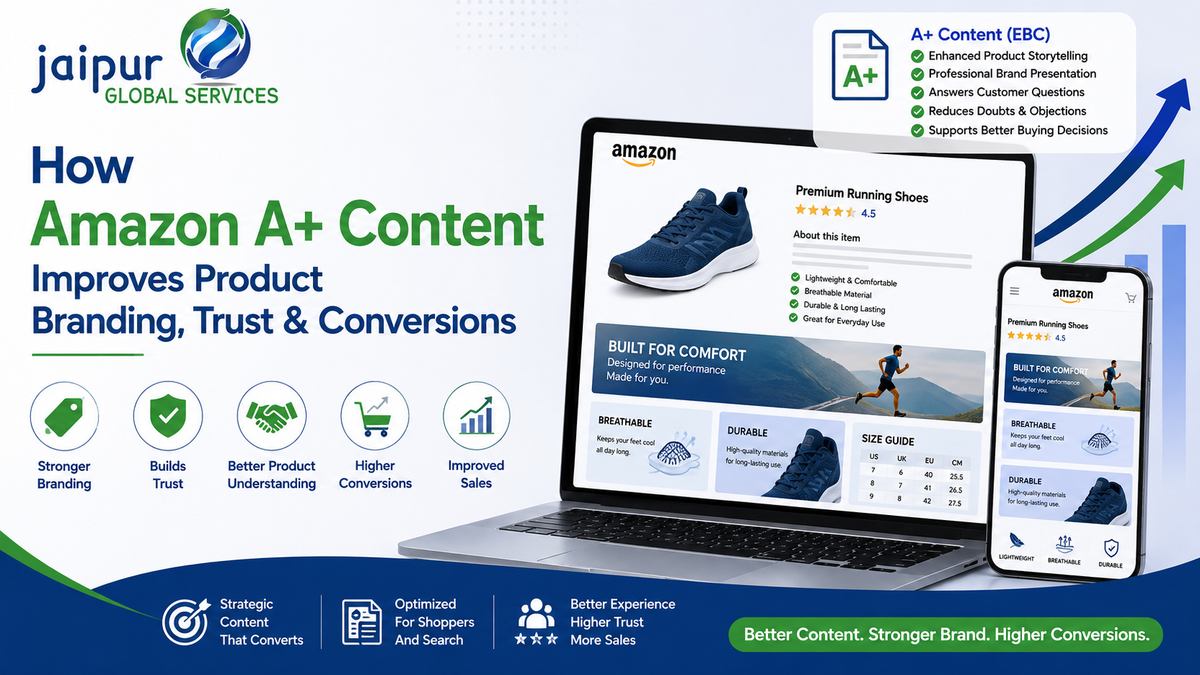
You've done everything that's supposed to work. The product is good. The price is competitive. Reviews are decent. PPC is sending traffic to the listing. And yet, conversions aren't where they should be.
This is a common situation for Amazon sellers, and the reason is often simpler than it looks: the product page itself isn't doing enough to convince the shopper. On Amazon, a customer can't pick up the product, turn it over, or ask a salesperson a quick question. All they have is what's on the screen — images, text, and whatever else the listing shows them.
This is where Amazon A+ Content comes in. It gives eligible brands a way to add richer, more visual content to the product detail page — beyond the standard title, bullet points, and basic images. It won't fix a weak product or bad pricing, but it can help a good product communicate its value more clearly.
This article walks through what A+ Content actually is, how it affects branding and trust, what makes it effective, and when it's worth investing in — before naturally looking at how this fits into broader Amazon listing and ecommerce management.
What Is Amazon A+ Content?
Amazon A+ Content is a feature available to brand-registered sellers that allows them to replace the plain-text portion of a product description with a more visual, modular layout. Instead of a block of text, brands can add images, comparison charts, additional product information, and structured content blocks that sit below the standard bullet points.
This feature was previously known as Enhanced Brand Content, or Amazon EBC. Amazon has since consolidated this functionality under the A+ Content name, so while you may still see "EBC" mentioned in older articles or by sellers who've used Amazon for a long time, A+ Content is the current terminology.
There are a few related terms worth understanding:
- A+ Content — the general feature that lets brand owners add enhanced content to their product pages
- Basic A+ Content — the standard version available to eligible sellers, offering a set of pre-built modules
- Premium A+ Content — an expanded version with additional layout options, including features like comparison charts and, in some cases, video, available to brands meeting certain eligibility requirements
- Brand Story — a section within A+ Content that allows a brand to introduce itself and showcase other products, appearing across a brand's ASINs
Eligibility, available modules, and feature access can change over time, so it's worth checking current requirements directly through Seller Central rather than relying on older information.
Why A+ Content Matters for Amazon Brands
Amazon is a crowded marketplace. On most searches, a shopper sees dozens of similar products within seconds, and most of them look fairly interchangeable at first glance — similar images, similar bullet points, similar price ranges.
A few things make this environment particularly challenging for sellers:
- Shoppers can't physically inspect the product before buying
- Attention spans on a search results page are short
- Many categories have significant competition from similar-looking listings
- Customers often have real uncertainty about fit, quality, or compatibility
- Products need to explain their own value without a salesperson present
A+ Content gives brands more visual space and structure to address this. It's not a guarantee of more sales — it's an opportunity to use that space more effectively than a plain paragraph of text would allow. What a brand does with that space still matters more than the fact that the space exists.
How A+ Content Strengthens Product Branding
One of the most practical benefits of A+ Content is what it does for brand presentation across a product catalogue.
1. Consistent visual identity. A+ modules let a brand use the same colors, fonts, and design language across every listing, rather than each product page looking like it was created by a different person.
2. Brand colors and design. Instead of relying entirely on Amazon's default layout, brands can bring their own visual identity into the page.
3. Brand story. The Brand Story module gives shoppers context about who the brand is, which can matter for buyers who care about the company behind the product.
4. Product positioning. A+ Content gives room to clearly position a product — premium, budget-friendly, specialized, entry-level — rather than leaving that to guesswork.
5. Lifestyle imagery. Beyond product-on-white shots, A+ modules allow lifestyle and in-context images that help shoppers picture the product in use.
6. Product benefits. There's more room to explain why a feature matters, not just list that it exists.
7. Consistent messaging across products. For brands with multiple ASINs, this creates a more cohesive experience as shoppers move between listings.
8. Differentiation from generic-looking listings. A well-designed page simply looks different from a bare-bones listing with a text-only description.
None of this replaces having a genuinely good product. But for two similar products at a similar price, presentation can meaningfully affect how credible and established a brand appears — and that perception matters when someone's deciding where to spend money.
How A+ Content Builds Customer Trust
Trust is a bigger factor in ecommerce than in physical retail, simply because the shopper is buying based on information rather than direct inspection.
Well-built A+ Content can help address the specific questions shoppers tend to have before buying:
- How does the product actually work?
- Who is this product designed for?
- What are the real features and benefits?
- What materials or ingredients are used?
- How should it be used or maintained?
- What size or specifications should I choose?
- Is this compatible with what I already own?
- What's different between the variants available?
- What actually sets this apart from similar products?
Comparison charts are particularly useful here — they let a shopper see, at a glance, how different variants or models differ, without having to read through multiple bullet lists to figure it out themselves.
It's worth being clear, though: A+ Content on its own doesn't create trust. It's one part of a bigger picture that includes genuine product reviews, ratings, pricing that matches perceived value, image quality, seller performance history, and reliable fulfillment. A beautifully designed product page attached to a product with poor reviews or inconsistent fulfillment won't overcome those issues. A+ Content works best when it supports a product that's already reasonably solid elsewhere.
How A+ Content Can Support Higher Conversions
It helps to think about this in terms of a simple journey a shopper takes:
Traffic → Product Page → Understanding → Trust → Reduced Doubt → Purchase Decision
A+ Content sits mainly at the "understanding" and "reduced doubt" stages. It's generally not something that drives traffic to a listing by itself — that's more the role of SEO, PPC, and external marketing. What it can do is help shoppers who've already landed on the page make a more informed, more confident decision.
Specifically, well-built A+ Content can support conversions through:
- Clearer communication of what the product actually is and does
- Better explanation of benefits rather than just features
- Reduced confusion, especially for products with technical specs or multiple variants
- Stronger differentiation from competitor listings
- More compelling storytelling around the brand and product
- Directly addressing common objections or hesitations
- Supporting the shopper's confidence at the exact moment they're deciding to buy
Amazon has publicly stated that Basic A+ Content can increase sales by up to 8%, while well-implemented Premium A+ Content can increase sales by up to 20%. These figures come directly from Amazon, and it's worth being clear about what they mean: they represent potential outcomes reported by Amazon, not guaranteed results. Actual impact depends heavily on the product, category, existing listing quality, pricing, competition, and execution. Treat these numbers as a general indicator of A+ Content's potential — not a promise for any specific listing.
A+ Content vs Regular Product Description
It's worth understanding exactly what changes when a brand adds A+ Content, versus relying on a standard product description.
Regular product description:
- Mostly plain text
- Limited visual storytelling
- Basic explanation of what the product is
- No structured modules or comparison features
A+ Content:
- Richer, more visual presentation
- Structured modules (images with text, comparison charts, etc.)
- Room for brand storytelling
- More space for product education
- Ability to include comparison elements across variants or related products
- More opportunities to explain benefits in context
One important clarification: A+ Content is not a replacement for a strong title, well-written bullet points, high-quality primary images, or solid keyword targeting. Those elements still do the initial work of getting a shopper to click and understand the basics. A+ Content adds to that foundation — it doesn't substitute for it.
What Makes High-Quality A+ Content?
Not all A+ Content performs the same way, even within the same product category. Some practical characteristics separate content that actually helps from content that just fills space:
- Clear hierarchy — the most important information should stand out first, not get buried in module five
- Strong visuals — actual product photography and graphics, not stretched stock images
- Benefit-focused messaging — explaining what a feature means for the customer, not just naming it
- Easy-to-read text — short, scannable sentences rather than dense paragraphs
- Consistent branding — matching colors, fonts, and tone across every module and every listing
- Product-specific storytelling — content that's actually about this product, not generic copy
- Strong comparison sections — genuinely useful when a brand sells multiple similar variants
- Mobile-friendly design — a large share of Amazon traffic is mobile, and content needs to hold up on a small screen
- Clear explanations — answering real questions a buyer would have, not just describing aesthetics
- Customer-focused content — written from the buyer's perspective, addressing their needs rather than just listing specs
A common mistake in A+ Content Design is treating it purely as a visual upgrade. The strongest content combines good design with information the shopper actually needs to make a decision.
Common A+ Content Mistakes Brands Should Avoid
Some recurring mistakes show up across a lot of A+ Content, regardless of category:
- Visually attractive but unclear. Good design that doesn't actually communicate anything useful is wasted effort.
- Too much text. Shoppers skim; walls of text get skipped.
- Repeating bullet points word-for-word. This wastes valuable space that could be used to add new information.
- Focusing on features instead of benefits. "10,000mAh battery" means less than "charges your phone twice before needing a recharge."
- Low-quality images. Blurry, poorly lit, or stretched images undercut an otherwise well-designed page.
- Ignoring mobile shoppers. Content that looks great on desktop but breaks or becomes unreadable on mobile loses a large share of viewers.
- Inconsistent branding. Different fonts, colors, or tones across listings weaken the sense of a cohesive brand.
- Unsupported claims. Claims that can't be backed up create risk and can also violate Amazon's content policies.
- Overloading modules. Trying to cram too much into the available space usually results in cluttered, hard-to-follow content.
- Failing to answer objections. If a customer's actual hesitation is never addressed, the content misses its purpose.
- Generic content. Content vague enough to apply to almost any product doesn't help a specific buyer make a decision.
- Forgetting comparison opportunities. For brands with multiple variants, not including a comparison chart is a missed chance to reduce confusion.
Basic A+ vs Premium A+: What Is the Difference?
Basic A+ Content gives brand-registered sellers access to a set of standard modules — combinations of images and text that can be used to build out the product description area.
Premium A+ Content offers additional layout options and modules, which can include features like comparison charts and, depending on current eligibility and availability, interactive or video elements. It generally allows for richer, more elaborate page layouts.
Eligibility for Premium A+ Content has historically depended on factors like sales performance, account history, or specific program invitations, and these requirements can change over time — so it's worth confirming current eligibility through Seller Central rather than assuming based on older information.
It's also worth being clear: Premium A+ isn't automatically the better choice for every product. The right format depends on:
- Whether the brand qualifies
- What the product actually needs explained
- Available assets like photography and video
- The brand's overall content strategy and resources
A simple, well-organized product with clear Basic A+ Content can outperform a cluttered Premium A+ page. The format matters less than how well it's used.
How A+ Content Works With Amazon PPC
It helps to think of these as three connected but distinct roles:
- Amazon PPC helps attract relevant shoppers to the product page
- The product listing (title, images, bullets, price) helps communicate the core offer
- A+ Content helps deepen product understanding and brand experience once the shopper is already on the page
A well-run PPC campaign can drive plenty of clicks, but if the product page itself doesn't clearly answer the shopper's questions, a lot of that traffic won't convert. This is a common — and expensive — gap: strong ad spend paired with a listing that underperforms once the click actually happens.
A+ Content should be considered part of the broader listing and conversion strategy, not a separate, isolated design task handled independently of everything else happening on the account — including Amazon PPC management, Amazon Product Listing Optimization, and overall Amazon Product Listing Services. It's worth being direct here too: A+ Content does not directly improve ad rankings or Quality Score-style metrics. Its role is in what happens after the click, not in how the ad itself performs.
When Should a Brand Consider A+ Content?
A+ Content tends to be genuinely useful in situations like:
- The product gets decent traffic but conversion rates are weaker than expected
- The product needs more explanation than bullet points alone can provide
- The product has several features that are hard to summarize briefly
- The brand wants a stronger, more consistent visual identity
- Competitors clearly have more polished, informative product pages
- The product comes in multiple variants that are easy to confuse
- Customers frequently ask similar pre-purchase questions
- The business is investing meaningfully in PPC and wants the listing to match
- The brand is expanding its catalogue and wants consistency across new ASINs
- Existing listing content looks outdated compared to current category standards
The decision should come from an honest look at the specific product's needs — not simply because competitors are using A+ Content. Some straightforward, well-understood products may not need extensive A+ modules to convert well.
Should You Create A+ Content Yourself or Hire a Professional?
Both approaches can work, depending on the situation.
DIY may work well when:
- The brand already has an experienced in-house designer
- The team understands Amazon's specific content policies and requirements
- Product information is already well organized and easy to work with
- The catalogue is small enough to manage without significant time investment
Professional support tends to be more useful when:
- Multiple ASINs need content, and consistency across all of them matters
- The brand wants a cohesive visual identity but lacks in-house design resources
- The internal team doesn't have specific Amazon listing expertise
- Design and copywriting need to work closely together to be effective
- The business wants A+ Content connected to a broader listing optimization strategy, rather than handled as a one-off task
This is where Amazon A+ Content Services, A+ Content Management, and A+ Content Writing become relevant as service categories — they exist because doing this well, consistently, across a growing catalogue takes more coordinated effort than most internal teams have time for. That said, hiring an agency isn't mandatory. Some brands manage this effectively in-house, particularly if they're small or already have the right skills on the team.
How JGS Can Support Amazon Sellers
Amazon A+ Content works best when it's not treated as a standalone design task, but as part of a wider approach to how a product listing is built, optimized, and managed over time.
JGS works with Amazon sellers on ecommerce and marketplace management, including services connected to Amazon product listings, catalogue management, account management, and PPC. The practical point here is straightforward: A+ Content, product listing optimization, and advertising all influence the same outcome — how well a product page converts — so managing them separately, with different teams that don't talk to each other, often creates gaps between what the ads promise and what the page actually delivers.
For sellers who are already investing in PPC or actively growing their Amazon catalogue, having listing content, catalogue management, and advertising considered together — rather than as disconnected tasks — is generally a more coherent approach than treating each one in isolation.
A Practical A+ Content Checklist for Amazon Brands
Before publishing or updating A+ Content, it's worth reviewing it against a simple checklist:
- Is the brand identity consistent with the rest of the catalogue?
- Are the key product benefits easy to understand at a glance?
- Does the content answer the questions customers are most likely to have?
- Are all visuals high quality and properly sized?
- Is the content genuinely readable and functional on mobile?
- Are features explained in terms of benefits, not just specs?
- Is the content meaningfully different from the existing bullet points?
- Are comparison elements included where they'd genuinely help?
- Are all claims accurate and defensible?
- Does the content support the product's overall positioning?
- Does it complement what's happening in PPC campaigns for this product?
- Is the content consistent in tone and design across the whole catalogue?
If a listing's A+ Content passes most of these checks, it's likely doing its job. If not, that's a useful starting point for revisions.
FAQs
1. What is Amazon A+ Content?Amazon A+ Content is a feature available to brand-registered sellers that lets them add richer, more visual content — like images, comparison charts, and structured text modules — to their product detail pages, beyond the standard description.
2. Does Amazon A+ Content increase sales?It can support sales by improving how clearly a product is presented, but it doesn't guarantee sales. Amazon has stated that Basic A+ Content can increase sales by up to 8%, and well-implemented Premium A+ Content by up to 20% — but these are potential outcomes, not guaranteed results, and depend on many other factors.
3. What is the difference between A+ Content and Enhanced Brand Content?Enhanced Brand Content (EBC) was the earlier name for this feature. Amazon has since consolidated it under the A+ Content name, so A+ Content is the current terminology sellers should use.
4. What is the difference between Basic A+ and Premium A+ Content?Basic A+ Content offers a standard set of modules for eligible brand-registered sellers. Premium A+ Content offers additional layout options and modules, potentially including comparison charts and richer formats, and generally has stricter eligibility requirements.
5. Does A+ Content improve Amazon SEO?A+ Content is not generally considered a direct ranking factor for Amazon's search algorithm. Its main value is improving how the page communicates with shoppers once they arrive, not in driving additional organic visibility.
6. Can A+ Content improve Amazon conversion rates?It can, by helping shoppers understand the product better and reducing hesitation before purchase. However, conversion also depends on price, reviews, images, competition, and overall listing quality — A+ Content is one contributing factor, not a standalone fix.
7. Who can use Amazon A+ Content?A+ Content is available to sellers and vendors enrolled in Amazon Brand Registry. Specific eligibility for Premium A+ features can vary and is worth confirming directly through Seller Central.
8. Should I hire an Amazon A+ Content service?It depends on your situation. If you have in-house design and Amazon expertise and a small catalogue, DIY can work well. If you're managing multiple ASINs, want consistent branding, or want A+ Content connected to your broader listing and advertising strategy, professional support can be more efficient.
Conclusion
A+ Content isn't just about making a product listing look more polished. Done well, it gives a brand a genuine opportunity to explain its product more clearly, build a more consistent brand identity, reduce the uncertainty a shopper feels before buying, and support the broader work already happening through listing optimization and advertising.
It won't fix a product that doesn't meet customer expectations, and it won't replace the fundamentals of good pricing, strong reviews, and accurate listings. But paired with those fundamentals, it can meaningfully improve how a product is understood and perceived.
If you're an Amazon seller looking at your current listings and wondering whether they're doing enough to convert the traffic you're already getting, it may be worth reviewing your A+ Content alongside your broader listing and advertising strategy. You're welcome to explore Jaipur Global Services (JGS) Amazon and ecommerce services to see whether that kind of connected approach fits what your business currently needs.