
Quick Commerce vs Ecommerce: Which Model Is Right for Your Business?
 June 22, 2026
 Yashwardhan Singh
 0 Comments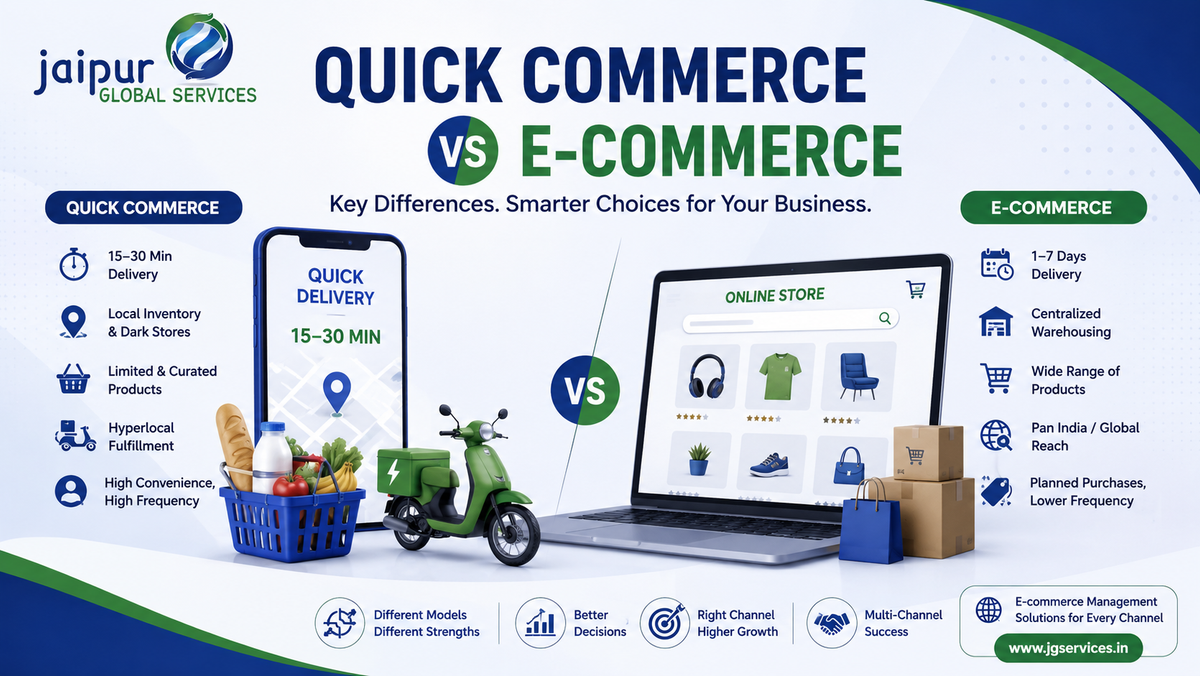
A customer who wants groceries, snacks, or personal-care products in 15 to 30 minutes behaves very differently from someone ordering electronics, furniture, or clothing and accepting delivery over the next few days. Same broad category — online shopping — but two genuinely different sets of expectations, and two genuinely different business models sitting behind them.
For sellers and brands, understanding quick commerce vs ecommerce isn't just an academic distinction. It changes what products make sense to sell where, how much margin you actually keep after fulfilment costs, what kind of inventory planning you need, and whether a single channel strategy is even realistic. This guide walks through both models properly — what each one is, how they differ operationally and financially, where marketplace selling fits into the picture, which products suit which channel, and how businesses in India are actually using both together rather than picking one and ignoring the other.
What Is Quick Commerce?
Quick commerce (sometimes called q-commerce) is a delivery model built around getting orders to customers extremely fast — commonly somewhere in the 10 to 30 minute range, though exact delivery windows vary by platform, city, and how far a customer is from the nearest fulfilment point. It's best understood as a specialized segment within the broader ecommerce world, built specifically for speed, rather than a completely separate industry.
The infrastructure behind it looks different from a typical online store. Quick commerce runs on dark stores — small, local fulfilment points positioned inside dense residential or urban areas, stocked with a limited, carefully chosen range of fast-moving products. These aren't warehouses in the traditional sense; they're built purely for picking speed within a tight delivery radius, not for browsing or storing a huge catalogue.
A few things that consistently characterise quick commerce:
- Local fulfilment, with each dark store typically serving only a small radius around it
- Curated, limited assortment — a dark store might stock several thousand SKUs, but that's a fraction of what a traditional ecommerce warehouse holds
- High inventory turnover, since shelf space is precious and only goes to products that reliably sell
- Customer behaviour skewed toward urgency and convenience — groceries, snacks, personal care, and household essentials dominate order patterns
Delivery time isn't a fixed universal promise across every platform or location — it depends on dark-store density in a given city, current demand, and the specific platform's operational model. But the underlying principle stays consistent: quick commerce is built around proximity and speed, not selection.
What Is Traditional Ecommerce?
Traditional ecommerce is the much broader category most people think of first — buying products online, with delivery typically taking anywhere from same-day in a few dense metro areas to a week or more depending on location, product, and shipping method.
Traditional ecommerce is built around a different set of priorities:
- Wide product assortment, often spanning thousands of categories and far more SKUs than any dark store could hold
- Centralised or regional warehousing, rather than hyperlocal fulfilment points
- National or international reach, not limited to a small radius around a fulfilment centre
- Product discovery and comparison, with customers often researching, reading reviews, and comparing options before buying
- Multiple business structures, including marketplaces (Amazon, Flipkart) where many sellers list products, and direct-to-consumer (D2C) websites run by a single brand
It's worth being clear about the relationship between these two models: ecommerce is the broad umbrella, and quick commerce is one increasingly significant model operating within it. They're not separate industries competing head-to-head across every category — they're two approaches to online selling, optimised for different customer needs.
Quick Commerce vs Ecommerce: What Is the Difference?
Here's where the practical differences actually matter for a business deciding where to sell.
Factor
Quick Commerce
Traditional Ecommerce
Delivery speed
Typically 10–30 minutes, varies by platform and location
Typically same-day to about a week, depending on shipping method
Product range
Limited, curated assortment per dark store
Extensive — thousands of categories and SKUs
Inventory model
Local dark stores, high turnover, limited shelf space
Centralised or regional warehouses, broader storage capacity
Fulfilment
Hyperlocal, platform-managed dark stores
Regional/national fulfilment centres, seller-managed or platform-managed
Geographic reach
Limited to dense urban areas near dark stores
National, often international
Customer expectation
Immediate availability, minimal wait
Willing to wait in exchange for selection and often better pricing
Order size
Typically smaller baskets, frequent orders
Often larger baskets, less frequent orders
Purchase frequency
High — repeat, routine purchases
Lower — more considered, planned purchases
Product categories
Groceries, snacks, personal care, household essentials
Broad — electronics, apparel, furniture, and more
Warehousing
Small-format dark stores, close to demand
Larger centralised or regional facilities
Shipping
Local delivery partners, short distances
Logistics networks, longer distances
Business operations
High operational intensity, tight margins, demand-sensitive
More standardised logistics, generally more predictable margins
Seller considerations
Limited shelf space, high performance standards for placement
Broader access, more listing flexibility
Suitable products
Fast-moving, high-frequency, easily stored items
Wide range, including considered and specialty purchases
Neither model is universally better. They're built for different customer moments — one for "I need this right now," the other for "I want to find exactly the right option and I can wait for it."
Quick Commerce vs Marketplace Selling
This distinction trips a lot of people up, so it's worth being precise: quick commerce and marketplace selling aren't direct opposites, and they're not even really comparable in the same way quick commerce and traditional ecommerce are. A marketplace is a business model where multiple sellers offer products through a shared platform — Amazon and Flipkart are the obvious examples. Quick commerce is a fulfilment model focused on delivery speed. These describe different aspects of how an ecommerce business operates, and they can overlap.
Here's how the overlap actually works in practice, using India's dominant quick commerce players as the example: platforms like Blinkit, Zepto, and Swiggy Instamart don't typically operate as open marketplaces the way Amazon or Flipkart do. Most run on a model where the platform itself buys and controls inventory (or works through tightly managed supplier relationships), rather than letting any registered seller list products directly. That's a meaningfully different seller relationship than uploading a listing to an open marketplace.
Key differences in how sellers actually engage with each model:
- Seller ownership — on a marketplace, sellers generally retain ownership and control of their own listings and pricing; on most quick commerce platforms, the platform exercises much tighter control over what gets stocked and how it's priced
- Inventory — marketplace sellers typically manage their own inventory (or use a fulfilment programme); quick commerce inventory sits inside the platform's own dark-store network, often bought and controlled by the platform
- Onboarding — marketplace seller registration is often more open and self-serve; quick commerce onboarding tends to be more selective, with the platform actively curating which brands and products get shelf space
- Product range — a marketplace can host a near-unlimited catalogue across sellers; a quick commerce dark store has hard physical limits on what it can stock
Not every quick commerce company runs the exact same model — the specifics vary by platform and are worth checking directly before assuming how a given company operates. But broadly, marketplace selling is about who's selling and how many of them, while quick commerce is about how fast the order gets fulfilled. A business could, in theory, be a marketplace seller and also supply into a quick commerce platform's inventory — they're not mutually exclusive categories.
Quick Commerce vs Traditional Ecommerce
Bringing this back to a direct comparison, a few factors matter more than others when deciding where a product actually fits:
Delivery speed shapes everything else. Quick commerce customers expect near-immediate fulfilment; traditional ecommerce customers generally accept a delivery window in exchange for more choice or better pricing.
Product assortment differs by design, not accident. Quick commerce deliberately limits what it stocks to keep dark stores fast and efficient; traditional ecommerce competes partly on having more options.
Inventory planning looks completely different. Quick commerce requires hyperlocal demand forecasting — a product that moves fast in one neighbourhood might sit unsold in another. Traditional ecommerce inventory planning works at a more regional or national level.
Order value and purchase frequency tend to run in opposite directions. Quick commerce sees smaller, more frequent orders (topping up groceries, replacing something you just ran out of). Traditional ecommerce sees larger, less frequent orders, often for considered purchases.
Customer expectations reflect the underlying need. A quick commerce customer values convenience and immediacy over having every possible option. A traditional ecommerce customer often values selection, price comparison, and product research more than speed.
Neither customer is "better" to serve — they're often the same person, just in a different buying mode depending on what they need and when.
How the Quick Commerce Business Model Works
Stripped down to the mechanics, a quick commerce order typically flows like this:
Customer places order on the app → Order routes to the nearest dark store with available stock → Product is picked from the shelf → Order is packed → A delivery partner collects it → Customer receives the order, typically within minutes
Where the revenue and costs come from is more complex than the simple flow above suggests. On the revenue side, platforms typically earn from product margins on what they sell, delivery or convenience fees charged to customers, and — where relevant — advertising or placement fees from brands wanting visibility on the app. On the cost side, the model carries real operational weight: inventory costs, dark-store rent and staffing, last-mile delivery costs (which are a genuinely significant expense given how many small, fast deliveries the model requires), and heavy spending on discounts and promotions to acquire and retain customers in a highly competitive market.
This is worth being clear about without inventing specific numbers: quick commerce is widely understood to be a capital-intensive, margin-thin model, precisely because the last-mile delivery infrastructure required for 10–30 minute fulfilment doesn't exist in traditional ecommerce. That's the core economic trade-off — speed costs money, and quick commerce platforms are still working out how to make that cost structure sustainably profitable, with some players closer to that goal than others.
Quick Commerce Model vs Marketplace Model
Area
Quick Commerce Model
Marketplace Model
Business focus
Speed of fulfilment, hyperlocal delivery
Breadth of selection, multiple sellers on one platform
Inventory
Platform-controlled, held in local dark stores
Typically seller-managed, sometimes platform-fulfilled
Seller relationship
Curated, selective supplier onboarding
Often more open, self-serve seller registration
Fulfilment
Platform-managed, hyperlocal dark stores
Seller-managed, platform-fulfilled, or a mix
Delivery
Minutes, via dedicated local delivery network
Days, via regional or national logistics
Product range
Limited per location, curated for velocity
Broad, spans many categories and sellers
Customer expectation
Immediate availability
Willing to wait for the right product or price
Operations
High intensity, demand-sensitive, real-time
More standardised, predictable logistics cycles
Seller control
Lower — platform often dictates pricing and placement
Higher — sellers typically control their own listings and pricing
Actual models vary meaningfully by company — this table describes general patterns, not a universal rule that applies identically to every platform.
How Brands and Sellers Can Use Quick Commerce
For a brand considering quick commerce as a channel, a few practical considerations matter more than enthusiasm about the growth numbers:
- Product suitability — does your product genuinely fit an impulse or routine-replenishment purchase pattern, or is it something customers research and compare before buying?
- Fast-moving potential — quick commerce dark stores have limited shelf space, so products need a credible case for consistent sell-through, not just occasional interest
- Local demand — does your target customer base cluster in the dense urban areas where quick commerce platforms actually operate?
- Packaging — products need to hold up to fast, high-volume handling in a compact fulfilment environment
- Margins — the cost structure (platform fees, fulfilment costs, promotional expectations) needs to leave enough room for genuine profitability, not just top-line sales
- Inventory availability — can you reliably keep dark stores stocked without stockouts, which cost visibility fast in this model?
- Distribution readiness — do you have the supply chain to support hyperlocal, high-frequency replenishment?
Not every product is suitable for quick commerce, and that's fine — it's a channel built for a specific kind of purchase, not a universal sales channel every brand needs to be on.
Which Products Are Suitable for Quick Commerce?
Categories that tend to naturally fit the quick commerce model:
- Groceries and everyday food items
- Snacks and beverages
- Personal care products
- Household essentials
- Beauty products, particularly smaller, frequently repurchased items
- Other convenience-oriented, everyday-use products
Categories that generally work better through traditional ecommerce, depending on the specific business:
- Large electronics
- Furniture and bulky home goods
- Specialised or niche products
- Long-tail products with unpredictable, infrequent demand
- Products with genuinely low purchase frequency, where customers are comparing options rather than repurchasing routinely
These aren't absolute rules — plenty of categories sit somewhere in between, and platform assortment decisions shift over time as quick commerce companies expand into new categories like pharmacy, beauty, and even electronics in some markets. The underlying question worth asking about your own product is simpler: is this something a customer decides to buy on the spot because they need it now, or something they research and plan for?
Quick Commerce vs Ecommerce: Cost Differences
Quick commerce typically involves cost categories that don't exist, or exist very differently, in traditional ecommerce:
- Local inventory and dark-store costs — rent, staffing, and operations for a hyperlocal network, rather than one or a few centralised warehouses
- Delivery costs, which run considerably higher per order given the speed and distance involved compared to standard shipping
- Packaging suited to fast handling and short-distance delivery
- Operational intensity — real-time demand management across many small locations is more labour- and system-intensive than centralised fulfilment
- Promotions, since customer acquisition and retention in quick commerce tends to rely heavily on discounts and incentives given the competitive market
- Platform-related costs for sellers or brands supplying into the platform, which vary by arrangement
Traditional ecommerce typically involves:
- Warehousing at a larger, more centralised scale
- Shipping, generally cheaper per unit at longer distances than quick commerce's short, fast deliveries, but slower
- Packaging built for transit durability over longer distances
- Marketplace fees, where applicable — referral fees, commission, and related charges
- Fulfilment costs, whether self-managed or through a platform's fulfilment programme
- Returns, which are a more established, structured process in traditional ecommerce
- Advertising, often a significant and mature cost category on marketplaces
Actual costs depend heavily on category, platform, and operating model — there's no single "quick commerce costs X% more" figure that holds up across every business, so this is worth calculating for your specific product and channel rather than assuming a general rule applies.
Which Is More Profitable: Quick Commerce or Ecommerce?
There's no universal answer here — profitability in either model depends on the same underlying variables, just weighted differently.
A simple framework for thinking about it:
Revenue per order − Product cost − Fulfilment/delivery cost − Platform fees or commission − Promotions/discounts − Returns − Customer acquisition cost − Product wastage (particularly relevant for perishables in quick commerce) = Estimated profit per order
What tends to differ between the two models is where the pressure sits. Quick commerce generally has higher delivery costs per order but potentially higher order frequency from repeat customers. Traditional ecommerce generally has lower per-order delivery costs but faces heavier competition, advertising spend, and customer acquisition costs to win a sale in the first place.
Neither model is automatically more profitable. A high-margin, frequently repurchased product might do well on quick commerce despite the delivery cost pressure. A considered, higher-order-value product might do better on traditional ecommerce, where the customer is willing to wait and the delivery cost is spread over a larger basket. The right answer depends on your specific product economics, not the model in the abstract.
How Customer Behaviour Differs in Quick Commerce and Ecommerce
The same person often behaves quite differently depending on which mode they're shopping in:
- Purchase urgency — quick commerce customers are often solving an immediate need (running out of milk, forgetting an ingredient); traditional ecommerce customers are usually planning ahead
- Basket size — quick commerce baskets tend to be smaller and more frequent; traditional ecommerce baskets tend to be larger and less frequent
- Product discovery — quick commerce customers often know exactly what they want; traditional ecommerce customers are more likely to browse, compare, and research
- Repeat purchases — quick commerce thrives on habitual, routine reordering; traditional ecommerce repeat purchases depend more on brand loyalty and satisfaction with a considered decision
- Price sensitivity — varies by category in both models, though convenience-driven quick commerce purchases can carry a willingness to pay a premium for speed that a planned ecommerce purchase might not
- Delivery expectations — quick commerce customers expect near-immediate delivery as the baseline; traditional ecommerce customers generally accept a defined delivery window as normal
A practical example: the same customer might order snacks on a quick commerce app on a random Tuesday evening, but research and compare a laptop for two weeks on a traditional ecommerce marketplace before buying. Same person, two entirely different buying modes.
Challenges of the Quick Commerce Business Model
- Inventory accuracy across many small, dispersed locations is genuinely harder to manage than a few large warehouses
- Delivery costs remain a persistent margin pressure given the speed and distance economics involved
- Local demand forecasting needs to work at a neighbourhood level, not just a city or regional level
- Product availability directly affects customer trust — running out of a staple item repeatedly damages the app experience quickly
- Operational complexity is high, with real-time coordination needed across picking, packing, and delivery
- Margins stay thin given the cost structure, making sustainable profitability an ongoing challenge across the sector
- Competition is intense, with a small number of well-funded players competing hard for the same dense urban markets
- Discounting to acquire and retain customers adds further pressure on already tight margins
- Product wastage, particularly relevant for perishable categories like fresh produce, adds another cost layer that traditional ecommerce mostly avoids
Challenges of Traditional Ecommerce
- High competition across nearly every product category, particularly on major marketplaces
- Customer acquisition costs, which have risen considerably as advertising on marketplaces and search platforms has matured and gotten more expensive
- Shipping, balancing cost against delivery speed expectations that keep rising
- Returns, which are a genuine operational and financial cost, especially in categories like apparel
- Advertising costs, often a significant and growing line item for visibility on competitive marketplaces
- Inventory management across potentially multiple warehouses or fulfilment centres
- Price competition, particularly on marketplaces where multiple sellers can list similar or identical products
- Marketplace dependence, where a business's visibility and sales are shaped heavily by a platform's algorithm and policies it doesn't control
- Product listing quality, which directly affects discoverability and conversion, and requires ongoing maintenance
- Customer expectations around delivery speed that have shifted upward, partly because of quick commerce raising the baseline for what "fast" means
Both models carry real, structural challenges — neither is the easier path, just a different set of problems to manage.
Can Brands Use Quick Commerce and Traditional Ecommerce Together?
Yes, and increasingly this is the norm rather than the exception. Businesses today typically draw on several channels as part of a broader strategy: marketplaces, D2C websites, quick commerce, social commerce, and sometimes offline retail — each serving a different customer need rather than competing for the exact same purchase.
A practical example: a personal care brand might use quick commerce for the urgent, routine repurchase — a customer who's run out of their usual shampoo and wants it within the hour. The same brand might use its D2C website or a traditional marketplace listing for a customer researching a new product line, comparing options, and wanting the full range of variants and sizes that a dark store's limited shelf space simply can't hold. Both channels serve the same brand, just different moments in the customer's decision-making.
This kind of multi-channel approach isn't about picking a winner between quick commerce and traditional ecommerce — it's about recognising that customers move between both modes depending on what they need, and meeting them in the right one at the right time.
Quick Commerce in India
India has become one of the clearest examples globally of how fast quick commerce can scale, and it's worth understanding the local context specifically, since India's dense urban markets and delivery economics differ from what's driven quick commerce adoption (or struggled to) in other countries.
A few things distinctive to the Indian market:
- High smartphone and digital payment penetration in urban areas has made ordering and paying for quick commerce frictionless for a large and growing customer base
- Dense urban markets in Indian metros make the dark-store model economically viable in a way it hasn't always been in lower-density Western markets — a single dark store can realistically serve a large number of customers within a short delivery radius
- Strong consumer demand for convenience, particularly around groceries and everyday essentials, has driven rapid adoption
- Category expansion — platforms have moved well beyond groceries into pharmacy, personal care, beauty, and in some cases electronics and even alcohol in select cities
- Intense competition, with Blinkit, Zepto, and Swiggy Instamart as the dominant players, alongside larger retail groups like JioMart and BigBasket scaling their own quick commerce capabilities
According to Mordor Intelligence, India's quick commerce market was valued at around $3.65 billion in 2026 and is projected to reach roughly $6.64 billion by 2031. A separate 2026 Research and Markets report estimated the sector had grown at a compound annual rate of over 70% between 2020 and 2024, with continued strong growth projected through the rest of the decade — reflecting how quickly the category moved from a pandemic-era convenience to a mainstream part of Indian ecommerce.
For brands, this creates a genuine opportunity, particularly in FMCG, personal care, and everyday essential categories, but it also means real operational challenges — intense competition for limited dark-store shelf space, thin margins across the sector, and the need for genuinely reliable local supply chains to keep up with a demand-sensitive, fast-moving model.
Should Your Business Choose Quick Commerce or Traditional Ecommerce?
A practical way to think about it:
Consider quick commerce if:
- Your products are frequently purchased and easily replenished
- Your customers value speed and convenience for this category
- Products are compact, easy to store, and don't require much explanation to sell
- You have strong demand concentrated in dense urban areas
- Your margins can genuinely absorb quick commerce's fulfilment and promotional costs
Consider traditional ecommerce if:
- Your product range benefits from being seen and compared alongside alternatives
- Customers typically research or compare before buying
- Products carry higher average order values that justify a longer delivery window
- Your customer base is spread more broadly, including beyond dense metro areas
- National or international reach matters to your growth plans
Consider using both if:
- Your brand has multiple product lines that fit different buying moments
- You want to capture both the "I need this now" and "I want to explore the full range" customer
- You have the operational capacity to manage more than one channel without spreading yourself too thin
Plenty of businesses land in that last category — using quick commerce for their highest-velocity, most habitual products, while relying on marketplaces and D2C for the rest of their range.
Why Marketplace Management Matters Across Ecommerce Channels
Whichever combination of channels a business ends up running, managing more than one at once brings real operational demands: keeping product catalogues consistent across channels, coordinating inventory so you're not overselling or understocking anywhere, managing pricing that makes sense per channel's cost structure, running promotions strategically rather than reactively, tracking performance across very different platforms, handling orders and customer service consistently, and pulling together reporting that actually tells you what's working.
This gets harder, not easier, as the number of channels grows — a business running a marketplace listing, a D2C site, and a quick commerce supply relationship is juggling three genuinely different operational models at once, each with its own rules and rhythms.
Need Help Managing Multiple Ecommerce Channels?
Running quick commerce, marketplace selling, and D2C well at the same time takes more than good products — it takes consistent catalogue management, coordinated inventory, and pricing that actually reflects each channel's real cost structure.
This is where a partner like Jaipur Global Services (JG Services) can help. JG Services provides ecommerce marketplace management covering catalogue upkeep, listing quality, and day-to-day operations for businesses managing accounts across platforms. For sellers who want dedicated support with account health and ongoing operations across channels, JG Services also offers ecommerce account management, including support for Amazon-specific seller operations for businesses running a marketplace presence alongside other channels.
Beyond platform-specific work, JG Services provides ecommerce consulting for businesses figuring out which channels genuinely fit their products and operational capacity, along with accounting and taxation support for the compliance side of running a multi-channel ecommerce business.
If you're weighing where to start, it's usually worth beginning with an honest look at which of your products genuinely fit which buying moment — that's what actually determines whether a channel is worth the operational investment, more than the channel's growth headlines.
Frequently Asked Questions
What is the difference between quick commerce and ecommerce?
Quick commerce delivers orders in roughly 10–30 minutes through local dark stores with a limited, curated product range. Traditional ecommerce ships from centralised or regional warehouses, typically taking anywhere from same-day to about a week, but offers a much wider product selection in exchange for that wait.
What is quick commerce?
Quick commerce is a fast-delivery model built around local, small-format fulfilment centres called dark stores, positioned close to customers to enable extremely fast delivery. It's best understood as a specialised segment within the broader ecommerce category, optimised specifically for speed rather than product range.
What is the quick commerce business model?
The model relies on local dark stores holding a curated, high-turnover product assortment, with orders picked, packed, and delivered by local partners within minutes. Revenue comes from product margins, delivery fees, and sometimes brand advertising, while costs are dominated by delivery, dark-store operations, and promotional spending.
How is quick commerce different from marketplace selling?
They describe different things. Marketplace selling refers to a platform where multiple sellers list and sell their own products; quick commerce refers to a fulfilment model built for speed. Most quick commerce platforms control their own inventory more tightly than an open marketplace does, and onboarding for suppliers tends to be more selective.
Is quick commerce more profitable than traditional ecommerce?
Neither is automatically more profitable — it depends on the specific product's margins, order frequency, and how well the business manages fulfilment and promotional costs. Quick commerce often faces higher delivery costs per order, while traditional ecommerce often faces higher customer acquisition and advertising costs.
What products are suitable for quick commerce?
Frequently purchased, easily stored, convenience-oriented products tend to fit best — groceries, snacks, personal care, and household essentials are common examples. Products that customers research or compare before buying, or that carry high value and low purchase frequency, generally suit traditional ecommerce better.
Can brands sell through both quick commerce and traditional ecommerce?
Yes, and many brands do exactly this — using quick commerce for routine, high-frequency purchases and traditional ecommerce or D2C for a broader product range and considered purchases. The two channels serve different customer needs, so combining them often works better than choosing only one.
Is quick commerce growing in India?
Yes, significantly. India's quick commerce market has grown rapidly in recent years, driven by dense urban markets, strong smartphone and digital payment adoption, and demand for convenience around groceries and everyday essentials. Market research firms have tracked strong compound annual growth through the current decade, with continued expansion expected.
Final Thoughts
Quick commerce and traditional ecommerce serve genuinely different customer needs — one built for immediacy, the other for selection and considered buying. Neither model is universally better, and the right choice for your business depends on your product type, how your customers actually behave, delivery expectations for that category, your margins, inventory capability, geographic reach, and broader business goals.
Increasingly, the answer isn't choosing one channel over the other — it's understanding which of your products fit which buying moment, and building the operational capability to run more than one channel well. If you're figuring out how quick commerce, marketplace selling, and D2C fit together for your specific business, JG Services can help you think through where to focus first.