
- jgservices
- Feb 3, 2026
- JGS
- 0 Comments
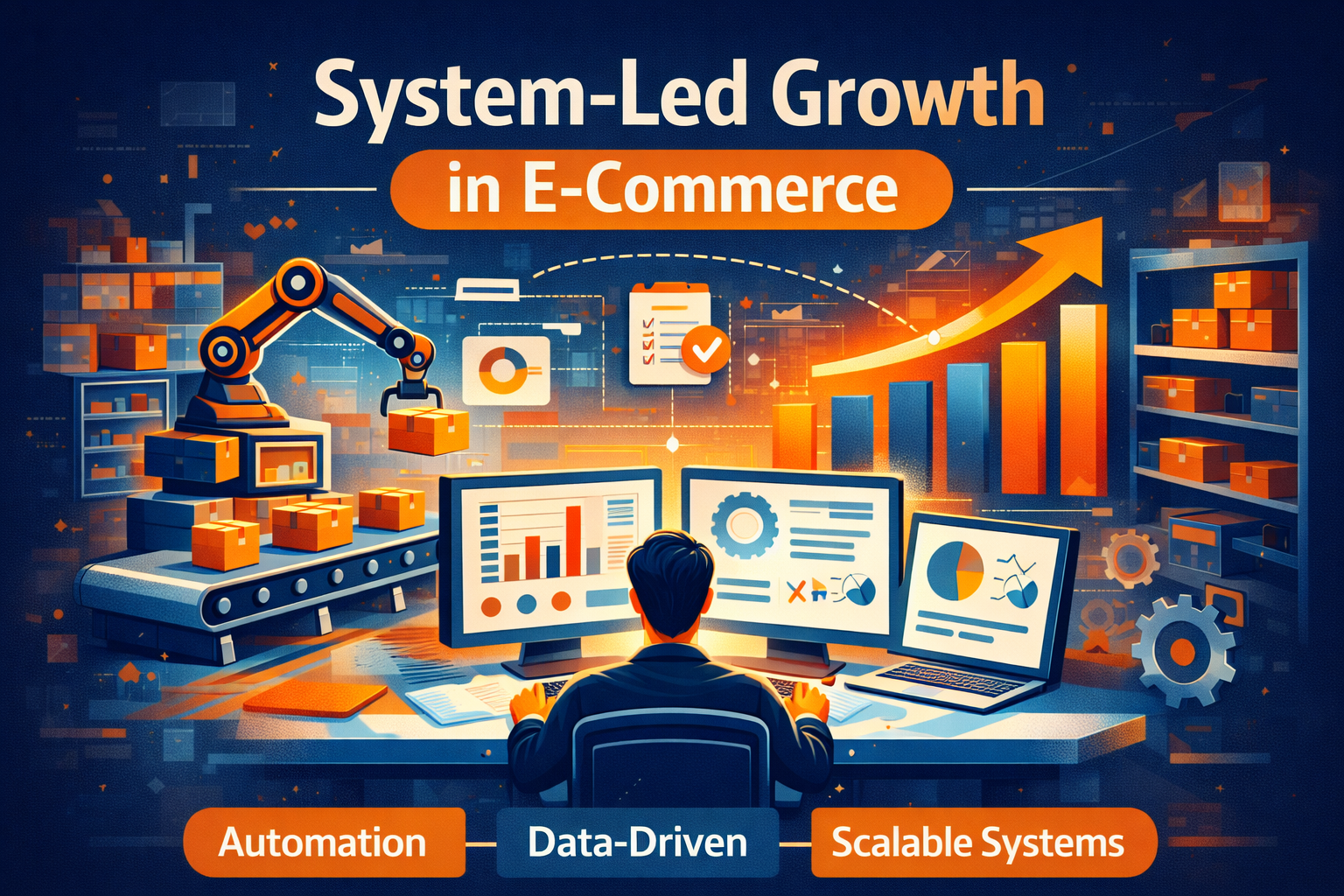
System-led growth in e-commerce is becoming essential as Indian sellers struggle not because they lack effort, but because they are doing too many things at once without clarity on what actually drives sustainable growth.
Ads are launched regularly. Listings are updated. Keywords are added. Dashboards are checked multiple times a day. Catalogues keep expanding. From the outside, everything looks active and busy.
Yet many e-commerce sellers still feel stuck.
Sales spike unpredictably. ROAS fluctuates without warning. Margins shrink even as revenue grows. Teams remain busy, but confidence doesn’t increase. Growth feels fragile instead of controlled.
This gap between effort and outcome is not caused by laziness, poor intent, or lack of tools. It exists because growth is being pursued without a system. This is where system-led growth in e-commerce begins, not as a buzzword, but as a practical way to regain control.
Why Effort-Led Growth Fails in E-commerce at Scale
In the early stages of an e-commerce business, effort often works.
You run ads and sales increase. You add products and revenue grows. You optimise listings and conversion improves. Founder involvement and quick reactions can create visible progress at smaller scales.
But as the business grows, the same approach starts breaking down.
Effort-led growth is when action comes before alignment. Sellers push ads before listings are conversion stable. Keywords are added because search volume looks attractive, not because they reflect buying intent. Inventory decisions are made after stockouts or sudden demand spikes. Pricing reacts to competitors instead of contribution margins. Returns are treated as losses rather than feedback.
This approach can deliver short-term wins, but over time it creates deeper problems. ROAS becomes volatile. Cash flow tightens. Operations turn reactive. Teams burn out. Decision-making becomes exhausting.
Mostly marketplaces don’t slow down because people stop working hard.
It slows down because effort is no longer supported by structure.
System-Led Growth in E-commerce: What It Actually Means
System-led growth in e-commerce means that growth is designed, not chased.
In a system-led business, ads do not create demand; they amplify readiness. Listings are not visual assets; they function as conversion infrastructure. Inventory is not reactive; it is planned against demand quality. Data is not watched emotionally; it is used diagnostically.
Instead of reacting to daily performance swings, sellers build a structure where decisions follow logic rather than pressure. Ads scale what already works. Operations support growth instead of breaking under it.
In simple terms, a system-led business knows what to fix first, what to ignore, and what can safely be scaled.
Effort still matters. But effort follows a system, not guesswork. When systems are in place, growth becomes predictable, not fragile.
How System-Led Sellers Think Differently
A system-led seller does not constantly ask, “Which new tactic should I try next?”
They ask better questions. Is conversion stable enough to scale traffic? Does inventory support sustained demand? Are returns signaling an issue that is being ignored? Will this decision still make sense three months from now?
This shift in thinking is subtle, but powerful. Growth becomes less emotional and more deliberate. It moves away from constant chasing and towards controlled progress. Sellers stop reacting to noise and start acting on signals.
The System-Led Growth Framework for E-commerce Sellers
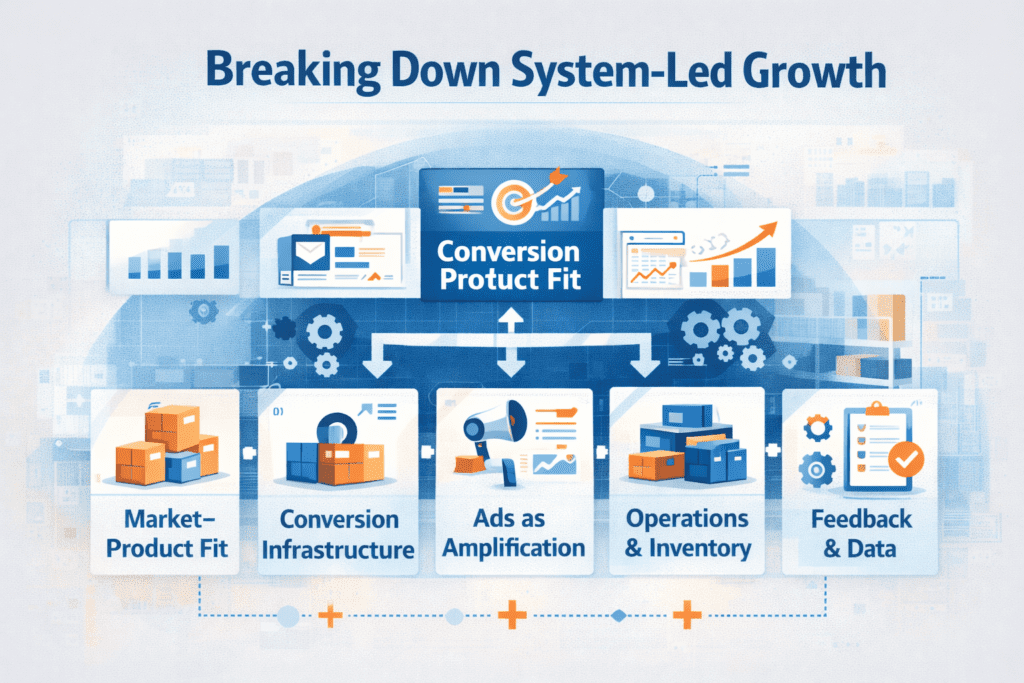
At Jaipur Global Services, we view e-commerce growth as a connected system rather than a collection of isolated activities. A stable growth system typically rests on five interdependent layers.
Market–Product Fit in E-commerce Growth
This is the foundation. Demand quality, price sensitivity, and competitive intensity determine whether growth is viable in the first place. If this layer is weak, no amount of optimization downstream can compensate.
Listing and Catalogue Infrastructure
Listings are not “content.” They are sales infrastructure. Clear product positioning, consistent catalogue structure, and stable conversion logic allow traffic to scale without losses. When conversion is unstable, increasing traffic only magnifies inefficiency.
Ads as an Amplification Layer
Ads do not fix systems; they expose them. When systems are aligned, ads accelerate growth. When they are not, ads accelerate inefficiency. Higher spend on a weak system magnifies problems instead of solving them.
Operations and Inventory as Strategy
Inventory is not storage; it is strategy. Stock depth must align with conversion confidence, forecasting must reflect real demand rather than temporary spikes, and cash flow must support scalability instead of optimism. Without this alignment, growth creates stress instead of leverage.
Feedback and Data Loops
This is where learning compounds. Return reasons, search term reports, repeat purchase behavior, and contribution margins are not noise. They are signals. Break one layer, and the entire system destabilizes.
Why Ads Stop Working for Many E-commerce Sellers
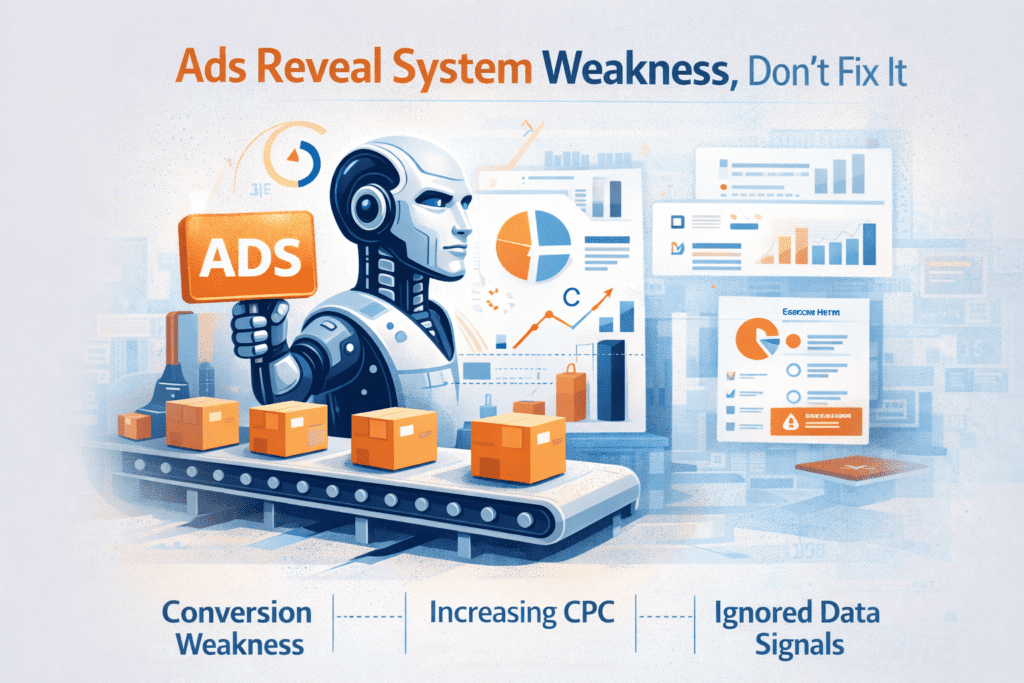
When sellers say, “Ads stopped working,” it is rarely an ad problem.
In most cases, it is a system exposure. Conversion weakens due to catalogue dilution. Inventory constraints increase CPC pressure. Pricing changes break contribution margins. Returns rise, but insights are ignored.
Ads didn’t fail. They simply revealed the problem faster.
This is why our core belief at JGS remains clear:
Ads amplify systems, not chaos.
Activity vs Progress in System-Led E-commerce Growth
Two sellers can look equally busy from the outside.
Both are running ads. Both are adding products. Both are optimising daily. Yet internally, they operate very differently.
One reacts to numbers. The other follows a structure.
Over time, the difference becomes obvious. One experiences volatility. The other experiences predictability. System-led growth in e-commerce does not eliminate uncertainty, but it reduces chaos enough for smart decisions to compound.
The JGS Approach to System-Led Growth
At Jaipur Global Services (JGS), we do not start with ads, tools, or dashboards.
We start with structure, readiness, and feedback loops.
Our role is not to push activity, but to build systems that can handle growth without constant firefighting. As marketplaces become more competitive, more expensive, and more operationally demanding, shortcuts fade. Systems compound.
The Real Takeaway
System-led growth in e-commerce is not about doing more.
It is about knowing what deserves effort and what doesn’t.
When growth is supported by systems, sellers stop feeling reactive. They gain clarity, confidence, and long-term control.
And in e-commerce, control is the real competitive advantage.
— Jaipur Global Services (JGS)
For More Information: