
Ecommerce Growth Strategy: Building a System for Sustainable Growth
 June 1, 2026
 Yashwardhan Singh
 0 Comments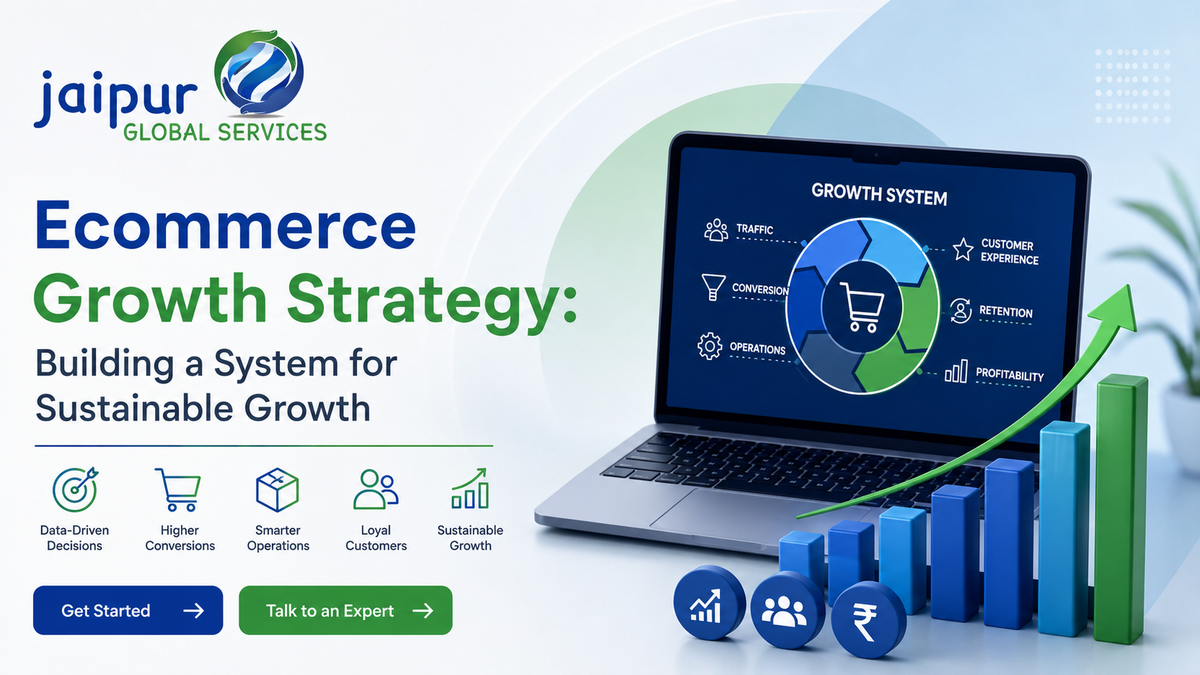
Picture a seller who's doing everything "right." Ads are running across three platforms. New products get added every month. Listings get tweaked whenever someone has time. Sales are, on paper, going up.
But look closer and the picture is less steady. ROAS swings from week to week for no obvious reason. Best-sellers run out of stock right when demand peaks. Margins are thinner than the revenue chart suggests. Returns creep up. The team spends most of its week reacting to whatever broke yesterday.
This is a business that's busy, not necessarily a business that's growing. That distinction is the starting point for this article.
Most ecommerce growth strategy advice focuses on isolated levers — run more ads, add more SKUs, chase more traffic. Those tactics can work for a while. But at scale, isolated fixes stop compounding and start creating new problems elsewhere in the business. Growth becomes more sustainable when it's designed as a system, not chased as a collection of tactics. That's the idea behind system-led growth in ecommerce, and it's what this guide walks through.
What Is an Ecommerce Growth Strategy?
An ecommerce growth strategy is a structured approach to increasing revenue, customers, conversion, repeat purchases, market reach, and profitability — not just one of these in isolation. A strategy that only chases revenue while ignoring margin, or only chases traffic while ignoring conversion, isn't really a strategy. It's a tactic wearing a strategy's name.
A sound growth strategy connects:
Demand → Traffic → Conversion → Fulfillment → Customer Experience → Retention → Profitability
Each stage affects the ones after it. Traffic without conversion readiness wastes ad spend. Conversion without fulfillment capacity creates operational strain. Growth without profitability isn't sustainable, no matter how good the top-line numbers look.
What Is System-Led Growth in Ecommerce?
System-led growth means building connected processes and decision frameworks so that growth doesn't depend entirely on constant manual firefighting or short-term tactics. It's the difference between a business that runs on individual heroics and one that runs on repeatable, understood processes.
This doesn't mean removing human judgment from the business — it means giving that judgment a stronger structure to work within.
Effort-Led Growth
System-Led Growth
Reacts to daily changes
Uses defined decision rules
Adds more activity
Improves the underlying system
Chases short-term wins
Builds repeatable growth
Treats ads independently
Connects ads with listings and conversion
Lets inventory react to sales
Plans inventory against demand
Monitors data
Uses data to drive decisions
Depends heavily on specific individuals
Lets processes support the whole team
Most ecommerce businesses start in the effort-led column — that's normal, and often necessary in the early stages. The problem is staying there as the business scales.
Why Effort-Led Growth Stops Working at Scale
Tactics that work fine for a small catalogue and a lean team tend to break down as the business grows, because growth adds complexity faster than effort alone can absorb it:
- More SKUs add catalogue complexity — inconsistent listings become harder to manage one by one.
- More ad spend exposes weaknesses in conversion and profitability that smaller budgets could mask.
- More orders increase operational pressure on fulfillment and support.
- More customers raise the bar on support and retention.
- More channels — Amazon, Flipkart, Shopify, and others — create coordination challenges around pricing, inventory, and messaging.
- More inventory makes demand forecasting harder, not easier.
- More data doesn't automatically translate into better decisions; without a framework, it just adds noise.
As complexity increases, a business needs systems to absorb it. Otherwise, the same effort that used to drive growth starts going toward simply keeping things from breaking.
The System-Led Ecommerce Growth Framework
Jaipur Global Services JGS approaches ecommerce growth as a set of interconnected layers, not separate departments operating in isolation:
- Market–Product Fit
- Listing & Catalogue Infrastructure
- Conversion Readiness
- Advertising & Traffic
- Inventory & Operations
- Fulfillment
- Customer Experience
- Data & Feedback
- Profitability & Decision-Making
Weakness in any one layer limits what the others can achieve — no amount of ad spend fixes a weak product-market fit, and no amount of traffic fixes an unstable checkout.
Market–Product Fit
Before optimizing anything downstream, it's worth being honest about the fundamentals: customer demand, competitive intensity, pricing position, product differentiation, and the quality of demand you're actually attracting. Advertising can create visibility, but it can't compensate indefinitely for a product that doesn't clearly solve a customer problem better than the alternatives.
Product Listings and Catalogue Infrastructure
Listings function as conversion infrastructure, not just product descriptions. This includes titles, images, descriptions, bullet points, attributes, categorization, brand consistency, A+ content where relevant, and the reviews attached to a listing.
The relationship is straightforward: better listing clarity leads to better customer understanding, which supports better conversion potential and more efficient use of traffic. This doesn't guarantee rankings or conversions on its own — but weak listings put a ceiling on what everything downstream can achieve.
Conversion Readiness Before Scaling Traffic
Before increasing traffic, it's worth evaluating product page quality, pricing, reviews, trust signals, checkout flow, mobile experience, shipping information, returns policy, and stock availability. Scaling traffic aggressively when the conversion system is unstable usually just means paying more to reach the same weak experience.
Advertising as an Amplification Layer
A core principle worth internalizing: ads amplify systems, not chaos. Whether it's Amazon PPC, Google Ads, Meta Ads, or retargeting, advertising increases exposure to whatever's already true about the business.
Weak listing + higher ad spend = more expensive traffic reaching a weak conversion experience. Strong listing + appropriately targeted traffic = a real opportunity to scale.
This isn't a claim that ads are useless when listings are imperfect — it's a reminder to check the foundation before pouring more budget on top of it.
Inventory and Operations as Growth Infrastructure
Inventory is part of the growth strategy, not a separate operational concern. This covers demand forecasting, stock availability, reorder planning, safety stock, lead times, SKU prioritization, cash flow, and inventory turnover.
Running out of stock interrupts momentum right when demand is strongest. Overstocking ties up working capital that could go toward better opportunities. The goal isn't maximum inventory — it's inventory appropriately aligned with actual demand and unit economics.
Fulfillment and Customer Experience
Growth increases order volume, which increases load on warehousing, shipping, returns, and support — and each of those is a customer touchpoint that shapes whether they come back. A business shouldn't scale order volume faster than its operational capacity can support; doing so tends to show up later as poor reviews, refund requests, and lost repeat customers.
Data and Feedback Loops
Data shouldn't just be watched on a dashboard — it should feed decisions elsewhere in the business. Some examples of what that looks like in practice:
- Search terms → listing improvements
- Return patterns → product or content fixes
- Low conversion → product page or pricing review
- Stockouts → forecasting adjustments
- Recurring customer questions → better product information
- Repeat purchase behavior → retention strategy
- Contribution margin by SKU → product and advertising decisions
A business that closes these loops learns continuously. A business that only monitors metrics without acting on them accumulates data without accumulating insight.
Profitability as Part of Ecommerce Growth
Revenue growth that erodes margin isn't the kind of growth worth chasing. This means tracking gross margin, contribution margin, advertising costs, fulfillment costs, returns, discounts, marketplace fees, customer acquisition cost, and customer lifetime value — together, not in isolation. A business can grow revenue while quietly weakening its underlying economics. The goal is healthy, sustainable growth, not simply more orders.
Activity vs. Progress in Ecommerce
Two sellers can look equally busy. Both run ads, add products, tweak listings, check dashboards, and update keywords. But one is making decisions through a system, and the other is reacting to whatever changed that day.
Activity
Progress
Launching more ads
Improving profitable acquisition
Adding more SKUs
Expanding validated product demand
Checking dashboards
Acting on meaningful signals
Updating keywords
Improving search relevance
Increasing inventory
Matching stock to actual demand
Increasing revenue
Improving profitable growth
Activity creates motion. Systems create direction. It's easy to confuse the two when everyone's busy — the difference only becomes visible when you ask whether last month's activity actually moved the business toward its goals, or just kept it occupied.
How System-Led Growth Changes Decision-Making
System-led thinking shifts the default question from "what should we do today?" to "what does the data tell us the system needs next?"
A few examples of that shift in practice:
- Instead of "ROAS dropped, reduce all ads" → ask "did conversion, CPC, pricing, inventory, or traffic quality change?"
- Instead of "sales increased, increase stock everywhere" → ask "which SKUs are showing sustainable demand?"
- Instead of "a competitor lowered their price" → ask "does matching that price actually improve our contribution margin and demand?"
The first version of each question invites a quick, reactive fix. The second invites a diagnosis. System-led growth is largely about training the business to ask the second question by default.
System-Led Growth Across Multiple Channels
Selling across Amazon, Flipkart, Shopify, Walmart, and a D2C website multiplies the coordination challenge — catalogue consistency, pricing, inventory, order management, channel-specific advertising, and reporting all need to line up. Managing each channel in isolation tends to create pricing conflicts, inventory imbalances, and inconsistent customer experiences. Multichannel growth works better when these functions are connected rather than run as separate silos with separate spreadsheets.
How to Build a System-Led Ecommerce Growth Strategy
A practical way to approach this:
- Audit the current system — review product, catalogue, conversion, advertising, inventory, operations, customer experience, and data as one connected picture.
- Identify the biggest constraint — figure out what's actually limiting growth right now, not just what feels urgent.
- Fix the foundation — improve the weakest high-impact layer before adding more activity on top of it.
- Create decision rules — define clear thresholds for when to increase or reduce spend, reorder stock, pause products, or launch new ones.
- Connect data across functions — make sure marketing, catalogue, inventory, and operations are learning from the same signals, not working from different numbers.
- Test before scaling — validate a change on a small scale before committing more budget or inventory to it.
- Scale what works — put more resources behind systems that have actually proven themselves.
- Create continuous feedback loops — use new data to keep refining the system rather than treating it as finished.
Signs Your Ecommerce Business Needs a Growth System
A quick self-check. If several of these sound familiar, the issue is likely structural rather than a matter of trying harder:
- Sales fluctuate heavily without a clear explanation
- ROAS changes unpredictably
- Best-selling products frequently run out of stock
- Too much dead stock sits in other categories
- The team is constantly firefighting
- No one can clearly explain why performance changed
- Different teams work from different data
- Listings are inconsistent across products or channels
- Advertising decisions are made reactively, day to day
- Revenue is growing but profit isn't
- Nothing moves forward without the founder's direct approval
- Coordinating across channels feels harder every quarter
These symptoms don't mean the business is failing — they usually mean the operating structure hasn't kept pace with how much the business has grown.
Common Ecommerce Growth Mistakes
- Scaling ad spend before fixing conversion
- Treating revenue as the only meaningful KPI
- Ignoring inventory until it becomes a crisis
- Adding too many products too quickly
- Managing channels as separate, disconnected businesses
- Reacting to daily performance swings instead of trends
- Ignoring what return data is actually saying
- Focusing only on ROAS instead of contribution margin
- Making decisions without defined thresholds or rules
- Adopting tools without the processes to use them well
- Scaling order volume before operations are ready
How to Measure System-Led Ecommerce Growth
Useful KPIs to track together, not in isolation:
Metric
Why It Matters
Revenue
Top-line growth indicator
Contribution Margin
Profitability after variable costs
Conversion Rate
Effectiveness of the conversion system
Customer Acquisition Cost
Efficiency of demand generation
ROAS
Advertising efficiency
Repeat Purchase Rate
Strength of the customer relationship
Customer Lifetime Value
Long-term value per customer
Return Rate
Product and listing accuracy
Inventory Turnover
Efficiency of stock management
Stockout Rate
Demand planning accuracy
Average Order Value
Basket-building effectiveness
Advertising-to-Sales Ratio
Overall spend efficiency
No single metric tells the full story. A product can show a strong ROAS while quietly carrying thin margins, high returns, poor repeat purchase rates, or constant stockouts. Reading these metrics together — as a system — is what actually reveals whether growth is healthy.
System-Led Growth for Different Ecommerce Businesses
Amazon sellers: Catalogue quality, conversion, PPC efficiency, inventory planning, reviews, account health, and profitability tend to be the highest-leverage areas.
D2C brands: Website performance, acquisition efficiency, conversion, retention, first-party customer data, and fulfillment usually matter most.
Shopify businesses: Store performance, product page quality, CRO, marketing efficiency, retention, and analytics.
Multichannel sellers: Catalogue consistency, inventory synchronization, pricing discipline, order management, channel-specific advertising, and centralized reporting across all channels.
The JGS Approach to System-Led Ecommerce Growth
JGS approaches ecommerce growth as a connected system rather than a collection of isolated activities — the same principle running through this article. In practice, that means looking at catalogue quality, marketplace account health, advertising efficiency, and operational readiness together, rather than treating each as a separate project.
(The specific Jaipur Global Services JGS services referenced below — account management, marketplace management, PPC, catalogue, and consulting — should be checked against the current jgservices.in service pages before publishing, since I can't browse the live site to confirm exact names and URLs.)
If your ecommerce business is showing some of the signs covered above — unpredictable ROAS, recurring stockouts, revenue growing faster than profit — it's often more useful to diagnose which layer of the system needs attention before adding more spend or more SKUs on top of it.
Frequently Asked Questions
1. What is an ecommerce growth strategy? A structured approach to increasing revenue, customers, conversion, retention, and profitability together — not chasing any one of these in isolation.
2. What is system-led growth in ecommerce? An approach where growth comes from connected processes and decision frameworks across the business, rather than depending on constant manual intervention or isolated tactics.
3. How is system-led growth different from traditional ecommerce marketing? Traditional marketing tactics often focus on individual levers like ads or SEO. System-led growth connects those levers with listings, inventory, fulfillment, and data so that improvements in one area support the others.
4. How can I scale an ecommerce business sustainably? By fixing the weakest layer in your growth system — often listings, conversion, or inventory — before increasing ad spend or adding more products.
5. Why should businesses fix listings before increasing ad spend? Because ads amplify whatever they point traffic toward. Weak listings turn increased spend into more expensive traffic reaching an unconvincing product page.
6. How does inventory affect ecommerce growth? Stockouts interrupt sales momentum, while overstocking ties up cash. Growth depends on inventory that's planned against actual demand, not reactive restocking.
7. What role does data play in ecommerce growth? Data should feed decisions across functions — search terms improving listings, returns improving product content, margins shaping advertising decisions — rather than sitting in a dashboard that nobody acts on.
8. How can ecommerce businesses grow across multiple channels? By keeping catalogue, pricing, inventory, and reporting connected across channels rather than managing Amazon, Flipkart, and Shopify as entirely separate businesses.
9. What metrics should businesses track for ecommerce growth? Revenue, contribution margin, conversion rate, CAC, ROAS, repeat purchase rate, customer lifetime value, return rate, and inventory turnover — read together, not individually.
10. Can an ecommerce consultant help build a system-led growth strategy? Yes — an experienced consultant can help audit the current system, identify the real constraint, and prioritize fixes in the right order rather than adding more activity on top of existing gaps. (Framed around JGS's actual consulting services once verified.)
Conclusion
Ecommerce growth doesn't come from constantly doing more. It comes from building systems that let product, listings, advertising, inventory, fulfillment, customer experience, data, and profitability work together instead of pulling in different directions.
Don't scale the chaos. Fix the system, then scale.
System-led growth doesn't eliminate uncertainty — no framework does. What it does is put the business in a better position to understand uncertainty, respond to it deliberately, and manage it as a system rather than a series of daily emergencies.
If you're seeing the signs of an effort-led business — unpredictable performance, constant firefighting, revenue growing faster than profit — it's worth stepping back and mapping the system before pushing harder on any single lever.