
Walmart Seller Account Setup: Complete Guide for Indian Sellers
 July 17, 2026
 Yashwardhan Singh
 0 Comments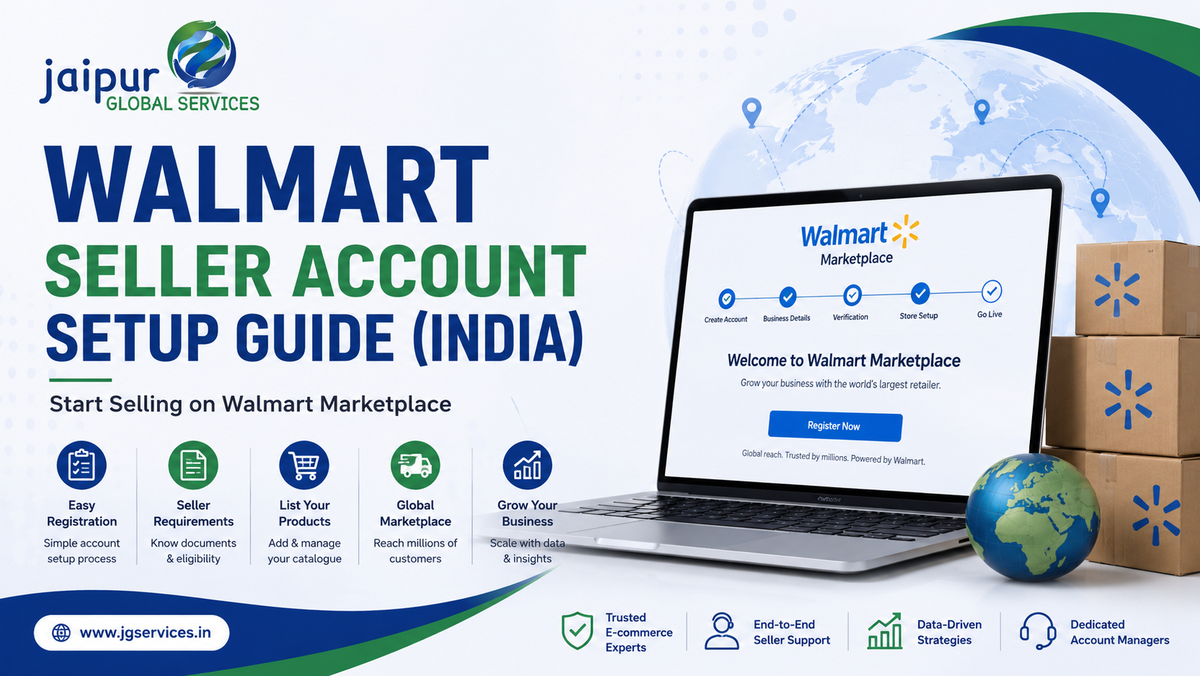
If you're researching Walmart seller account setup, it's worth knowing upfront that Walmart Marketplace isn't an open, sign-up-and-go platform. Walmart runs a curated application process — it evaluates your business, your product catalogue, and your ability to deliver a reliable customer experience before approving you to sell. For Indian businesses specifically, there's an added layer: Walmart's US Marketplace expects a genuinely US-facing operation, which means understanding exactly what that requires before you apply.
This guide walks through the complete process: who's actually eligible, what documents and business setup you need, how the application and account setup process works, what Walmart Seller Center does, fulfilment options including Walmart Fulfillment Services, realistic fees, and — because this matters enormously for Indian sellers — what selling into the US market from India genuinely involves in terms of business structure, shipping, returns, and currency.
A note on accuracy: Walmart's eligibility criteria, fees, and country-specific requirements for international sellers change periodically, and requirements can vary by category and seller history. Everything here reflects current, cross-checked information at the time of writing, but always confirm specifics directly on Walmart's Seller Center or with a qualified professional before making business decisions based on them.
Who Can Sell on Walmart Marketplace?
Walmart Marketplace uses what's often described as a curated seller model — closer to a vetting process than an open marketplace. Eligibility generally depends on:
- Business legitimacy — Walmart works with registered legal business entities, not individuals selling under a personal name or Social Security Number. Sole proprietorships with a valid EIN, LLCs, S-corps, and C-corps are all accepted structures.
- Ecommerce track record — Walmart typically looks for some history of marketplace or ecommerce selling experience, though it doesn't publish one universal minimum revenue or sales threshold.
- Product assortment and catalogue quality — your product listings need to be clean, complete, and compliant with Walmart's catalogue policies from the start.
- Competitive, consistent pricing — Walmart checks that your pricing is reasonably aligned with what similar products sell for elsewhere; large discrepancies compared to other marketplaces can delay approval.
- Fulfilment capability — you need a credible plan for how orders will actually ship and arrive on time, whether that's self-fulfilment with a strong track record or using Walmart's own fulfilment service.
- Customer service readiness — the ability to handle returns, respond to customer queries, and meet Walmart's ongoing performance standards.
This applies to established brands, manufacturers, D2C businesses, existing multi-marketplace sellers, and international sellers from approved countries — including India, which Walmart has specifically invited sellers from as part of a broader push to expand sourcing and export relationships. What it doesn't include is an individual without a registered business, or a seller with no ecommerce history and no plan for reliable fulfilment. Not every application gets approved, and incomplete or inconsistent information is one of the most common reasons for rejection or delay.
How to Set Up a Walmart Seller Account
Here's the practical, step-by-step version of the process, based on Walmart's current application flow.
Step 1 – Check Walmart Marketplace Eligibility
Before applying, confirm your business type, product category, and country are eligible. Walmart has expanded its list of approved countries for international sellers over time, and India is on that list, but eligibility and specific requirements can still vary, so it's worth double-checking current status before investing time in the application.
Step 2 – Prepare Your Business Information
Gather your legal business name, business type, and registered address exactly as they appear on official records. Walmart cross-checks this information closely, and even small mismatches between what you enter and your official documents can delay review.
Step 3 – Prepare Tax and Business Documents
You'll need a valid US Business Tax ID — Walmart explicitly does not accept a Social Security Number as a substitute for this, regardless of your business structure. Depending on your situation, you'll complete either a W-9 (for businesses with a US EIN) or a W-8 form (for eligible international businesses using supported tax classifications). Have your business registration documents ready and consistent with everything else you'll submit.
Step 4 – Apply to Walmart Marketplace
Submit your application through Walmart's official Marketplace application page. Use a business email address, ideally matching your business domain, and keep your legal business details on hand throughout.
Step 5 – Complete Seller Verification
Walmart reviews your business information, tax documents, and often your existing website or online storefronts as part of verification — having an active, professional-looking website and a track record on other platforms (Amazon, eBay, or similar) can genuinely help here. The approval process typically takes two to four weeks, though sellers with complete documentation and a clean track record sometimes clear review faster.
Step 6 – Set Up Your Seller Account
Once approved, you'll create your Seller Center login using your business email and a secure password. This is the point where "having an approved application" turns into "having an actual working account."
Step 7 – Configure Payment and Business Information
Choose one of Walmart's two supported payment processors — Payoneer or Hyperwallet — since Walmart pays sellers via direct deposit every two weeks through one of these. For Indian sellers without a US bank account, this is genuinely important groundwork, since it determines how you'll actually receive money from sales.
Step 8 – Set Up Shipping and Fulfilment
Decide between self-fulfilment (shipping orders yourself, which requires a reliable US-based fulfilment plan) or Walmart Fulfillment Services, where Walmart stores and ships your inventory for you. International sellers, including those from India, generally need a physical US address for returns regardless of which option they choose — a P.O. box isn't accepted.
Step 9 – Add Your Products
Build out your catalogue with complete, accurate product information — titles, descriptions, images, attributes, and product identifiers like UPC or GTIN. Walmart also runs a free Seller Academy certification course covering onboarding, seller standards, and account setup, which is worth completing before going fully live.
Step 10 – Complete the Marketplace Launch Process
With your account, payment setup, fulfilment plan, and catalogue in place, you can launch. From here, the real work of managing pricing, inventory, orders, and performance metrics begins — Walmart evaluates sellers for Pro Seller status after a minimum of 90 days, based on completed order volume and several performance thresholds, so what you do in these first few months genuinely matters.
Walmart Seller Account Requirements
Requirements can vary somewhat depending on your business type, product category, and whether you're applying as a US or international entity, so treat this as the general baseline.
Generally required:
- A registered legal business entity — sole proprietorship with an EIN, LLC, S-corp, or C-corp
- A valid US Business Tax ID (EIN); a Social Security Number is never accepted as a substitute
- Business name and address consistent across all submitted documents
- A completed W-9 (US businesses) or supported W-8 form (eligible international businesses)
- Bank/payment processor setup through Payoneer or Hyperwallet
- A credible fulfilment plan, whether self-fulfilled or through Walmart Fulfillment Services
- Product information meeting Walmart's catalogue and compliance standards
May be required depending on the seller or business:
- A US phone number for customer support, which many international sellers arrange through a virtual number or fulfilment partner
- A physical US return address, since P.O. boxes aren't accepted — often handled through a 3PL partner for sellers without their own US presence
- Demonstrated ecommerce track record or sales history on other platforms
- Additional documentation for specific product categories, particularly regulated ones
- A US LLC or equivalent entity, which isn't always strictly mandatory but significantly improves approval chances for international applicants
Don't assume every requirement listed by every third-party guide applies to your specific situation — Walmart's own application flow will indicate what it needs from you based on your business type and country, and confirming directly there is more reliable than any single external source, including this one.
Can Indian Sellers Sell on Walmart Marketplace?
Yes, in principle. Walmart has specifically invited Indian sellers to apply to its Marketplace as part of a broader effort to expand its international seller base and grow sourcing relationships with Indian exporters. That said, "eligible to apply" and "guaranteed approval" are two different things, and Indian sellers face some genuinely specific practical hurdles worth understanding before you commit time to this.
- Business registration — your Indian business registration alone typically isn't sufficient on its own for the smoothest approval path. Most Indian sellers find that either forming a US entity (commonly an LLC) or using a supported international tax classification via a W-8BEN-E form gives a more reliable route through the application.
- US Tax ID — Walmart explicitly requires a US Business Tax ID rather than an SSN, and while some eligible international sellers can proceed without one by indicating this during application and relying on the W-8 pathway, having a US EIN generally smooths the process considerably.
- Payment setup — Indian sellers don't need a US bank account personally, since Payoneer and Hyperwallet are built specifically to support international sellers receiving USD payouts and converting to INR.
- Product compliance — your products need to meet US regulatory standards for their category, which can differ meaningfully from what's required for the Indian market, so this needs its own review rather than assuming compliance transfers automatically.
- Shipping and fulfilment — since Walmart requires a US return address and generally expects reliable US-based delivery timelines, most Indian sellers either use a 3PL/fulfilment partner in the US or rely on Walmart Fulfillment Services rather than trying to ship every order internationally from India.
- Returns handling — a US-based returns process is close to unavoidable given Walmart's requirements, which again usually means a third-party or fulfilment partner rather than routing returns back to India.
- Customer service — a US-facing phone number and responsive support during US business hours is expected, which needs planning around time zones.
- Currency — pricing needs to work in USD, factoring in the INR conversion rate and any conversion fees from your payment processor, on top of Walmart's own fees.
None of this rules out Indian sellers — plenty do sell successfully on Walmart Marketplace — but it does mean treating this as a genuine international market entry with real operational and structural decisions to make, not simply an extension of an existing Amazon India or Flipkart account. This isn't legal or tax advice; the right business structure for your situation depends on your specific circumstances, and it's worth a conversation with a professional familiar with US-India cross-border ecommerce before you commit to a structure.
Documents Indian Sellers May Need for Walmart Marketplace
Commonly required:
- Business registration documents from your home entity (and from a US entity, if you form one)
- US Business Tax ID (EIN) or completed W-8BEN-E form if proceeding without one
- Proof of business address (Indian and/or US, depending on your structure)
- Bank/payment processor account (Payoneer or Hyperwallet)
- Product information and compliance documentation for your category
Situational, depending on your setup:
- US LLC formation documents, if you choose to establish a US entity
- EIN Verification Letter from the US Department of the Treasury, sometimes requested specifically to confirm your US business presence
- 3PL or fulfilment partner agreement, covering your US return address and delivery capability
- Brand authorisation or trademark documents, if relevant to your product category
- Additional certifications for regulated product categories
Don't assume Indian GST registration or PAN details satisfy Walmart's US requirements — they don't map directly onto what Walmart's application asks for. Your Indian tax and business documentation remains relevant for your own compliance and accounting, but Walmart's Marketplace application is built around US tax classifications (W-9/W-8 forms) and US business verification, which is a separate system entirely.
Walmart Marketplace Seller Registration Process
Putting the full journey together:
Eligibility check → Application submission → Business and tax verification → Account setup in Seller Center → Payment processor configuration → Fulfilment plan setup → Product catalogue build-out → Marketplace launch → Ongoing performance monitoring
It's worth being clear about something that trips people up: creating a Walmart seller account and getting marketplace approval are not automatically the same event. Your application goes through review before you get account access, and even after approval, your first weeks are effectively a probation period — Walmart evaluates your fulfilment reliability and customer service before considering you for Pro Seller status. Registration is the entry point, not a guarantee of long-term standing on the platform.
What Is Walmart Seller Center?
Walmart Seller Center is the dashboard you use to manage your entire Walmart Marketplace business once approved. It's the equivalent operational hub to Amazon Seller Central or Flipkart Seller Hub, adapted to Walmart's specific systems and policies.
Inside Seller Center, you can:
- Create and manage product listings and catalogue data
- Track and manage inventory
- Process and fulfil orders
- Set and adjust pricing
- Configure shipping settings and fulfilment method
- Manage returns and customer service
- Monitor seller performance metrics and account health
- Access payment and payout reporting
- Review advertising options through Walmart Connect, if you choose to use them
Getting comfortable with Seller Center matters especially in your first 90 days, since Walmart is actively watching your performance metrics during this window as part of its Pro Seller evaluation.
How to Add Products to Walmart Marketplace
A seller account by itself doesn't generate sales — the listing does that work. A complete, accurate listing needs:
- A clear product title, matching what customers actually search for
- A complete, honest description, covering use case, materials, and specifications
- High-quality images, meeting Walmart's format and background requirements
- Accurate product attributes, filled in fully rather than left blank, since these drive search and filtering
- The correct category, since miscategorised products hurt discoverability
- Brand information, consistent with any brand authorisation or trademark documentation on file
- A unique SKU for your internal tracking
- A UPC or GTIN, Walmart's standard product identifiers — some sellers can apply for a GTIN exemption in specific categories, but this needs a separate request and approval
- Competitive pricing, checked against what similar products sell for elsewhere, since large mismatches can flag your listing for review
- Accurate inventory and shipping information, since Walmart tracks fulfilment reliability closely from day one
Accurate product data isn't just about looking professional — Walmart's catalogue compliance checks and customer experience standards depend on it, and getting it wrong can affect both approval and ongoing account health.
Why Walmart Product and Catalogue Management Matters
Catalogue quality affects more than first impressions. Complete, accurate product data improves discoverability, since Walmart's search and category systems rely heavily on filled-in attributes. It reduces customer confusion, which lowers avoidable returns. It keeps your inventory numbers accurate, which prevents order cancellations that hurt your performance metrics. And it supports conversion, since a well-presented listing simply does a better job of answering a shopper's questions before they have to ask.
None of this guarantees a specific ranking or sales outcome, but a catalogue that's actively maintained — updated pricing, current stock levels, complete attributes — consistently performs more reliably than one set up once at launch and left alone.
Walmart Marketplace Fulfilment Options
Walmart offers two broad approaches:
Seller-fulfilled orders: You handle storage, packing, and shipping yourself, either directly or through your own logistics or 3PL partner. This gives you full control but means you're responsible for meeting Walmart's delivery and tracking standards on your own — late shipments and tracking errors count against your account from day one.
Walmart Fulfillment Services (WFS): You send inventory to Walmart's fulfilment centres, and Walmart handles storage, packing, shipping, and much of the customer service and returns process for those orders — similar in concept to Amazon FBA. WFS also supports international sellers shipping inventory into the US, though this involves its own logistics planning, since Walmart's preferred carriers pick up only from a US warehouse, not directly from an overseas port.
For Indian sellers specifically, WFS is often the more practical starting option, since it sidesteps the need to build your own reliable US-based shipping and returns operation from scratch. Self-fulfilment remains a real option too, but it generally requires a more established US logistics partner to execute reliably.
Shipping and Returns for Walmart Sellers
Walmart holds sellers to defined delivery and tracking standards regardless of fulfilment method — valid tracking rates and on-time shipping are both metrics Walmart monitors as part of ongoing seller performance. For orders shipped internationally or coordinated from India, this makes fulfilment planning especially important, since delays or tracking gaps directly affect your account standing, not just individual orders.
Returns need a workable US-based process, given Walmart's requirement for a physical US return address (P.O. boxes aren't accepted). Most Indian sellers handle this either through Walmart Fulfillment Services, which manages returns as part of the service, or through a 3PL partner who accepts and processes returns on the seller's behalf in the US.
It's worth being realistic here: promising delivery timelines you can't reliably meet from an India-based operation will hurt account performance quickly. Planning fulfilment and returns properly before launch matters more than it might on a domestic Indian marketplace, where logistics infrastructure and expectations are more familiar.
How Much Does It Cost to Sell on Walmart Marketplace?
Unlike Amazon, which charges a monthly subscription fee for a Professional selling plan, Walmart currently charges no upfront setup or monthly subscription fee for a standard seller account — costs are tied to actual sales and services used rather than a flat access fee.
Cost categories to plan for:
Cost
What it means
Referral fee
A percentage of each sale, varying by product category — check Walmart's current category-specific rate card rather than relying on a single flat figure
Fulfilment fees
Applicable if you use Walmart Fulfillment Services, covering storage, picking, packing, and shipping
Storage fees
Charged under WFS based on the space your inventory occupies
Returns handling
Costs tied to processing customer returns, whether self-managed or through WFS
Advertising
Optional spend through Walmart Connect for product visibility
International logistics
Freight, customs, and shipping costs to get inventory from India into US fulfilment centres or your own warehouse
Currency/payment costs
Conversion fees through your payment processor (Payoneer or Hyperwallet) when converting USD payouts to INR
Because referral fees vary meaningfully by category and Walmart periodically updates its fee structure, check the current rate card in Seller Center for your specific categories before finalising pricing — don't rely on a fixed percentage from an older article.
How Indian Sellers Can Calculate Walmart Marketplace Profit
Given the extra cost layers involved in selling internationally — shipping from India, US fulfilment or 3PL costs, and currency conversion — working out real profitability before committing inventory matters more here than on a domestic marketplace.
A simple framework:
Selling Price (USD) − Product Cost − Walmart Marketplace Fees (referral fee + WFS fees, if applicable) − Fulfilment/Shipping − Packaging − Advertising (if used) − Returns − International Logistics (freight from India to the US) − Currency/Payment Conversion Costs = Estimated Profit
Here's a simple fictional example to illustrate the logic — not actual current Walmart rates, just to show the calculation: say you're selling a home textile product at $25. Your product cost plus freight from India to a US warehouse might come to $8, your combined Walmart referral fee and WFS fulfilment costs might come to a meaningful chunk of the selling price depending on category, and currency conversion through your payment processor takes another small percentage off whatever USD amount you eventually convert to INR. What's left after all of that — not just after product cost and Walmart's own fee — is your real margin, and for international sellers, the shipping and currency layers often matter as much as Walmart's own fee structure.
Always confirm actual current fees in Seller Center for your specific category, and factor in real freight and conversion costs from your own logistics and payment setup, before finalising pricing — the example above is illustrative only.
How to Sell on Walmart Marketplace From India
Bringing the pieces together, here's what the practical journey looks like for an Indian business:
- Set up your business structure. Decide whether you're applying as an Indian entity using the W-8BEN-E pathway, or forming a US entity (commonly an LLC) for a smoother application and easier banking. This is a genuine business decision worth discussing with a professional familiar with cross-border US-India ecommerce.
- Apply to Walmart Marketplace, with your business, tax, and product information ready and consistent across every document.
- Research the US market properly for your specific product category — pricing expectations, competition, and demand can differ meaningfully from what you're used to on Amazon India or Flipkart.
- Check product compliance against US regulatory standards for your category, rather than assuming Indian compliance carries over.
- Plan your inventory and shipping strategy — most Indian sellers either ship in bulk to a US fulfilment centre (self-managed or via WFS) or work with a freight forwarder and 3PL partner for ongoing supply.
- Set up US fulfilment, whether through Walmart Fulfillment Services or a third-party logistics partner capable of meeting Walmart's delivery standards.
- Establish your returns process, using a US-based address as required.
- Handle customer service with US time-zone coverage in mind, even if your team operates from India.
- Price in USD with your full cost stack — product, shipping, fees, and currency conversion — properly accounted for.
- Set up ongoing marketplace management, since catalogue upkeep, pricing adjustments, and performance monitoring are continuous work, not a one-time setup task.
Treating this as "Amazon India, but in dollars" is the single most common mistake — the operational reality of selling into the US from India is genuinely different, and planning for that difference upfront saves a lot of trouble later.
Common Mistakes Indian Sellers Make on Walmart Marketplace
- Applying without properly checking eligibility and current country-specific requirements first
- Assuming Indian GST and business registration alone will satisfy Walmart's US-focused verification
- Underestimating how much a US Tax ID or US entity smooths the application process
- Poor US market research, assuming a product that sells well in India will perform the same way in the US
- Ignoring US customer expectations around delivery speed and communication
- Weak, incomplete product listings that don't meet Walmart's catalogue standards
- Incorrect product data, particularly around UPC/GTIN and category classification
- Pricing without accounting for currency conversion and international shipping costs
- Underestimating the complexity of setting up reliable US-based fulfilment and returns
- Ignoring Walmart's ongoing performance standards after approval, treating approval as the finish line
- Not calculating actual margins after all fee, shipping, and conversion costs are included
- Assuming approval guarantees sales — it doesn't, any more than opening a store guarantees customers
- Treating Walmart exactly like Amazon, without adjusting for its different application process, fee structure, and fulfilment options
Most of these come down to underestimating how much more preparation international selling requires compared to an existing Indian marketplace operation.
Walmart Marketplace vs Amazon for Indian Sellers
Factor
Walmart Marketplace
Amazon
Seller onboarding
Curated, application-based, 2–4 week review
More open self-registration, though international selling still requires setup
Monthly fee
No standard subscription fee
Professional plan carries a monthly fee
Customer base
Broad, value-conscious US shoppers
Broad US customer base with generally higher marketplace competition
Competition
Currently lower in many categories, given a smaller active seller base
Typically higher, given Amazon's scale and seller volume
Fulfilment options
Self-fulfilled or Walmart Fulfillment Services (WFS)
Self-fulfilled (FBM) or Fulfillment by Amazon (FBA)
Advertising
Walmart Connect
Amazon PPC, generally more mature and widely used
International/Indian seller support
Actively invites select international sellers, including India
Also supports international sellers through Amazon Global Selling
Neither platform is universally better for Indian sellers. Walmart currently offers comparatively lower competition and no subscription fee, which can suit sellers testing US demand without a large upfront commitment. Amazon offers a larger, more mature ecosystem with more advertising tools and support infrastructure, but with correspondingly more competition. The right choice depends on your product category, margins, and how much operational capacity you have to run either — or both — well.
Need Help Managing Your Walmart Marketplace Business?
Getting a Walmart seller account approved is a genuine achievement, especially for an Indian business navigating US-specific requirements. What comes after — catalogue upkeep, pricing, inventory coordination across international logistics, and staying on top of performance metrics during your first 90 days and beyond — is ongoing work that takes real attention.
This is where a partner like Jaipur Global Services (JG Services) can help. JG Services provides ecommerce marketplace management covering listing and catalogue management, inventory coordination, and ongoing operational support for businesses managing marketplace accounts across platforms. For sellers who want dedicated support with account health and day-to-day operations, JG Services also offers ecommerce account management built around consistent attention rather than one-time setup.
Beyond platform-specific work, JG Services provides ecommerce consulting for Indian businesses figuring out which international marketplaces make sense for their products, along with accounting and taxation support for the compliance side of running a cross-border ecommerce business.
If you're weighing whether outside support makes sense, it's usually worth considering once international logistics, catalogue upkeep, and performance monitoring start taking more time than the business can reasonably absorb internally — that's typically when dedicated marketplace management starts paying for itself.
Frequently Asked Questions
How do I set up a Walmart seller account?
Confirm your business and country are eligible, prepare your business and tax documents (including a US Business Tax ID or supported W-8 form), and apply through Walmart's official Marketplace application page. After a review process that typically takes two to four weeks, approved sellers get access to Seller Center to configure payments, fulfilment, and their product catalogue.
What are the requirements for a Walmart seller account?
A registered legal business entity, a valid US Business Tax ID (an SSN is never accepted as a substitute), consistent business information across all documents, a credible fulfilment plan, and product listings meeting Walmart's catalogue standards. International sellers also typically need a US return address and US phone number for customer support.
Can Indian sellers sell on Walmart Marketplace?
Yes — Walmart has specifically invited Indian sellers to apply. That said, most Indian sellers find the process smoother with either a US entity (commonly an LLC) or a completed W-8BEN-E form for international tax classification, along with a US-based fulfilment and returns setup, since Walmart requires a physical US return address.
How does Walmart seller registration work?
Registration starts with an application reviewing your business legitimacy, tax status, and product information. Approval typically takes two to four weeks. Getting an approved application and account access isn't the end of the process — Walmart continues evaluating seller performance closely in the following months, including for Pro Seller status after 90 days.
What documents are required to sell on Walmart?
Business registration documents, a US Business Tax ID or completed W-8 form for international sellers, proof of business address, and product/category compliance documentation. Indian sellers may also need US entity formation documents or an EIN Verification Letter, depending on their chosen business structure.
How much does it cost to sell on Walmart Marketplace?
There's no standard monthly subscription fee, unlike Amazon's Professional plan. Costs come from category-based referral fees on each sale, optional Walmart Fulfillment Services charges, advertising if you choose to use Walmart Connect, and — for Indian sellers — international shipping and currency conversion costs on top of Walmart's own fees.
What is Walmart Seller Center?
Seller Center is the dashboard for managing your entire Walmart Marketplace business once approved — listings, inventory, orders, pricing, fulfilment settings, returns, and performance metrics. It's the operational hub you'll use daily after account setup is complete.
Can I sell on Walmart Marketplace from India?
Yes, with the right preparation. You'll need to handle US tax classification (via a US entity or W-8BEN-E form), set up USD payments through Payoneer or Hyperwallet, arrange US-based fulfilment and returns, and price products accounting for shipping and currency conversion — it's a genuine international market entry, not a simple extension of an Amazon India account.
Final Thoughts
Setting up a Walmart seller account is only the starting point, and for Indian businesses, it comes with genuine extra groundwork — US tax classification, international fulfilment, and currency planning — that a domestic marketplace setup doesn't require. Getting approved is a real milestone, but what determines long-term success is everything after that: product selection that actually fits US demand, complete and accurate listings, pricing that holds up after all the fee and conversion layers, reliable fulfilment, and staying on top of performance metrics as Walmart evaluates your account in those first crucial months.
If you're working through this process and want support with marketplace operations, catalogue management, or broader ecommerce strategy for international expansion, JG Services can help you look at where things stand and plan the next steps.