
Why Most Amazon Ads Fail Before They Even Start: A Guide to Better PPC Strategy
 June 1, 2026
 Yashwardhan Singh
 0 Comments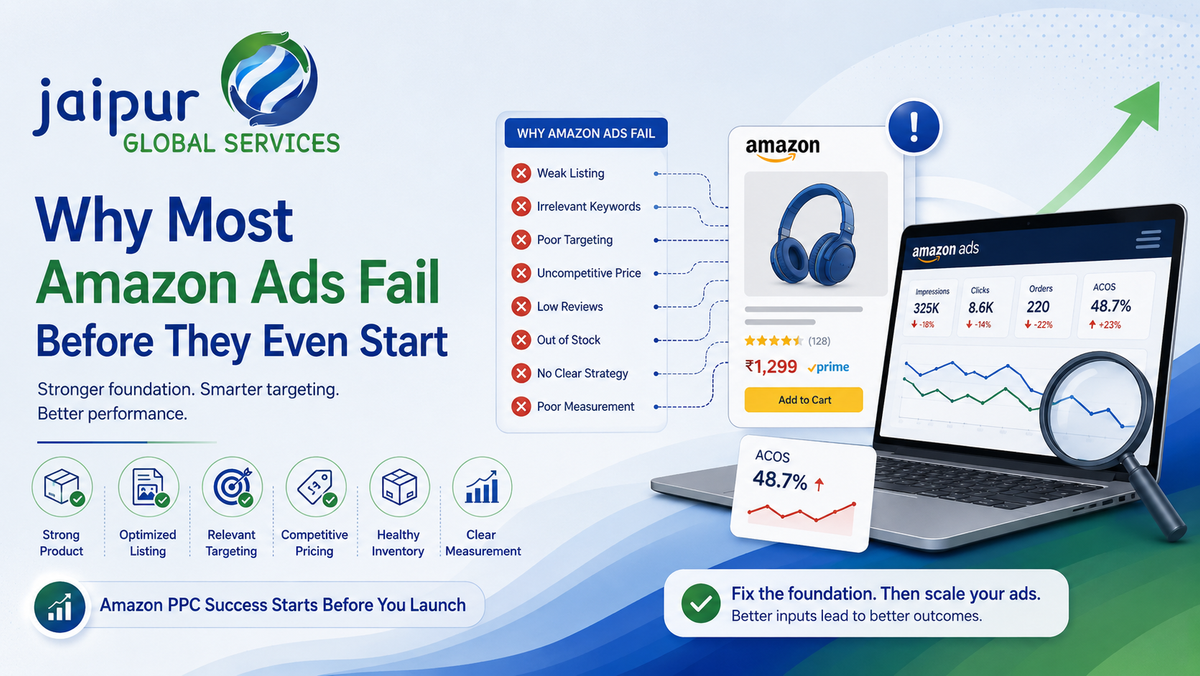
A seller launches Sponsored Products. The budget is healthy. Keywords have been researched and added. Bids are set at what seems like a reasonable level. Campaigns go live.
A week later: impressions are weak, clicks are expensive, conversion is low, ACOS keeps climbing, and sales stay inconsistent. The natural conclusion is "Amazon PPC isn't working."
That conclusion is usually premature. Amazon ads can amplify demand, but they cannot fix every weakness in the product and conversion system behind them. If the campaign is struggling, the campaign itself may not be where the problem started. It may have started earlier — in product-market fit, listing quality, images, keyword relevance, pricing, review confidence, inventory position, or how the campaign was measured in the first place.
This guide works through what actually determines Amazon PPC management outcomes — before, during, and after a campaign goes live.
What Is Amazon PPC?
Amazon PPC (pay-per-click) lets sellers and advertisers promote products through paid placements across Amazon's search results and product pages. The main current ad types include Sponsored Products, Sponsored Brands, and Sponsored Display — though it's worth checking Amazon's current advertising console for the latest formats and terminology, since these evolve over time.
The basic flow looks like this:
Targeting → Ad impression → Click → Product detail page → Customer decision → Purchase
Every one of those stages can succeed or fail independently. A campaign can generate strong impressions and still convert poorly. It can generate great click-through rates and still lose money. PPC performance is the sum of several stages, not a single number to optimize.
Why Amazon Ads Can Fail Before Campaign Launch
Before a campaign ever goes live, several foundational issues can already be working against it:
- Wrong product — advertising something with limited genuine demand
- Weak product-market fit — the product doesn't clearly beat the alternatives on the page
- Poor listing — unclear, incomplete, or unpersuasive product content
- Weak images — images that don't explain the product or build confidence
- Unclear product benefits — the value isn't obvious within a few seconds
- Poor keyword research — targeting terms that don't match actual buyer intent
- Weak pricing — priced out of line with comparable listings
- Low review confidence — not enough recent, relevant feedback to reassure buyers
- Inventory problems — stock that can't support increased demand
- Poor offer competitiveness — nothing that makes this listing the obvious choice
- Incorrect campaign objective — optimizing for the wrong goal (e.g., pure ACOS when the real goal is new-customer acquisition)
- No clear profitability target — no defined sense of what "working" actually means economically
If the foundation is weak, increasing ad spend usually just exposes that weakness to more shoppers, faster.
The Amazon PPC Foundation Checklist
Before diagnosing the campaign itself, it's worth checking the fundamentals:
- Product — Is there clear customer demand for this specific item?
- Listing — Is the product page clear and persuasive?
- Images — Do the images actually explain the product?
- Title & bullets — Do they communicate the benefits that matter to the buyer?
- Keywords — Are the targeted terms genuinely relevant to the product?
- Price — Is the offer competitive for the category?
- Reviews — Is there enough recent customer feedback to support buyer confidence? (There's no universal review threshold — what's "enough" varies by category and price point.)
- Inventory — Can the business support increased demand if the campaign works?
- Fulfillment — Can orders be processed reliably at a higher volume?
- Profitability — What's the acceptable advertising cost for this product, given its margin?
Your Listing Can Make or Break PPC Performance
An ad's job is to generate a click. Everything after that click is the listing's job. Title, main image, secondary images, bullet points, product description, A+ Content where applicable, product attributes, variations, reviews, pricing, and overall brand trust all determine whether that click turns into a sale.
High traffic combined with a weak product page doesn't automatically produce efficient advertising — it often just produces expensive traffic that bounces. This doesn't mean listing optimization guarantees a specific conversion lift; it means a weak listing puts a ceiling on what any amount of traffic can achieve.
Keyword Research Comes Before Campaign Structure
Keyword selection should be based on relevance, search intent, actual product fit, competition, commercial intent, and the language customers actually use — not just volume.
A few keyword categories worth understanding:
- Branded keywords — searches containing a brand or product name
- Generic keywords — broader category or product searches
- Long-tail keywords — more specific, often lower-competition search phrases
- Competitor/alternative keywords — worth approaching carefully and strictly within Amazon's current advertising policies, since rules around this vary and change
Negative keywords matter just as much as the keywords you target — they prevent budget from being spent on searches that will never convert for your product.
The Wrong Targeting Can Waste Budget
More keywords is not the same as better targeting. Irrelevant search terms, broad targeting without proper controls, weak keyword-to-product match, and poor campaign segmentation all lead to the same outcome: spend leaking toward searches that were never going to convert. Regular search-term analysis is one of the highest-value habits in PPC management — it's where this kind of waste actually gets caught.
Campaign Structure Matters
A deliberate campaign structure — organized by product, category, match type, targeting type, budget, and bidding approach — makes it possible to actually understand what's working. There's no single universal structure that fits every seller; the right approach depends on the product, category, budget, business goal, catalogue size, competitive intensity, and how much historical data is already available. Search-term harvesting and negative targeting are ongoing parts of maintaining that structure, not one-time setup tasks.
Bidding and Budget Are Not the Whole Strategy
"If my ads aren't working, increase the bid" is one of the most common — and most limited — PPC instincts. Bidding is one lever among several. Relevance, conversion rate, listing quality, product competitiveness, targeting precision, search intent match, budget distribution, placement, and historical performance all matter too. Higher bids can increase exposure, but they don't guarantee profitable results — sometimes they just buy more expensive traffic reaching the same underlying problems.
Pricing and Offer Competitiveness
Price, discounts, coupons, promotions, shipping costs, and how the offer compares to competing listings all shape what happens after the click. A PPC campaign can successfully bring a customer to the product page — but the offer itself still has to make sense to that shopper once they're there.
Reviews, Ratings, and Social Proof
Rating, review volume, review quality, and how recent the feedback is all influence buyer confidence — though no specific star rating guarantees a specific conversion outcome. Reviews are also a diagnostic tool: they reveal product objections, quality issues, expectation gaps, and the questions customers keep asking. Feeding that information back into listing and product improvements is often more valuable than treating reviews as just a trust score.
Inventory Can Quietly Break an Ad Strategy
Advertising can create additional demand — but if inventory is limited, that demand runs into a wall. When that happens, campaign efficiency metrics become harder to interpret, products can go out of stock at the worst possible time, sales momentum gets interrupted, and budget allocation may need adjusting mid-campaign. Advertising and inventory planning shouldn't be managed as if they're unrelated to each other.
ACOS vs. ROAS: Don't Optimize One Number Blindly
ACOS (Advertising Cost of Sale) = Ad Spend ÷ Ad Revenue × 100 ROAS (Return on Ad Spend) = Ad Revenue ÷ Ad Spend
Neither metric should be read in isolation. Product margin, Amazon fees, cost of goods, fulfillment costs, discounts, and returns all determine whether a given ACOS or ROAS actually represents healthy performance. A lower ACOS isn't automatically better if it comes packaged with significantly lower profitable sales volume. A higher ROAS isn't automatically better if that campaign isn't contributing to broader goals like new-customer acquisition or category ranking. There's no universal "good" ACOS number that applies across categories — what's acceptable depends heavily on margin and business goals.
Why Some Sellers Optimize for ACOS and Still Struggle
Chasing a lower ACOS number can quietly work against the business when it means cutting profitable traffic, ignoring organic ranking goals, ignoring new-customer acquisition value, overlooking product-level margins, only looking at campaign-level data, skipping search-term analysis, or ignoring conversion rate entirely. The healthier approach evaluates ad performance, product performance, and overall business profitability together — not any single metric in isolation.
The Amazon PPC Optimization Loop
PPC isn't a one-time setup — it's a recurring cycle:
Research → Structure → Launch → Collect Data → Analyze Search Terms → Optimize Targeting → Adjust Bids/Budgets → Improve Listing → Review Profitability → Repeat
Sellers who treat campaign launch as the finish line tend to see performance plateau or decline. Sellers who treat it as the starting point of an ongoing loop tend to see it improve over time.
Amazon PPC Mistakes That Waste Advertising Budget
- Launching ads before checking listing quality
- Targeting irrelevant keywords
- Using one campaign to cover everything
- Never reviewing search-term data
- Ignoring negative keywords
- Increasing bids as the default fix for every problem
- Ignoring product price relative to competitors
- Ignoring reviews and customer feedback
- Advertising products with weak margins
- Ignoring inventory position
- Measuring success by ACOS alone
- Making decisions from too little data
- Changing too many variables at once, making it impossible to know what worked
- Stopping campaigns too quickly, before enough data has accumulated
- Scaling spend without understanding underlying profitability
How to Audit an Amazon PPC Campaign Before Spending More
- Check product economics — selling price, cost, fees, and actual margin
- Check listing quality — images, title, bullets, description, A+ content, product information
- Check search relevance — keywords, search terms, match types, negative keywords
- Check campaign structure — organization, product grouping, targeting, budget allocation
- Check performance data — impressions, clicks, CTR, CPC, conversion rate, spend, sales, ACOS, ROAS
- Check inventory — confirm stock availability actually supports the advertising strategy
- Identify the actual constraint — don't assume the bid is the problem until the rest has been ruled out
When Should You Increase Amazon Ad Spend?
Increased spend should follow evidence, not hope. Reasonable signals include relevant traffic, strong conversion, acceptable unit economics, adequate inventory, a solid listing, and enough data to be confident the performance is real rather than noise. Increasing spend before those conditions are met is usually premature — there's no universal spend threshold that applies across products or categories, so this needs to be judged case by case.
When Should You Reduce or Pause Amazon Ads?
Worth considering when there's extremely poor keyword relevance, product availability problems, listing errors actively hurting conversion, campaigns that are clearly unprofitable, conversion issues traceable to fixable product-page problems, or targeting that consistently pulls in irrelevant traffic. The decision to pause should come from diagnosis, not panic — pulling a campaign the moment ACOS spikes for a week often throws away data that would have explained the spike.
How JGS Approaches Amazon Advertising
JGS's approach to Amazon advertising centers on connecting campaign management with the rest of the ecommerce system — catalogue, inventory, and analytics — rather than treating PPC as an isolated service. In practice, that generally covers campaign management and optimization, ad performance analysis, product-level insights, and analytics that connect advertising data to broader business performance.
(The specific tools, AI capabilities, and exact current service scope referenced here should be confirmed against jgservices.in before publishing — I can't browse the live site to verify current feature names or capabilities, so I've kept this description general rather than specific.)
JGS doesn't guarantee a specific ROAS, ACOS, sales volume, or ranking outcome — no legitimate advertising management service can promise that, since results depend on the product, category, and competitive landscape.
Why Connect Amazon PPC With Catalogue, Inventory, and Analytics?
The pieces are genuinely interdependent: catalogue determines what customers actually see, advertising brings relevant traffic to it, inventory determines whether resulting demand can be fulfilled, analytics shows what's actually working, customer feedback reveals product and listing problems, and profitability data determines whether the growth is economically worth pursuing. Managing PPC as a disconnected activity, separate from these other functions, tends to produce exactly the kind of campaigns described earlier in this article — technically running, but disconnected from what actually drives results.
Amazon PPC Management: DIY vs. Professional Management
DIY Amazon PPC
Professional PPC Management
Seller handles keyword research
Specialist handles research
Manual, ad-hoc monitoring
Structured, ongoing monitoring
Limited available time
Dedicated optimization time
Decisions can be reactive
Data-driven optimization process
Seller learns through trial and error
Specialist experience plus data
Scaling can be difficult to manage alone
Processes designed to support scaling
DIY isn't inherently the wrong choice — experienced sellers with enough time and expertise can manage PPC well internally, especially at smaller scale. Professional management tends to become more valuable as campaign complexity increases, spend grows, the catalogue expands, multiple marketplaces get added, internal expertise is limited, or the business needs more structured, ongoing optimization than it can realistically do in-house.
Frequently Asked Questions
1. Why do Amazon PPC campaigns fail?
Often because of issues that started before launch — weak product-market fit, poor listing quality, irrelevant keywords, uncompetitive pricing, low review confidence, or inventory problems — rather than the campaign setup itself.
2. What is Amazon PPC management?
The ongoing process of researching, structuring, launching, monitoring, and optimizing Amazon advertising campaigns, connected to product, listing, and inventory decisions rather than managed in isolation.
3. How can I improve Amazon PPC performance?
Start with the foundation — listing quality, keyword relevance, pricing, and inventory — then move to campaign structure, bidding, and ongoing search-term analysis.
4. Why are my Amazon ads getting clicks but no sales?
This usually points to the listing, pricing, or offer rather than the ad itself — the click is working, but something on the product page isn't converting that traffic.
5. How does listing quality affect Amazon PPC?
The listing determines what happens after the click. High traffic to a weak listing tends to produce expensive, inefficient advertising regardless of how well-targeted the campaign is.
6. What is a good Amazon ACOS?
There's no universal number — it depends on your product margin, category, fees, and business goals. A "good" ACOS for one product can be unprofitable for another.
7. What is the difference between ACOS and ROAS?
ACOS measures ad spend as a percentage of ad revenue; ROAS measures ad revenue as a multiple of ad spend. They're two ways of viewing the same relationship, and neither should be read without considering margin and total business economics.
8. Should I increase my Amazon bids if ads are not performing?
Not automatically. Bidding is one lever among many — check listing quality, keyword relevance, pricing, and inventory before assuming the bid is the actual problem.
9. How important are keywords in Amazon PPC?
Very — but relevance matters more than volume. Poorly matched keywords waste budget on traffic that was unlikely to convert regardless of bid level.
10. How does inventory affect Amazon advertising?
Limited inventory can interrupt sales momentum right when a campaign starts working, and it complicates how you interpret and adjust campaign performance.
11. When should I hire an Amazon PPC management company?
When campaign complexity, ad spend, or catalogue size has grown beyond what can be managed with the available internal time and expertise, or when the business needs more structured, ongoing optimization.
12. Can JGS manage Amazon advertising campaigns?
Yes — JGS's Amazon advertising approach connects campaign management with catalogue and inventory data as part of a broader ecommerce growth approach. (Exact current service scope should be confirmed on jgservices.in.)
Conclusion
Most Amazon advertising problems shouldn't automatically be treated as "ad problems." Before increasing bids, raising budgets, or launching new campaigns, it's worth checking the product, the listing, the keywords, the pricing, the reviews, the inventory, the conversion rate, and the underlying profitability.
Before you scale the ads, make sure the system behind the ads is ready to scale.
For sellers who've checked the foundation and still need help structuring, running, or optimizing Amazon advertising at scale, professional Amazon PPC management — connected to the rest of the ecommerce operation rather than run in isolation — is where JGS can help.