
Amazon Reinstatement: A Complete Guide to Recovering Your Seller Account
 June 1, 2026
 Yashwardhan Singh
 0 Comments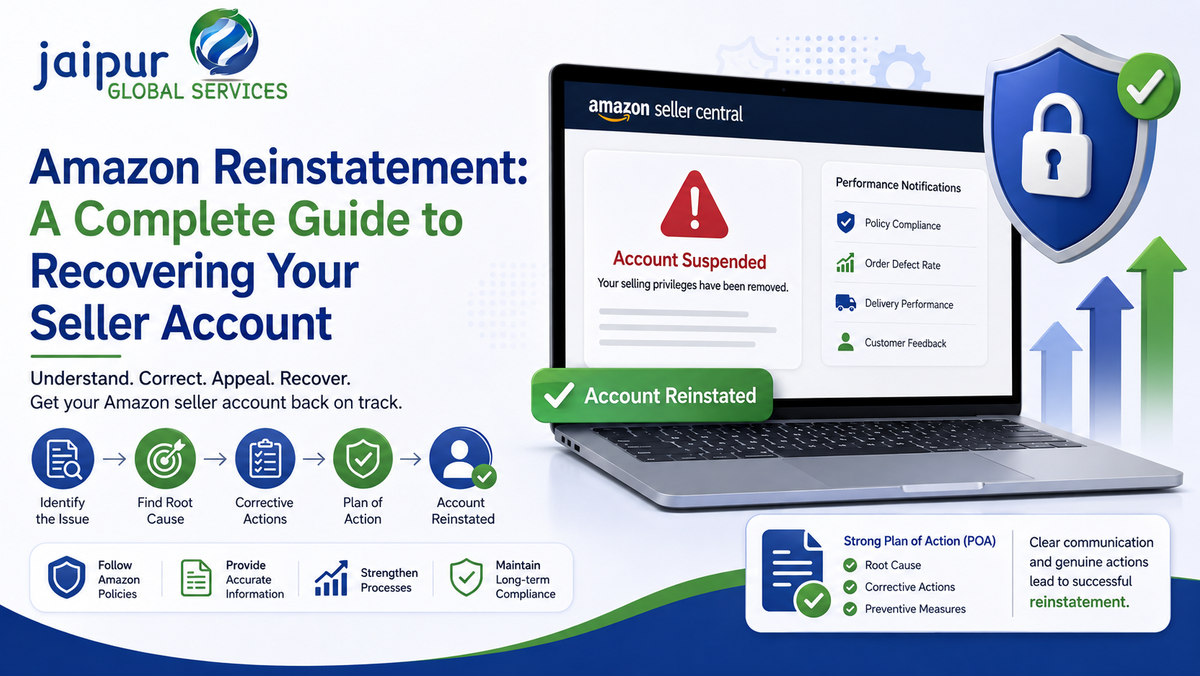
If Amazon is a meaningful part of your business, a sudden account suspension is more than an inconvenience. Listings stop showing, orders can't be processed, advertising pauses, and inventory sitting in FBA warehouses becomes inaccessible. For a lot of sellers, this is one of the most stressful moments in running an Amazon business.
The instinct in that moment is often panic — writing an emotional appeal and hitting submit within the hour. That's usually the wrong move. Amazon Account Reinstatement isn't about reacting quickly. It's a structured process that depends on understanding exactly why your account was suspended, what Amazon is actually asking for, what caused the underlying issue, and how to explain the corrective steps you've taken clearly and honestly.
This guide walks through that process — from reading your suspension notice correctly, through building a proper Plan of Action, to knowing what to do if your first appeal doesn't work.
What Is Amazon Account Reinstatement?
Amazon account reinstatement refers to the restoration of selling privileges after Amazon has suspended, restricted, or deactivated a seller account. It's the outcome sellers are working toward when they submit an appeal — but reinstatement itself only happens after Amazon reviews the situation and determines the account meets its requirements again.
It helps to understand a few related terms, because sellers often use them interchangeably even though they describe different things:
- Account suspension — selling privileges across the account are paused, usually due to a performance or policy issue
- Listing suspension — a specific product or listing is removed or blocked, without necessarily affecting the whole account
- Account deactivation — access to the seller account is removed, often used for more serious or repeated issues
- Selling privilege restriction — a narrower limitation, which may affect specific categories or actions rather than the entire account
The exact reinstatement process depends heavily on which of these applies to your situation and what specific reason Amazon has cited. There's no single universal appeal that works regardless of the issue — the right approach is dictated by the actual notice you received.
Why Does Amazon Suspend Seller Accounts?
Amazon enforces its marketplace policies and seller performance standards fairly strictly, and suspensions can stem from a wide range of issues. Some of the more common categories include:
- Policy violations (listing policies, prohibited content, restricted actions)
- Product authenticity concerns
- Intellectual property complaints
- Product condition or quality issues
- Customer complaints, including safety concerns
- High order defect rates
- Late shipment or fulfillment issues
- Excessive order cancellations
- Selling restricted or gated products without approval
- Inaccurate or misleading product information
- Concerns about multiple or related seller accounts
- Issues with invoices or supporting documentation
- Broadly poor seller performance metrics
- Suspected manipulation of reviews or other prohibited activity
This isn't an exhaustive list — Amazon's policies are extensive, and enforcement reasons can be specific to your category, product type, or account history. This is exactly why the first and most important step is always reading your actual performance notification or suspension notice carefully. The reason stated there is what determines everything that follows, not a generic understanding of "why accounts usually get suspended."
What Should You Do Immediately After an Amazon Suspension?
A rushed, emotional response rarely helps. A more methodical approach gives you a far better chance:
Step 1: Read the suspension notification carefully. Don't skim it. The specific policy or performance issue cited is the entire basis for your appeal.
Step 2: Identify the exact policy or performance issue. Note the specific ASINs, orders, or metrics referenced, if any.
Step 3: Review your account history and relevant orders or listings. Look for patterns — is this an isolated incident or a recurring issue?
Step 4: Identify the root cause. Not the surface-level trigger, but the actual underlying reason the issue occurred.
Step 5: Correct the underlying problem. This needs to happen before you appeal, not just be promised in writing.
Step 6: Collect relevant evidence. Genuine documentation that supports your explanation — invoices, records, correspondence, whatever is actually relevant to your specific case.
Step 7: Prepare the appeal or Plan of Action. Structure it clearly around root cause, corrective action, and preventive action.
Step 8: Submit through the appropriate Amazon process, typically via Seller Central's Account Health or Performance Notifications section.
Sellers who skip straight to Step 8 without doing the earlier work almost always end up with a weaker appeal — and often a rejected one.
What Is an Amazon Plan of Action (POA)?
A Plan of Action, or POA, is the structured document Amazon typically expects when a seller appeals a suspension. It's built around three core components:
1. Root Cause This section explains what actually caused the issue — specifically and honestly. Vague statements like "we made a mistake" don't help Amazon understand what actually went wrong. A useful root cause explanation identifies the specific process, decision, or gap that led to the problem.
2. Corrective Action This explains what has already been done to fix the immediate issue. If a defective product caused customer complaints, this might mean the batch was pulled from inventory, or the supplier issue was addressed. This section should describe actions genuinely already taken — not actions you intend to take eventually.
3. Preventive Action This explains what systems, checks, processes, or training will prevent the same issue from happening again going forward. This is often the section that most differentiates a strong POA from a weak one, because it shows Amazon that the underlying process — not just the individual incident — has been addressed.
It's worth being direct about something important here: your Plan of Action needs to reflect your actual situation. There's no template that works by filling in generic phrases about causes and corrections you haven't actually implemented. Amazon's review process is designed to identify appeals that don't hold up, and a POA that doesn't match the real facts of your account is far more likely to be rejected — and can create bigger problems if inconsistencies are discovered later.
How to Write an Effective Amazon Suspension Appeal
A strong appeal generally shares a few characteristics:
- It directly addresses the specific issue Amazon cited — not a general defense of your business
- It takes appropriate responsibility where the issue genuinely originated on your end
- It's built on factual, verifiable information
- It clearly explains the root cause, not just the symptom
- It shows real corrective action already taken
- It shows genuine preventive measures going forward
- It includes documentation that's actually relevant to the specific issue
- It's organized and easy for a reviewer to follow
- It avoids unnecessary emotional language
- It doesn't blame Amazon, customers, or external parties without basis
- It doesn't make claims that can't be supported
At its core, a good Amazon seller account suspension appeal answers four questions clearly: What happened? Why did it happen? What have you fixed? How will you prevent it from happening again? If your appeal doesn't clearly answer all four, it's worth revising before submission.
Common Reasons Amazon Appeals Get Rejected
Understanding why appeals fail is often as useful as understanding how to write a good one. Common issues include:
- The appeal doesn't address the actual suspension reason. Sometimes sellers respond to what they assume the issue is, rather than what Amazon actually stated.
- The root cause is unclear or superficial. "It was an error" doesn't tell Amazon anything useful.
- The POA is too generic. Content that could apply to almost any seller in almost any situation signals a lack of genuine reflection.
- Corrective actions are vague. "We've fixed the issue" without specifics doesn't demonstrate anything concrete.
- Preventive measures are missing entirely or too weak to be credible.
- The seller blames Amazon, customers, or competitors instead of taking ownership where appropriate.
- Supporting evidence doesn't actually support the stated explanation.
- Irrelevant documents are submitted that don't address the specific issue.
- The same appeal is resubmitted repeatedly without any real changes.
- The underlying business process was never actually corrected, even if the appeal claims it was.
- The appeal contains contradictions, whether internal or compared to account history.
- Inaccurate information is provided, even unintentionally.
Each of these weakens Amazon's confidence that reinstating the account won't simply lead to the same issue recurring — which is ultimately what Amazon is trying to determine.
What Documents May Be Relevant to an Amazon Appeal?
The specific documentation needed depends entirely on the reason for suspension — there's no single universal document list. Depending on your situation, relevant documents might include:
- Supplier invoices
- Purchase records
- Business registration or documentation
- Shipping and fulfillment records
- Order records
- Product authenticity documentation
- Evidence of corrective action already taken
- Relevant internal policy or process documentation
It's worth being unambiguous here: any documentation submitted must be genuine, accurate, and current. Amazon does not always require a specific document type — what matters is that whatever you submit is real and directly relevant to the stated issue. Submitting documents that are fabricated, altered, or misleading in any way isn't just ineffective — it violates Amazon's policies and can seriously damage your ability to ever restore the account.
How Long Does Amazon Account Reinstatement Take?
There's no fixed or guaranteed timeline, and any claim promising a specific number of days should be treated with skepticism. Timing depends on multiple factors:
- The type and severity of the suspension
- The complexity of the underlying issue
- The quality and completeness of your documentation
- How clearly your appeal addresses the actual concern
- Amazon's internal review process and current volume
- Whether Amazon requests additional information after your initial submission
Some appeals are resolved relatively quickly; others take considerably longer, particularly for more serious or complex issues. The most useful thing a seller can do during this period is monitor Seller Central regularly and respond promptly and accurately to any additional requests from Amazon.
What If Amazon Rejects Your Appeal?
A rejection isn't necessarily the end of the process, but it does require a different approach than simply resubmitting the same appeal:
- Read the rejection carefully. It often contains clues about what Amazon still finds insufficient.
- Identify what Amazon still needs. Is more detail required? Different documentation? A clearer explanation of root cause?
- Re-examine the root cause. Ask honestly whether your original explanation was actually accurate and complete.
- Check whether your previous POA genuinely addressed the issue, or whether it was addressing the wrong problem.
- Make meaningful corrections, not just wording changes.
- Improve your documentation if the previous submission was thin or irrelevant.
- Submit a more accurate, specific response once you've genuinely strengthened the appeal.
It's worth being direct: repeatedly submitting the same appeal without addressing the underlying problem doesn't improve your odds — it typically just delays resolution and can signal to Amazon that the seller isn't engaging seriously with the issue.
Amazon Suspension Appeal vs Amazon Account Reinstatement
These terms are often used as if they mean the same thing, but they describe different stages of the same process:
Suspension appeal is the process of formally asking Amazon to review a suspension and restore selling privileges — it's the action the seller takes.
Account reinstatement is the outcome — the actual restoration of the account, which happens after Amazon reviews and accepts the appeal, or otherwise resolves the issue.
In other words, you submit an appeal in hopes of achieving reinstatement. Understanding this distinction helps clarify that submitting an appeal is a step in the process, not a guaranteed result.
How to Prevent Future Amazon Account Suspension
Once an account is reinstated — or even if it's never been suspended — prevention matters more than most sellers initially realize. Useful ongoing practices include:
- Monitoring Seller Central notifications regularly, not just when something goes wrong
- Tracking your Account Health dashboard and seller performance metrics consistently
- Keeping supplier documentation organized and easily accessible
- Maintaining accurate, up-to-date product listings
- Following product and category restrictions carefully, especially for gated categories
- Monitoring customer complaints and responding promptly
- Reviewing intellectual property concerns proactively, especially with new product launches
- Maintaining shipping and fulfillment standards consistently
- Training staff who handle marketplace operations on current Amazon compliance requirements
- Staying current on Amazon policy updates, which do change over time
- Maintaining internal compliance processes rather than relying on reactive fixes
Sellers who treat Amazon compliance as an ongoing operational discipline — rather than something to think about only after a suspension — tend to face fewer serious issues over time.
Should You Handle Amazon Reinstatement Yourself or Hire Professional Help?
Both paths can work, and the right choice depends on your specific situation.
Handling it yourself may be appropriate when:
- The suspension reason is clearly stated and easy to understand
- You genuinely understand what caused the issue
- You have the proper documentation readily available
- The corrective action needed is relatively straightforward
- You're confident in preparing a clear, well-organized appeal
Professional support may be useful when:
- The suspension involves multiple or overlapping issues
- A previous appeal has already failed
- The root cause isn't clear, even after your own review
- Documentation needs to be organized or clarified
- You want broader support with Amazon account management going forward
- You'd like an outside perspective on your account situation and appeal strategy
It's important to be realistic here: Amazon account reinstatement services and Amazon account recovery services can help sellers build a stronger, more accurate appeal — but no legitimate provider can guarantee reinstatement, because the decision ultimately rests with Amazon.
What to Look for in an Amazon Reinstatement Service
If you're considering professional help, a legitimate provider should:
- Genuinely understand Amazon's policies and current processes
- Ask to see your actual suspension notice, not just a general description
- Take time to review your account situation in detail
- Work with you to identify the actual root cause
- Explain their proposed strategy clearly before proceeding
- Rely only on genuine, accurate documentation
- Avoid guaranteeing outcomes
- Explain what you need to correct on your end, not just what they'll write
Watch for these red flags, which typically indicate a provider you should avoid entirely:
- Claims of "100% guaranteed reinstatement"
- Promises of reinstatement within an unrealistically specific timeframe, like "guaranteed in 24 hours"
- Offers to provide fake invoices or supplier documents
- Claims of secret contacts or special relationships inside Amazon
- Advice to create a new seller account to bypass an existing suspension
- Requests for you to provide misleading or inaccurate information
- No real interest in understanding what actually caused your suspension
Any of these should be treated as a serious warning sign, regardless of how confident the provider sounds.
How JGS Can Support Amazon Sellers
Amazon reinstatement is fundamentally about understanding your account, correcting real issues, and communicating that clearly and accurately to Amazon. Beyond the reinstatement process itself, ongoing account health depends heavily on how well a seller's broader Amazon operations are managed.
JGS works with Amazon sellers on account management, seller support, and marketplace operations. For sellers dealing with suspension or working to prevent future issues, having consistent, well-managed account operations — accurate listings, organized catalogue management, and properly run advertising — reduces a lot of the risk factors that lead to policy or performance issues in the first place.
It's worth being direct: no ecommerce partner, including JGS, can guarantee that Amazon will reinstate a suspended account, and no legitimate provider should claim otherwise. What a knowledgeable partner can do is help you understand your account situation clearly and support stronger day-to-day account management going forward.
Amazon Reinstatement Checklist
Use this as a practical, step-by-step reference:
- Read the suspension notification in full
- Identify the exact reason Amazon has cited
- Review affected listings, orders, or account history
- Identify the actual root cause of the issue
- Correct the underlying problem before appealing
- Gather genuine, relevant evidence
- Prepare a Plan of Action covering root cause, corrective action, and preventive action
- Clearly explain corrective actions already taken
- Clearly explain preventive measures going forward
- Review the appeal carefully before submission
- Submit through the appropriate Amazon Seller Central process
- Monitor Seller Central regularly for updates or requests
- Respond promptly and accurately to any further Amazon requests
- Maintain ongoing compliance after reinstatement
FAQs
1. What is Amazon Account Reinstatement? It's the restoration of selling privileges after Amazon has suspended, restricted, or deactivated a seller account, typically following a successful appeal.
2. Why was my Amazon seller account suspended? Reasons vary widely, including policy violations, product authenticity concerns, performance issues, customer complaints, or documentation concerns. Your specific suspension notice will state the exact reason — always start there.
3. How do I appeal an Amazon suspension? By submitting a clear, factual response through Seller Central that addresses Amazon's stated reason, typically structured as a Plan of Action covering root cause, corrective action, and preventive action.
4. What is an Amazon Plan of Action? A structured appeal document explaining what caused the issue (root cause), what you've done to fix it (corrective action), and what you'll do to prevent it from happening again (preventive action).
5. How long does Amazon account reinstatement take? There's no fixed timeline — it depends on the complexity of the issue, the quality of your appeal, and Amazon's review process. Be cautious of anyone promising a specific guaranteed timeframe.
6. Can a suspended Amazon account be recovered? Many suspended accounts are successfully reinstated when the seller accurately identifies the root cause, corrects the issue, and submits a clear, well-supported appeal. However, reinstatement is never guaranteed.
7. Should I hire an Amazon reinstatement service? It can help, particularly for complex cases or after a failed appeal, but choose carefully — avoid any provider guaranteeing outcomes or suggesting fake documentation.
8. What should I do if Amazon rejects my appeal? Review the rejection carefully, re-examine whether your root cause and corrective actions genuinely addressed the issue, strengthen your documentation, and submit a more specific and accurate response.
9. Can I create another Amazon account after suspension? No — creating a new account to bypass an existing suspension violates Amazon's policies and can lead to further enforcement action. The correct path is appealing the existing account.
10. How can I prevent another Amazon suspension? Monitor your Account Health regularly, maintain accurate listings and documentation, follow category and policy requirements, and address performance issues proactively rather than reactively.
Conclusion
Amazon account reinstatement isn't simply about writing an appeal and hoping for the best. It requires genuinely understanding why your account was suspended, identifying the real root cause, correcting the underlying problem, and clearly communicating that correction to Amazon with accurate evidence. A well-built Plan of Action — one that honestly reflects your actual situation — gives you a far stronger chance than a rushed, generic response.
Even after reinstatement, the work isn't finished. Maintaining consistent compliance and account health matters just as much as recovering from the initial suspension.
If you're currently dealing with a suspended account, or want to strengthen your broader Amazon account management to reduce future risk, it may help to have an experienced perspective on your situation. You're welcome to explore Jaipur Global Services (JGS) Amazon seller and marketplace support services to see if that kind of support fits what your business currently needs.