
How Brand Videos Improve Product Listings and Increase Conversions
 June 1, 2026
 Yashwardhan Singh
 0 Comments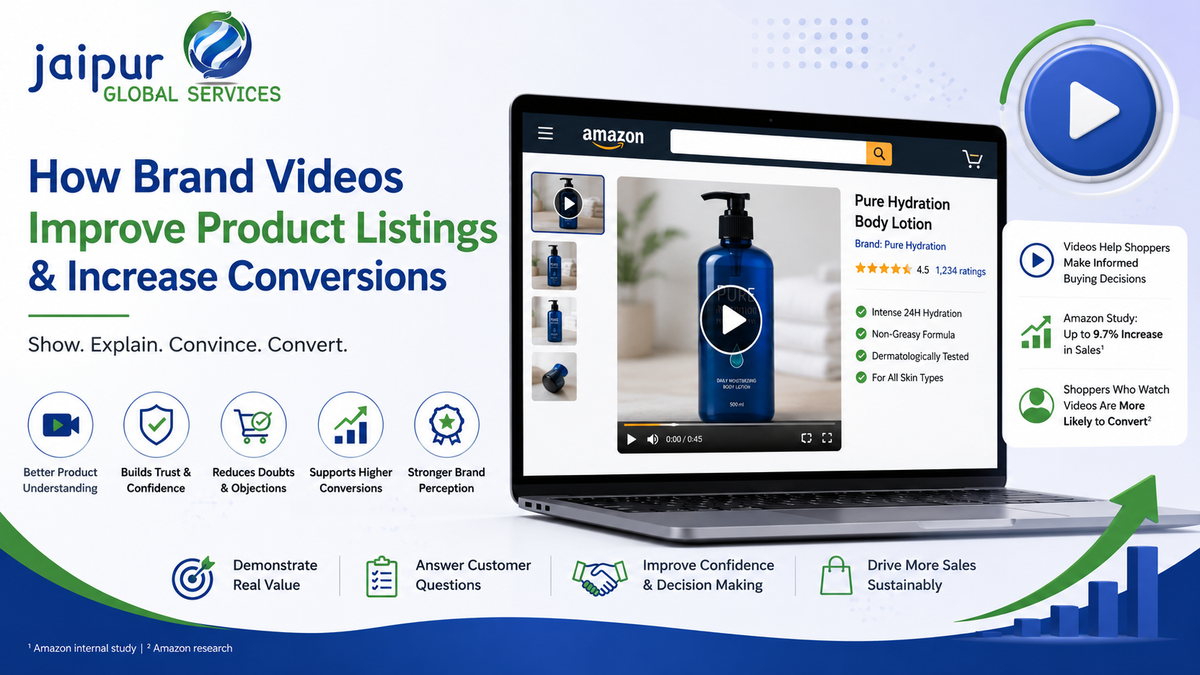
A shopper lands on your Amazon listing. They see the images, read the title, skim the bullet points, check the price, and glance at the reviews. And they still have questions. How big is this actually? How does it work? Will it fit what I already have at home? Does it look as good in real life as it does in the photos?
Static images and text can answer a lot of these questions, but not all of them. Some products are simply easier to understand when a shopper can watch them in action — how they operate, how they're assembled, how they fit into an actual room or routine, what they look like from angles a photo can't capture.
This is where an Amazon product video comes in. It's not a replacement for good photography or a well-written listing. It's an additional layer of communication that can help close the gap between "I think I understand this product" and "I'm confident this is right for me." This article looks at what product videos actually do, how they fit into a listing, what makes them effective, and when they're genuinely worth the investment.
What Is an Amazon Product Video?
An Amazon product video is video content that appears on a product detail page, alongside the standard images, to help shoppers understand a product visually. Depending on the product and the brand's approach, this might include:
- Product demonstrations showing the item in use
- How-to or instructional content
- Installation or setup walkthroughs
- Feature explanations
- Lifestyle footage showing real-world use
- Product comparisons, where appropriate and compliant with Amazon's content guidelines
These videos typically sit within the image carousel or a dedicated video section on the product page, depending on account type and current Amazon functionality. Eligibility, upload requirements, and available placements can change over time, so it's worth checking current guidance in Seller Central or Amazon's official brand resources rather than relying on older information you might find elsewhere.
It's also worth being clear early on: an Amazon Listing Video on a product detail page is a different thing from an Amazon Video Ad, which is a paid placement shown elsewhere on Amazon or across the web. We'll come back to that distinction later in this article.
Why Product Videos Matter on Amazon
A few realities of online shopping make video a genuinely useful format, when used well:
- Shoppers can't physically handle the product before buying.
- Some products are hard to fully understand from still images alone.
- Video can demonstrate functionality in a way text can't.
- Video can show scale — how big or small something actually is.
- Video can answer common pre-purchase questions in a compact format.
- Video can make complex or multi-feature products easier to grasp quickly.
- Video complements existing listing content rather than replacing it.
Amazon has stated that video is part of the shopping journey and that customers use product video to make more informed purchasing decisions. Amazon has also published data suggesting that shoppers who view product videos are more likely to convert, and in at least one study context, has reported that adding video can increase sales by up to 9.7%.
It's important to treat these numbers correctly: they're Amazon-reported findings from specific study contexts, not a guarantee that any individual listing will see this exact lift. Actual results depend on the product, the video's quality and relevance, the rest of the listing, and market conditions — not the mere presence of a video file.
How Brand Videos Improve Product Understanding
There's a natural progression a shopper goes through when evaluating a product:
"What is this product?" → "How does this product work?" → "Will this work for me?" → "I understand what I'm buying."
Video can support movement through each stage by demonstrating:
- How the product actually functions
- Its real size and scale
- Specific features in action
- Materials and build quality
- Controls and how they're used
- Correct usage
- Installation or setup steps
- Differences between variants
- How it performs in a real-world setting rather than a studio
A well-made product demonstration video essentially answers the question "how does this work?" faster and more clearly than paragraphs of bullet points ever could. This is particularly valuable for products with moving parts, multiple functions, or anything where the "how" matters as much as the "what."
How Product Videos Build Customer Confidence
Online shoppers carry a certain amount of doubt into every purchase decision, especially with unfamiliar brands or products:
- Is the product really as shown in the photos?
- How exactly does it work?
- Is it actually easy to use?
- Is this the right size for my needs?
- What does it look like in everyday use, not just a studio shot?
- Does it actually have the features I'm looking for?
- How is this meaningfully different from similar options?
A relevant, well-produced video can address several of these doubts directly, showing rather than just claiming. But it's worth being honest about what video can and can't do on its own. Video is one input into a much bigger trust equation that also includes genuine reviews and ratings, product quality, accurate descriptions, image quality, seller performance history, pricing that matches perceived value, and reliable fulfillment. A great video attached to a listing with poor reviews or inconsistent delivery won't overcome those deeper issues.
How Product Videos Can Support Conversions
It helps to think about this through a simple journey:
Traffic → Product Page → Product Understanding → Confidence → Purchase Decision
Product video is generally most useful at the middle stages of this journey — after a shopper has already reached the page, but before they've made their final decision. It's not typically a traffic driver by itself; that's more the role of PPC, SEO, and external marketing.
Once someone's on the page, video can help by:
- Demonstrating the product directly
- Clarifying real benefits, not just listed features
- Reducing uncertainty around use or fit
- Showing genuine real-life application
- Explaining complex features simply
- Helping the shopper picture themselves actually owning and using the product
The honest way to frame this: a well-planned product video can support conversion by helping shoppers understand the product and make a more informed purchase decision. That's a meaningfully different claim from saying a video will increase your conversion rate — the second implies a guarantee that no single asset on a page can reliably deliver on its own.
What Types of Amazon Product Videos Work Best?
Different video formats suit different products and different customer questions:
1. Product Demonstration Videos — show the product actually being used. Useful for almost any product, especially ones where function matters.
2. How-To Videos — walk through how to use the product correctly. Particularly useful for anything with a learning curve.
3. Installation or Setup Videos — valuable for furniture, electronics, or anything requiring assembly, where uncertainty about difficulty often stalls a purchase.
4. Feature-Focused Videos — highlight one or two standout features in detail, useful when a specific feature is the main differentiator.
5. Lifestyle Videos — show the product in realistic, everyday settings, helping shoppers picture it in their own life.
6. Product Comparison Videos — explain differences between variants or related products, where this is done accurately and within Amazon's content guidelines.
7. Unboxing Videos — show exactly what arrives in the box, useful for setting accurate expectations.
8. Problem-Solution Videos — open with a relatable problem, then show how the product addresses it, which works well for products solving a clear pain point.
The right choice depends on what customers are actually confused or curious about — not which format looks most impressive.
What Makes a High-Converting Amazon Product Video?
Production budget matters less than most sellers assume. What tends to matter more:
- A strong opening that gets to the product quickly, without a long intro
- Clear demonstration of the product actually being used
- A message that's easy to follow without rewatching
- Good, even lighting
- Clean, clear visuals
- Benefit-focused narration or text, not just a features list
- Reasonable pacing — not rushed, not padded
- Clean, consistent branding
- Clear audio, or readable on-screen text if audio isn't guaranteed to be on
- A design that works even when viewed on a phone
- A thumbnail that accurately represents what's in the video
- Claims that are accurate and defensible
The goal should be answering the customer's real questions, not making the product look as flashy as possible. A slightly simpler video that clearly answers "how does this work" often outperforms a polished video that never actually explains anything.
Common Amazon Product Video Mistakes
Some recurring issues show up across a lot of seller-produced video content:
- Making it feel like a traditional advertisement rather than useful information
- Spending too much of the runtime on the logo or brand intro
- Taking too long to actually show the product
- Focusing only on listing features instead of demonstrating them
- Never actually showing the product in use
- Poor lighting that makes the product hard to see clearly
- Unclear or hard-to-read on-screen text
- Low-quality or inconsistent audio
- Making claims that can't be backed up
- Overlooking Amazon's content policies around what can and can't be shown or claimed
- Using misleading visuals that don't match the actual product
- Simply repeating what's already in the bullet points, without adding anything new
- Overcomplicating the video with too many messages at once
- Ignoring how the video will actually look and play on a mobile screen
Each of these reduces how useful the video actually is to a shopper trying to make a decision — which is the entire point of having one.
Amazon Product Video vs Product Images
Video and photography do different jobs, and neither replaces the other.
Product images are useful for:
- Showing fine product detail
- Highlighting specifications clearly
- Capturing multiple angles
- Communicating individual features
- Showing packaging and what's included
Video is useful for:
- Demonstrating movement and function
- Showing the product actually working
- Explaining multi-step processes
- Showing real-world usage and context
- Walking through installation or setup
- Telling a short, focused product story
The strongest Amazon listings generally use images, text, and video together — each covering something the others can't do as well. Treating video as a replacement for strong photography, rather than a complement to it, usually leaves gaps in how the product is presented.
How Product Videos Work With Amazon Product Listing Optimization
A product video shouldn't be created and uploaded as an isolated asset, disconnected from everything else on the page. It works best as one part of a coordinated listing, alongside:
- The product title
- Bullet points
- The product description
- Product images
- A+ Content
- Brand Story
- Targeted keywords
- Accurate product information
- Genuine customer reviews
- PPC traffic bringing shoppers to the page
Each of these elements does a specific job. The title and images get attention and set initial expectations. The bullet points communicate key facts quickly. A+ Content adds depth and brand context. Video demonstrates the product directly. Reviews provide social proof. When all of these work together consistently, the result is Amazon Product Listing Optimization done properly — not a collection of disconnected assets, but a page that answers a shopper's questions in the order they naturally come up.
How Amazon PPC and Product Videos Work Together
It's useful to think of this as a simple chain, where each part does something distinct:
- PPC → brings relevant traffic to the page
- The listing → communicates the core product information
- Images → provide visual proof of what's being sold
- Video → demonstrates the product in action
- A+ Content → adds deeper explanation and brand storytelling
- Reviews → provide social proof from other buyers
Amazon PPC can do an excellent job of bringing the right shopper to your page. What happens next depends on whether the page itself can actually convince that shopper — and a relevant, well-made video is one part of doing that convincingly. Video doesn't replace PPC or SEO; it supports the page experience that PPC traffic eventually lands on.
It's also worth repeating the distinction from earlier: a product detail page video (an Amazon Listing Video) is different from an Amazon Video Ad, which is a paid placement format shown in ad slots rather than embedded directly in the product's own image gallery. Amazon Video Marketing can involve both, but they serve different roles — one is organic content on your own listing, the other is paid media designed to attract clicks.
How Product Videos Can Reduce Customer Uncertainty
A few practical examples make this easier to picture:
A kitchen appliance — a video demonstrating the actual controls and everyday usage removes a lot of the "how does this even work" hesitation.
A beauty product — a video showing application technique and result helps a shopper judge whether it'll suit them.
A fitness product — a video showing setup and correct usage form reduces concern about doing it wrong.
A home product — a video showing real dimensions and placement in an actual room setting helps with the "will this fit my space" question.
A technical product — a video walking through installation or operation removes a common barrier to purchase for anything perceived as complicated.
A clothing or accessory item — a video showing fit, movement, or styling (where genuinely useful and compliant) helps address the "will this actually look good on me" uncertainty that photos alone often can't fully resolve.
In each case, the best video answers the specific question the customer is already asking themselves — not a generic demonstration disconnected from their actual hesitation.
When Should a Brand Invest in Product Videos?
Product video tends to be genuinely worth the investment when:
- The product is genuinely difficult to explain using images alone
- The product has moving parts or mechanical function
- The product requires installation or assembly
- The product has multiple functions that are hard to summarize in bullet points
- Customers frequently ask usage-related questions
- Competitors already have stronger visual content on similar listings
- The product involves a higher level of consideration before purchase
- The brand is launching something genuinely new to the market
- The business is investing meaningfully in Amazon PPC and wants the page to match
- The listing gets decent traffic but underperforms on conversion
- The brand wants generally stronger visual presentation across its catalogue
That said, not every product needs an elaborate video. A simple, well-understood product with clear photography and a solid listing may convert perfectly well without one.
Should You Create Amazon Product Videos In-House or Hire a Professional?
Both paths can work, depending on the product and the team.
DIY may work well when:
- The product itself is fairly simple to demonstrate
- The business has basic filming equipment and reasonable lighting
- The internal team genuinely understands the product and its use cases
- Someone on the team has decent video editing skills
Professional support tends to make more sense when:
- Multiple ASINs need video content, and consistency matters across them
- The brand wants a cohesive visual style across its catalogue
- The product demonstration itself is complex or technical
- The video needs proper scripting to communicate clearly and concisely
- The internal team doesn't have specific video production experience
- The video needs to align with a broader listing and content strategy rather than exist as a one-off
This is where Amazon Product Video Services become a relevant option for brands managing this at scale — but professional production isn't mandatory. Plenty of simpler products are demonstrated perfectly well with a straightforward, honest, in-house video.
How JGS Can Support Better Amazon Product Listings
A product video works best when it's treated as one part of a coordinated listing strategy, rather than a standalone creative asset uploaded and left alone.
JGS works with Amazon sellers on marketplace management and ecommerce growth, including services connected to product listings, catalogue management, account management, and PPC. The relevant point here is that video, listing content, A+ Content, and advertising all influence the same outcome — how well a page actually converts the traffic it receives. When these are handled by disconnected teams that don't coordinate with each other, gaps tend to appear between what the ads promise, what the images show, and what the video actually demonstrates.
For sellers already investing in PPC or actively expanding their catalogue, considering listing content, video, and advertising together tends to produce a more coherent product page than treating each one as a separate task handled in isolation.
Amazon Product Video Checklist
Before publishing a product video, it's worth running it through a practical checklist:
- Does the video show the product clearly?
- Does it demonstrate actual use, not just talk about it?
- Does it answer the questions customers are most likely to have?
- Is the main benefit obvious within the first few seconds?
- Does it get to the actual product quickly, without a long intro?
- Is the visual quality genuinely good?
- Is the audio clear, or is there readable text as a backup?
- Is on-screen text easy to read, even on a small screen?
- Is the branding consistent with the rest of the listing and catalogue?
- Are all claims made in the video accurate and defensible?
- Does it follow Amazon's current video and content policies?
- Does it complement the existing listing rather than repeat it?
- Does it work well alongside the product images and A+ Content?
- Does it add information the rest of the listing doesn't already provide?
If a video passes most of these checks, it's likely doing genuinely useful work on the page.
FAQs
1. What is an Amazon product video? It's video content shown on an Amazon product detail page, alongside standard images, used to demonstrate the product, explain its features, or show it in real-world use.
2. Do product videos increase Amazon conversions? They can support conversion by helping shoppers understand a product better and reducing uncertainty before purchase, but they don't guarantee it. Amazon has reported that shoppers who watch product videos are more likely to convert, and has cited sales increases of up to 9.7% in specific study contexts — but actual results depend on the product, video quality, and overall listing.
3. What should an Amazon product video include? A strong opening, a clear demonstration of the product in actual use, benefit-focused messaging, good lighting and visual quality, and accurate claims that follow Amazon's content policies.
4. What type of video works best for Amazon listings? It depends on the product. Demonstration videos work broadly well, while installation videos, how-to videos, and feature-focused videos suit products with specific complexity or usage questions.
5. Can Amazon product videos improve product listings? Yes, when done well — they add a layer of communication that static images and text can't fully provide, particularly for products that benefit from being seen in motion or in use.
6. Are Amazon product videos different from Amazon Video Ads? Yes. Product detail page videos appear directly within your listing's image gallery as organic content. Amazon Video Ads are a separate, paid placement format shown in ad slots elsewhere on Amazon or across the web.
7. How long should an Amazon product video be? There's no fixed rule, but shorter videos that get to the product quickly and stay focused on answering real customer questions tend to hold attention better than long, overproduced videos.
8. Should I hire an Amazon Product Video Service? It depends on your catalogue and resources. Simple products with an in-house team that understands video basics can often manage DIY. Brands with multiple ASINs, complex products, or a need for consistent style across the catalogue may benefit more from professional production.
Conclusion
Product videos aren't decorative content — at least, they shouldn't be treated that way. A well-planned Amazon Product Video can help shoppers understand a product more clearly, see it in actual use, picture it in their own life, grasp important features faster, and move through their doubts with more confidence.
But video works best as part of a bigger picture. The strongest Amazon product pages combine strong images, clear listing copy, relevant A+ Content, genuine reviews, and — where it genuinely adds value — video, rather than relying on any single element to do all the work.
If you're evaluating whether your current listings are communicating clearly enough to convert the traffic they're getting, it's worth looking at your product pages as a whole — not just whether they have a video, but whether every element is working together. You're welcome to explore Jaipur Global Services JGS's Amazon and ecommerce marketplace services to see if that kind of coordinated approach fits what your business currently needs.