
Fulfillment by Amazon (FBA): How It Works and Why Sellers Use
 June 1, 2026
 Yashwardhan Singh
 0 Comments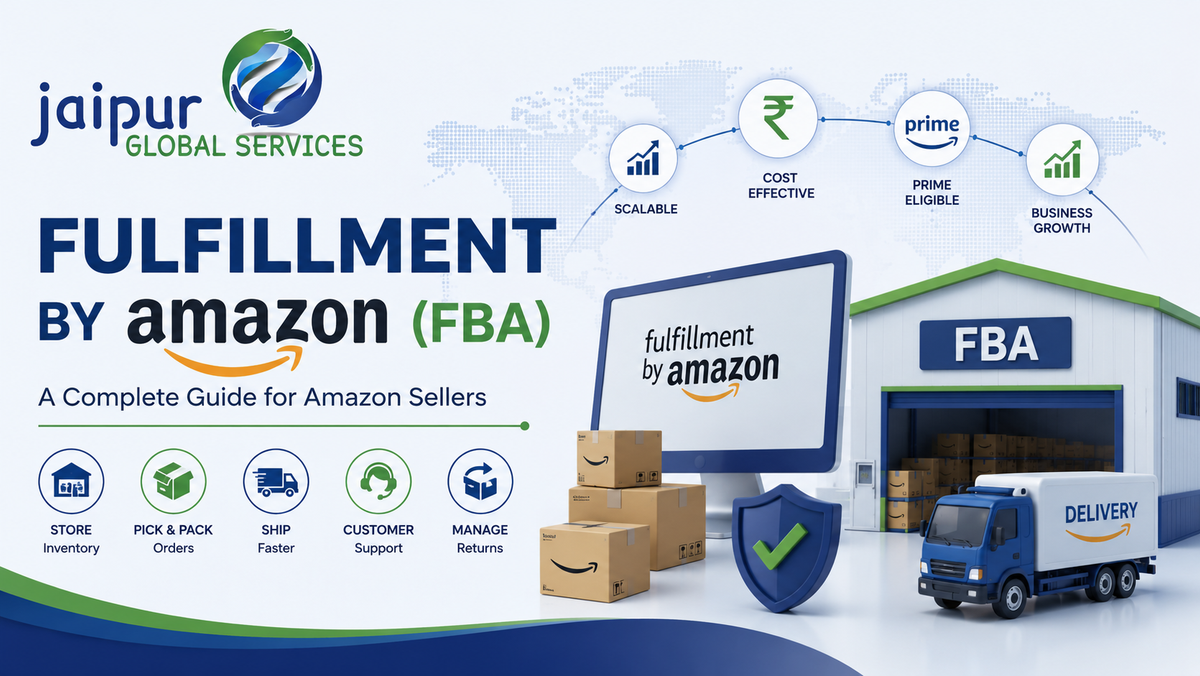
Getting a product listed on Amazon is only the beginning. Once orders start coming in, someone has to store the inventory, pick and pack each order, ship it out, handle customer questions, and process returns when they happen. For a growing seller, this operational side of the business can quickly become as demanding as sourcing and marketing the product itself.
Fulfillment by Amazon (FBA) exists to take a large chunk of this operational burden off a seller's plate. Under FBA, eligible sellers send inventory to Amazon's fulfillment network, and Amazon handles storage, picking, packing, shipping, and much of the customer service and returns process for those orders.
This guide walks through how Amazon FBA actually works, its genuine advantages and real limitations, how fees and inventory management affect profitability, how it compares to other fulfillment approaches, and when it makes sense to bring in professional support for your Amazon operations.
What Is Fulfillment by Amazon (FBA)?
Fulfillment by Amazon is a service that lets eligible sellers store their inventory in Amazon's fulfillment centers, with Amazon then handling the fulfillment activities for orders on that inventory. At a high level, this generally includes:
- Inventory storage in Amazon's fulfillment network
- Order processing
- Picking and packing
- Shipping to the customer
- Customer service related to FBA orders
- Returns processing, according to Amazon's FBA policies
It's worth being clear from the outset: the exact services included, eligibility requirements, and program details can vary by marketplace, product category, and individual seller circumstances. Amazon FBA is a program with specific rules, and those rules do get updated over time — so sellers should always verify current requirements directly through Seller Central rather than relying on older information.
How Does Amazon FBA Work?
The FBA process generally follows a series of steps, each with specific seller responsibilities:
Step 1: Create an Amazon seller account. This is the foundation for selling on Amazon at all, FBA or otherwise.
Step 2: Create or prepare product listings. Listings need to be set up correctly, including accurate titles, images, and product information.
Step 3: Prepare inventory according to Amazon's current requirements. This includes packaging and labeling standards, which sellers need to check against current Seller Central documentation.
Step 4: Create a shipment plan to Amazon. Sellers specify which products and quantities they're sending into the fulfillment network.
Step 5: Send inventory to the designated fulfillment center(s). Amazon determines where inventory should be sent based on its own logistics network.
Step 6: Amazon receives and stores the inventory. Once received, the inventory becomes available for fulfillment against customer orders.
Step 7: A customer places an order. The listing needs to be visible and competitive enough to generate this order in the first place — FBA doesn't create demand.
Step 8: Amazon picks, packs, and ships the order. This happens through Amazon's fulfillment infrastructure, generally without direct seller involvement in each individual order.
Step 9: The customer receives the order.
Step 10: Returns and related customer service are handled according to Amazon's FBA process, when applicable.
Throughout all of this, the seller retains responsibility for product sourcing, listing quality, pricing, advertising, and overall inventory strategy — FBA handles the physical fulfillment, not the business decisions around it.
What Does Amazon Handle Through FBA?
FBA covers the physical fulfillment side of the business:
- Storage of inventory in Amazon's fulfillment centers
- Picking the correct items for each order
- Packing orders for shipment
- Shipping to the customer
- Customer service related to FBA-fulfilled orders
- Returns processing, following Amazon's FBA return policies
It's important not to overstate what this means for the broader business. Even with FBA handling fulfillment, sellers still need to manage:
- Product sourcing and supplier relationships
- Product selection and category decisions
- Pricing strategy
- Listing creation, optimization, and maintenance
- Advertising and marketing
- Inventory planning and forecasting
- Account health and policy compliance
- Overall business strategy and growth planning
FBA solves the "how does this physically get to the customer" problem. It doesn't solve the "will this product sell, at what price, and how do we grow this business" problems — those remain squarely the seller's responsibility.
Benefits of Amazon FBA
Outsourced fulfillment. Sellers avoid the need to manage their own warehousing, packing, and shipping operations for FBA-eligible inventory.
Faster delivery opportunities. FBA inventory is generally positioned to take advantage of Amazon's fast shipping options, though actual delivery speed depends on Amazon's current logistics capabilities and the specific situation.
Reduced operational workload. Sellers spend less time on day-to-day fulfillment tasks, freeing up time for other parts of the business.
Customer service support. Amazon handles a meaningful portion of customer service related to FBA orders.
Returns handling. Returns on FBA orders are processed according to Amazon's established return process, rather than the seller needing to build this from scratch.
Ability to scale order volume. Amazon's fulfillment infrastructure can generally support higher order volumes than most individual sellers could handle independently.
Potential Prime eligibility. FBA inventory may be eligible for Prime and other Amazon delivery promises, subject to Amazon's current eligibility requirements.
Access to established fulfillment infrastructure. Sellers benefit from a logistics network built at a much larger scale than most individual businesses could build themselves.
It's worth being direct: Prime eligibility and delivery speed are not automatic or guaranteed for every product under every circumstance — they depend on current Amazon requirements and specific product situations. Sellers should verify current eligibility criteria rather than assume blanket coverage.
Potential Disadvantages of Amazon FBA
In the interest of giving a balanced picture, FBA also comes with real trade-offs:
- Fulfillment fees apply to FBA orders, affecting per-unit profitability
- Storage fees apply to inventory held in Amazon's fulfillment centers
- Long-term storage or inventory-related costs may apply to slow-moving stock, depending on current Amazon policy
- Less direct control over the fulfillment process compared to handling it yourself
- Inventory management complexity, since inventory sits in Amazon's network rather than under the seller's direct physical oversight
- Product preparation requirements that must be met before shipment, adding upfront work
- Potential for stranded inventory, where products become temporarily unsellable due to listing or catalog issues
- Returns-related considerations, including how returned inventory is handled and its condition
- Cash tied up in inventory, since stock sent to Amazon represents capital that isn't immediately recoverable
None of this means FBA is a poor choice — it means FBA isn't automatically profitable or appropriate for every product or every seller. The decision should be based on a genuine cost-benefit analysis specific to your business.
Amazon FBA Fees Explained
FBA involves several categories of cost that affect overall profitability:
- Selling or referral fees, which Amazon charges as a percentage of the sale, varying by category
- Fulfillment fees, covering the pick, pack, and ship process
- Storage fees, based on how much space inventory occupies and for how long
- Removal or disposal-related fees, which may apply when inventory needs to be removed from Amazon's fulfillment network
- Returns-related costs, which can vary depending on the situation
- Other applicable fees, which can depend on specific programs or circumstances
It's important to be direct here: this article intentionally does not state specific fee amounts, because Amazon's FBA fees vary by marketplace, product category, size, weight, fulfillment method, storage duration, and season — and these figures are updated by Amazon periodically. Stating specific numbers here risks giving sellers outdated or incorrect information. Before shipping any inventory or making profitability decisions, sellers should check Amazon's current official fee schedules directly in Seller Central, since this is the only reliable source for figures that actually apply to your specific products right now.
Amazon FBA Inventory Management
Inventory management is one of the areas where FBA sellers most commonly run into trouble, because it directly affects both cash flow and sales.
Key considerations include:
- Reorder points — knowing when to reorder before running out of stock
- Demand forecasting — predicting future sales based on historical trends and seasonality
- Stock levels — maintaining enough inventory without overstocking
- Slow-moving inventory — identifying products that aren't selling as expected
- Overstock — excess inventory that ties up cash and can incur additional storage costs
- Stockouts — running out of inventory, which halts sales and can hurt organic ranking momentum
- Seasonal demand — planning inventory around predictable demand spikes or dips
- Lead times — accounting for how long it takes to manufacture and ship new inventory to Amazon
The relationship here is straightforward: Inventory → Sales → Cash Flow → Profitability. If a seller overstocks a product that doesn't sell as quickly as expected, cash gets tied up in unsold inventory sitting in a fulfillment center, potentially accumulating storage costs. If a seller understocks a strong-selling product, they lose sales during the stockout period and may lose organic ranking momentum that's difficult to fully recover. Getting this balance right is one of the most financially important parts of running an FBA business.
Amazon FBA Product Preparation
Before inventory can be shipped to Amazon, it needs to be prepared according to Amazon's current requirements. This generally involves:
- Packaging that meets Amazon's specific standards for the product type
- Labeling, including product identification requirements
- Product identification through appropriate barcodes or identifiers
- Shipment preparation, following Amazon's shipping and box requirements
- Restricted or prohibited product considerations, since some products have additional requirements or aren't eligible for FBA at all
It's genuinely important not to rely on older articles or outdated guides for these specifics — packaging and labeling requirements can and do change, and shipping non-compliant inventory can result in delays, additional fees, or rejected shipments. Always verify current requirements directly in Seller Central before preparing and shipping inventory. This is exactly the kind of detail-heavy, frequently-updated area where Amazon FBA prep services can add genuine value for sellers who don't want to track every requirement change themselves.
Amazon FBA vs FBM
Fulfillment by Merchant (FBM) is the alternative model, where the seller handles fulfillment directly rather than through Amazon's network.
Factor
FBA
FBM
Storage
Amazon fulfillment network
Seller or third party
Packing
Amazon
Seller or third party
Shipping
Amazon
Seller or third party
Returns
Amazon processes under FBA policy
Seller manages according to FBM process
Operational control
Lower
Higher
Fulfillment workload
Lower
Higher
Cost structure
FBA fees
Seller's own fulfillment costs
Neither model is automatically the better choice. Some sellers use FBA exclusively, some use FBM exclusively, and many use a hybrid approach — FBA for high-volume or Prime-eligible products, FBM for slower-moving items, oversized products, or products where direct fulfillment control matters more. The right mix depends on product type, margins, order volume, and operational capacity.
Amazon FBA vs Third-Party Fulfillment
Beyond FBA and FBM, some sellers use third-party logistics (3PL) providers or manage fulfillment through their own warehousing, particularly when selling across multiple channels.
Factors worth considering include:
- Control over the fulfillment process and customer experience
- Cost structures, which can differ meaningfully between FBA, FBM, and 3PL arrangements
- Location and how well fulfillment infrastructure matches customer geography
- Customer experience consistency across channels
- Multi-channel fulfillment needs, if selling on Amazon, Shopify, and other channels simultaneously
- Integration with existing systems and processes
- Scalability as order volume grows
Brands selling across Amazon, a Shopify store, and other marketplaces often need to think about fulfillment more holistically than a single-channel Amazon seller would. Relying purely on FBA for Amazon orders while managing separate fulfillment for other channels can work, but it requires careful coordination to avoid inventory and customer experience inconsistencies.
How FBA Affects Amazon Seller Profitability
It's easy to look at a product's selling price and assume that's close to the actual margin. In reality, several layers of cost sit between revenue and profit.
For example, imagine a product selling at ₹1,500. Before arriving at actual profit, a seller needs to account for:
- The product's underlying cost
- Amazon's referral fee
- FBA fulfillment fees
- Storage costs
- Advertising spend tied to that product
- Shipping and preparation costs incurred before sending inventory to Amazon
- The cost impact of any returns
- Other broader business expenses (software, staff time, overhead)
Once all of these are accounted for, the actual profit on that ₹1,500 sale could be considerably lower than it initially appears — sometimes low enough that a product assumed to be profitable actually isn't, once the full cost picture is calculated properly.
There's no universal profit margin benchmark that applies across every product and category — margins vary enormously depending on the product type, competition, and business model. What matters is that sellers actually calculate this fully before assuming FBA (or any fulfillment method) is financially viable for a specific product.
Common Amazon FBA Mistakes
Some recurring mistakes show up frequently among FBA sellers, particularly newer ones:
- Sending too much inventory without accounting for actual demand, tying up cash and risking storage costs
- Running out of stock at critical moments, losing sales and organic momentum
- Ignoring storage costs, especially for slower-moving inventory
- Not calculating FBA fees correctly when setting pricing, eroding margins without realizing it
- Ignoring advertising costs when assessing whether a product is actually profitable
- Poor product preparation, leading to shipment delays or rejected inventory
- Not monitoring stranded inventory, leaving products unsellable due to listing or catalog issues
- Ignoring returns and their impact on actual net profitability
- Not reviewing inventory reports regularly, missing early warning signs of over- or under-stocking
- Treating revenue as profit, leading to poor business decisions based on an incomplete financial picture
- Not monitoring account health, risking performance issues or suspension
- Not forecasting seasonal demand, leading to stockouts or overstock during predictable demand shifts
Each of these mistakes tends to erode profitability or create operational headaches that compound over time if left unaddressed.
Who Should Consider Amazon FBA?
FBA tends to make sense for:
- Sellers with growing order volumes who need scalable fulfillment
- Brands that want to outsource fulfillment rather than build in-house logistics
- Businesses that don't want to operate their own warehouse
- Sellers looking for fulfillment that can scale without major operational investment
- Businesses whose products qualify for relevant FBA programs and eligibility requirements
FBA may be less appropriate for:
- Products with unusual fulfillment requirements that don't fit standard FBA processes
- Very low-margin products, where FBA fees may erode already-thin profitability
- Businesses needing highly specialized fulfillment (temperature control, custom packaging processes, etc.)
- Businesses that require complete control over the fulfillment and customer experience
- Brands selling heavily across multiple non-Amazon channels, where a unified fulfillment approach might make more operational sense
There's no universal answer — it depends on the specific product, margins, and business model.
Amazon FBA for Indian Sellers
For sellers operating on Amazon India, FBA involves the same general principles as elsewhere, with a few India-specific considerations worth keeping in mind:
- Inventory management within Amazon India's fulfillment network
- Product compliance with applicable Indian regulatory requirements for specific product categories
- Fulfillment and returns processes, which follow Amazon India's current policies
- Marketplace fees, which apply to Amazon India transactions
- Seller account management, including maintaining account health under Amazon's Indian marketplace requirements
It's worth being clear about a separate but related topic: GST and broader tax compliance. FBA operations and tax compliance are distinct matters — using FBA doesn't change a seller's underlying GST or income-tax obligations, and this article isn't providing personalized tax advice. Indian ecommerce sellers should consult a qualified tax professional and refer to official government sources for accurate, current guidance on their specific tax obligations, since these can depend on individual business circumstances and can change over time.
Amazon FBA India and Amazon FBA seller India considerations are ultimately about combining Amazon's standard FBA framework with the specific regulatory and marketplace realities of selling in India.
Amazon FBA and International Selling
FBA can be part of a broader international expansion strategy, but it's worth being clear that simply enrolling in FBA doesn't automatically enable international selling — expanding into other Amazon marketplaces involves its own separate requirements.
Considerations for international FBA expansion include:
- Selling in additional Amazon marketplaces beyond your home market
- Managing cross-border inventory logistics
- Understanding international fulfillment processes and timelines
- Customs requirements and documentation
- Tax obligations in each relevant jurisdiction
- Product compliance requirements, which can vary significantly by country
- Currency considerations for pricing and settlements
- Local regulations specific to each target market
International expansion through FBA requires genuine planning around compliance and logistics for each target marketplace — it's a meaningfully bigger undertaking than simply flipping a switch to enable a new country.
When Should You Use Amazon FBA Services?
Beyond the physical fulfillment FBA provides, many sellers look for support managing the broader Amazon operations that surround FBA. This can include:
- Account management
- Inventory planning and forecasting
- Product listing creation and optimization
- Catalog management
- Advertising campaign management
- FBA-related coordination and troubleshooting
- Financial reconciliation
- Performance reporting
- Broader marketplace operations
Amazon FBA services and Amazon FBA management, in this broader sense, often extend well beyond just the physical fulfillment piece — covering the operational and strategic work that determines whether the FBA setup actually supports business growth.
What to Look for in an Amazon FBA Service Provider
If you're considering outsourcing parts of your Amazon operations, a genuinely capable provider should understand:
- Amazon Seller Central and its current tools and reporting
- FBA operations and requirements
- Inventory management principles
- Product listing best practices
- Catalog management
- Amazon advertising
- Account health monitoring
- Current marketplace policies
- Fulfillment workflows
- Clear, regular reporting
Useful questions to ask a potential provider:
- What specific Amazon services do you provide?
- Do you manage FBA-related operations, and if so, which parts?
- How do you monitor inventory levels and forecasting?
- How do you handle listing issues when they arise?
- How do you monitor account health?
- How do you report performance, and how often?
- How do you coordinate with me as the seller?
- What happens when inventory becomes overstocked or stranded?
- How do you handle sellers operating across multiple marketplaces?
- What is specifically included in the service, and what isn't?
How Jaipur Global Services Can Help Amazon Sellers
FBA solves fulfillment, but it doesn't solve listing quality, advertising strategy, account health monitoring, or catalog management — all of which still require ongoing attention for an Amazon business to actually grow.
Jaipur Global Services works with Amazon sellers on account management, product listings, catalogue management, advertising, and broader marketplace management. For sellers using FBA, this kind of support can complement the fulfillment side by helping ensure that listings are optimized, inventory-related listing issues are caught early, advertising is aligned with actual product margins, and account health is being actively monitored rather than left unattended.
It's worth being direct: this doesn't mean Jaipur Global Services operates or manages the physical FBA fulfillment process itself — FBA fulfillment is handled by Amazon directly. What a broader ecommerce and marketplace management partner can support is everything around that fulfillment: the listings, advertising, account management, and catalog work that determines whether an FBA-based business actually performs well. No guarantee of sales, rankings, or profitability should be assumed, and no partnership or certification claims should be taken as verified beyond what's actually stated on https://jgservices.in/.
Amazon FBA Seller Checklist
Before using FBA:
- Product eligibility for FBA checked
- Product margins calculated, including all applicable fees
- Current FBA fees reviewed in Seller Central
- Inventory forecast created based on realistic demand estimates
- Current packaging requirements checked
- Current product labeling requirements checked
- Shipment plan created
- Listing optimized before launch
- Pricing reviewed against full cost structure
After starting FBA:
- Inventory levels monitored regularly
- FBA fees reviewed periodically for changes
- Storage costs monitored, especially for slower-moving SKUs
- Returns monitored and factored into profitability
- Stranded inventory checked and resolved promptly
- Sales tracked against forecasts
- Advertising costs reviewed against actual margins
- Profitability recalculated periodically, not assumed to be static
- Account health monitored consistently
- Reorder planning maintained proactively rather than reactively
FAQ’s
What is Fulfillment by Amazon?
Fulfillment by Amazon is a program where sellers send inventory to Amazon's fulfillment centers, and Amazon handles storage, picking, packing, shipping, and much of the customer service and returns for those orders.
How does Amazon FBA work?
Sellers create listings, prepare and ship inventory to Amazon's fulfillment network, and Amazon then picks, packs, and ships orders as they come in, while also handling related customer service and returns.
Is Amazon FBA worth it for sellers?
It can be worth it for many sellers, particularly those with growing order volumes who want to reduce fulfillment workload, but profitability depends on product margins, fees, and how well inventory is managed — it isn't automatically worthwhile for every product.
How much does Amazon FBA cost?
Costs vary by product category, size, weight, and storage duration — always check Amazon's current official fee schedule in Seller Central for accurate, up-to-date figures for your specific products.
What fees does Amazon FBA charge?
FBA fees generally include referral fees, fulfillment fees, and storage fees, with possible additional costs for long-term storage or removals — exact amounts depend on current Amazon fee schedules.
What is the difference between FBA and FBM?
FBA means Amazon handles storage and fulfillment; FBM means the seller handles fulfillment directly. Neither is universally better — the right choice depends on product type, margins, and operational capacity.
Does Amazon FBA handle returns?
Yes, FBA orders are typically returned according to Amazon's established FBA return process, though specific outcomes can depend on the situation and current policy.
How do I manage inventory with Amazon FBA?
Effective inventory management involves demand forecasting, monitoring reorder points, tracking slow-moving stock, and planning around seasonal demand to avoid both overstock and stockouts.
Can Indian sellers use Amazon FBA?
Yes, Indian sellers can use FBA through Amazon India, subject to Amazon's current eligibility and program requirements for that marketplace.
What services can an Amazon FBA management company provide?
An Amazon FBA management provider can typically support account management, listing optimization, catalog management, advertising, and inventory coordination — though the physical fulfillment itself remains handled by Amazon.
Conclusion
Fulfillment by Amazon can meaningfully reduce the operational burden of running an Amazon business by letting Amazon's fulfillment infrastructure handle storage, picking, packing, shipping, and much of customer service and returns. For a lot of growing sellers, that's a genuinely valuable trade-off.
But FBA is a fulfillment method — not a complete Amazon growth strategy. Successful FBA selling still depends on having a genuinely good product, accurate and optimized listings, sound inventory planning, real profitability analysis, effective advertising, active account management, ongoing compliance, and consistent performance monitoring. FBA handles the "how does this get to the customer" question; it doesn't answer the harder questions about whether the underlying business is actually working.
If you're evaluating whether FBA makes sense for your products, or you're already using FBA but want stronger support across listings, advertising, and account management, it's worth looking at your Amazon operations as a whole rather than fulfillment in isolation. You're welcome to explore Jaipur Global Services Amazon seller and marketplace management services to see if that kind of support fits what your business currently needs.