
Accounting and Taxation Services for Ecommerce Sellers: A Complete Guide
 June 1, 2026
 Yashwardhan Singh
 0 Comments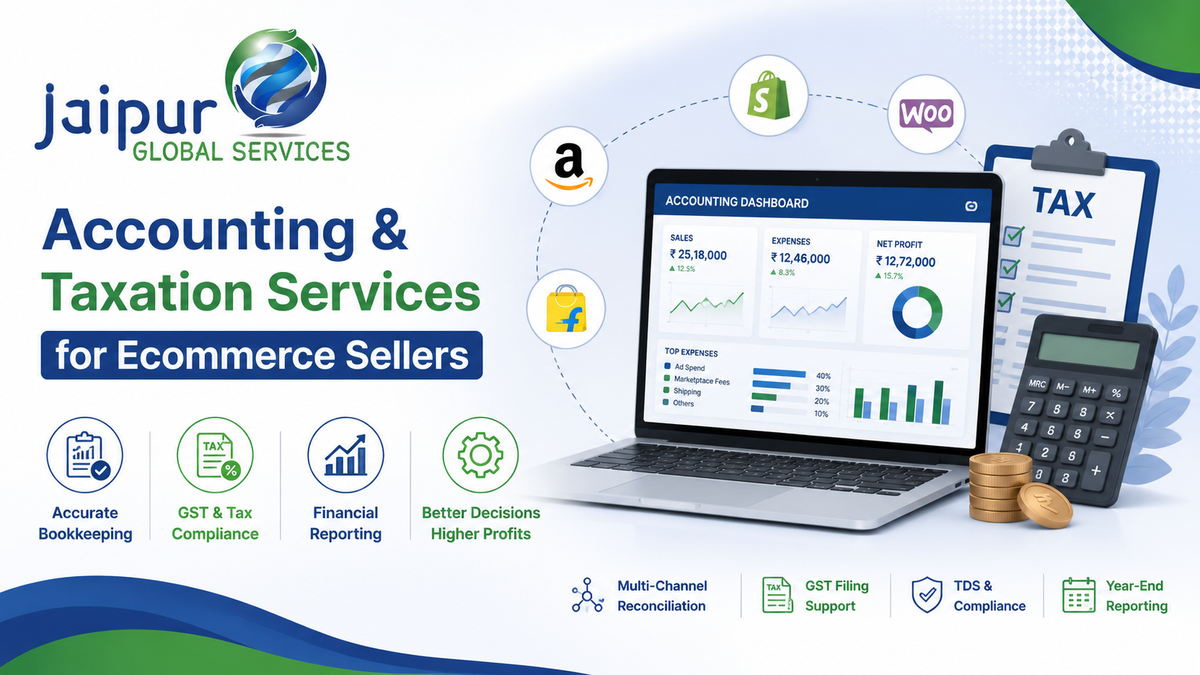
A seller can be doing genuinely good business — solid sales on Amazon, steady orders from a Shopify store, decent traffic and repeat customers — and still have almost no real clarity on whether the business is actually profitable. Money moves in from marketplace settlements, payment gateways, and direct payments. Money moves out for inventory, advertising, shipping, platform fees, and returns. What lands in the bank account at the end of the month rarely matches what most owners assume it represents.
This gap is the reason ecommerce accounting exists as its own specialized discipline rather than just "accounting, but for an online business." The transactions themselves are more fragmented, the fee structures are more layered, and the reconciliation work required to understand actual profit is genuinely more involved than most sellers expect when they start out.
This guide walks through what ecommerce accounting services actually cover, why marketplace and multi-channel selling complicates standard bookkeeping, what Indian ecommerce sellers should understand about GST and related tax obligations at a general level, and how to evaluate whether outsourced support makes sense for your business.
A note before we start: this article is educational, not personalized tax or legal advice. Tax rules, rates, thresholds, and filing requirements can change and can depend heavily on your specific business circumstances. For anything tax-specific to your business, consult a qualified CA or tax professional and refer to official sources like the GST portal, CBIC, or the Income Tax Department.
What Is Ecommerce Accounting?
Ecommerce accounting involves recording, organizing, reconciling, and analyzing the financial transactions generated by an online business. It covers the same fundamental purpose as any accounting function — accurate financial records — but applied to a business model with more moving parts than a typical brick-and-mortar operation.
For an ecommerce business, this generally includes:
- Sales across one or more channels
- Marketplace and platform fees
- Payment gateway charges
- Inventory purchases and movement
- Cost of goods sold (COGS)
- Returns and refunds
- Advertising spend
- Shipping and fulfillment costs
- Applicable taxes
- Payouts and settlement timing
Accounting for ecommerce isn't just about entering numbers into a spreadsheet or accounting software — it's about correctly interpreting what each transaction actually represents, since a single marketplace order can generate several distinct financial events (the sale, the fee deduction, a possible return, a possible ad cost tied to that sale) that all need to be captured accurately.
How Is Ecommerce Accounting Different From Traditional Accounting?
A traditional business — say, a local service provider — often has relatively straightforward revenue and expense flows: an invoice goes out, payment comes in, expenses are paid directly.
Ecommerce businesses typically deal with a more layered set of financial events:
- Multiple sales channels, each with different reporting formats
- High transaction volume, sometimes thousands of small orders per month
- Marketplace commissions deducted before payout
- Payment gateway fees deducted from processed amounts
- Returns and refunds that need to be tracked separately from original sales
- Inventory that moves between purchase, storage, and fulfillment
- Shipping costs that vary by order
- Advertising spend that needs to be tied back to specific sales performance
- Payout cycles that don't align with when the sale actually happened
Here's a simple example of why this matters: if a seller simply records the amount that lands in their bank account from an Amazon settlement as "revenue," they're actually recording a net figure — after commission, fulfillment fees, and any refund adjustments have already been deducted. That number tells you what you received, but it doesn't tell you what you actually sold, what fees you paid, or where your margin is being eroded. Proper ecommerce accounting separates these out, so each piece is visible rather than bundled into a single deposit figure.
What Does Ecommerce Bookkeeping Include?
Ecommerce bookkeeping services typically cover the day-to-day recording and organizing work that feeds into accurate financial reporting:
- Recording sales, broken out by channel
- Categorizing expenses consistently
- Reconciling marketplace payouts against actual orders
- Reconciling payment gateway settlements
- Recording marketplace and platform fees separately from revenue
- Tracking refunds and returns
- Tracking shipping and fulfillment costs
- Tracking advertising expenses
- Recording inventory purchases
- Monitoring accounts payable and receivable where relevant
- Preparing regular financial reports
Good ecommerce bookkeeping isn't a once-a-year task done before tax filing — it works best as an ongoing process, since fees, returns, and reconciliation issues compound quickly when left unaddressed for months at a time.
Why Marketplace Reconciliation Is Important
Marketplace reconciliation is one of the areas where ecommerce accounting differs most clearly from simpler business models.
Consider a straightforward example: a customer buys a product listed at ₹2,000. Before the seller actually receives that money, the marketplace may deduct several things — a marketplace commission, fulfillment or shipping charges, any advertising or promotional deductions tied to that sale, and potentially a refund adjustment if a related return occurred. What actually lands in the seller's account might be meaningfully lower than the original ₹2,000 order value.
If a seller's books only record the final payout figure, the accounting will show incomplete information — it won't distinguish between gross sales, the fees that reduced that amount, and the net amount received. This matters for understanding true margins, for accurately calculating tax obligations, and for spotting fee patterns that might be worth addressing (for example, unusually high return-related deductions in a specific category).
Amazon payout reconciliation, along with reconciliation of other marketplace settlements and payment gateways, means matching each individual transaction — the sale, the fees, any refunds — against what was actually deposited, rather than treating the deposit itself as the whole story.
Ecommerce Inventory Accounting and COGS
Inventory is one of the most financially significant — and most commonly mismanaged — areas for ecommerce sellers.
Proper ecommerce inventory accounting involves tracking:
- Inventory purchases
- Opening and closing inventory values
- Cost of goods sold (COGS)
- Freight costs
- Applicable duties, where relevant
- Storage costs
- Fulfillment-related costs
Here's why this matters for understanding actual profitability: imagine a seller with ₹10 lakh in total sales for a month. That figure alone tells you very little about whether the business made money. Once you subtract the actual product cost, marketplace fees, advertising spend, shipping costs, the cost of processed returns, and other operating expenses, the real profit could be a small fraction of that ₹10 lakh — or, in a poorly managed situation, close to nothing at all.
Sellers who only track top-line sales, without properly accounting for COGS and inventory movement, often have a distorted sense of how healthy their business actually is.
How Returns and Refunds Affect Ecommerce Accounting
Returns are a normal part of ecommerce, but they add real complexity to financial records if not handled carefully.
Relevant factors include:
- Refunds issued to customers
- Returned inventory that needs to be tracked back into stock (or written off if damaged)
- Damaged goods that can't be resold
- Restocking costs
- Return-related shipping costs
- Marketplace adjustments tied to the original sale
- Chargebacks, where applicable
A business can show strong headline sales numbers while actually carrying a meaningful hidden cost from returns that haven't been properly reconciled. Accurate accounting means returns are tracked against the original sale, not left as a separate, disconnected adjustment that never gets reflected in true profitability figures.
Accounting for Amazon Sellers
Amazon selling introduces its own set of recurring financial considerations. Depending on the seller's specific program and category, these can include:
- Sales revenue
- Fulfillment fees, where using Amazon's fulfillment programs
- Referral fees
- Storage-related costs, where applicable
- Returns and related reimbursements
- Advertising costs
- Marketplace settlement timing
- Inventory movement and valuation
It's worth being clear that exact fees, fee structures, and program terms vary by product category, fulfillment method, marketplace, and individual seller circumstances — this article isn't stating specific fee amounts, since these are set and updated by Amazon directly. Sellers should refer to their own Seller Central account and Amazon's current fee schedules for exact, up-to-date figures relevant to their business.
Amazon seller accounting and Amazon bookkeeping services generally focus on making sense of the settlement reports Amazon provides — breaking down what looks like a single payout into the individual sales, fees, and adjustments that actually make it up.
Accounting for Shopify and D2C Businesses
Shopify and other direct-to-consumer setups bring a different but related set of accounting considerations:
- Order revenue
- Payment gateway processing (Razorpay, Stripe, PayPal, and similar)
- Refunds and discounts
- Shipping costs
- Payment processing fees
- Inventory
- Advertising spend
- Multiple currencies, for brands selling internationally
Shopify accounting isn't simply a matter of taking total Shopify revenue and subtracting expenses. Payment gateways deduct their own processing fees before settlement, discounts reduce the actual transaction value versus the listed price, and D2C brands often run more concentrated advertising spend that needs to be properly tracked against actual sales performance. Shopify bookkeeping needs to account for each of these layers individually rather than working from a single net revenue figure.
Accounting for Multi-Channel Ecommerce Businesses
Many ecommerce businesses don't sell through just one channel — they might run Amazon, Flipkart, a Shopify store, and possibly WooCommerce or other platforms simultaneously. This adds real complexity:
- Multiple payout schedules, each with different timing
- Multiple, differently structured fee arrangements
- Different reporting formats across platforms
- The need to track sales performance by individual channel
- Inventory that needs to be synchronized across channels
- Reconciliation work multiplied across each platform separately
Without a consolidated view, it becomes genuinely difficult to know which channels are actually profitable and which are simply generating sales volume without meaningful margin. Marketplace accounting, done properly across multiple channels, brings these separate data sources together into a single, coherent financial picture — supporting better ecommerce financial management overall.
GST and Taxation for Indian Ecommerce Sellers
For Indian ecommerce sellers, understanding applicable GST and related tax obligations is an important part of running a compliant business. At a general level, this can involve:
- GST registration, which may be required depending on the seller's turnover, business structure, and the marketplaces or channels used
- GST invoicing, ensuring that sales are documented in line with applicable GST invoice requirements
- GST returns, filed periodically as required under current GST law
- TCS (Tax Collected at Source), which can apply in the context of ecommerce operator transactions under applicable provisions
- TDS (Tax Deducted at Source), which may apply under certain provisions relevant to ecommerce transactions
- Input Tax Credit, where eligible, which can affect a business's overall GST liability
- Marketplace reporting requirements that ecommerce operators may need to fulfill
- Reconciliation between marketplace-reported sales data and a seller's own GST filings
This is intentionally a general overview rather than a specific rulebook — GST registration thresholds, applicable rates, TCS and TDS provisions, filing frequencies, and related requirements can vary depending on a seller's turnover, business structure, product category, and the specific platforms they sell through, and these rules can also be updated over time. For current, accurate information, sellers should refer to the official GST portal, CBIC guidance, and Income Tax Department resources, and consult a qualified CA or tax professional for advice specific to their business.
Ecommerce GST services and broader ecommerce tax compliance support generally focus on helping sellers organize their sales and settlement data in a way that supports accurate GST filing — but the filing and interpretation of tax obligations themselves should always involve a qualified tax professional.
What Is Ecommerce Tax Accounting?
It's worth distinguishing between two related but different functions:
Accounting focuses on accurately recording and reporting a business's financial transactions — what was sold, what was spent, what the business actually earned.
Tax compliance focuses on meeting the business's applicable tax obligations based on those financial records — filing GST returns, handling TCS/TDS where relevant, and meeting income-tax requirements.
These two areas work closely together: accurate accounting is the foundation that makes tax compliance possible. Ecommerce tax services and ecommerce tax accounting typically involve organizing financial data clearly enough that a business's tax positions can be determined and filed correctly and on time, in coordination with a qualified tax professional.
Key Financial Reports Ecommerce Sellers Should Track
Beyond just watching the bank balance, a handful of core reports give a much clearer view of business health:
- Profit and Loss Statement — revenue, expenses, and resulting profit or loss over a period
- Balance Sheet — assets, liabilities, and equity at a point in time
- Cash Flow Statement — how cash is moving in and out of the business
- Sales reports, broken down by channel and product
- Inventory reports, showing stock levels and movement
- Marketplace settlement reports, detailing fees and deductions
- Expense reports, categorized clearly
- COGS reports
- Tax reports, supporting GST and other filings
A few metrics worth tracking beyond gross sales:
- Gross margin — revenue minus COGS, as a percentage
- Net margin — profit after all expenses, as a percentage
- Contribution margin — revenue minus variable costs
- Average order value
- Inventory turnover — how quickly stock is sold and replaced
- Cash conversion cycle — how long cash is tied up in inventory before being recovered through sales
Sellers don't need to track every possible metric, but relying only on gross sales figures tends to hide the real financial picture of the business.
Common Ecommerce Accounting Mistakes
Some recurring issues show up across a lot of growing ecommerce businesses:
- Treating marketplace payouts as total revenue, missing the fees already deducted
- Ignoring marketplace fees as a distinct, trackable cost
- Not reconciling payment gateways against actual orders
- Poor inventory tracking, leading to inaccurate COGS
- Ignoring COGS entirely when assessing profitability
- Mixing personal and business expenses, which muddies financial reporting
- Not recording returns correctly, overstating actual sales performance
- Ignoring advertising costs when calculating true product-level margin
- Failing to track applicable taxes consistently throughout the year
- Using inconsistent bookkeeping categories month to month
- Not reconciling across multiple sales channels, missing the full picture
- Looking only at sales instead of actual profit, mistaking revenue growth for business health
Each of these can quietly distort a seller's understanding of how the business is actually performing — sometimes for months before the problem becomes obvious.
When Should an Ecommerce Business Hire an Accountant?
Outsourced accounting support tends to make practical sense when:
- Transaction volume is increasing and becoming harder to track manually
- The business sells across multiple channels
- Inventory has become genuinely difficult to track accurately
- Marketplace settlements are complex enough to cause reconciliation issues
- GST or other tax compliance is becoming harder to manage confidently
- The owner is spending significant time on bookkeeping instead of running the business
- Financial reports are inconsistent or unreliable
- Actual profit margins aren't clear
- The business is expanding into new markets or currencies
- Better financial planning and forecasting are needed
That said, not every ecommerce business needs outsourced accounting immediately — a smaller, single-channel seller with straightforward operations may manage well with basic in-house bookkeeping and periodic CA support for filings.
What to Look for in Ecommerce Accounting Services
A genuinely capable provider should understand:
- Ecommerce platforms specifically, not just general small-business accounting
- Marketplace settlement structures
- Payment gateway reconciliation
- Inventory and COGS tracking
- Returns and refund handling
- Marketplace fee structures
- Advertising expense tracking
- Applicable GST and tax requirements
- Clear, regular financial reporting
Useful questions to ask a potential provider:
- Do you understand Amazon, Shopify, or other marketplace-specific accounting?
- How do you handle payout reconciliation?
- How do you track inventory and COGS?
- What reports will I actually receive, and how often?
- Do you support GST or broader tax compliance, and how?
- How frequently are accounts reconciled?
- Can you support multiple sales channels simultaneously?
- Who specifically handles tax filing — is this in-house or coordinated with a CA?
- What information or access will you need from me?
- What exactly is included in the service, and what isn't?
In-House vs Outsourced Ecommerce Accounting
Neither approach is universally better — it depends on the business.
In-house accounting
Potential advantages:
- Direct, immediate control over the process
- Easy internal communication
- Deep internal knowledge of the business
Potential limitations:
- Hiring and salary costs
- Time needed for training on ecommerce-specific processes
- Ongoing management overhead
- The need for genuinely ecommerce-specific expertise, which isn't always easy to find or develop internally
Outsourced ecommerce accounting
Potential advantages:
- Specialized ecommerce-specific expertise
- Flexible support that can scale with the business
- Reduced day-to-day workload on the internal team
- Processes already built around marketplace and multi-channel accounting
Potential limitations:
- Requires clear, consistent communication to work well
- Provider selection genuinely matters — not all providers understand ecommerce specifics
- Business financial information needs to be shared securely and thoughtfully
The right choice depends on business size, complexity, budget, and how much in-house expertise is realistically available.
How Jaipur Global Services (JGS) Can Support Ecommerce Sellers
Ecommerce accounting depends heavily on having organized, accurate underlying data — clean sales records, properly tracked marketplace fees, consistent inventory data, and clear visibility across sales channels. A lot of the financial confusion sellers experience actually starts upstream of the accounting itself, in how marketplace accounts, listings, and operations are managed day to day.
Jaipur Global Services works with ecommerce sellers on marketplace management and ecommerce operations, including Amazon account management, seller support, and broader ecommerce consulting. The relevant connection here is straightforward: better-organized marketplace operations — consistent order and settlement data, properly managed listings and inventory tracking — make the accounting and financial reporting process considerably more manageable, whether that accounting work is handled in-house or by a specialized accounting provider.
It's worth being direct: this article does not claim that Jaipur Global Services provides CA services, GST filing, income-tax filing, or other direct accounting/taxation services — only verified information from jgservices.in should determine that, and this content isn't representing Jaipur Global Services as a tax or accounting firm. Sellers looking specifically for CA, GST filing, or tax preparation services should engage a qualified accounting professional for that work directly. Where Jaipur Global Services can be genuinely useful is on the ecommerce operations side — the marketplace management, account handling, and broader ecommerce consulting that ultimately feeds cleaner data into whatever accounting process a seller uses.
Ecommerce Accounting Checklist
Every ecommerce seller should regularly review:
- Sales by channel
- Marketplace payouts
- Payment gateway settlements
- Marketplace fees
- Advertising costs
- Shipping and fulfillment costs
- Returns and refunds
- Inventory levels and movement
- COGS
- GST records
- TDS/TCS records, where applicable
- Profit and loss statement
- Cash flow
- Outstanding payments
- Overall financial reports
3. FAQ Questions
What are ecommerce accounting services?
Ecommerce accounting services cover the recording, reconciliation, and reporting of financial transactions specific to online selling — including marketplace fees, inventory, COGS, returns, and applicable taxes.
Why is ecommerce accounting different from traditional accounting?
Traditional accounting typically deals with simpler, more direct revenue and expense flows, while ecommerce accounting involves multiple sales channels, marketplace fee deductions, returns, and more complex reconciliation.
What does an ecommerce bookkeeper do?
An ecommerce bookkeeper records sales, categorizes expenses, reconciles marketplace and gateway payouts, tracks inventory and returns, and prepares regular financial reports.
How does Amazon seller accounting work?
Amazon seller accounting involves reconciling settlement reports against actual orders, tracking applicable fees, and correctly recording revenue, returns, and advertising costs — exact fee structures vary by category and program.
What is marketplace payout reconciliation?
It's the process of matching marketplace payout amounts against the individual sales, fees, and refund adjustments that make up that payout, rather than treating the deposit as the full transaction picture.
Do ecommerce sellers need GST accounting support?
Many ecommerce sellers benefit from support with GST-related recordkeeping and reconciliation, though specific requirements depend on individual business circumstances — consult a qualified tax professional for guidance specific to your business.
What is ecommerce tax accounting?
It refers to the tax compliance side of ecommerce finances — using accurate financial records to meet applicable GST, TDS/TCS, and income-tax obligations.
When should an ecommerce business hire an accountant?
Generally when transaction volume grows, multiple channels are involved, reconciliation becomes time-consuming, or tax compliance and financial visibility start feeling unmanageable in-house.
How is Shopify accounting different from Amazon accounting?
Amazon accounting centers heavily on marketplace settlement reconciliation and platform-specific fees, while Shopify accounting focuses more on payment gateway reconciliation, discounts, and direct-to-consumer cost structures.
Can ecommerce accounting help identify actual profit?
Yes — proper ecommerce accounting separates revenue from fees, COGS, returns, and other costs, giving a much clearer view of actual profit rather than just gross sales.
Conclusion
Ecommerce accounting is not simply a matter of recording sales and expenses in a spreadsheet. A growing online business genuinely needs clear visibility into revenue by channel, marketplace fees, inventory and COGS, returns, advertising spend, applicable taxes, payout timing, and — ultimately — actual profitability, not just top-line sales.
Specialized ecommerce accounting services exist because the standard approach to small-business bookkeeping often doesn't hold up well against the complexity of multi-channel, marketplace-driven selling. Getting this right gives sellers a much clearer basis for real business decisions, rather than guessing based on bank balances alone.
If your ecommerce operations feel disorganized in ways that are making financial visibility harder — scattered marketplace data, inconsistent listings, or account management that's eating up time better spent elsewhere — it may be worth looking at the operational side of the business alongside the accounting itself. You're welcome to explore Jaipur Global Services ecommerce marketplace management and consulting services to see if that kind of support fits what your business currently needs — and to pair that with a qualified accounting or tax professional for the financial and compliance side.