
Ecommerce Product Listing Services for Growing Online Businesses
 June 1, 2026
 Yashwardhan Singh
 0 Comments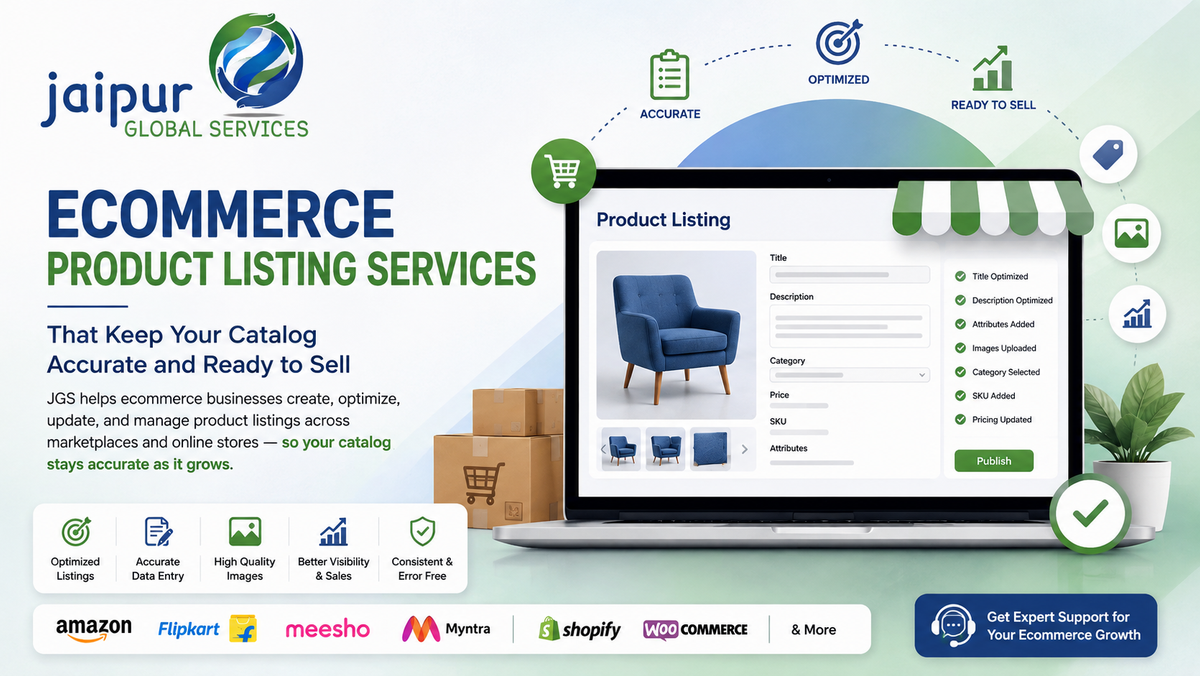
Ecommerce Product Listing Services That Keep Your Catalog Accurate and Ready to Sell
JGS helps ecommerce businesses create, optimize, update, and manage product listings across marketplaces and online stores — so your catalog stays accurate as it grows, instead of becoming harder to manage with every new SKU or channel.
Get Started Talk to an Ecommerce Expert
What Are Ecommerce Product Listing Services?
Ecommerce product listing services cover the work involved in creating, uploading, optimizing, updating, and maintaining product information across ecommerce websites and marketplaces. A single listing typically includes several connected pieces of information, and getting each one right matters: product title, description, features, images, pricing, SKU, category, attributes, variations, specifications, search terms, and brand information.
None of these exist in isolation. A title that doesn't match a product's actual attributes creates confusion. An image that doesn't reflect the listed specifications leads to returns. Accurate, consistent product information helps customers understand exactly what they're buying, and it helps businesses maintain a catalog that stays reliable as it grows — rather than accumulating small inconsistencies that become harder to untangle over time.
Product listing services matter most when a catalog reaches a size or complexity where doing this manually, listing by listing, stops being realistic — which for a lot of growing sellers happens faster than expected.
Why Product Listings Matter for Ecommerce Businesses
The connection between listing quality and business performance runs in a fairly direct line: product information shapes customer understanding, which affects whether someone clicks through, which affects whether that click turns into a sale, which ultimately reflects back on the overall quality of the catalog.
Better product discoverability. Complete, accurate product data — the right category, filled-in attributes, relevant search terms — is what makes a product findable in the first place, both through marketplace search and general web search.
Clearer product information. A well-written listing answers a customer's questions before they have to ask, reducing the hesitation that leads to cart abandonment.
Better customer experience. Customers who understand exactly what they're buying are less likely to be surprised — and disappointed — when the product arrives.
Consistent brand presentation. Across a catalog with many products, consistent formatting and tone make a business look more credible and easier to trust.
Fewer catalog errors. Careful, structured listing management catches problems — missing fields, incorrect categories, mismatched attributes — before they affect live listings.
Easier marketplace management. A well-organized catalog is simply easier to update, expand, and troubleshoot than one that's grown without much structure.
Better conversion potential. Complete, well-optimized listings tend to convert better than incomplete ones — though it's worth being clear that listing quality is one factor among several (price, reviews, competition, and demand all play a role too), not a guarantee of higher rankings or sales on its own.
What Is Included in JGS Ecommerce Listing Services?
Product Listing Creation. Product information gets organized and uploaded in a structured way, whether you're launching a new product or building out an entirely new catalog.
Product Data Entry. Careful, accurate entry of product information — titles, specifications, pricing, and every other required field — with attention to getting the details right the first time.
Product Title Optimization. Titles are built to be clear and relevant, reflecting both what the product actually is and how customers search for it, adapted to each marketplace's specific title requirements.
Product Description Optimization. Descriptions are written to communicate product benefits, specifications, and the information customers actually need to make a buying decision — not filled with vague, generic phrasing that doesn't tell a customer anything useful.
Product Attribute Management. Size, color, material, weight, dimensions, compatibility, and other category-specific attributes are filled in and kept consistent, since incomplete attributes are one of the most common reasons listings underperform in search and filtering.
Product Categorization. Products get placed in the categories and subcategories that actually match how customers browse and search, rather than a default or convenient choice that hurts visibility.
Product Image Management. Images are uploaded and organized according to each marketplace's specific requirements — sizing, background, and formatting rules vary by platform, and getting this wrong can mean a listing gets rejected or simply looks unprofessional next to competitors.
SKU and Variation Management. Parent and child listing structures, where relevant, are set up and maintained so that size, color, or style variations are organized properly rather than fragmented into confusing, disconnected listings.
Bulk Product Upload. Large catalogs can be uploaded and maintained efficiently, which matters considerably for businesses with hundreds or thousands of SKUs where manual, one-by-one uploads simply aren't practical.
Catalog Updates. Ongoing changes — price adjustments, inventory updates, new images, revised descriptions, attribute corrections — are handled as an ongoing part of the service, not a one-time setup that's forgotten afterward.
Catalog Quality Checks. Listings are reviewed for missing information, duplicate data, incorrect attributes, formatting issues, broken content, and inconsistencies across the catalog — catching problems before they affect customer experience or marketplace compliance.
Ecommerce Product Listing Services Across Multiple Marketplaces
Different marketplaces structure listings differently — categories, required attributes, content policies, image specifications, and variation structures all vary from one platform to the next. This means copying the exact same listing content across every channel usually isn't the right approach, even for the same physical product.
Amazon, Flipkart, Walmart, Shopify, and other marketplaces each have their own rules for what a compliant, well-optimized listing actually looks like. A title format that works well on Amazon might not fit Flipkart's structure. An attribute set required on one platform might not even exist as a field on another. Marketplace listing services that account for these differences — rather than treating every channel identically — tend to produce listings that actually perform on each specific platform, instead of a generic listing that technically works everywhere but excels nowhere.
For businesses managing more than one channel, this is really where ecommerce marketplace management services become valuable: coordinating listing quality and consistency across platforms while still respecting each one's specific requirements.
Amazon Product Listing Services
Amazon rewards complete, well-structured listings, and JGS has built deep, direct experience with the platform — including as part of Amazon's Service Provider Network for more than nine years, and as an Amazon-authorised Private Brand Sourcing Partner. Amazon product listing services cover:
- Product titles built around both clarity and Amazon-specific search behavior
- Bullet points that communicate key product benefits clearly
- Product descriptions, including support for Enhanced Brand Content (EBC) and A+ Content for eligible brands
- Backend search terms, where applicable, to support discoverability without violating Amazon's content policies
- Images formatted to Amazon's specific requirements
- Product attributes and variations, structured correctly for Amazon's system
- Category selection aligned with Amazon's taxonomy
- Ongoing catalog updates as pricing, inventory, or product details change
- Listing quality checks to catch issues before they affect visibility or compliance
Amazon listing optimization services are exactly that — optimization, not a guarantee. No provider can promise a specific ranking outcome on Amazon, since ranking depends on factors beyond listing content, including price, reviews, and advertising performance. What structured Amazon product listing optimization does offer is a listing built to perform as well as it can on the factors actually within your control.
Flipkart Product Listing Services
Flipkart has its own structure for product information, categories, and attributes, distinct from Amazon's. Flipkart product listing services cover organizing product information according to Flipkart's specific category and attribute requirements, writing product descriptions suited to the platform, managing images to Flipkart's specifications, structuring product variations correctly, and handling ongoing catalog updates. Flipkart catalogue management also extends to Flipkart Product Listing Optimization (PLA) work, aimed at improving how existing listings are structured and presented within Flipkart's system.
Walmart Product Listing Services
Walmart Marketplace has its own listing structure, category system, and content requirements, distinct from both Amazon and Flipkart. Walmart product listing services cover organizing product content, managing categories and attributes, handling images according to Walmart's specifications, and maintaining catalog accuracy on an ongoing basis as products, pricing, or inventory change.
Shopify Product Listing and Catalog Management
Shopify works differently from a marketplace, since you're managing your own store rather than competing for visibility inside someone else's platform. Shopify product listing services cover product titles and descriptions written for your own storefront, product images organized for your specific theme and layout, collections structured to help customers browse logically, variants set up properly across sizes, colors, or other options, tags and product types organized for internal management and customer-facing filtering, SKU organization, and ongoing catalog updates as your product range changes. Shopify product catalog management is particularly relevant for D2C brands running a growing product range on their own store, where catalog structure directly affects how easily customers can browse and find what they're looking for.
Product Listing Optimization vs Product Listing Creation
These two services solve related but different problems, and it's worth understanding which one your business actually needs.
Product Listing Creation
Product Listing Optimization
Creates initial product content
Improves existing content
Uploads product information from scratch
Improves titles and descriptions already live
Adds images for the first time
Improves how existing images are presented
Adds attributes to a new listing
Corrects missing or weak attributes on live listings
Creates catalog structure for new products
Improves the quality of an existing catalog
A business launching a new product line typically needs listing creation. A business with an existing catalog that's underperforming — vague descriptions, missing attributes, poor images — typically needs optimization. Many growing businesses need both at once: creation for new products entering the catalog, and optimization for older listings that haven't kept pace with the rest of the catalog's quality.
Why Outsource Ecommerce Product Listing Management?
Saves internal team time. Listing creation and maintenance is detailed, repetitive work — outsourcing it frees internal staff to focus on other parts of the business.
Handles large catalogs. A catalog with hundreds or thousands of SKUs needs a structured process to manage well, which is exactly what dedicated listing management is built for.
Improves consistency. A dedicated team working from a defined process tends to produce more consistent results across a catalog than ad hoc, split-between-different-people internal handling.
Reduces repetitive manual work. Bulk upload and structured catalog processes handle repetitive tasks more efficiently than manual, one-by-one listing work.
Supports marketplace expansion. Adding a new marketplace means learning that platform's specific listing requirements — a provider already familiar with multiple platforms can shorten that learning curve considerably.
Helps maintain catalog accuracy. Ongoing quality checks catch errors and inconsistencies before they sit live on a marketplace for an extended period.
Allows internal teams to focus on growth. Time not spent on manual listing upkeep can go toward strategy, sourcing, or other growth-focused work.
Supports ongoing catalog updates. Pricing, inventory, and product details change regularly — outsourced listing management keeps this maintained as a continuous process rather than something that gets deprioritized internally.
It's worth being direct about one thing: outsourcing doesn't automatically reduce costs. For some businesses it does, particularly once internal time costs are factored in; for others, especially very small catalogs, managing listings internally may still make more sense. The right call depends on catalog size, internal capacity, and how much of this work is realistically getting done well in-house right now.
Ecommerce Catalog Management for Large Product Catalogs
Large catalogs create a specific set of challenges that don't really show up at a smaller scale: thousands of SKUs to track, product variations that multiply the number of individual listings involved, multiple marketplaces each with their own requirements, frequent price updates, inventory changes that need to stay in sync, product discontinuations that need to be handled cleanly, new product launches that need to be onboarded consistently, and attribute changes that need to propagate correctly across every affected listing.
Structured ecommerce catalog management addresses this by treating the catalog as a coordinated system rather than a collection of individual listings managed independently. This is where the difference between ad hoc listing work and genuine ecommerce catalog management services becomes clear — a structured process is what keeps a large catalog accurate and manageable as it continues to grow, rather than becoming progressively harder to maintain with every new product added.
How JGS Manages Product Listing Quality
Step 1: Collect product information — gathering the specifications, images, and details needed to build or update a listing.
Step 2: Organize product data — structuring the information so it's ready for the specific requirements of the target marketplace or store.
Step 3: Review category and attributes — confirming the product is placed in the right category with the correct, complete set of attributes.
Step 4: Create or optimize product content — writing titles, descriptions, and bullet points that communicate the product clearly and accurately.
Step 5: Prepare images and supporting information — organizing visuals and any additional content according to platform requirements.
Step 6: Upload listings — getting the finished content live on the relevant platform or store.
Step 7: Review marketplace requirements — checking the listing against current platform-specific policies before it goes live.
Step 8: Quality-check the listing — reviewing for missing information, formatting issues, or inconsistencies before publishing.
Step 9: Publish or update — making the listing live, or pushing updates to an existing one.
Step 10: Monitor and maintain — keeping the listing accurate over time as pricing, inventory, or product details change.
This structured approach is what keeps listing quality consistent across a catalog, rather than relying on one-off effort that varies from product to product.
Common Ecommerce Product Listing Problems
A number of recurring problems tend to show up in catalogs that haven't had dedicated, structured attention:
- Missing product information that leaves customers with unanswered questions
- Poor titles that don't reflect how customers actually search
- Weak descriptions that don't communicate real product benefits
- Incorrect categories that hurt discoverability
- Missing attributes that weaken search filtering and matching
- Inconsistent specifications across similar or related listings
- Poor-quality images that don't meet platform standards or simply don't build customer confidence
- Duplicate listings that split reviews and confuse both customers and marketplace algorithms
- Incorrect variations that group or separate products the wrong way
- Outdated information that no longer matches the actual product
- SKU errors that create inventory tracking problems
- Marketplace rejection, when listings don't meet a platform's specific content or compliance requirements
Professional listing management addresses these systematically — through the structured process outlined above — rather than fixing problems one at a time as they're noticed, which tends to mean many of them go unnoticed for longer than they should.
How JGS Helps Ecommerce Businesses
Jaipur Global Services has worked within Amazon's Service Provider Network for more than nine years and is also an Amazon-authorised Private Brand Sourcing Partner. On the listing and content side specifically, the team has built more than 5,000 EBC and A+ listings for Amazon sellers, and provides Flipkart account management services including Flipkart Product Listing Optimization (PLA). Beyond individual listing work, JGS's catalogue management runs on custom-built internal workflow software developed specifically for tracking and maintaining product data across accounts.
Day to day, this covers ecommerce product listing services, Amazon-specific account and listing support, and Enhanced Brand Content and A+ Listing work for Amazon sellers looking to strengthen how their products are presented. For businesses managing more than product listings alone, JGS's broader ecommerce marketplace management work covers the connected areas — account health, advertising, and catalog strategy — that listing quality tends to intersect with.
Why Choose JGS for Ecommerce Product Listing Services?
Ecommerce-focused expertise, built specifically around marketplace and online store listing work rather than general content writing.
Marketplace understanding, developed through direct, long-standing experience within Amazon's partner network and hands-on Flipkart account management work.
Structured catalog management, using an internal process — and internally developed software — built specifically for tracking and maintaining product data at scale.
Multi-channel support, covering Amazon, Flipkart, Walmart, and Shopify, with attention to how each platform's specific requirements differ.
Listing optimization, for businesses with an existing catalog that needs improvement rather than a rebuild from scratch.
Ongoing updates, treating catalog maintenance as continuous work rather than a one-time project.
Attention to product data accuracy, with structured quality checks built into the listing process.
Scalable support, able to work with catalogs ranging from a handful of products to large, multi-thousand-SKU operations.
Who Can Benefit From Ecommerce Listing Services?
- Amazon sellers building or maintaining a catalog on the platform
- Shopify brands running their own online store
- Flipkart sellers managing listings and catalog quality on the platform
- Walmart sellers entering or growing on Walmart Marketplace
- D2C brands managing both a website and marketplace presence
- Manufacturers entering ecommerce for the first time
- Retailers moving inventory online alongside existing offline operations
- Distributors managing catalogs on behalf of multiple brands
- Startups building their first product catalog
- Businesses with large catalogs that have outgrown manual, ad hoc listing management
- Businesses expanding into new marketplaces and facing an unfamiliar set of listing requirements
How to Choose an Ecommerce Product Listing Service Provider
Whether or not you choose JGS, here's what's worth evaluating in any provider:
- Marketplace experience — genuine, hands-on experience with the specific platforms you sell on
- Product data accuracy — evidence of a structured process for catching errors before they go live
- Catalog management capabilities — can they handle your catalog size, not just a handful of test listings?
- SEO knowledge — do they understand how search and discoverability actually work on your specific platforms?
- Marketplace policy knowledge — are they current on each platform's content and compliance requirements?
- Quality control — what process do they actually use to catch mistakes?
- Bulk upload capabilities — can they realistically handle a large catalog efficiently?
- Multi-channel support — can they manage consistency across more than one platform if you need that?
- Communication — will you have clear visibility into what's being done and why?
- Reporting — how will progress and catalog status actually be communicated to you?
- Scalability — can they grow with your catalog, or will you outgrow them quickly?
- Pricing — is their pricing structure clear and easy to understand upfront?
- Turnaround time — how quickly can they realistically move on new listings or updates?
Questions worth asking directly: Which marketplaces do you have hands-on experience with, specifically? How do you handle quality control before a listing goes live? Can you show examples of catalog work for a business of similar size to mine? What's included in your standard process versus billed as an extra? How do you handle urgent updates, like a price change or a compliance issue that needs fixing quickly? What does your reporting or communication process actually look like month to month? How do you stay current on marketplace policy changes? What's your typical turnaround time for a new listing versus a bulk catalog update?
Ecommerce Product Listing Services vs In-House Management
Factor
In-House
Outsourced
Staffing
Requires internal team dedicated to listings
Uses external, already-trained team
Scalability
Limited by internal team size and capacity
Can scale with provider capacity
Training
Internal responsibility, ongoing
Managed by the provider
Marketplace expertise
Has to be developed and maintained internally
Available through a specialist already experienced across platforms
Large catalog management
Resource-intensive as catalog grows
Can be handled through established, scalable processes
Ongoing updates
Internal team's ongoing responsibility
Provider manages as part of the service
Neither option is automatically right. A business with a small, stable catalog and existing internal capacity may manage well in-house. A business with a growing, multi-marketplace catalog — or one where listing quality has been inconsistent — often finds outsourced management brings more structure and consistency than stretched internal resources can realistically maintain.
Frequently Asked Questions
What are ecommerce product listing services?
Services covering the creation, upload, optimization, and ongoing maintenance of product information across ecommerce websites and marketplaces — including titles, descriptions, images, attributes, categories, and pricing.
What does an ecommerce product listing service provider do?
They handle the detailed work of building and maintaining accurate, well-structured product listings — from initial creation through ongoing updates and quality checks — across whichever platforms a business sells on.
What is product listing optimization?
Improving existing product listings — titles, descriptions, images, attributes — that are already live but underperforming or incomplete, as distinct from creating entirely new listings from scratch.
How much do ecommerce product listing services cost?
Pricing depends on catalog size, the number of marketplaces involved, and whether you need creation, optimization, or ongoing management. It's best discussed directly based on your specific catalog and requirements.
Can product listings be managed across multiple marketplaces?
Yes, provided the provider has genuine experience with each specific platform involved, since Amazon, Flipkart, Walmart, and Shopify all have different listing structures, category systems, and content requirements.
What are Amazon product listing services?
Services covering Amazon-specific listing work — titles, bullet points, descriptions, backend search terms, images, attributes, variations, and Enhanced Brand Content or A+ Content for eligible brands, built around Amazon's specific requirements.
Can you manage large product catalogs?
Yes — large catalogs need a structured, scalable process for bulk upload, ongoing updates, and consistent quality control, which is a core part of what dedicated catalog management is built for.
What is ecommerce catalog management?
The ongoing process of maintaining a product catalog's accuracy and consistency as it grows — handling price and inventory updates, new product launches, discontinuations, and attribute changes across potentially large numbers of SKUs.
Why should businesses outsource product listing management?
It frees internal time, brings marketplace-specific expertise, supports large catalogs more efficiently, and helps maintain consistency and accuracy — though it doesn't automatically reduce costs for every business, and the right choice depends on catalog size and internal capacity.
How can JGS help with ecommerce product listings?
JGS provides listing creation, optimization, and ongoing catalog management across Amazon, Flipkart, Walmart, and Shopify, backed by long-standing experience within Amazon's Service Provider Network and hands-on Flipkart account management work.
Conclusion
Have a growing product catalog that's becoming harder to manage across marketplaces? JGS can help you organize, create, optimize, and maintain your ecommerce product listings, so your team can spend more time on growth instead of catalog upkeep.