
- Khushboo Sadhnani
- Jan 10, 2026
- Uncategorized
- 0 Comments
Most sellers assume reviews are a reflection of marketing success.
If ads are running well, pricing is competitive, and the product is solid, positive reviews should follow.
But e-commerce operations and reviews don’t work that way.
By the time a buyer opens the review box, their opinion is already formed—and it has very little to do with your ads.
In reality, reviews are shaped by e-commerce operations long before marketing gets the credit.
In modern marketplaces, e-commerce operations and reviews are tightly connected.
When operations fail after checkout, reviews decline, even if marketing performance remains strong.
How E-Commerce Operations and Reviews Are Shaped After Checkout
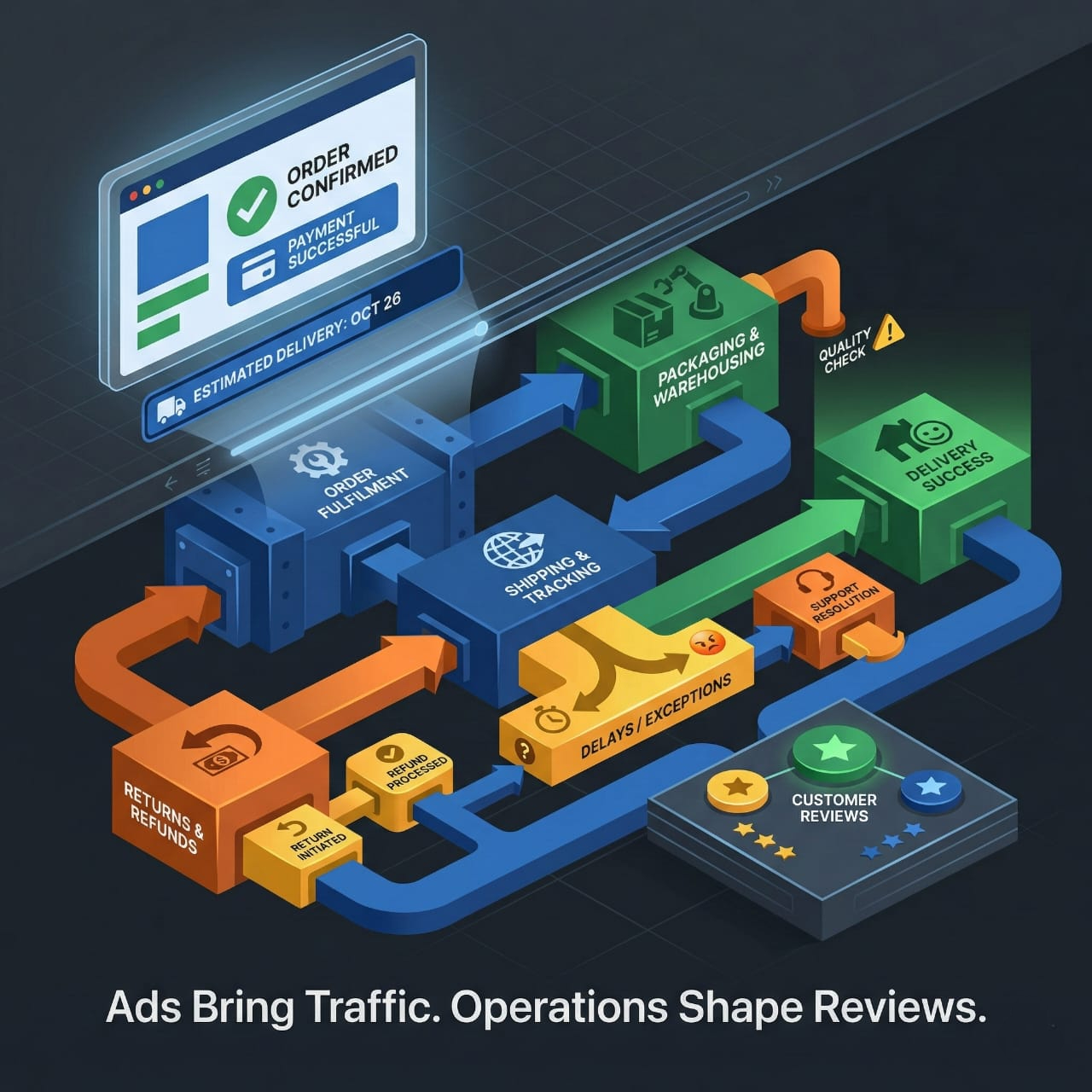
Customers don’t review the effort behind your campaigns or the sophistication of your keyword strategy.
They review the experience that followed their payment.
They remember:
- Was the product delivered on time?
- Was the packaging intact and professional?
- Did tracking updates feel reliable or confusing?
- Was customer support reachable when needed?
- Was a return or refund handled smoothly and without friction?
These moments decide whether a customer writes:
“Great experience”
or
“Not buying again.”
This is why two sellers with similar products, pricing, and ad visibility can end up with completely different ratings. The difference is not demand generation, it’s execution after the sale.wo sellers with similar ads and pricing often have drastically different seller ratings on marketplaces.
Marketplace ratings and fulfilment reliability are widely recognised as key trust factors in e-commerce ecosystems such as Amazon and Flipkart.
Where Seller Ratings Quietly Decline
Many sellers keep improving front-end efforts: better ads, cleaner listings, sharper pricing.
At the same time, backend issues quietly go unchecked.
Late dispatches.
Inconsistent tracking updates.
Delayed refunds.
Generic or delayed customer responses.
These problems don’t always create immediate complaints.
Instead, they create silent dissatisfaction.
The product may be fine.
The experience is not.
And customers don’t separate the two.
In their mind, the brand is responsible for everything that happens after checkout – whether it’s logistics, platform processes, or third-party partners.
Why Operations Now Define Brand Trust
As marketplaces become more competitive, customers stop comparing just prices or features.
They compare reliability.
A delayed order or unresolved return does more damage than a poor ad ever could.
Ratings influence search visibility, conversion rates, and long-term trust, making operations a direct driver of growth or decline.
In today’s ecosystem, fulfilment, refunds, and customer communication are no longer backend tasks.
They are part of the brand promise.
Every operational failure chips away at brand equity, often invisibly, until it shows up as declining ratings and stalled growth.
How High-Rating Sellers Stay Consistent
Sellers with stable 4+ ratings don’t rely on luck or seasonal spikes.
They build systems.
They track orders proactively.
They flag fulfilment risks before deadlines are breached.
They communicate clearly before customers chase updates.
They handle returns with speed, transparency, and ownership.
Good reviews aren’t aggressively requested.
They are engineered through predictable, disciplined execution.
Consistency—not perfection—is what customers reward.
How JGS Helps Sellers Control the Experience
At Jaipur Global Services (JGS), we treat operations as a measurable system, not a reactive process.
Our in-house automation flags fulfilment risks early, tracks delivery and refund timelines, and enables structured pre- and post-delivery communication.
This allows sellers to address issues before they escalate into customer frustration.
By aligning operations, CRM, and compliance workflows, sellers protect ratings, trust, and long-term brand equity – without firefighting every order.
Because preventing a bad review is far more powerful than responding to one.
For sellers scaling on Amazon, Flipkart, or other marketplaces, operational discipline is no longer optional. It is the foundation of sustainable growth. When systems replace guesswork, sellers gain control – not just over reviews, but over customer trust, repeat purchases, and long-term profitability.
The Real Takeaway
Marketing brings customers to your listing.
Operations decide what they say about you.
In e-commerce, every order is a brand interaction.
And every delivery writes a review; whether the customer types it or not.