
10 Leading Ecommerce Service Providers in 2026
 July 27, 2026
 Yashwardhan Singh
 0 Comments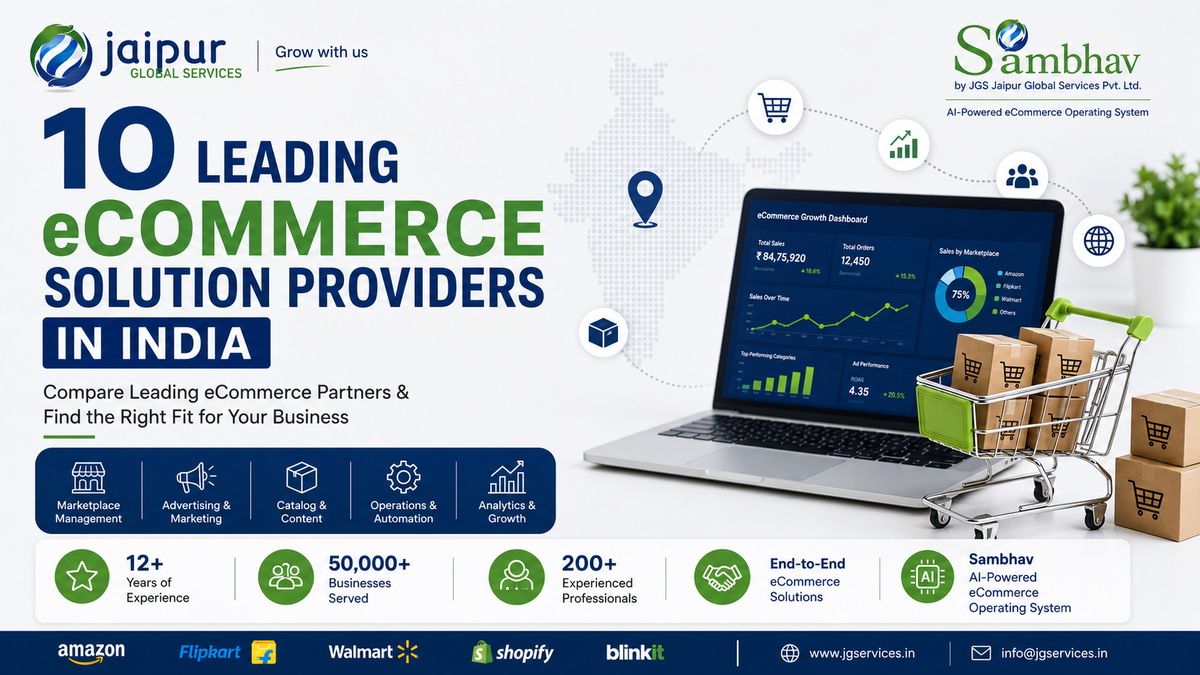
A seller running one product on one marketplace can usually manage things alone. The moment you add a second marketplace, a bigger catalogue, or your own Shopify store, the workload changes. Listings need updating, ad budgets need watching, and account health issues show up when you least expect them.
This is why so many sellers, from small D2C brands to larger manufacturers, now bring in outside help. Ecommerce account management services exist to take on that daily operational load, so the business owner can focus on product, sourcing, and strategy instead of backend admin. Below, we'll look at what these providers actually do, ten worth knowing about in 2026, and how to pick one that fits your business.
What Does an Ecommerce Service Provider Do?
The term covers a wide range of work, which is part of why it confuses people comparing providers.
In practice, ecommerce service providers typically handle:
- Marketplace account management – running your Amazon, Flipkart, or Walmart seller account day to day, including account health and compliance
- Product listings and catalogue management – titles, descriptions, images, backend keywords, and fixing listing errors before they hurt visibility
- PPC and advertising – setting up and adjusting ad campaigns on the marketplace
- Store management and order flow – inventory sync, order processing, returns
- Marketplace expansion – helping a seller move from one marketplace to two or three without losing control
- Shopify support – building or maintaining a brand's own website alongside marketplace accounts
- Ecommerce consulting – higher-level strategy on which channels to prioritise and how to structure operations
Not every provider offers all of this. Some focus narrowly on Amazon PPC. Others cover the full account end to end. Knowing which one you actually need is the first real decision.
10 Leading Ecommerce Service Providers in 2026
1. Jaipur Global Services (JG Services)
JG Services is an India-based ecommerce service provider working across Amazon, Flipkart, and Shopify. Their scope includes account setup, listing and catalogue work, advertising, and A+ content, aimed at sellers who want these pieces handled by one team rather than several vendors.
Platforms: Amazon, Flipkart, Shopify
Strengths: Combines marketplace account management with Shopify development under one roof
Best suited for: Indian sellers managing Amazon and Flipkart together, or brands that also need a Shopify store built or maintained
2. SunTec India
A long-established IT outsourcing company with a dedicated ecommerce catalogue and product data practice, serving clients across several countries.
Platforms: Amazon and multichannel catalogue systems
Strengths: Deep experience in catalogue data cleansing at scale
Best suited for: Brands with large, complex catalogues needing ongoing data accuracy work
3. Vserve Ebusiness Solutions
A back-office and virtual assistant provider built around Amazon store operations, with teams in India and the US.
Platforms: Amazon
Strengths: Affordable, hands-on listing and catalogue support
Best suited for: Smaller sellers who mainly need reliable execution rather than a large strategy team
4. CedCommerce
A multichannel integration company offering apps that connect Shopify and other platforms to marketplaces like Amazon, eBay, and Walmart.
Platforms: Shopify, Amazon, Walmart, eBay
Strengths: Technical sync tools for inventory, orders, and listings
Best suited for: Shopify sellers who want marketplace listings synced automatically instead of managed manually
5. SalesDuo
A full-service Amazon agency covering Seller Central and Vendor Central, combining account management with advertising and catalogue work.
Platforms: Amazon
Strengths: Combined advertising and account operations under one team
Best suited for: Established Amazon brands that have outgrown a PPC-only agency
6. Amify
Now part of Cart.com, Amify is a US-based Amazon-as-a-service agency built for direct-to-consumer brands.
Platforms: Amazon
Strengths: Backed by Cart.com's broader logistics and fulfilment network
Best suited for: DTC brands wanting Amazon fully managed without an in-house team
7. BellaVix
A marketplace management agency working with Amazon, Walmart, and Target, serving established retail brands.
Platforms: Amazon, Walmart, Target
Strengths: Dual Amazon-Walmart account handling
Best suited for: Brands expanding beyond Amazon into Walmart account management services
8. Pattern
A publicly traded ecommerce acceleration company helping large brands sell across dozens of marketplaces globally, including Amazon, Walmart, and TikTok Shop.
Platforms: Amazon, Walmart, and 60+ global marketplaces
Strengths: Proprietary data and automation infrastructure at scale
Best suited for: Larger or global brands, less suited to early-stage sellers
9. Envision Horizons
A marketplace growth agency originally focused on Amazon beauty brands, now working across Amazon, Walmart, and Target for several consumer categories.
Platforms: Amazon, Walmart, Target
Strengths: Category-specific experience and proprietary reporting tools
Best suited for: Established consumer brands wanting a strategic marketplace partner, not just campaign execution
10. APPWRK
A Shopify development company building custom stores and Shopify Plus builds for D2C brands.
Platforms: Shopify
Strengths: Custom development and platform migration work
Best suited for: Brands whose priority is their own website rather than marketplace accounts
Services You Should Look for in an Ecommerce Growth Partner
Once you're comparing providers, it helps to know which services actually matter for your situation.
If Amazon is your main channel, check their depth in Amazon Account Management Services and Amazon PPC Management specifically, not just general digital marketing experience. Ask how they approach Amazon Product Listing Services and Amazon Catalogue Services — this is where a lot of lost sales quietly happen, through outdated images, missing keywords, or suppressed listings nobody noticed.
If you sell on Flipkart too, ask directly about their Flipkart Account Management and Flipkart Seller Services experience. It's a different platform with its own seller scorecard and ad system, and general Amazon knowledge doesn't automatically transfer over.
Selling across multiple channels calls for real Ecommerce Marketplace Management experience — someone who can look at Amazon, Flipkart, and Walmart together rather than treating each as a separate project. And if you're weighing platform decisions or planning to move beyond marketplaces, look for genuine Ecommerce Consulting Services, not just execution support.
For brands building a website of their own, ask what their Shopify Development Services actually cover — custom builds, migrations, ongoing maintenance, or just basic setup.
How to Choose the Right Ecommerce Service Provider
A few practical checks before you commit:
- Marketplace-specific experience. Ask for examples on the exact platform you sell on, not general ecommerce experience.
- Range of services. Can they cover listings, PPC, and catalogue together, or will you need separate vendors?
- Reporting and communication. You should know what changed in your account weekly, not just get a summary once a month.
- Pricing and contract terms. Flat fee, percentage of ad spend, or percentage of revenue each create different incentives — understand which one applies.
- Scalability. A provider that works well for 50 SKUs should still work at 500.
- Track record. Ask for references or examples relevant to your category, not just generic testimonials.
- Transparency. Be cautious of anyone promising guaranteed rankings or guaranteed sales — no one can honestly promise that on a marketplace.
- Understanding of your goals. A provider chasing revenue growth alone isn't the same as one watching margins, ad spend, and returns together.
Why Ecommerce Account Management Services Matter
The value of ecommerce account management services isn't about handing over control. It's about having someone watch the parts of your account that are easy to neglect when you're also running the rest of the business — account health, listing accuracy, ad spend efficiency, and compliance with marketplace policies.
A good account management partner catches issues early: a suppressed listing, a rising ACoS, an inventory gap before a big sale event. None of this guarantees a specific sales number or ranking position, and any provider claiming otherwise should raise a flag. What it does offer is fewer surprises and more consistent operations.
This is the space JG Services works in — helping sellers manage Amazon and Flipkart accounts, listings, and advertising, with Shopify support for brands building their own site alongside marketplace sales.
Final Thoughts
There isn't one provider that fits every seller. The right partner depends on which marketplace carries most of your sales, how large your catalogue is, whether you're also building a Shopify store, and how much your internal team can already handle on its own.
Start by being honest about where you're actually losing time or money — ad spend, catalogue errors, or slow order handling — and match that gap to a provider's specific strength rather than their marketing pitch.
If you're weighing up support for Amazon, Flipkart, Shopify, or managing several channels at once, JG Services can help review your current setup and point out where better account management, catalogue work, or advertising support would genuinely help.
FAQ Section
What does an ecommerce service provider do?
They handle the operational side of running an online store or marketplace account — listings, catalogue upkeep, advertising, order management, and reporting — so the business owner doesn't have to manage every detail in-house.
How do ecommerce account management services help sellers?
They keep an eye on account health, listing accuracy, and ad performance on an ongoing basis. This helps catch problems early and keeps operations consistent, though it doesn't guarantee specific sales or ranking outcomes.
What services should an Amazon seller agency provide?
At minimum: account health monitoring, listing and catalogue management, PPC management, and clear weekly or monthly reporting. Larger sellers should also expect A+ content and inventory planning support.
How do I choose the right ecommerce service provider?
Check their experience on your specific marketplace, ask about pricing structure and reporting, and confirm they can scale with your catalogue size. Be cautious of anyone guaranteeing results.
Is ecommerce account management worth it for small businesses?
It depends on how much time marketplace management is already taking from you. If listings, ads, and account issues are eating into hours you'd rather spend on product or sourcing, outsourcing that work often makes sense even at a smaller scale.