
How to Hire an eCommerce Consultant
 June 1, 2026
 Yashwardhan Singh
 0 Comments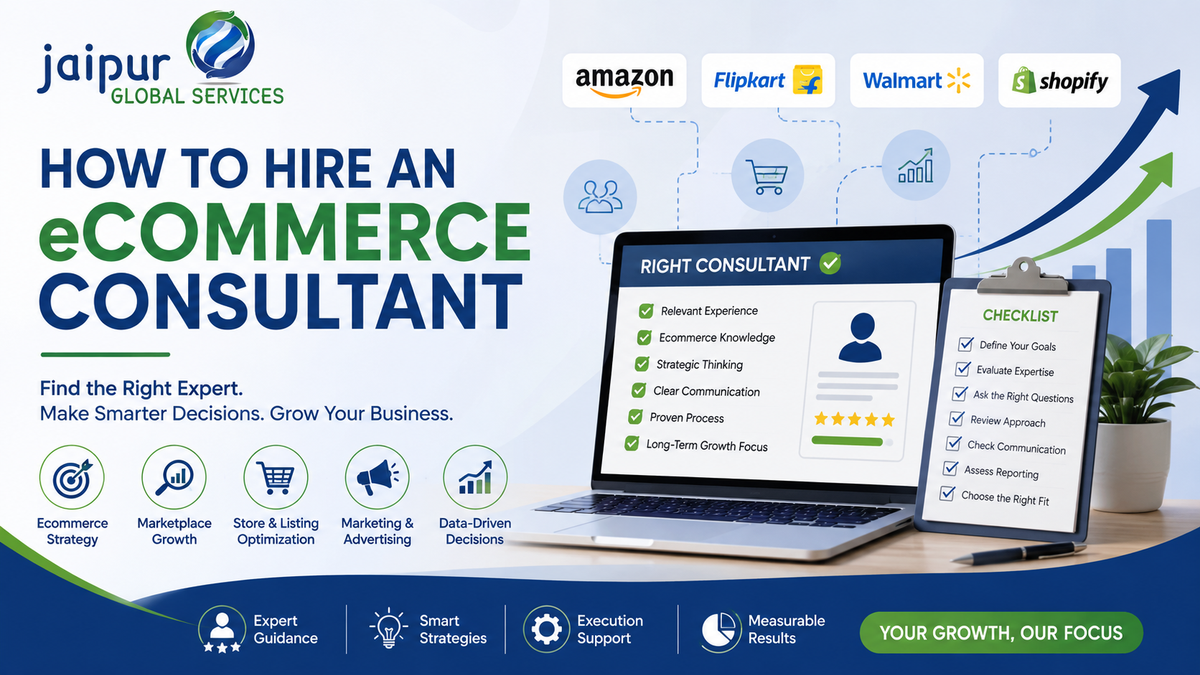
If you run an ecommerce business, you already know that "just selling online" is rarely simple. Behind every sale sits a chain of decisions: which marketplaces to prioritize, how to keep product listings accurate, whether your ad spend is actually working, and whether your Shopify store is built to convert visitors rather than just look nice.
For a lot of business owners, this juggling act works fine for a while. Then growth slows down, or a new marketplace launch doesn't go as planned, or the team is spending more time firefighting than planning. That's usually when the idea of hiring an ecommerce consultant starts to come up.
The tricky part isn't deciding whether you need help. It's figuring out who to trust with that help. There are individual consultants, boutique agencies, and large ecommerce consulting firms, all claiming to understand your business. Some genuinely do. Others will sell you a generic playbook regardless of what your business actually needs.
This guide walks through how to evaluate, compare, and hire an ecommerce consultant who's actually right for your situation — not just the one with the flashiest pitch.
What Does an Ecommerce Consultant Actually Do?
At a basic level, an ecommerce consultant helps a business figure out what's working, what isn't, and what to do next. But the specific work varies a lot depending on the business and the consultant's own strengths.
Some of the common areas an ecommerce business consultant might get involved in include:
- Ecommerce strategy — deciding priorities, sequencing initiatives, and setting realistic goals
- Marketplace strategy — figuring out which platforms (Amazon, Flipkart, your own Shopify store, etc.) deserve the most attention
- Store and website optimization — improving how a Shopify or other ecommerce store is structured and how it converts visitors
- Product listings — making sure titles, descriptions, images, and keywords are actually helping products get found and bought
- Ecommerce SEO — improving organic visibility for product and category pages
- Digital marketing — advising on paid ads, email, and other acquisition channels
- Conversion optimization — identifying why traffic isn't turning into sales
- Customer acquisition — helping the business bring in new buyers more efficiently
- Marketplace expansion — supporting a move into new platforms or regions
- Sales and performance analysis — reading the data correctly and drawing the right conclusions
- Business growth planning — connecting day-to-day ecommerce activity to longer-term goals
Not every consultant covers all of this, and that's fine. A good consultant is upfront about what they specialize in rather than claiming expertise in everything.
When Should You Hire an Ecommerce Consultant?
Not every ecommerce business needs outside help immediately. But there are situations where bringing in a consultant makes practical sense:
- Sales have plateaued and you're not sure why
- You're getting traffic, but conversions are low
- You don't know which marketplace deserves your attention and budget
- Your Shopify store isn't performing the way you expected
- Marketplace advertising has become too complex to manage confidently in-house
- Your product listings aren't ranking or converting well
- You're considering expanding into new marketplaces but don't have a clear plan
- Your internal team is capable but lacks specific ecommerce or marketplace expertise
- You're making decisions based on gut feeling rather than reliable data
- Marketing activities are happening, but without a coherent strategy tying them together
If none of these describe your situation, you may not need a consultant right now — and a good one will tell you that honestly rather than manufacturing a problem to solve.
What Should You Look for in an Ecommerce Consultant?
Once you've decided to look for help, it's worth having a clear framework for evaluating candidates rather than going purely on gut feeling or a good sales pitch.
1. Relevant ecommerce experience. Have they actually worked on problems similar to yours — not just "ecommerce" broadly, but your specific model (D2C, marketplace-led, Shopify-based, etc.)?
2. Understanding of your business model. A consultant who asks detailed questions about your margins, supply chain, and customer base is more useful than one who jumps straight to recommendations.
3. Marketplace knowledge. If you sell on Amazon or Flipkart, does the consultant understand how those platforms actually work — algorithms, policies, advertising systems — not just ecommerce in general?
4. Ecommerce SEO knowledge. Product and category page SEO is different from general SEO, and it matters if organic traffic is part of your strategy.
5. Marketing knowledge. Do they understand how paid and organic marketing should work together, rather than treating them as separate silos?
6. Analytical thinking. Can they explain what the data is telling them and why, rather than throwing dashboards at you?
7. Communication. Can they explain strategy in plain language, or does every conversation drown in jargon?
8. Strategic ability. Do they connect individual tasks to a broader plan, or do they just react to whatever seems urgent that week?
9. Execution understanding. Even if they're strategy-focused, do they understand what it actually takes to implement their recommendations?
10. Transparency. Are they upfront about limitations, timelines, and what's realistic — or do they oversell?
Many ecommerce consulting firms and independent consultants will look similar on paper. These ten factors are what separate a genuinely useful partner from someone who sounds good in a pitch meeting.
Should You Hire an Individual Consultant or an Ecommerce Consulting Firm?
There's no universally "better" option here — it depends on your business.
Individual ecommerce consultant. Often more affordable and can offer highly personalized attention. The limitation is capacity — one person can only do so much, especially if you need ongoing execution alongside strategy.
Ecommerce consulting firm. Usually brings a team with different specializations (SEO, marketplace management, paid ads, etc.), which can be useful if your needs span multiple areas. The trade-off is that you may get less direct access to senior expertise, depending on how the firm is structured.
Ecommerce agency. Agencies are often more execution-focused than strategy-focused. If you already have a strategy and need someone to run campaigns or manage listings, an agency might fit. If you need someone to help build the strategy itself, that's a different conversation.
In-house ecommerce specialist. Hiring internally gives you a dedicated resource who deeply understands your business over time. It's a bigger long-term investment and takes time to build the expertise that an experienced external consultant may already have.
The right choice usually comes down to your business size, budget, the complexity of your operations, how many marketplaces you're managing, the specific ecommerce consulting services you need, and your long-term goals. A small Shopify store with one product line has very different needs than a business selling across Amazon, Flipkart, and its own website simultaneously.
What Ecommerce Consulting Services Might You Need?
It's tempting to hire whoever offers the longest list of services. That's usually the wrong approach. Instead, start by identifying the actual problem in your business, then figure out which service addresses it.
Common ecommerce consulting services include:
- Ecommerce strategy and planning
- Ecommerce SEO
- Marketplace management (Amazon, Flipkart, and others)
- Amazon-specific strategy and account management
- Flipkart-specific strategy and account management
- Shopify consulting and store development
- Ecommerce marketing (paid and organic)
- PPC strategy for marketplaces and search engines
- Product listing and catalogue optimization
- Conversion rate optimization
- Marketplace expansion support
- Broader ecommerce business planning
A consultant worth hiring will recommend the services that actually solve your problem — not push every service on their list. If your issue is that your Amazon listings aren't converting, you don't necessarily need a full rebrand of your Shopify store at the same time.
Do You Need an Ecommerce SEO Consultant?
Ecommerce SEO is a specialized skill, and it's worth understanding why it's different from general SEO before deciding you need dedicated help.
General SEO often focuses on blog content, backlinks, and broad site authority. Ecommerce SEO is more transactional — it deals directly with product pages, category pages, and search intent tied to purchase decisions.
An ecommerce SEO consultant typically focuses on:
- Optimizing product and category pages for relevant search terms
- Improving overall search visibility for commercial keywords
- Keyword targeting that matches buyer intent, not just traffic volume
- Internal linking between products, categories, and collections
- Coordinating with developers on technical SEO issues (site speed, crawlability, structured data)
- Content strategy that supports product discovery
- Aligning SEO work with actual search intent rather than vanity keywords
- Driving organic traffic that's genuinely likely to convert
If a meaningful share of your traffic and revenue depends on organic search — or should — this is an area where specialized expertise tends to pay off more than general marketing advice.
When Should You Hire a Shopify Consultant?
Shopify gives you a lot of flexibility, which is exactly why some stores end up with structural issues that hurt sales without the owner realizing it.
A Shopify consultant can be genuinely useful when:
- You're setting up a new store and want it built correctly from the start
- Your store structure or navigation is confusing for customers
- Product organization and collections aren't set up logically
- Your theme or overall user experience isn't converting well
- You need focused conversion rate optimization
- Shopify SEO needs attention alongside general site SEO
- You're trying to integrate marketing tools (email, ads, analytics) properly
- You're planning to scale the store and need the technical foundation to support it
- You need coordination between design, development, and marketing decisions
That said, not every Shopify store needs a consultant. If your store is small, straightforward, and performing reasonably well, you may not need this level of specialized input yet. A Shopify marketing expert becomes more valuable once your store has enough complexity — multiple product lines, growing traffic, or ambitious growth targets — that small inefficiencies start costing real revenue.
What About an Ecommerce Marketing Consultant?
It's worth being clear-eyed about the difference between ecommerce consulting broadly and ecommerce marketing consulting specifically, because the two get confused often.
An ecommerce marketing consultant typically focuses on:
- Paid advertising across search, social, and marketplaces
- Organic marketing and content
- Social media strategy
- Email marketing and lifecycle campaigns
- Customer acquisition strategy
- Retention and repeat purchase strategy
- Conversion rate optimization
- Measuring marketing performance accurately
The important point here is that marketing shouldn't operate as a separate function disconnected from your broader ecommerce strategy. If your marketing consultant is running campaigns without visibility into your marketplace strategy, product roadmap, or operational constraints, you can end up with marketing that looks busy but doesn't move the business forward.
How to Evaluate an Ecommerce Growth Consultant
"Growth" gets thrown around loosely in this industry, so it helps to ask specific questions rather than accepting the word at face value.
When evaluating an ecommerce growth consultant, pay attention to:
- How they identify growth opportunities. Are they looking at your actual data, or offering generic tactics that could apply to any business?
- How they analyze current performance. Do they dig into specifics, or give surface-level observations?
- What metrics they track. Vanity metrics (impressions, followers) or metrics tied to revenue and profitability?
- How they prioritize actions. Do they explain why one initiative comes before another?
- How they test strategies. Is there a structured approach to testing, or is everything based on assumption?
- How they report progress. Will you get clear, regular updates, or vague summaries?
- How they handle underperforming channels. Do they adjust based on evidence, or keep pushing the same approach regardless of results?
A good growth consultant should be able to explain the reasoning behind every recommendation. If the answer to "why this, and why now" is unclear or evasive, that's worth noticing.
10 Questions to Ask Before Hiring an Ecommerce Consultant
- What ecommerce businesses have you worked with? This tells you whether their experience is relevant or too broad to be useful.
- Have you worked with businesses similar to mine? Similar size, model, or industry matters more than general experience.
- Which ecommerce platforms do you specialize in? Someone who knows Amazon deeply may not know Shopify equally well, and vice versa.
- How would you evaluate my current ecommerce setup? Their answer shows how they think, not just what they'll eventually recommend.
- What would you prioritize first? This reveals whether they've actually understood your specific situation.
- Which metrics would you track? Their answer should align with your actual business goals, not generic KPIs.
- How do you measure progress? Look for a clear, repeatable process rather than a vague promise.
- What will you actually handle? Strategy only, or hands-on execution too?
- What will my internal team need to handle? This affects whether you have the internal capacity to support the engagement.
- How will you communicate recommendations and results? Regular reporting, calls, dashboards — find out what to expect before you commit.
Red Flags to Watch for When Hiring an Ecommerce Consultant
Some warning signs are worth taking seriously, regardless of how confident or polished the pitch sounds:
- Guaranteed sales or revenue numbers. No one can honestly guarantee this in ecommerce.
- Guaranteed Google or marketplace rankings. Rankings depend on many factors outside any consultant's full control.
- No clear process. If they can't explain how they'll approach your business, that's a problem.
- No real interest in understanding your business. If they're proposing solutions before asking meaningful questions, be cautious.
- Excessive jargon. Complexity in language sometimes hides a lack of substance.
- No explanation of strategy. You should understand the "why," not just the "what."
- Unrealistic promises or timelines. Sustainable ecommerce growth rarely happens overnight.
- No reporting. If you can't track progress, you can't know if it's working.
- Refusal to discuss measurement. A confident consultant should welcome accountability.
- One-size-fits-all recommendations. Your business isn't identical to every other client they've had.
- Trying to sell every available service upfront. This often signals a sales-first approach rather than a problem-first one.
How Much Does an Ecommerce Consultant Cost?
There's no single answer here, because pricing depends heavily on the specifics of the engagement:
- The scope of work involved
- The size and complexity of your business
- How many marketplaces or platforms are involved
- Which specific services you need
- The overall complexity of the project
- How frequently you'll need consulting support
- Whether you need strategy only, or strategy plus execution
Broadly, ecommerce consulting arrangements tend to fall into a few structures:
- One-time consultation — a single session or short engagement focused on a specific question or audit
- Project-based consulting — a defined scope with a clear start and end, such as a marketplace launch or store setup
- Monthly consulting — ongoing strategic guidance on a retainer basis
- Ongoing ecommerce management — continuous, hands-on management of listings, ads, or marketplace accounts
Rather than asking "what's the going rate," it's more useful to ask a potential consultant to scope your specific situation and explain how their pricing structure works for that scope.
Why Businesses Consider JGS for Ecommerce Consulting
If you've read this far, you now have a solid framework for evaluating any ecommerce consultant — which is the point of this guide, regardless of who you eventually work with.
That said, this is where we'll introduce JG Services (JGS) as one option worth considering.
JGS works across ecommerce consulting and marketplace management, with services spanning Amazon and Flipkart account management, Shopify-related work, and broader ecommerce strategy and growth support. The relevant point for this discussion is that JGS's model combines strategic consulting with practical execution — meaning a business doesn't necessarily need to hire one team for strategy and a separate team for implementation.
This can matter in practice. Some consultants stop at recommendations and leave execution entirely to your internal team, which can be an issue if that team doesn't have bandwidth or specific platform expertise. A partner that can advise on strategy and also manage the marketplace accounts, listings, or campaigns directly can reduce that gap.
This isn't a claim that this approach is superior for every business — some businesses genuinely prefer a strategy-only consultant and a separate execution team. It's simply one factor to weigh when comparing options.
How to Decide if JGS Is the Right Fit for Your Business
Using the framework from earlier in this guide, JGS may be worth exploring if your business needs:
- Ecommerce strategy that connects to actual marketplace execution
- Support managing multiple marketplace accounts (Amazon, Flipkart) rather than just one
- Shopify-related consulting or development support
- Guidance on marketplace expansion
- A single partner rather than juggling multiple vendors for strategy and execution separately
That said, the most useful thing you can do — with JGS or any other consultant — is apply the same evaluation criteria covered throughout this article. Ask the same ten questions. Watch for the same red flags. Confirm they understand your specific business model before assuming they're the right fit.
FAQs
1. What does an ecommerce consultant do? An ecommerce consultant helps businesses improve their online sales performance by advising on strategy, marketplace management, SEO, marketing, conversion optimization, and overall growth planning. The exact scope depends on the consultant and the business's specific needs.
2. When should I hire an ecommerce consultant? Consider hiring one when sales have plateaued, conversions are low despite decent traffic, you're unsure which marketplace to prioritize, or your internal team lacks specific ecommerce expertise needed to move forward confidently.
3. What is the difference between an ecommerce consultant and an ecommerce agency? Consultants typically focus more on strategy and advisory work, while agencies are often more execution-focused, running campaigns or managing accounts. Some firms, including consulting firms with execution capabilities, blend both roles.
4. How do I choose the right ecommerce consultant? Evaluate their relevant experience, understanding of your business model, marketplace and SEO knowledge, communication style, and transparency. Ask specific questions about their process rather than judging based on their pitch alone.
5. Do I need an ecommerce SEO consultant? If a significant portion of your traffic and sales depends on organic search, or you want it to, specialized ecommerce SEO expertise can help — it differs from general SEO because it focuses on product and category pages tied directly to purchase intent.
6. When should I hire a Shopify consultant? It's worth considering when your store structure, user experience, or conversion rate isn't performing as expected, or when you're setting up a new store and want it built correctly from the start. Smaller, simple stores may not need this yet.
7. What should I ask an ecommerce consultant before hiring them? Ask about their relevant experience, how they'd evaluate your current setup, what they'd prioritize first, which metrics they track, and how they'll communicate progress and results.
8. Can an ecommerce consultant help with Amazon and Flipkart? Many ecommerce consultants and consulting firms do work across multiple marketplaces, including Amazon and Flipkart, though expertise levels vary by platform. It's worth confirming platform-specific experience before hiring.
Conclusion
Hiring an ecommerce consultant isn't about finding the company with the longest service list or the boldest promises. It's about finding someone who genuinely understands your business, can accurately diagnose what's actually going wrong (or what's holding back growth), and can build a practical strategy around that — one they can explain clearly and measure honestly.
The right ecommerce consultant will ask more questions than they answer in your first conversation. They'll be upfront about what they can and can't do. And they'll be willing to be measured against real outcomes, not vague promises.
If you're currently evaluating options, it's worth taking the time to ask the questions outlined in this guide — to JGS or to anyone else you're considering. If you'd like to explore whether Jaipur Global Services (JGS) ecommerce consulting and marketplace management services fit what your business currently needs, you're welcome to look into what they offer and see if it lines up with your specific situation.