
How to Reduce Ecommerce Returns: 15 Practical Strategies
 March 17, 2026
 Yashwardhan Singh
 0 Comments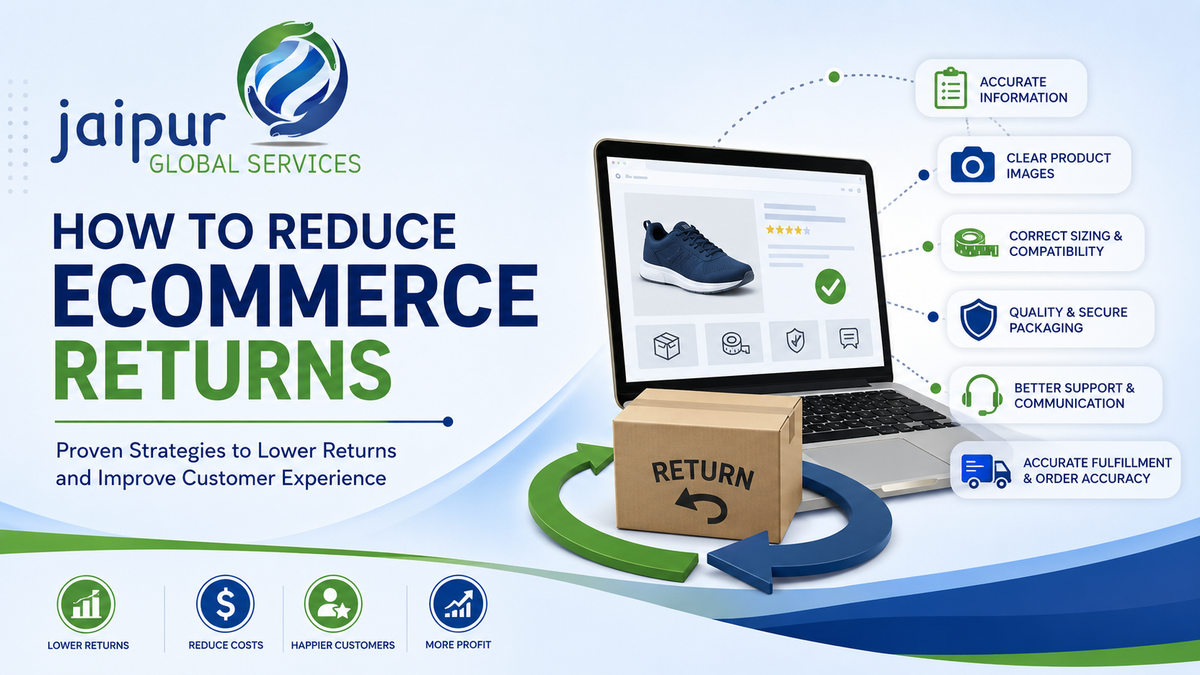
A return doesn't begin when a customer clicks "Return." It usually begins much earlier — in a listing with unclear size information, a product photo that makes an item look bigger than it is, a fragile item wrapped in packaging that wasn't built to protect it, or a warehouse pick that grabbed the wrong SKU.
By the time the return request arrives, the actual cause happened somewhere upstream. That's the lens this guide takes: returns are rarely just a logistics problem. They come from incorrect product information, misleading images, unclear sizing, compatibility confusion, quality issues, damage in transit, wrong items shipped, a mismatch between expectation and reality, and gaps in customer support — often well before a package ever leaves the warehouse.
It's worth setting the right goal from the start: the goal isn't eliminating every return. Some returns are genuinely unavoidable — a customer changes their mind, a gift doesn't fit the occasion, a need simply goes away. The real goal is identifying and reducing the avoidable returns while keeping the return process itself easy and fair for customers who do need it.
Why Do Ecommerce Customers Return Products?
Understanding the full range of causes is the starting point for fixing any of them.
Product doesn't match the description — wrong color, wrong material, incorrect specifications, missing features, or an appearance that simply differs from what was shown.
Wrong size or fit — especially common in apparel, footwear, furniture and accessories, where a customer has to guess how a product will actually fit or fill a space.
Product doesn't meet expectations — the customer expected something different based on images, description, reviews or marketing claims, even if nothing was technically inaccurate.
Damaged during shipping — caused by weak packaging, rough handling in transit, or insufficient protective material for a fragile item.
Wrong product shipped — usually a warehouse picking error, SKU confusion, a labeling problem, or an inventory discrepancy.
Product quality problems — defects, missing components, poor construction, or damaged parts discovered after unboxing.
Compatibility problems — particularly relevant for electronics, accessories, spare parts, and anything meant to work with another device or system.
Customer changed their mind — not every return traces back to something the business did wrong, and it's worth being honest about that rather than treating every return as a fixable failure.
Start With Accurate Product Information
Accurate product information is one of the strongest, most controllable return-prevention tools a business has. That means getting the title, description, specifications, dimensions, weight, materials, color, compatibility, included components, and usage instructions right — and consistent with the actual product.
This means neither exaggerating benefits nor quietly hiding limitations. The principle is simple: the more accurately customers understand what they're buying, the lower the risk of an expectation mismatch that ends in a return. Amazon's own seller guidance points in the same direction — accurate descriptions and clear details on size, color and compatibility are consistently framed as core tools for avoiding the misunderstandings that lead to returns.
Improve Product Images
Images do a lot of the work of setting expectations before a customer reads a word of text. A well-built image set typically covers multiple angles (front, back, side, close-up), a scale reference (the product next to a hand, a common object, or in a room/environment), lifestyle shots showing realistic use, clear dimension callouts (length, width, height, capacity), and detail images covering texture, material, ports, buttons, closures and other important components.
Misleading or heavily edited images create exactly the kind of expectation gap that generates returns — a product that looks larger, glossier, or more feature-rich in photos than it is in hand almost guarantees disappointment on arrival.
Make Size and Fit Information Clear
Sizing deserves its own focus because it's one of the single biggest return drivers across many ecommerce categories.
For clothing, "Medium" alone tells a shopper almost nothing useful — chest, waist, length measurements and fit type (slim, regular, relaxed) give them something they can actually compare to their own body or existing wardrobe. For furniture, height, width, depth and genuine room-scale context matter more than a product shot alone. For shoes, foot length guidance and clear size-conversion information reduce the guesswork that drives so many footwear returns.
None of this eliminates sizing returns entirely — a size chart helps, but it doesn't guarantee a perfect fit for every body or space.
Use Product Videos to Set Better Expectations
Video can show what static images and text struggle to convey: actual product size and scale, movement and functionality, setup process, real usage, texture, packaging, and genuine real-world appearance. A coffee machine's brewing process, how a piece of furniture actually assembles, how a beauty product applies, how an electronic device connects, or how a fitness product is actually used in practice — these are all easier to understand from a short video than from bullet points.
Video helps customers understand a product before they buy — it's a meaningful tool for setting expectations, not a guaranteed fix that automatically reduces a return rate on its own.
Improve Product Descriptions
A strong description answers the questions a shopper actually has: what the product is, who it's for, what it does, how it's used, what's included, what its limitations are, its dimensions, whether it's compatible with something else the customer owns, and anything they should know before buying.
Clear, specific language beats exaggerated claims, vague benefit statements, unsupported promises, and ambiguous specifications every time — not just ethically, but practically, since vague language is exactly what generates return reasons like "not as described."
Show Exactly What Customers Will Receive
"What's included" information removes a common, entirely avoidable source of returns — a customer assuming an accessory, cable, or component is included when it isn't. For electronics, appliances, tools, furniture, kits and bundles especially, spelling out box contents explicitly (main product, charging cable, adapter, manual, any accessories) means a customer never has to guess.
Improve Packaging to Prevent Damage-Related Returns
Packaging protects both the product and the customer's first impression of it. That means the right box size for the item, adequate cushioning, genuinely protective materials, careful handling guidance for fragile items, moisture protection where the product category calls for it, secure internal placement so items don't shift in transit, and clear labeling.
This doesn't mean over-packaging every item regardless of cost or environmental impact — the goal is proportionate protection matched to what the specific product actually needs. Amazon's own FBA preparation and packaging guidance consistently emphasizes durable, protective packaging and correct labeling as ways to prevent both fulfillment problems and the damage-related returns that follow poor packaging.
Reduce Warehouse Picking and Packing Errors
Some returns are entirely operational rather than product-related — the product itself was fine, but the wrong SKU, variation, quantity, color or size ended up in the box, or the label was simply incorrect.
Practical prevention: barcode scanning at pick and pack stages, SKU verification before an order ships, structured pick-and-pack quality checks, documented warehouse SOPs, regular inventory accuracy checks, and general quality control built into the fulfillment process itself. A simple process worth having explicitly: order received → SKU verified → product picked → product scanned → quantity checked → packaging checked → order shipped. Skipping any one of these steps is where operational returns usually originate.
Analyze Return Reasons Instead of Treating All Returns Equally
This is one of the highest-leverage things a business can do, and it's often skipped. A raw "return rate" number alone doesn't explain why customers are returning products — and without the "why," there's nothing concrete to fix.
Worth tracking at the return level: the stated return reason, SKU, product category, size or variation, sales channel, fulfillment method, warehouse of origin, customer comments, product condition on return, and refund value. The useful framework: return reason → identify the pattern → find the root cause → fix the actual problem → monitor whether the return rate improves.
A concrete example: out of 100 returns on a product, 40 cite "product smaller than expected." The fix isn't a generic "improve the listing" — it's specific: add or improve dimension callouts, add a scale-reference image, add a comparison image, and tighten the description's size language. Amazon itself recommends regularly reviewing return trends for exactly this reason — repeated patterns like sizing confusion or unclear descriptions are treated as a signal that specific listing improvements are needed, not just noise to absorb.
Use Customer Reviews and Questions as Return-Prevention Data
Reviews and pre-purchase questions are a genuinely underused source of return-prevention insight. Phrases worth watching for: "smaller than expected," "doesn't fit," "not compatible," "color is different," "missing accessory," "difficult to install," "poor quality," "not as shown."
Each of these maps directly to a fixable gap — better images, clearer descriptions, a useful FAQ section, a demonstration video, improved packaging, or in some cases a genuine product improvement. Treated systematically, negative feedback becomes operational intelligence rather than just something to feel bad about.
Improve Product Quality and Quality Control
Some returns simply can't be solved through better content, because the underlying issue is the product itself — broken parts, defects, poor construction, missing components, or manufacturing inconsistency. When returns repeatedly cite these causes, the fix has to happen upstream: supplier quality checks, pre-shipment inspection, batch testing, defect tracking over time, ongoing supplier performance monitoring, and genuine root-cause analysis rather than treating each defective unit as an isolated incident.
It's worth being direct about this: no amount of listing optimization compensates for a genuinely poor-quality product. Content fixes the returns caused by miscommunication; only the product itself fixes returns caused by the product being bad.
Set Accurate Customer Expectations
Marketing and listing content should never promise more than the product can actually deliver — that means avoiding overly edited images, unsupported performance claims, exaggerated scale, unrealistic outcome claims, and misleading comparisons to competitors. The goal is simple consistency: what the advertisement says, what the listing says, and what the customer actually receives should all match. Every gap between these three is a potential return.
Improve Compatibility Information
For technical products especially — phone accessories, laptop accessories, printer supplies, automotive parts, smart devices — compatibility confusion is a recurring, largely preventable return driver. Clear "Compatible With" and, where useful, "Not Compatible With" information (covering compatible devices, models, operating systems, voltage, dimensions, connection types, and any required accessories) closes the exact gap that generates "wrong product for my device" returns.
Improve Fulfillment and Delivery Accuracy
Customers return products for reasons that have nothing to do with the product itself: the wrong item arrived, it arrived late, it arrived damaged, the quantity was wrong, or the packaging itself was compromised in transit. This depends on inventory accuracy, order accuracy at the fulfillment stage, disciplined warehouse SOPs, consistent shipping quality, reliable tracking, and active delivery monitoring. Amazon's own seller guidance consistently frames accurate shipping, tracking and inventory management as core parts of keeping fulfillment-related returns down.
Reduce Returns Without Making the Return Process Difficult
This deserves explicit emphasis: do not make legitimate returns harder as a way to reduce the return count. A difficult return process generates customer frustration, negative reviews, damaged trust, and more support burden — trading a short-term return-rate number for longer-term reputation damage.
The right equation is fewer avoidable returns plus an easy process for legitimate ones, together producing a better overall customer experience — not fewer returns at the cost of a worse one. Amazon's own guidance reflects this same balance: sellers are encouraged to prevent avoidable returns through better listings and analysis while still maintaining a smooth returns experience for customers who genuinely need one.
Create a Return-Reduction Dashboard
Worth tracking together, not in isolation: product-level metrics (units sold, units returned, return rate, top return reason, defect rate); customer experience signals (negative feedback, complaints, product questions, recurring misunderstandings); operations metrics (picking errors, packing errors, shipping damage, inventory discrepancies); and financial impact (refund value, return shipping cost, restocking cost, lost product value, replacement cost).
The dashboard earns its value by connecting return reasons directly to financial impact — a return-reason breakdown without a cost view makes it hard to prioritize; a cost view without return reasons makes it hard to know what to actually fix.
Return Rate Formula
A simple, standard calculation: Return Rate = Returned Orders ÷ Total Orders × 100.
Example: 100 returned orders ÷ 2,000 total orders × 100 = a 5% return rate.
Define the measurement period consistently (weekly, monthly, trailing 90 days) and apply the same methodology every time, so trends are actually comparable over time. There's no single universal "good" return rate across ecommerce — rates vary meaningfully by product type, category, customer behavior, geography, season and business model, so a rate that's normal for apparel would be alarming for, say, industrial hardware.
Create a 30-Day Ecommerce Return Reduction Plan
Week 1 — Analyze. Review return reasons, affected SKUs, customer feedback, current product listings, packaging, and any known fulfillment errors to find where the real problems concentrate.
Week 2 — Fix content. Improve product descriptions, images, dimension information, size guidance, compatibility details, FAQs, and add product video where it genuinely helps.
Week 3 — Fix operations. Review packaging adequacy, warehouse processes, picking and packing accuracy, quality control checkpoints, and inventory accuracy.
Week 4 — Measure. Compare return rate, return reasons, product-level performance, customer feedback, and operational error rates against the baseline from Week 1 — and identify honestly what improved and what still needs work.
How to Reduce Returns Across Different Ecommerce Categories
Fashion — prioritize size charts, fit information, fabric details, model measurements, and accurate color representation across devices and screens.
Electronics — prioritize compatibility information, precise specifications, clear setup guidance, an explicit included-accessories list, and product demonstration content.
Furniture — prioritize dimensions, room-scale imagery, assembly information, material details, and weight capacity.
Beauty — prioritize ingredient lists, usage instructions, texture representation, suitable use cases, and accurate expectation-setting — while avoiding medical or unsupported efficacy claims.
Home & Kitchen — prioritize capacity, dimensions, usage guidance, cleaning/care instructions, and a clear included-components list.
Common Mistakes Businesses Make When Trying to Reduce Returns
- Making the return process deliberately difficult to discourage returns
- Hiding known product limitations from the listing
- Using misleading or heavily edited images
- Collecting return reasons without ever acting on the patterns
- Focusing only on logistics while ignoring content-driven causes
- Ignoring genuine product quality issues
- Letting listings go stale as the product or market changes
- Ignoring what customer questions are actually revealing
- Using generic, one-size-fits-all size charts across different fits
- Under-investing in packaging appropriate to the product
- Overlooking warehouse-level picking and packing errors
- Treating every return as a customer mistake rather than examining the cause
- Looking only at an aggregate return rate instead of SKU-level detail
- Never connecting return data to financial impact
- Optimizing purely for a lower return number instead of genuinely better customer experience
How JGS Can Help Reduce Ecommerce Returns
Returns rarely trace back to one single cause, which is why fixing them usually requires touching several parts of the operation at once — content, catalog accuracy, warehouse process, fulfillment quality, and the analytics that connect them. JGS works across these areas: listing content (accurate titles, descriptions, specifications and images), catalog management (accurate SKUs, variations and product attributes), warehouse and fulfillment operations (aimed at reducing picking and packing errors and inventory discrepancies), and performance analytics that can help surface high-return SKUs, common return reasons, and the specific product-level or operational patterns behind them.
We won't claim that any service eliminates returns or promise a specific percentage reduction — return rates depend on the product, category, customer base and market as much as on execution. What JGS can offer is a structured way to identify the actual content, catalog, fulfillment and operational issues behind recurring returns, and build a more efficient process around fixing them.
Talk to an Ecommerce Operations Expert
Are product returns affecting your ecommerce profitability? JGS can help identify the content, catalog, fulfillment and operational issues behind recurring returns and build a more efficient ecommerce process.
Return Reduction Checklist
Product Information
- Accurate title
- Accurate description
- Correct specifications
- Clear dimensions
- Clear size information
- Compatibility information
- What's included clearly stated
Visual Content
- High-quality images
- Multiple angles
- Scale reference
- Lifestyle images
- Accurate colors
- Product video where useful
Operations
- Accurate inventory
- SKU verification
- Picking checks
- Packing checks
- Protective, proportionate packaging
- Quality control checkpoints
Customer Experience
- Clear expectations set throughout the listing
- Easy-to-understand instructions
- Helpful, responsive customer support
- Return reasons actively analyzed
- Customer questions actively reviewed
Analytics
- Return rate tracked consistently
- SKU-level return data captured
- Return reasons categorized
- Financial impact measured
- Corrective actions monitored over time
Frequently Asked Questions
How can I reduce ecommerce returns?
By identifying and fixing the actual causes — inaccurate product information, misleading images, unclear sizing, poor packaging, fulfillment errors and quality issues — rather than treating returns purely as a logistics or refund-processing problem.
What are the most common reasons for ecommerce returns?
A product not matching its description, wrong size or fit, unmet expectations, shipping damage, the wrong item being shipped, product quality issues, compatibility problems, and simple changes of mind.
How can product descriptions reduce returns?
Clear, accurate descriptions that cover what the product is, how it's used, what's included and its limitations reduce the expectation gap that drives "not as described" returns.
Can better product images reduce ecommerce returns?
Yes — images showing multiple angles, scale, real usage and important details close information gaps that would otherwise leave customers guessing, and misleading or over-edited images have the opposite effect.
How does packaging affect ecommerce returns?
Inadequate packaging leads directly to damage-related returns; appropriately protective packaging matched to the product reduces transit damage without over-packaging every item.
How can businesses reduce size-related returns?
Detailed size charts with exact measurements, model measurements, fit guidance, and clear conversion information — while accepting that sizing returns can't be eliminated entirely.
How can ecommerce businesses reduce damaged-product returns?
Through appropriate packaging materials and box sizing, careful handling procedures, and quality checks at the packing stage before an order ships.
How do customer reviews help reduce returns?
Reviews and pre-purchase questions surface exactly where expectations and reality diverge — recurring phrases like "smaller than expected" or "not compatible" point directly to specific, fixable listing gaps.
How should businesses analyze return reasons?
By tracking return reason, SKU, category, variation and channel together, identifying patterns rather than looking at an aggregate return rate, and connecting each pattern to a specific root cause and fix.
What is a good ecommerce return rate?
There's no single universal benchmark — acceptable return rates vary significantly by product category, customer base, geography and business model, so trends within a consistent measurement period matter more than comparing to an outside number.
How can Amazon sellers reduce product returns?
By focusing on listing accuracy, clear sizing and compatibility information, and monitoring Amazon's own return-rate tools (like the Voice of the Customer dashboard) to catch and address at-risk products before they're flagged for high returns.
Can JGS help businesses reduce ecommerce returns?
Yes — by improving listing content, catalog accuracy, warehouse and fulfillment processes, and providing the analytics needed to identify and address the specific causes behind recurring returns.
Conclusion
Returns are a normal, permanent part of ecommerce — the goal was never to eliminate every one of them. The real opportunity is reducing the avoidable ones by improving the full customer journey: accurate product information, leading to better product understanding, leading to correctly set expectations, leading to accurate order fulfillment, leading to safe delivery, leading to a genuinely better customer experience, and finally, fewer avoidable returns.
The more useful question isn't just "how many products were returned?" It's "why were they returned?" and "what can we actually change to prevent the same problem from happening again?"
Are product returns affecting your ecommerce profitability? JGS can help identify the content, catalog, fulfillment and operational issues behind recurring returns and build a more efficient ecommerce process.