
Why Web Design Is Important for Business Growth
 June 1, 2026
 Yashwardhan Singh
 0 Comments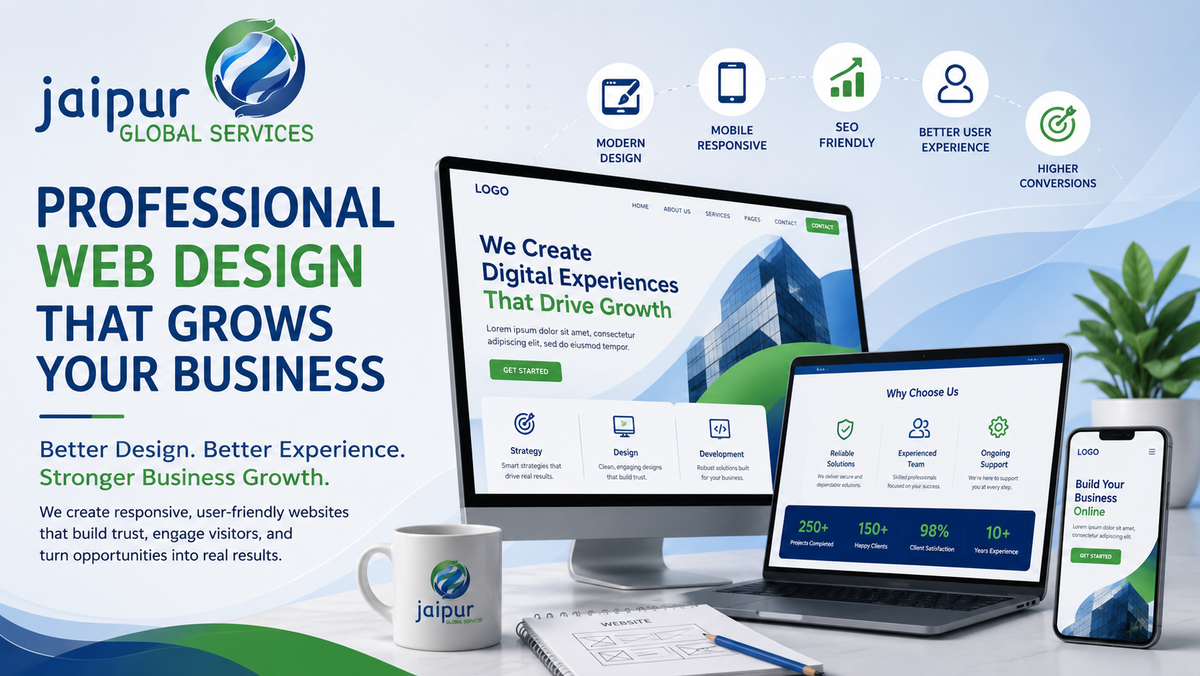
Why Professional Web Design Matters for Your Business
A well-designed website can help businesses build credibility, improve user experience, communicate their value clearly, and create more opportunities for conversions.
Get Started Talk to a Web Design Expert
For a lot of potential customers, your website is the first real interaction they have with your business — before a call, before a meeting, sometimes before they've even fully decided whether you're worth their time. What they find there shapes their first impression more than most business owners give it credit for.
Web design is often reduced to colors, fonts, and images, but that's only part of it. It also covers user experience, navigation, how content is structured and presented, mobile responsiveness, page layout, calls to action, accessibility, loading performance, and whether the whole site feels consistent with the brand behind it. Get these right, and a website works quietly in the background, helping visitors find what they need and move toward taking action. Get them wrong, and even a business with a strong product or service can lose potential customers before they've properly understood what's on offer.
This page walks through why web design actually matters — for first impressions, usability, SEO, and conversions — what separates good design from poor design, when a redesign is worth considering, and what to look for if you're evaluating web design services for your business.
What Is Web Design?
Web design covers how a website looks, feels, and functions for the people using it. That includes the visual layer — layout, color, typography, imagery — but it extends well beyond that into user experience (how easily someone can actually use the site), navigation (how content is organized and accessed), content layout (how information is structured on the page), branding (how consistently the site reflects the business behind it), responsiveness (how well it adapts across devices), and conversion elements (the paths that guide a visitor toward taking action).
It's worth clarifying the difference between web design and web development, since the two get used interchangeably fairly often. Design focuses primarily on how a website looks and works for the person using it — the layout, the user experience, the visual decisions. Development focuses on the technical build behind that — the code, the functionality, the systems that make the design actually work in a browser. In practice, these overlap constantly on any real project; a design decision often has technical implications, and technical constraints often shape what's actually possible to design. Most web design services today, JGS included, cover both together rather than treating them as entirely separate disciplines.
Why Is Web Design Important for Businesses?
1. Creates a strong first impression. Visitors form an opinion about a website — and by extension, the business behind it — within seconds of arriving. A cluttered, dated, or confusing layout suggests a business that hasn't invested in itself, regardless of how good the actual product or service is.
2. Builds brand credibility. Professional, well-executed design signals that a business is established and takes itself seriously. This matters especially for newer businesses or service providers where trust has to be built before a customer commits to anything.
3. Improves user experience. Clear navigation and a logical page structure help visitors find what they're looking for without friction — which matters because visitors who can't quickly find information tend to leave rather than dig for it.
4. Supports conversions. Thoughtful design guides visitors toward the actions that matter for the business — contact forms, product pages, service pages, phone calls, enquiries, or purchases. It's worth being clear that design supports conversions; it doesn't guarantee them on its own, since pricing, offer, and market fit all play a role too.
5. Makes information easier to understand. Visual hierarchy — the way headings, spacing, and emphasis guide the eye — helps visitors process information faster than a wall of undifferentiated text.
6. Supports mobile users. With a large and growing share of web traffic coming from phones and tablets, a site that doesn't work well on smaller screens is turning away a meaningful portion of potential visitors before they even get to see what the business offers.
7. Supports SEO. Good design contributes to SEO indirectly, through mobile usability, sensible page structure, a positive user experience, solid performance, genuinely crawlable content, and clear navigation. It's worth being precise here: visual design alone doesn't improve search rankings — but the structural and usability qualities that come with good design do support the technical and experience-based factors search engines actually evaluate.
8. Helps differentiate a business. Design communicates positioning — whether a business reads as premium, budget-friendly, technical, approachable, and so on — which matters for attracting the right kind of customer, not just more traffic.
9. Supports ecommerce. For online stores specifically, design directly shapes whether a visitor can browse, understand, and buy a product without getting stuck along the way (covered in more detail below).
10. Makes future growth easier. A site built with a scalable structure — organized content, a sensible information architecture — is easier to expand later than one that was never designed with growth in mind, which saves real rework down the line.
Key Benefits of Professional Web Design
Bringing these together, professional web design tends to deliver a consistent set of practical benefits: stronger first impressions, a more coherent brand identity across every page, better usability for visitors trying to accomplish something specific, mobile responsiveness across the range of devices people actually browse on, clearer navigation that reduces visitor frustration, better content presentation that makes information easier to absorb, stronger calls to action that guide visitors toward a next step, improved accessibility for users with different needs, a better ecommerce experience where relevant, greater visitor trust, easier content management for the team maintaining the site day to day, and better scalability as the business and its content needs grow.
Each of these compounds over time — a site that's easy to navigate and trustworthy on day one tends to stay that way as more content and pages get added, while a poorly structured site tends to get harder to manage the more it grows.
How Web Design Affects User Experience
User experience (UX) covers how a visitor actually moves through and interacts with a website. Key elements include navigation (how easily someone finds their way around), page hierarchy (what's emphasized and in what order), readability (how easy content actually is to read and absorb), button placement (whether calls to action are where visitors expect them), forms (how simple or frustrating they are to complete), search functionality, product filtering for ecommerce sites, overall content organization, mobile usability, and page speed.
Poor UX creates friction in fairly predictable ways: navigation that's difficult to follow, cluttered pages that overwhelm rather than guide, text that's too small to read comfortably, menus that confuse rather than clarify, contact information that's genuinely hard to find, mobile layouts that don't adapt properly to smaller screens, and popups that interrupt more than they help. Any one of these can be the reason a visitor leaves before taking the action a business actually wants them to take.
Responsive Web Design and Mobile Users
Responsive web design means a website automatically adapts its layout to whatever device it's being viewed on — smartphones, tablets, laptops, and desktop screens — rather than forcing visitors to zoom, scroll sideways, or squint at a layout built only for a large screen.
Mobile usability matters because a meaningful and growing share of web traffic happens on phones, and a site that doesn't work well on mobile is creating friction for a significant portion of its visitors before they've even engaged with the content. Responsive web design services address this by building layouts that genuinely adapt — not just shrink — across screen sizes, so navigation, text, images, and calls to action all remain usable regardless of the device someone's using.
How Web Design Influences SEO
Design and SEO are connected, though it's worth being precise about how. Search engines evaluate a range of technical and experience-based factors, several of which are shaped directly by design decisions:
- Mobile usability, since search engines factor in how well a site performs on mobile devices
- Website structure, since a logical, well-organized structure helps both users and search engines understand what a site contains
- Navigation, since clear internal pathways help search engines properly crawl and index a site's content
- Internal linking, which connects related content and helps distribute authority across pages
- Content accessibility, ensuring text and information are genuinely readable by both visitors and search engines
- Page experience, a broader signal covering how usable and stable a page feels to visit
- Performance, since slow-loading pages hurt both user experience and search visibility
- Image optimization, balancing visual quality against file size and loading speed
- Technical implementation, including clean code and proper markup that search engines can interpret correctly
The important distinction: good design supports SEO by getting these structural and experience factors right, but web design alone does not guarantee search rankings. Rankings depend on many additional factors — content quality, backlinks, competition, and more — that sit outside design entirely. Anyone promising that a redesign alone will improve rankings is overstating what design can deliver on its own.
Web Design and Conversion Optimization
Design plays a real role in whether visitors take action, through elements like clear calls to action, deliberate visual hierarchy that draws attention to what matters most, trust signals (testimonials, credentials, clear contact information), well-designed forms that don't create unnecessary friction, clear product or service presentation, transparent pricing information where relevant, and a simplified overall user journey from arrival to action.
It's worth separating two things that often get conflated: traffic and conversion. Getting more visitors to a site is a different problem from getting a higher percentage of those visitors to actually take action once they arrive. A beautiful website is not automatically a high-converting one — visual polish without a clear path to action, credible trust signals, and content that actually answers a visitor's questions can still underperform, regardless of how well it photographs.
Why Web Design Matters for Ecommerce Businesses
Ecommerce raises the stakes on design considerably, since the website isn't just informing visitors — it's directly handling the transaction.
Homepage design needs to orient a new visitor quickly. Product page design needs to answer the questions a shopper has before they'll commit to buying. Category navigation needs to help visitors browse logically, especially across a large catalog. Product filtering and search need to work well enough that customers can actually find what they're looking for without frustration. The cart and checkout experience needs to be simple and trustworthy, since this is exactly where hesitant customers abandon a purchase. Product images and information need to be complete and accurate. Trust signals — reviews, secure checkout indicators, clear return policies — matter more here than almost anywhere else on a site. And the mobile shopping experience needs particular attention, since a large share of ecommerce browsing and buying now happens on phones.
For ecommerce specifically, ecommerce website design and development and Shopify development work goes beyond general web design principles, since online stores carry platform-specific considerations — catalog structure, checkout flow, and integration with inventory and marketplace operations — that a general-purpose website doesn't need to account for.
Good Web Design vs Poor Web Design
Good Web Design
Poor Web Design
Clear navigation
Confusing navigation
Responsive layout
Poor mobile experience
Readable content
Difficult-to-read text
Clear CTAs
Unclear next steps
Consistent branding
Inconsistent design
Organized pages
Cluttered layout
Optimized images
Heavy, unoptimized images
Strong UX
Friction-heavy UX
The practical impact of these differences shows up in how visitors actually behave: clear navigation and readable content keep people engaged rather than confused; responsive layouts keep mobile visitors from bouncing immediately; clear CTAs turn interest into action instead of leaving visitors unsure what to do next; and optimized images keep pages loading fast instead of testing a visitor's patience before they've even seen the content.
Signs Your Business Website Needs a Redesign
A website may be due for a redesign if:
- It looks visibly outdated compared to competitors
- It isn't genuinely mobile-friendly
- Navigation is confusing or inconsistent
- Visitors struggle to find basic information
- Pages load slowly
- Branding is inconsistent across different pages
- Content is difficult to read or poorly organized
- The site generates very few enquiries relative to its traffic
- It doesn't clearly communicate what the business actually offers
- Product pages (for ecommerce sites) are difficult or frustrating to use
- Calls to action are unclear or missing
- The site is difficult for the internal team to update
- The overall design no longer reflects where the business actually is today
If several of these sound familiar, that's usually a stronger signal than any single one alone — website redesign services are worth considering seriously once a handful of these issues are compounding rather than existing in isolation.
What Makes a Good Business Website?
A handful of components consistently show up in websites that actually work for the business behind them: a clear value proposition that tells visitors what the business does and why it matters within seconds, a strong homepage that orients new visitors quickly, simple and intuitive navigation, responsive design that works across devices, fast-loading pages, genuinely useful content rather than filler, clear calls to action, visible trust elements (testimonials, credentials, case studies), easy-to-find contact information, consistent branding throughout, an SEO-friendly structure, accessible design that works for users with different needs, and a secure website that protects visitor data.
It's worth being direct that these components don't automatically guarantee rankings or conversions on their own — they create the foundation that makes strong performance possible, but results still depend on the quality of the offer, the content, and the ongoing work behind the site.
Web Design Elements Businesses Should Prioritize
Typography, color choices, layout, imagery, white space, navigation structure, button design, forms, icons, content hierarchy, responsive layouts, and accessibility all play a role in how a site actually performs. The important principle underneath all of these: design decisions should support business goals, not simply follow whatever's currently trending visually. A striking design that doesn't help visitors accomplish what they came to do isn't serving the business, no matter how modern it looks.
Custom Web Design vs Template-Based Website
Custom Website
Template-Based Website
More design flexibility
Faster setup
Can reflect specific brand needs
Lower initial complexity
Can support unique UX requirements
Limited by the template's built-in structure
Greater customization overall
Easier to manage for simple requirements
Neither option is automatically the better choice. The right one depends on budget, specific business requirements, the functionality actually needed, how much the site needs to scale over time, how important precise brand differentiation is, and the project timeline. A business with straightforward needs and a tight budget may be well served by a strong template. A business with specific functional or brand requirements that a template can't accommodate is usually better off with a custom build.
How to Choose a Web Design Company
Whether or not you choose JGS, here's what's worth evaluating in any web design provider:
- Portfolio — does their previous work reflect the quality and style you're looking for?
- Industry experience — have they worked with businesses similar to yours?
- UX approach — do they design with genuine usability in mind, or focus on visuals alone?
- Responsive design capabilities — can they demonstrate strong mobile experiences in past work?
- SEO understanding — do they build with search-friendly structure in mind from the start?
- Development capabilities — can they handle the technical build, not just the visual design?
- CMS experience — will you be able to manage and update the site yourself afterward?
- Ecommerce experience — if relevant, do they genuinely understand online store requirements?
- Communication — will you have clear visibility into progress throughout the project?
- Project process — do they have a defined, transparent process, or an ad hoc approach?
- Maintenance and support — what happens after launch if something needs fixing or updating?
- Pricing transparency — is their pricing structure clear upfront?
- Scalability — can the site they build grow with your business?
Questions worth asking directly: Can I see examples of websites you've built for businesses similar to mine? What does your design process actually look like, from kickoff to launch? How do you approach mobile responsiveness? Do you handle both design and development, or only one? What CMS or platform do you build on, and how easy is it for my team to update afterward? How do you factor SEO into the build? What ongoing support or maintenance do you offer after launch? What's your typical project timeline? How do you handle revisions during the design process? What's included in your pricing versus billed separately?
How JGS Can Help With Web Design and Development
Jaipur Global Services (JGS) provides website design and development services, including responsive, mobile-friendly, SEO-conscious builds for businesses looking to establish or improve their online presence. For ecommerce specifically, JGS is a Shopify development partner, supporting store builds, migrations to Shopify, custom app and feature development, Shopify SEO optimization, and ongoing store support and maintenance.
This web design and development work connects naturally with JGS's broader ecommerce experience — for businesses that need a website built alongside marketplace operations, ecommerce marketplace management and platform-specific support are available as part of a wider ecommerce strategy, rather than treating the website as disconnected from how the business actually sells.
Why Choose JGS?
Ecommerce understanding, built through direct, hands-on experience across Amazon, Flipkart, and Shopify, which shapes how JGS approaches ecommerce website builds specifically.
Business-focused website solutions, designed around what a site needs to actually accomplish for the business, not visual trends alone.
Shopify development expertise, including store builds, migrations, custom app development, and Shopify-specific SEO.
Responsive, mobile-friendly builds, since usability across devices is treated as a baseline requirement, not an afterthought.
Consulting support for businesses that need broader ecommerce strategy alongside their website, not just a standalone design project.
Avoid unsupported superlatives like "best" or "#1" — instead, evaluate based on the specific capabilities above and how well they match your actual project needs.
Frequently Asked Questions
Why is web design important for a business?A website is often a potential customer's first interaction with a business, and its design shapes their first impression, whether they trust the business, how easily they find information, and whether they take action — making design directly relevant to both credibility and business outcomes.
What are the benefits of professional web design?Stronger first impressions, better brand credibility, improved usability, mobile responsiveness, clearer navigation, stronger calls to action, better content presentation, and — for online stores — a smoother shopping experience that supports conversions.
What is responsive web design?A design approach where a website automatically adapts its layout to different screen sizes — phones, tablets, laptops, and desktops — so visitors get a usable experience regardless of the device they're using.
How does web design affect SEO?Good design supports SEO through mobile usability, clear site structure, sensible navigation, strong page experience, and solid performance — all factors search engines evaluate. Design alone doesn't guarantee rankings, since content quality, backlinks, and competition also matter significantly.
How does website design affect conversions?Design guides visitors toward taking action through clear calls to action, visual hierarchy, trust signals, and a simplified user journey. It supports conversion but doesn't guarantee it — a visually appealing site that lacks a clear path to action or strong content can still underperform.
How often should a business redesign its website?There's no fixed timeline — it depends on how well the current site is performing. Signs worth watching for include outdated visuals, poor mobile usability, confusing navigation, slow load times, and declining enquiries relative to traffic, rather than redesigning on a fixed schedule regardless of performance.
What is the difference between web design and web development?Design focuses on how a website looks and works for the visitor — layout, usability, visual decisions. Development covers the technical build behind it — code and functionality. In practice, most projects involve both working closely together rather than as fully separate processes.
How much do web design services cost?Pricing depends on project scope, whether it's a custom build or template-based, the platform involved, and functionality required. It's best discussed directly based on your specific requirements rather than a generic estimate.
What should I look for in a web design company?A strong portfolio, relevant industry or platform experience, a genuine focus on usability rather than visuals alone, SEO awareness, both design and development capability, transparent pricing, and clear post-launch support.
Can JGS help with ecommerce website design?Yes — JGS provides ecommerce website design and development, including Shopify store builds, migrations, custom app development, and ongoing support, alongside broader ecommerce marketplace and consulting services.
Is your website failing to clearly communicate what your business offers? JGS can help you build a site that combines professional design, genuine usability, business-focused content, and ecommerce expertise where it's needed.