
Multi-Location Fulfilment (MLF): How It Works and How Sellers Can Plan Inventory
 September 16, 2026
 Yashwardhan Singh
 0 Comments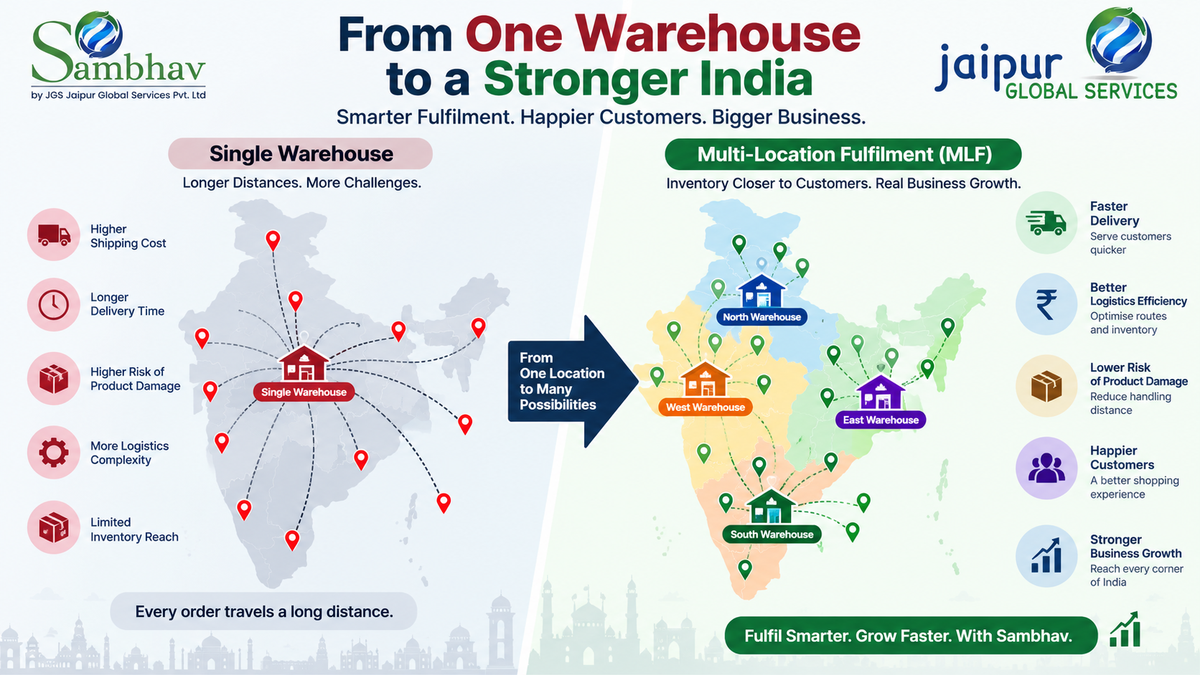
Most Amazon sellers in India begin the same way. One warehouse, one pickup address, and every order in the country shipping out of that same door. For a while this works fine.
Then the business grows. Orders start arriving from Chennai, Guwahati, Kochi, Ludhiana. Now that single warehouse in, say, Jaipur is serving the entire country, and every parcel travels the full distance regardless of where the buyer sits.
This is where Multi-Location Fulfilment becomes worth understanding. It isn't a magic fix and it isn't right for everybody. But once demand genuinely spreads across India, where your inventory sits starts to matter as much as how much you hold.
What Is Multi-Location Fulfilment (MLF)?
First, a clarification, because these terms get mixed up constantly.
Amazon Easy Ship is a delivery service. You store products in your own warehouse, and when an order comes in, an Amazon Logistics delivery associate picks it up and delivers it to the buyer. Easy Ship orders also carry the Pay on Delivery option, with funds deposited to your bank account. You own the storage; Amazon handles the movement.
Multi-Location Fulfilment (MLF), also written ES-MLF, is Easy Ship running from more than one registered location. Instead of every order shipping from a single origin, orders can be fulfilled from whichever registered location is better placed for that customer.
Keep this separate from Amazon's other programmes. FBA means your stock sits in Amazon's fulfilment centres and Amazon handles storage, packing and returns. MCF is an FBA-based service for fulfilling orders from your other sales channels. With MLF, your inventory stays in your own facilities — you simply have more than one.
The plain version: a seller in Rajasthan sells home furnishing products. A customer in Bengaluru orders. With one location, that parcel travels from Rajasthan to Karnataka every time. With MLF, if the seller also holds stock in South India, the same order could ship from there — shorter route, fewer touchpoints.
MLF is about where your inventory sits, not just how much you have.
Why One Fulfilment Location Can Become a Problem
Serving a national customer base from one warehouse creates strain that builds quietly as you scale.
Every order travels the same distance. A customer 80 km away and one 2,000 km away are served from the same shelf. Distance drives cost and transit time, and with a single origin you have no lever to pull.
Some regions are structurally disadvantaged. Certain states consistently see longer transit because of geography, not because demand there is weak.
Logistics gets more complicated. Shipping to every corner of India from one point means more handoffs, more hubs, and more places where something can go wrong.
All your stock sits in one place. A capacity crunch, a local disruption or a stockout on a fast-moving SKU hits the whole business at once.
Bulky products suffer most. Furniture, appliances, mattresses and large décor cost more to move and carry higher damage risk over long distances.
Scaling gets harder. A single warehouse becomes a bottleneck for space, processing speed, and your confidence in entering a new region.
One caveat: MLF doesn't automatically fix any of this. A second location without a plan creates new problems — split stock, stockouts in the wrong place, higher holding costs. The strategy behind it does the work.
How Multi-Location Fulfilment Works
Think of MLF as a cycle rather than a one-time setup.
1. Understand demand. Which states produce consistent volume, and which SKUs drive it? This is data work, and it comes first.
2. Identify suitable locations. Pick locations that map to where customers actually are — not more warehouses for the sake of it.
3. Plan inventory allocation. Decide which SKUs go where, and how much. A fast mover with strong South India demand belongs in a South India location. A slow mover probably doesn't need to be everywhere.
4. Fulfil from the right location. Orders are routed from the registered location best positioned for that customer.
5. Monitor. Track stock levels, order flow and fulfilment consistency at each location.
6. Optimise. Demand shifts, new regions grow, festive season arrives. Revisit allocation instead of setting it once.
One practical flag: operating across multiple states in India brings state-level GST and registration considerations, and onboarding involves working with Amazon directly. Exact eligibility rules, documentation and timelines depend on Amazon's current seller policies and your account setup — check Seller Central or Seller Support rather than relying on any blog, this one included.
Why Inventory Location Matters More Than Warehouse Count
Most sellers skip this section. It's the one that decides whether MLF works for them.
Adding warehouses is easy; deciding what goes in them is the real problem. The useful question isn't "how many locations should I have?" — it's "where should each SKU sit?"
Regional demand and historical sales. Not where you think customers are — where six to twelve months of order data says they are, consistently. One good week isn't a pattern.
SKU velocity by region. A product selling 200 units a month in Maharashtra and 4 in Assam shouldn't be stocked identically in both.
Size and weight. A 40 kg dining table and a 200 g cosmetic tube have completely different economics. Heavy items gain far more from being close to the customer.
Inventory value. High-value stock spread wider needs tighter monitoring and ties up more working capital.
Replenishment time. This gets ignored and causes real damage. A location you can restock in three days behaves very differently from one that takes twelve. If it runs dry at peak demand, proximity stops mattering.
Warehouse capacity and seasonality. Can the location hold what your plan needs at peak? Festive season and regional events shift where demand concentrates, sometimes sharply.
Operating cost. Rent, staffing, handling, carrying cost. If the fulfilment benefit doesn't exceed this, the location isn't justified, however strong sales look.
The difference between an MLF strategy that works and one that just duplicates stock everywhere comes down to doing this analysis honestly.
Benefits of Amazon Multi-Location Fulfilment for Sellers
These are potential outcomes, not promises.
- Shorter fulfilment distances. Stock closer to customers can reduce how far an order travels. Whether that means faster delivery depends on your setup, carrier performance and Amazon's policies.
- Better inventory distribution. Stock placed according to where demand exists, rather than one undifferentiated pool.
- Room to scale nationally. A framework for growing capacity alongside expansion instead of overloading one warehouse.
- Less dependence on a single point. If one location has a capacity issue or disruption, you have options.
- Planned rather than reactive fulfilment. Sales data drives stock placement instead of stock sitting wherever it landed.
- Better handling of bulky items. Shorter routes and fewer touchpoints can help with handling cost and transit risk, though outcomes vary.
To be direct: cost savings, delivery improvements and sales growth all depend on your products, locations, demand patterns, order volumes, warehouse setup, replenishment discipline, carrier performance and Amazon's policies. MLF creates the framework. It doesn't guarantee a result.
Which Amazon Sellers Can Benefit From MLF?
Category matters, and the reasons differ.
Furniture is the clearest case — bulky, expensive to move, vulnerable to damage across multiple touchpoints. Large appliances follow the same logic: heavy, often fragile, expensive to freight, with both damage risk and cost responding directly to distance. Home, décor and mattresses mix fragile and heavy items with broad national demand, so regional stock helps balance careful handling with reasonable transit.
Fragile and glass products gain from fewer hops — every extra touchpoint is another chance for breakage. Solar panels, inverters, bikes, scooters and auto parts are large and awkward, with freight cost as a serious line item. Home and kitchen and food and FMCG sellers see high order frequency and wide demand, where regional allocation keeps availability consistent.
Fashion and lifestyle flips the logic. These aren't bulky, so the driver isn't freight weight — it's SKU count, turnover speed and trend cycles. Planning here focuses on velocity and avoiding dead stock in the wrong region. Beauty and personal care and general consumer products usually suit a straightforward regional split based on where orders concentrate.
How to Plan Inventory for MLF
Work through this in order. Analysis first, warehouse decision second.
- Analyse sales by state. Pull six to twelve months of data. Which states consistently produce volume?
- Go down to PIN code or city level. Concentrated in two or three metros, or genuinely spread? A state total can hide the answer.
- Break it down SKU-wise. Which products drive orders in each region? This determines allocation.
- Check inventory turnover. Slow movers rarely justify duplication across locations.
- Factor in dimensions and weight. Map how shipping cost changes with product type and distance.
- Assess warehouse capacity. Can the location hold what you plan to put there, including peak stock?
- Calculate replenishment time. Build it into stock levels or you'll hit avoidable stockouts.
- Work out inventory carrying cost. Rent, capital tied up, handling, insurance.
- Compare fulfilment economics. Does the shipping cost saved exceed the added operational cost? This is the go/no-go number.
- Account for seasonality. Plan festive peaks separately from baseline allocation.
Steps 8 and 9 are where MLF plans usually fall apart. Sellers see strong regional sales, open a location, then discover the carrying cost eats the shipping benefit.
Common MLF Mistakes Sellers Should Avoid
Splitting inventory equally across locations. The most common error. Treating every location identically produces overstock where demand is weak and stockouts where it's strong.
Choosing locations by assumption instead of data. Picking a city because it feels central, or because you know someone with space there, defeats the purpose.
Moving slow-moving SKUs unnecessarily. Duplicating slow sellers ties up capital and shelf space for very little return.
Ignoring replenishment time. A location that's slow to restock runs out exactly when demand peaks.
Looking only at sales and ignoring fulfilment economics. Strong regional sales don't automatically justify a location. Holding and operational cost must be weighed against the shipping benefit.
How Technology Helps With Multi-Location Fulfilment
Running one warehouse on spreadsheets is manageable. Running three or four is not.
Once stock sits in multiple places, you need to know at any moment what's available where, which location fulfilled which order, which SKUs are moving fast in which region, and where a stockout is building. Doing that manually means working from data that's always slightly stale — and stock decisions made on stale data cause problems.
What helps: inventory visibility across every location in one view, order tracking that shows what shipped from where, regional demand analysis, SKU-level velocity by location, allocation planning that reflects real sales trends, and fulfilment monitoring across all active locations.
This is the gap Sambhav, JGS's ecommerce seller platform, is built to address — bringing catalog management, forecasting and planning, order and return management, growth analytics and centralised operational data into one place, so the demand and velocity data MLF decisions depend on is accessible rather than scattered across reports.
The platform doesn't make the strategic call for you. What a seller operations platform does is ensure you're deciding with current, complete information rather than guesswork.
Is Amazon MLF Right for Every Seller?
No — and that's worth being straightforward about.
MLF probably isn't right yet if volume is still low and the overhead won't pay for itself; demand is concentrated in one region; your products move slowly; your inventory is limited, so splitting it creates stockouts in several places instead of one; or you lack the operational bandwidth to run more locations properly.
MLF becomes more relevant when demand is genuinely spread across regions, volume is growing and your single location is straining, you sell bulky products where distance drives real cost, you're expanding into new markets, or your data shows a consistent demand cluster far from your warehouse.
If you're unsure which side you're on, the answer is in your own reports. Pull sales by state for the last year and look at how concentrated it is. That usually settles the question faster than any general advice.
Frequently Asked Questions About MLF
What is Amazon Easy Ship Multi-Location Fulfilment?
It's an approach where a seller operates from more than one registered fulfilment location under Easy Ship. Orders are fulfilled from the location best positioned for that customer instead of always shipping from one warehouse. Your inventory stays in your own facilities — unlike FBA, where Amazon stores it.
How does Amazon MLF work?
You analyse where demand comes from, register suitable additional locations, allocate inventory based on regional sales and SKU velocity, and orders are fulfilled from the appropriate location. You then monitor and adjust as demand shifts. Registration requirements depend on Amazon's current policies and your account setup.
Who should consider Amazon MLF?
Sellers with genuine multi-regional demand, growing volumes, or bulky products where shipping distance drives real cost. Furniture, appliances and large goods sellers see the clearest case. Sellers with low volume or highly localised demand usually don't need it yet.
How should inventory be divided between multiple locations?
By regional demand and SKU-level velocity, not by splitting stock equally. Fast movers should be stocked in proportion to regional demand. Slow movers often don't need duplicating at all. Replenishment time should also shape the quantities you hold.
How many locations should an Amazon seller use?
There's no standard number. It depends on how widely demand is spread, what you sell, and your operational capacity. Two well-planned locations usually beat four poorly planned ones. The count should come out of your data.
Can Amazon MLF help reduce fulfilment costs?
It has the potential to, by shortening the distance some orders travel. The actual impact depends on your products, locations, volumes and logistics setup — and the extra location's carrying cost has to be subtracted from any shipping savings. It can't be guaranteed.
Can MLF improve delivery speed?
Positioning inventory closer to customers can shorten timelines for some orders. Outcomes depend on your setup, carrier performance, stock availability at each location, and Amazon's policies. If a nearby location is out of stock, proximity doesn't help.
Final Thoughts
The most useful thing to take from all this: MLF is not about having more warehouses. It's about having the right inventory in the right place.
A seller with two well-planned locations, stocked to real regional demand and restocked on a realistic cycle, will run a better operation than one with four stocked by guesswork. The warehouses are the easy part; the allocation decisions determine whether it works.
Start with your own data — sales by state, sales by SKU, turnover rates, and an honest calculation of what an extra location costs to run. If the numbers point towards MLF, the plan builds itself. If they don't, you've saved yourself considerable expense.
For sellers who want that data in one place rather than spread across a dozen reports, an ecommerce management platform makes the analysis less painful — and once you're running multiple locations, having order, inventory and regional performance data centralised is close to essential.