
Multi-Channel Warehouse Services: A Complete Guide for Growing Ecommerce Businesses
 June 1, 2026
 Yashwardhan Singh
 0 Comments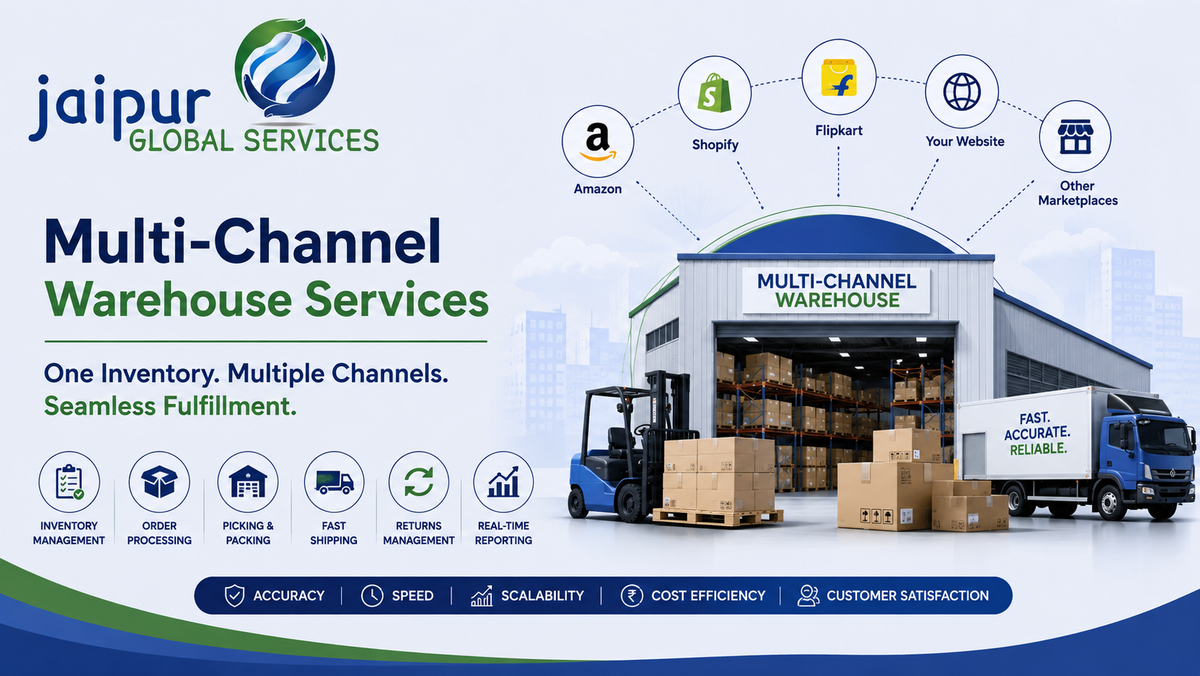
Selling through one channel is manageable. You know your stock, you know your orders, and you can pack and ship them yourself without much confusion. The moment a business adds a second channel — Amazon alongside Shopify, or Flipkart alongside a company website — that simplicity disappears fast. Every channel generates its own stream of orders, and customers on all of them expect the same thing: fast, accurate delivery, regardless of where they bought from.
This is where things get genuinely complicated. Inventory needs to be tracked across every channel at once. Orders need to be processed without mixing up which warehouse location has what. Picking, packing, and shipping need to happen consistently, no matter which platform the order came from. And returns start arriving from multiple directions, each with its own process to follow.
Multichannel fulfillment services exist to solve exactly this problem — coordinating inventory, orders, and shipping across every channel a business sells on, instead of managing each one as a separate operation. This guide explains what that actually looks like in practice, how it works day to day, what it costs, and what to look for if you're evaluating a fulfillment partner.
What Are Multi-Channel Warehouse Services?
Multi-channel warehouse services cover the full operational chain involved in getting a product from your supplier to your customer, regardless of which sales channel the order came through. That includes:
- Receiving inventory as it arrives from manufacturers or suppliers
- Storage, keeping products organized and accessible
- Inventory management, tracking what's available and where
- Order processing, turning an incoming order into a fulfillment task
- Picking, locating the right products for a given order
- Packing, preparing the order to ship
- Shipping, getting the package to the customer
- Returns, handling products that come back
- Reporting, giving visibility into how all of the above is actually performing
The goal isn't just to store products — it's to create one coordinated operation that can serve every channel a business sells through, rather than running separate, disconnected processes for each platform. That distinction matters more than it might sound, because disconnected processes are exactly where inventory mistakes, shipping delays, and overselling tend to happen.
What Is Multi-Channel Fulfillment?
Here's a practical way to picture it: a brand sells the same products through Amazon, Shopify, and Flipkart, plus its own website. Without a coordinated system, that business would need to track inventory separately for each channel, process orders differently depending on where they came from, and hope nothing falls through the cracks between them.
Multi-channel fulfillment replaces that with a centralized operation that coordinates orders and inventory across all of those channels from one place. In general terms, the flow looks like this:
Sales channel → Order received → Order management/integration → Inventory check → Warehouse picking → Packing → Shipping → Tracking update → Customer delivery
The exact way this works — how tightly integrated the systems are, how quickly inventory updates propagate across channels, what technology handles the handoffs — depends heavily on the specific fulfillment provider and the tools they use. Not every setup is equally automated or equally fast, which is worth keeping in mind when evaluating a provider rather than assuming all multi-channel fulfillment operations work identically.
Why Growing Ecommerce Brands Need Multi-Channel Warehousing
Growth creates operational strain in fairly predictable ways: more orders, more SKUs, more marketplaces, sometimes more physical inventory locations, more shipping complexity, more returns, and customers who expect the same fast delivery regardless of how much more complicated things have gotten behind the scenes.
A few problems show up consistently once a business outgrows a simple, single-channel setup:
Overselling. Inventory shows as available on one channel when it's actually already sold out through another, because the systems aren't talking to each other in real time.
Stockouts. A product runs out before anyone notices it needs replenishing, often because inventory visibility across channels is patchy.
Manual order processing. Someone on the team is manually moving order details between systems — a marketplace dashboard here, a spreadsheet there — which is slow and prone to errors as volume increases.
Shipping delays. Orders sit longer than they should before being processed, simply because the operational workflow can't keep pace with order volume.
Inventory visibility problems. The business owner genuinely isn't sure how much stock is actually available at any given moment, which makes planning and purchasing decisions harder than they need to be.
Returns complexity. Returns come back from several different channels, each with its own process and paperwork, and keeping track of all of it manually gets messy fast.
None of these problems are unusual — they're the normal growing pains of adding channels without the operational infrastructure to support them. That's precisely the gap multi-channel fulfillment is built to close.
How Multi-Channel Warehouse Fulfillment Works
Here's what the process typically looks like, step by step, once a business is working with a coordinated fulfillment operation:
- Inventory arrives at the warehouse from the manufacturer or supplier.
- Inventory is checked — quantities and SKUs are verified and recorded against what was expected.
- Inventory is stored in designated warehouse locations, organized for efficient picking later.
- Sales channels are connected, where supported, linking ecommerce platforms and marketplaces to the fulfillment or order management system.
- A customer places an order on any connected channel.
- The order enters the fulfillment workflow, routed automatically where integrations support it.
- Inventory is allocated to that specific order, drawing from the shared stock pool.
- Warehouse staff pick the products, locating the right items for that order.
- The order is packed according to the required process for that product or channel.
- The order is shipped, with the appropriate carrier or shipping method selected.
- Tracking information is updated and sent back through the relevant system so the customer and the seller both have visibility.
- Inventory is adjusted to reflect what was just shipped, updating availability across every connected channel.
The reliability of this whole chain depends heavily on how well the systems are actually integrated. A fulfillment provider with strong, real-time integrations across your specific sales channels will keep this loop tight; weaker or partial integrations introduce delays and the kind of sync issues that cause overselling.
Key Services Included in Multi-Channel Warehousing
A full-service multi-channel fulfillment operation typically covers:
- Receiving and inventory intake, checking and recording stock as it arrives
- Warehousing and storage, keeping inventory secure and organized
- Inventory management, maintaining accurate, up-to-date stock visibility
- Pick and pack, the physical process of preparing individual orders
- Order fulfillment, managing the order from receipt through to shipment
- Shipping coordination, selecting carriers and managing outbound logistics
- Returns processing, handling products coming back from customers
- Inventory reporting, giving sellers visibility into stock levels and movement
- Order management, tracking orders through their full lifecycle
- Kitting and bundling, where offered — combining multiple products into a single packaged unit for orders that require it
Not every fulfillment provider offers every one of these as standard, and the specifics of what's included can vary. It's worth confirming exactly which of these a given provider covers rather than assuming a full-service model automatically applies.
Multi-Channel Fulfillment vs Traditional Warehousing
Factor
Traditional Warehousing
Multi-Channel Fulfillment
Main focus
Storage
Storage + fulfillment
Sales channels
Often limited
Multiple channels
Order processing
May be manual
Usually integrated
Inventory visibility
Can be limited
Designed for cross-channel visibility
Picking/packing
May be separate
Part of fulfillment workflow
Shipping
Seller-managed
Often coordinated by provider
Returns
Separate process
Integrated into operations
Traditional warehousing isn't inferior — it simply serves a different operational need. A business with one sales channel and predictable, low order volume might not need the added coordination multi-channel fulfillment provides. The distinction matters most once a business is genuinely juggling several channels at once, which is when the coordination gap starts costing real time and money.
Multi-Channel Fulfillment for Amazon and Shopify
A common setup: a brand receives Amazon orders and Shopify orders from the same shared inventory pool. Without synchronization between the two, it's easy to end up promising a product on Shopify that's already been sold through Amazon, or vice versa.
This is why inventory synchronization matters so much in an Amazon and Shopify fulfillment setup specifically. A few things need to stay consistent:
- SKU consistency across both platforms, so the fulfillment system can match an order to the correct physical product without confusion
- Inventory availability updating in close to real time on both channels as orders come in from either one
- Order routing, making sure orders from each channel land in the same fulfillment workflow rather than being handled through entirely separate processes
- Shipping, ideally coordinated consistently regardless of which channel generated the order
- Tracking, flowing back to the right channel so customers get accurate delivery information
- Returns, handled consistently whether the original order came through Amazon or Shopify
Amazon fulfillment services and Shopify fulfillment services aren't identical — Amazon has its own fulfillment programs and requirements (including FBA-specific rules), while Shopify fulfillment depends on how the store itself is set up and which fulfillment app or integration it uses. A provider genuinely experienced in both is more useful than one that's only deeply familiar with a single platform.
Multi-Channel Fulfillment for Walmart, Flipkart and Other Marketplaces
Expansion doesn't stop at Amazon and Shopify for most growing brands. Walmart, Flipkart, other regional marketplaces, a direct website, and sometimes retail channels all add their own order streams and their own platform-specific requirements.
Each additional channel increases operational complexity in a fairly linear way — more integrations to maintain, more places inventory needs to stay accurate, more shipping and packaging requirements to keep consistent. Marketplace fulfillment services that are genuinely built for multichannel ecommerce fulfillment aim to give centralized visibility across all of these channels from one system, rather than requiring a business to check five different dashboards to understand their actual stock position.
This is really the core value proposition of multi-channel fulfillment: as channels multiply, the coordination problem grows faster than most businesses expect, and a centralized system is what keeps that growth from turning into operational chaos.
Benefits of Multi-Channel Fulfillment Services
1. Centralized inventory. One accurate view of stock across every channel, rather than piecing together numbers from separate systems.
2. Better order visibility. Knowing where every order stands, regardless of which channel it came from.
3. Reduced manual work. Less time spent manually transferring order data between disconnected systems.
4. Faster order processing. Integrated workflows generally move orders through fulfillment more efficiently than manual handoffs.
5. Easier marketplace expansion. Adding a new channel is more manageable when the underlying fulfillment infrastructure is already built to handle multiple channels.
6. Better inventory control. Reduced risk of the mismatches that lead to overselling or unexpected stockouts.
7. Scalable operations. A coordinated system is generally better positioned to handle order volume growth than an ad hoc, manual setup.
8. Simplified returns. Returns from different channels flowing through one consistent process rather than several disconnected ones.
9. Potentially lower operational burden on internal staff, who spend less time on manual coordination between systems.
10. Better customer experience. Consistent, accurate order fulfillment tends to translate into fewer delivery problems and fewer customer complaints, regardless of which channel a customer bought from.
None of this guarantees a specific cost reduction or delivery-time improvement for every business — actual results depend on your current setup, order volume, and how well a given provider's systems actually integrate with your channels.
How Multi-Channel Fulfillment Helps Prevent Stockouts and Overselling
Here's a simple example of why synchronization matters so much. Say a business has 100 units of a product in stock. Amazon sells 30 of them, Shopify sells 20, and Walmart sells 15. If these three channels aren't synchronized in real time, each one might still show close to the full 100 units as available — because none of them know what's already been sold elsewhere. That's a direct path to overselling: promising inventory that no longer exists.
Centralized inventory visibility addresses this by maintaining one shared stock count that updates as sales happen on any channel, so all three platforms reflect the same, accurate availability. How precisely this actually works — how close to real-time the updates are, how reliably integrations catch every sale — depends on the specific technology and integration quality behind a given fulfillment setup. This is worth asking about directly when evaluating a provider, since not all systems sync with the same speed or reliability.
Multi-Channel Warehouse Technology
A few categories of technology typically sit behind a well-run multi-channel fulfillment operation:
- Warehouse Management Systems (WMS), which manage the physical operations inside the warehouse — where inventory is stored, how it's picked, and how movement is tracked
- Order Management Systems (OMS), which handle incoming orders from every connected channel and route them into the fulfillment workflow
- Inventory Management Systems, which maintain accurate stock counts and availability across channels
- Ecommerce integrations, connecting platforms like Shopify directly into the fulfillment workflow
- Marketplace integrations, doing the same for Amazon, Flipkart, Walmart, and similar platforms
- Barcode scanning, used for accuracy during receiving, picking, and packing
- Shipping software, selecting carriers and generating labels and tracking
- Tracking systems, keeping both the seller and the customer updated on order status
- Reporting dashboards, giving visibility into performance across inventory, orders, and shipping
At a high level, these systems work together to keep the whole fulfillment chain connected — from the moment inventory arrives to the moment a customer receives (or returns) their order.
How Multi-Channel Fulfillment Supports Business Growth
Fulfillment needs change as a business grows, and it's worth thinking about this as a progression rather than a fixed setup.
Small business: Typically has a manageable number of SKUs, relatively low order volume, and one or two sales channels. A simpler, more manual setup can often work fine at this stage.
Growing business: SKU count expands, order volume increases, multiple marketplaces come into play, and returns start requiring more structured handling. This is usually the stage where manual processes start breaking down and a more coordinated system becomes genuinely necessary.
Established brand: Operating across multiple sales channels, holding larger inventory volumes, sometimes across multiple warehouse locations, managing more complex integrations, and potentially handling international operations on top of everything else.
The practical takeaway: fulfillment infrastructure should evolve alongside the business, not lag years behind it. A setup that worked fine at a small scale often becomes the actual bottleneck once order volume and channel count grow past what it was built to handle.
When Should You Outsource Warehouse and Fulfillment Services?
A few signs tend to show up when a business has outgrown managing fulfillment entirely in-house:
- Warehouse space is running out and expanding it isn't practical
- Order volume is increasing faster than internal capacity can keep up with
- Fulfillment errors — wrong items, delayed shipments — are becoming more frequent
- Staff are spending a disproportionate amount of time on packing and shipping instead of higher-value work
- Inventory visibility is genuinely poor, making planning difficult
- Managing multiple sales channels manually has become unsustainable
- Shipping operations are getting more expensive without a clear way to bring costs back down internally
- Returns are difficult to track and process consistently
- The business wants to expand into new marketplaces but doesn't have the fulfillment infrastructure to support it
None of these alone necessarily means outsourcing is the right call — but when several of them show up together, that's usually a sign the current setup has reached its limits.
Multi-Channel Fulfillment vs 3PL
These terms overlap significantly but aren't exact synonyms, and it's worth understanding the distinction.
A third-party logistics provider (3PL) generally offers warehousing, inventory management, pick and pack, shipping, and returns handling as its core service. Multi-channel fulfillment specifically refers to the capability of serving orders across multiple sales channels in a coordinated way.
In practice, a 3PL may or may not offer genuine multi-channel fulfillment — some 3PLs are built primarily around a single channel or a simpler fulfillment model, while others are specifically structured to handle multiple marketplaces and platforms at once with proper integrations. When evaluating a 3PL, it's worth confirming directly whether true multi-channel coordination is part of what they offer, rather than assuming every 3PL automatically covers this.
How to Choose a Multi-Channel Warehouse Partner
A practical evaluation checklist:
- Warehouse locations — where are they, and does that make sense for your customer base and shipping needs?
- Storage capacity — can they realistically handle your current inventory and reasonable growth?
- Technology integrations — do their systems actually connect properly with the platforms you sell on?
- Marketplace integrations — specifically, do they support Amazon, Flipkart, Shopify, Walmart, or whichever channels you actually use?
- Inventory accuracy — what processes do they have in place to keep stock counts reliable?
- Order processing speed — how quickly do orders typically move from receipt to shipment?
- Shipping options — what carriers and delivery speeds can they support?
- Returns management — how do they handle returns, and how is that communicated back to you?
- Reporting — what visibility will you actually have into inventory, orders, and performance?
- Scalability — can they grow with your business, or will you outgrow them quickly?
- Pricing structure — is it transparent, and do you understand every cost component?
- Customer support — how responsive and accessible is their team when something needs attention?
- Service-level agreements — what commitments do they actually make around accuracy and turnaround time?
- Data and security practices — how is your inventory and order data handled and protected?
- Experience with ecommerce businesses — do they genuinely understand ecommerce-specific requirements, or are they a general logistics provider without that context?
Questions worth asking directly in a conversation with a potential partner: Which specific marketplaces and platforms do you integrate with? How do you handle inventory synchronization across channels? What happens when there's a discrepancy between system inventory and physical stock? How do you handle a sudden spike in order volume? What's included in your standard pricing versus billed separately?
Costs of Multi-Channel Fulfillment Services
Pricing varies considerably depending on the provider, your product type, and your order volume, so it's worth understanding the components rather than expecting one flat number.
Common cost components include:
- Storage, typically based on space or volume occupied
- Receiving, for processing inventory as it arrives
- Pick and pack, often charged per order or per item
- Per-order fulfillment fees
- Packaging materials
- Shipping, which varies by carrier, weight, and destination
- Returns processing
- Special handling, for fragile, oversized, or otherwise non-standard products
- Technology or integration fees, where applicable
- Additional services, like kitting or bundling
Rather than comparing providers on a single headline rate — like storage cost alone — it's worth calculating the total fulfillment cost per order across all of these components, since a provider with a low storage rate but high per-order fees might end up costing more overall than one with the reverse pricing structure.
Common Multi-Channel Fulfillment Mistakes
1. Poor SKU organization. Inconsistent or unclear SKU naming makes inventory tracking harder than it needs to be, especially across multiple channels.
2. Inaccurate inventory. Stock counts that don't reflect reality undermine the entire point of centralized fulfillment.
3. No inventory synchronization. Running multiple channels without real-time (or close to real-time) syncing reintroduces the overselling problem multi-channel fulfillment is meant to solve.
4. Choosing a provider based only on price. The cheapest option often comes with weaker integrations, slower processing, or less reliable accuracy — costs that show up indirectly rather than on the invoice.
5. Ignoring returns. Treating returns as an afterthought rather than planning for them properly creates ongoing operational friction.
6. Not planning for seasonal demand. Order volume spikes around sales events or holidays can overwhelm a fulfillment setup that wasn't built with that variability in mind.
7. Poor integration setup. Rushed or incomplete integrations between sales channels and the fulfillment system are a common source of ongoing sync issues.
8. Lack of reporting. Without clear visibility into performance, it's hard to know whether the fulfillment operation is actually working well or quietly causing problems.
9. No clear SLA. Without defined expectations around accuracy and turnaround time, there's no real basis for holding a fulfillment partner accountable.
10. Failing to plan for growth. Choosing a setup that fits current volume without room to scale often means switching providers sooner than expected, which carries its own disruption.
How JGS Can Help With Ecommerce Fulfillment
Jaipur Global Services (JGS) offers multi-channel warehouse facilities for online sellers across Amazon, Flipkart, Meesho, and Shopify, with distribution centers that handle inventory management, order processing, return handling, and removal processing. JGS is an Amazon Authorized Partner for Multi-Seller Flex (MSF) storage services, operating warehouse locations including RNNF in Ratangarh, Rajasthan; REOD in Bengaluru, Karnataka; and GNZN, a Heavy & Bulky (H&B) warehouse also in Ratangarh, supporting multi-packaging shipping across India. The team works across sectors including FMCG, fashion and clothing, and electronics.
Beyond fulfillment itself, JGS's broader work in ecommerce marketplace management and Amazon-specific services means fulfillment doesn't have to sit disconnected from the rest of a seller's marketplace operations — listings, account management, and advertising can be coordinated alongside warehousing and order fulfillment, rather than managed as entirely separate relationships with different providers.
This isn't a claim that any fulfillment setup automatically guarantees faster delivery, lower costs, or higher sales — those outcomes depend on your specific products, order volume, and how well a given operation is run. What multi-channel fulfillment offers is a more coordinated way to manage inventory and orders as a business grows across channels. If you're weighing whether your current fulfillment setup can keep up with where your business is headed, JG Services is worth a look as part of that evaluation.
Multi-Channel Fulfillment Checklist
Before selecting a partner:
- Sales channels identified
- SKU count calculated
- Monthly order volume estimated
- Inventory requirements calculated
- Warehouse requirements identified
- Integration requirements documented
- Shipping requirements documented
- Return requirements documented
- Pricing structure reviewed
- SLA reviewed
After implementation:
- Inventory synchronization checked
- Order accuracy monitored
- Shipping performance monitored
- Returns monitored
- Inventory reports reviewed
- Channel performance reviewed
- Fulfillment costs reviewed
- Customer complaints monitored
FAQ’s
What are multi-channel warehouse services?
Multi-channel warehouse services cover the full fulfillment chain — receiving, storage, inventory management, order processing, picking, packing, shipping, and returns — coordinated across every sales channel a business uses, rather than handled separately for each one.
What is multi-channel fulfillment?
It's the process of managing orders and inventory from multiple sales channels — like Amazon, Shopify, and Flipkart — through one centralized, coordinated operation instead of running separate systems for each platform.
How does multi-channel fulfillment work?
Inventory is received, checked, and stored in a warehouse connected to your sales channels. When an order comes in from any channel, it's processed, picked, packed, and shipped through the same workflow, with inventory and tracking updated across every connected platform.
What is the difference between warehousing and fulfillment?
Warehousing primarily refers to storing inventory. Fulfillment covers the full order lifecycle — from inventory storage through picking, packing, shipping, and returns — making it a broader operational service than storage alone.
Can one warehouse fulfill Amazon and Shopify orders?
Yes, provided the fulfillment provider has proper integrations with both platforms and can synchronize inventory across them in close to real time to avoid overselling or stock mismatches between the two channels.
What is a 3PL fulfillment service?
A third-party logistics (3PL) provider handles warehousing, inventory management, pick and pack, shipping, and returns on behalf of a business. Not every 3PL automatically offers true multi-channel coordination, so it's worth confirming this capability directly.
How much do multi-channel fulfillment services cost?
Costs vary by provider and typically include storage, receiving, pick and pack, per-order fees, shipping, and returns processing, among other components. It's more useful to compare total cost per order across providers than to compare a single rate like storage alone.
Is multi-channel fulfillment suitable for small businesses?
It can be, though smaller businesses with low order volume and one or two channels sometimes manage fine with a simpler setup. Multi-channel fulfillment tends to become more valuable as order volume, SKU count, and the number of sales channels increase.
How does multi-channel fulfillment manage inventory?
Through a centralized inventory system that updates across all connected sales channels as orders are placed, aiming to keep stock counts consistent everywhere rather than letting each channel operate from outdated or disconnected numbers.
How do I choose a multi-channel fulfillment partner?
Evaluate their warehouse locations, technology and marketplace integrations, inventory accuracy processes, shipping options, returns handling, reporting visibility, pricing structure, and experience with ecommerce businesses specifically — and ask directly how they handle inventory synchronization across the channels you actually use.
Conclusion
As ecommerce businesses expand across Amazon, Shopify, Walmart, Flipkart, their own websites, and other channels, warehouse and fulfillment operations get more complicated in ways that are easy to underestimate until they're already causing problems. Multi-channel fulfillment exists to bring inventory, orders, warehousing, picking, packing, shipping, and returns together into one coordinated operation, instead of managing each channel as its own separate, disconnected process.
The right fulfillment strategy depends on your specific order volume, SKU count, sales channels, product type, geographic requirements, budget, and growth plans — there's no single setup that fits every business. If you're evaluating whether your current fulfillment operation can support where your business is headed, JG Services offers multi-channel warehouse and fulfillment support alongside broader marketplace management, worth considering as part of that evaluation.