
Why Shopify Is One of the Best Ecommerce Platforms for Growing Brands
 June 1, 2026
 Yashwardhan Singh
 0 Comments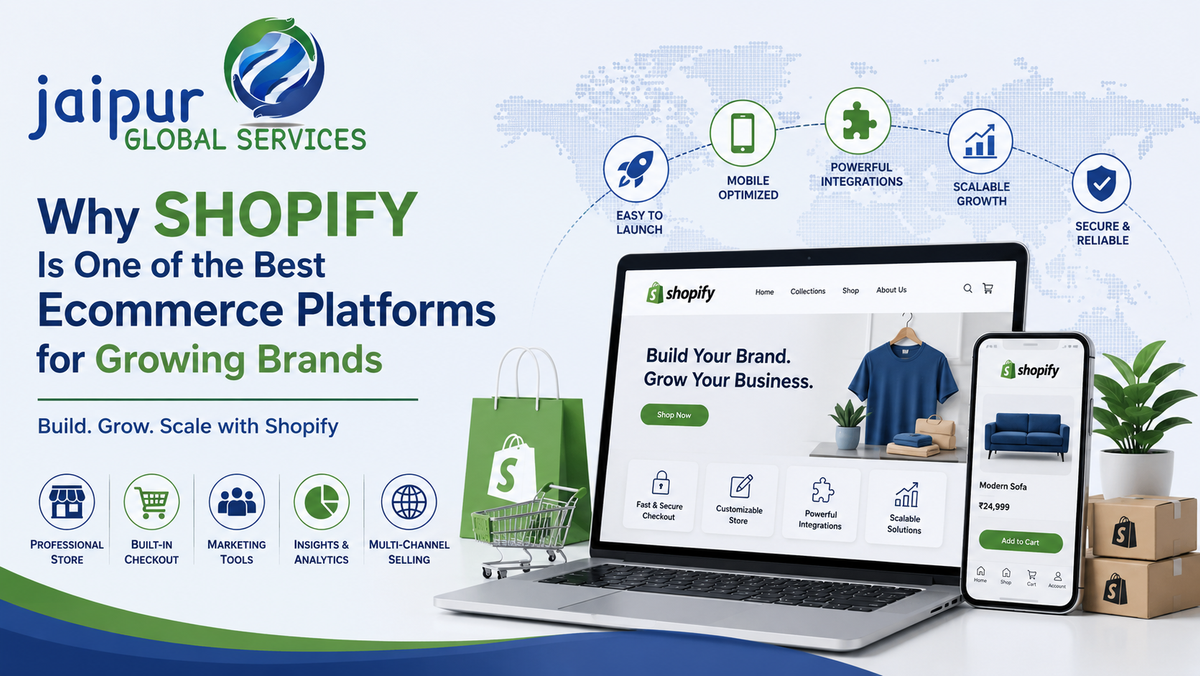
Choosing an ecommerce platform is one of those decisions that feels simple until you actually sit down to make it. It's not just about where products get listed — the platform shapes the entire store experience, how checkout works, how inventory gets managed, what marketing tools are available, how well the store performs on mobile, and how easily the business can grow without hitting a technical wall.
Shopify has become one of the more common choices for brands trying to solve this problem, particularly ones that want to launch relatively quickly while still having room to scale later. That popularity is worth examining honestly rather than taking at face value — Shopify is a strong option for a lot of businesses, but it isn't automatically the right choice for every one of them. This article looks at what actually makes the Shopify ecommerce platform useful for growing brands, where it has real limitations, and how to think about whether it fits your specific business.
What Is Shopify?
Shopify is a hosted ecommerce platform, meaning it provides the underlying infrastructure — servers, security, checkout systems — so a business doesn't need to build and maintain that technical foundation itself. On top of that infrastructure, Shopify gives businesses tools to build a storefront, manage products, process payments, handle orders, and track performance.
At a practical level, this includes:
- Store creation using themes and a visual editor
- Product and inventory management
- A built-in checkout system
- Payment processing options
- An app ecosystem for extending functionality
- Analytics and reporting
- Marketing tool integrations
- Order and fulfillment management
The core value proposition is straightforward: a business doesn't need an in-house development team just to get a functional, reasonably professional online store running. That said, "functional out of the box" and "fully optimized for your specific business" are two different things — which is a distinction worth keeping in mind throughout this article.
Why Shopify Is Popular With Growing Brands
Easy to launch. Compared to building a custom ecommerce site from scratch, Shopify's setup process is considerably more accessible, letting businesses get a store live without deep technical expertise.
Professional storefronts. Shopify's theme library and store editor let brands build a reasonably polished-looking store without needing custom design work from day one, though more advanced customization typically does require development support.
Scalable infrastructure. As a hosted platform, Shopify handles the underlying infrastructure that would otherwise need separate management as traffic and order volume grow.
App ecosystem. A large marketplace of third-party apps lets businesses add specific functionality — from marketing tools to inventory management — without building custom solutions for common needs.
Marketing integrations. Shopify connects with email marketing platforms, social media channels, advertising platforms, and analytics tools, supporting a more connected marketing approach.
Multi-channel selling. Shopify supports connecting a store with other sales channels where available, which matters increasingly for brands that don't want to rely on a single sales channel.
None of these points make Shopify universally superior to every alternative — they explain why it's become a common default choice for a wide range of growing brands.
Shopify Makes It Easier to Build an Online Store
Building a store involves more than picking a theme and uploading products. Shopify's store-building tools cover:
- Themes, which provide a design starting point
- The store editor, allowing visual customization without needing to write code for basic changes
- Product pages, structured to display images, descriptions, pricing, and variants
- Collections, for organizing products into browsable categories
- Navigation, helping customers find what they're looking for
- Checkout, Shopify's built-in and generally well-optimized purchase flow
- Mobile experience, since Shopify themes are generally built to be responsive across devices
It's worth being clear that good design isn't purely about how a store looks. It affects how much a shopper trusts the brand, how easily they can navigate and find products, and ultimately whether they complete a purchase. Shopify website development and Shopify store development work — whether basic setup or more advanced customization — exists specifically because getting these elements right takes more than just picking a template and leaving it as-is.
Shopify's App Ecosystem
One of Shopify's more genuinely useful features is its app ecosystem, which lets businesses add functionality without custom development for a lot of common needs. Categories include:
- Marketing and email automation
- SEO tools
- Review and rating management
- Customer support tools
- Inventory and stock management
- Shipping and fulfillment tools
- Analytics and reporting
- Loyalty and rewards programs
- Conversion rate optimization tools
This means a business can extend its store's capabilities considerably without building everything internally — which is a real advantage over more rigid, custom-built systems.
That said, there's a genuine downside worth taking seriously. Installing too many apps can:
- Increase ongoing subscription costs, since most apps have their own pricing
- Slow down store performance, since each app adds code that runs on the storefront
- Create compatibility issues between different apps
- Increase the maintenance burden as apps update, conflict, or become deprecated
The practical takeaway is that apps should be installed selectively, based on genuine need, rather than accumulated indiscriminately just because they're available.
How Shopify Supports Ecommerce Growth
Shopify's usefulness tends to shift across different stages of a business's growth.
Stage 1: Launch. Building the store, adding products, configuring payment methods, and setting up shipping — the foundational work needed to start selling.
Stage 2: Early growth. Marketing execution, basic SEO work, initial conversion optimization, analytics tracking, and early customer retention efforts.
Stage 3: Scaling. Managing a larger product catalog, handling increased order volume, adding more integrations, expanding into multi-channel selling, and potentially international markets.
Stage 4: Enterprise growth. This is where Shopify Plus becomes relevant — Shopify's offering aimed at larger, higher-growth businesses with more advanced operational and technical requirements. It's worth being clear that not every growing business needs Shopify Plus; it's designed for a specific tier of business complexity and scale, and the standard Shopify plans are genuinely sufficient for a large number of growing brands.
Shopify for D2C Brands
Direct-to-consumer brands often find Shopify particularly appealing, largely because of the level of control it offers over the customer relationship:
- Direct customer relationship, without a marketplace intermediary shaping the buying experience
- Brand control over how products are presented and how the store looks and feels
- Store customization that reflects the brand's specific identity
- Customer data ownership, which supports more informed marketing and retention decisions
- Marketing integrations tailored to the brand's specific acquisition and retention strategy
- Product storytelling, with more space and flexibility than a marketplace listing typically allows
- Customer retention tools, supporting repeat purchase behavior over time
This doesn't mean marketplaces are a poor choice — many successful brands run both a D2C Shopify store and a presence on marketplaces like Amazon or Flipkart simultaneously, using each channel for what it does well.
Shopify and Omnichannel Selling
A growing number of brands sell across more than one channel — a Shopify store alongside Amazon, Flipkart, social commerce platforms, physical retail, or other marketplaces. Shopify supports connecting with several of these channels, depending on current integrations and eligibility.
The real challenge in omnichannel selling isn't just connecting the channels technically — it's keeping the underlying business data consistent across all of them:
- Product information staying accurate and synchronized
- Inventory levels reflecting real stock across all channels
- Orders being tracked and fulfilled correctly regardless of where they originated
- Customer experience staying reasonably consistent across touchpoints
This is where broader ecommerce marketplace management becomes relevant — Shopify can be one part of a multi-channel strategy, but keeping everything organized across channels is an ongoing operational task, not something that happens automatically just because the technical connections exist.
Shopify SEO and Marketing
It's worth being direct about something important here: creating a Shopify store does not automatically generate search traffic or rankings. Shopify provides a technical foundation that supports good SEO practices, but the actual SEO work still has to happen.
This includes:
- Product page optimization, including titles, descriptions, and keyword relevance
- Collection page structure and optimization
- Metadata (titles and descriptions) for search visibility
- Clean, logical URL structures
- Internal linking between related products and collections
- Quality content that supports both users and search engines
- Image optimization, including alt text and file size
- Structured data, where applicable, to support rich search results
- Site speed and performance, which affects both user experience and search visibility
- Mobile experience, given how much ecommerce traffic is mobile
On the marketing side, Shopify connects with tools like Google Ads, Meta Ads, email marketing platforms, social media channels, and analytics tools — but again, these are integrations that support a marketing strategy, not a strategy in themselves. Shopify SEO and Shopify marketing require deliberate, ongoing work regardless of how capable the underlying platform is.
Shopify Payments, Checkout and Customer Experience
Checkout is one of the most important moments in the entire customer journey — it's where trust, friction, and hesitation either resolve into a completed purchase or cause the customer to abandon the cart entirely.
Relevant factors include:
- The overall checkout experience and how many steps it involves
- Available payment options for the customer's preferred method
- How well the purchase flow works on mobile devices, given how much shopping happens there
- Trust signals present during checkout
- Clarity around shipping information and expected delivery
- Order confirmation communication
It's worth noting that payment availability, including Shopify Payments specifically, varies by country and by business eligibility — it isn't universally available to every business in every market. Businesses should confirm current payment options and eligibility directly through Shopify's official resources for their specific market rather than assuming availability.
Shopify Inventory and Order Management
As a business grows, inventory visibility becomes increasingly critical — losing track of stock levels leads to overselling, fulfillment delays, and frustrated customers. Shopify supports management of:
- Products and their variants (size, color, and other options)
- Inventory levels across locations
- Order processing and status tracking
- Fulfillment workflows
- Multiple store locations, where relevant
For businesses with more complex operations, Shopify can integrate with:
- Warehouse management systems
- Third-party logistics (3PL) providers
- Marketplace platforms, to sync inventory across channels
- ERP systems, for broader business operations
- Shipping and carrier platforms
The specific integrations needed depend heavily on how complex a business's fulfillment operations actually are — a small, single-location business has very different needs than one running multiple warehouses and channels simultaneously.
Shopify Analytics and Business Insights
Shopify's built-in analytics can help brands understand what's actually happening in the business — sales trends, order patterns, customer behavior, product-level performance, traffic sources, conversion rates, and marketing channel performance.
The real value of analytics isn't just having the data available — it's using it to make decisions. For example: if a specific product page gets meaningful traffic but converts poorly, that's a signal to investigate the page itself — pricing, images, description, or reviews. If a marketing channel is generating sales but margins on those sales are thin, that's a signal to review the actual cost of acquiring those customers through that channel.
Analytics without action doesn't move a business forward — the numbers matter mainly because of what they suggest should change.
Shopify vs Other Ecommerce Platforms
It's worth comparing Shopify honestly against other common options, rather than assuming it's automatically the best fit for every business.
WooCommerce — a WordPress-based plugin, generally more flexible and potentially lower-cost for smaller stores, but requiring more hands-on technical management (hosting, security, updates) than a fully hosted platform like Shopify.
Magento / Adobe Commerce — historically popular for larger, more complex ecommerce operations requiring deep customization, but generally requiring significantly more development resources and technical expertise to manage than Shopify.
BigCommerce — a hosted platform similar in concept to Shopify, with its own particular strengths in areas like built-in features and API flexibility, worth evaluating directly against Shopify for specific business requirements.
Custom ecommerce development — building a fully bespoke platform, offering maximum control and customization, but requiring substantial development investment, ongoing maintenance, and typically longer timelines to launch.
There's no universally "best" choice here. A small business wanting to launch quickly with manageable ongoing maintenance often finds Shopify's hosted, relatively accessible model appealing. A business with very specific, unusual technical requirements or existing infrastructure investments might reasonably choose differently.
Is Shopify Good for Small Businesses?
Generally, yes — Shopify's accessibility, relatively manageable setup process, and hosted infrastructure make it a practical option for new brands, small businesses, and D2C stores that want to launch without heavy technical overhead.
That said, small businesses should still think through:
- The size and complexity of their product catalog
- Their available budget, including ongoing subscription and app costs
- The specific functionality they actually need
- Integrations required with other tools or systems
- Realistic expectations about growth over the next year or two
- Any specific technical requirements unique to their business or industry
Shopify tends to work well for straightforward to moderately complex ecommerce operations. Businesses with highly unusual requirements from day one may need to think more carefully about fit.
Is Shopify Good for Growing Ecommerce Brands?
This is where Shopify's value becomes more nuanced and worth examining closely.
As a business grows, it typically needs to manage larger product catalogs, handle increasing order volumes, add more third-party integrations, expand into multiple sales channels, potentially sell internationally, automate more operational processes, and rely on more advanced analytics for decision-making.
It's worth being clear that platform scalability isn't just about server capacity or handling more traffic — that's actually the easier part for a hosted platform like Shopify to manage. The harder scalability challenges involve operations, integrations, customer experience consistency, data management across systems, marketing complexity, inventory coordination, and fulfillment logistics as the business becomes more complex.
Shopify — including Shopify Plus for larger, higher-growth businesses — is generally built to support this kind of growth reasonably well, but "the platform can support growth" and "growth happens automatically" are different things. Growing brands still need deliberate strategy, proper store configuration, the right app and integration choices, and ongoing optimization to actually realize that scalability.
When Shopify May Not Be the Right Choice
In the interest of balance, it's worth being direct about situations where Shopify may not be the strongest fit:
- A business requires highly unusual or specialized functionality that doesn't fit standard ecommerce patterns
- A business needs complete control over its underlying infrastructure for specific technical or compliance reasons
- The business has very particular enterprise architecture requirements that don't align well with Shopify's model
- App costs, once functionality requirements are accounted for, become genuinely excessive relative to the business's budget
- Complex custom workflows require extensive development work that may be easier to build on a different foundation
- Another platform simply matches the specific business model more naturally
The right starting point for platform selection isn't "which platform is popular" — it's a clear-eyed look at actual business requirements, and then evaluating which platform genuinely fits those requirements best.
When Should You Hire a Shopify Consultant?
Professional Shopify consulting tends to be genuinely useful in situations like:
- Building a new store from scratch
- Redesigning an existing store that isn't performing well
- Migrating from another ecommerce platform
- Improving a store's conversion rate
- Integrating third-party systems or tools
- Improving overall store structure and navigation
- Expanding into international markets
- Connecting the store with marketplace channels
- Fixing complex technical issues within the store
- Planning longer-term ecommerce growth strategy
A Shopify consultant or Shopify consulting engagement generally brings experience across multiple stores and business types, which can help avoid common mistakes and identify opportunities a business might not spot on its own.
What Shopify Development Services Can Include
Depending on a business's specific needs, Shopify development services commonly cover:
- Full Shopify store development, from setup through launch
- Theme customization beyond default template options
- Custom sections and layout elements
- Product and collection setup and organization
- Third-party app integration
- Integration with external systems and tools
- Payment method integration
- Shipping and fulfillment integration
- Marketplace integration, connecting the store with other sales channels
- Store migration from another platform
- Performance optimization, including site speed improvements
- Conversion-focused improvements to store structure and design
Shopify ecommerce development and Shopify website development services essentially exist to handle the parts of running a store that go beyond what most businesses can reasonably manage entirely in-house, particularly as requirements become more specific or technical.
How Jaipur Global Services Can Help Growing Shopify Brands
Shopify development is one piece of a broader ecommerce growth picture — a well-built store still needs product optimization, marketing, ongoing management, and, for many brands, coordination with other sales channels to actually generate sustained growth.
Jaipur Global Services works with ecommerce brands across Shopify-related services and broader ecommerce consulting and marketplace management. The practical connection here is straightforward: a Shopify store built well but left disconnected from broader marketplace strategy, product optimization, or ongoing management tends to underperform relative to its actual potential.
It's worth being direct about what this article isn't claiming: it doesn't state that Jaipur Global Services holds Shopify Plus partner status, official Shopify certification, or any specific partnership designation — only verified information from jgservices.in should determine claims like that. What can be said is that Shopify development is genuinely more valuable when it's connected to the rest of a brand's ecommerce operations, whether that's product listing optimization, marketplace management, or ongoing ecommerce consulting — rather than treated as a standalone, one-time build.
Shopify Growth Checklist
Before launching:
- Business model clearly defined
- Products organized and catalogued
- Store structure planned
- Theme selected
- Mobile experience checked and tested
- Payment methods configured
- Shipping options configured
- Product pages optimized
- Analytics configured
- SEO basics completed
- Legal and policy pages added
- Full testing completed before going live
After launch:
- Monitor conversion rate regularly
- Monitor traffic sources and volume
- Track product-level performance
- Review abandoned cart data
- Monitor customer behavior patterns
- Test and refine landing pages
- Continuously improve product pages
- Review marketing channel performance
- Optimize store speed periodically
- Review installed apps regularly for necessity and performance impact
FAQ’s
Is Shopify a good ecommerce platform for growing brands?
Yes, for many growing brands — Shopify's combination of ease of use, hosted infrastructure, and scalability makes it a strong fit, though the right platform always depends on specific business needs.
What are the main benefits of Shopify?
Key benefits include accessible store setup, a large app ecosystem, built-in checkout, marketing integrations, useful analytics, and support for multi-channel selling.
Is Shopify good for small businesses?
Generally yes — Shopify's accessibility and relatively low technical overhead make it practical for new and small businesses, though catalog size, budget, and specific functionality needs should still be considered.
Is Shopify scalable for large ecommerce businesses?
Yes, including through Shopify Plus for larger, higher-growth businesses with more advanced operational needs — though scalability also depends on how well operations, integrations, and strategy are managed, not just the platform itself.
How much does Shopify cost?
Shopify offers multiple pricing tiers depending on business size and needs, with Shopify Plus positioned for larger enterprises — check Shopify's official pricing page for current, accurate figures, as plans and pricing can change.
Is Shopify better than WooCommerce?
Neither is universally "better" — Shopify offers a more hosted, lower-maintenance experience, while WooCommerce offers more flexibility but requires more hands-on technical management. The right choice depends on your specific requirements and technical resources.
Can Shopify support multiple sales channels?
Yes, Shopify supports connecting with various other sales channels, though specific integrations and eligibility can vary and should be confirmed for your situation.
Does Shopify help with SEO?
Shopify provides a technical foundation that supports good SEO practices, but it doesn't automatically generate rankings or traffic — ongoing SEO work is still required.
When should I hire a Shopify consultant?
Consider a consultant when building a new store, migrating platforms, improving conversion, integrating complex systems, or planning significant growth or international expansion.
What are Shopify development services?
Shopify development services can include store setup, theme customization, app and third-party integrations, migration support, performance optimization, and conversion-focused improvements.
Conclusion
Shopify has become a genuinely strong option for a lot of growing brands because of how it combines ease of use, a hosted infrastructure that removes a lot of technical burden, extensive customization options, a large app ecosystem, solid marketing integrations, useful analytics, and real scalability — including Shopify Plus for businesses that eventually need more advanced enterprise capability.
But choosing an ecommerce platform shouldn't be based on popularity alone. It should be based on your business's actual goals, budget, product catalog, technical requirements, growth plans, and operational needs. For many growing brands, Shopify genuinely fits that picture well. For others with more specific or unusual requirements, a different platform might be the better starting point.
If you're evaluating Shopify for a new store, considering a migration, or trying to get more out of an existing Shopify setup, it's worth thinking about the platform alongside your broader ecommerce strategy — not in isolation. You're welcome to explore JGS's Shopify and ecommerce services to see if that kind of connected approach fits what your business currently needs.