
Smart Order Routing: How Ecommerce Sellers Can Route Orders Efficiently
 October 7, 2026
 Yashwardhan Singh
 0 Comments
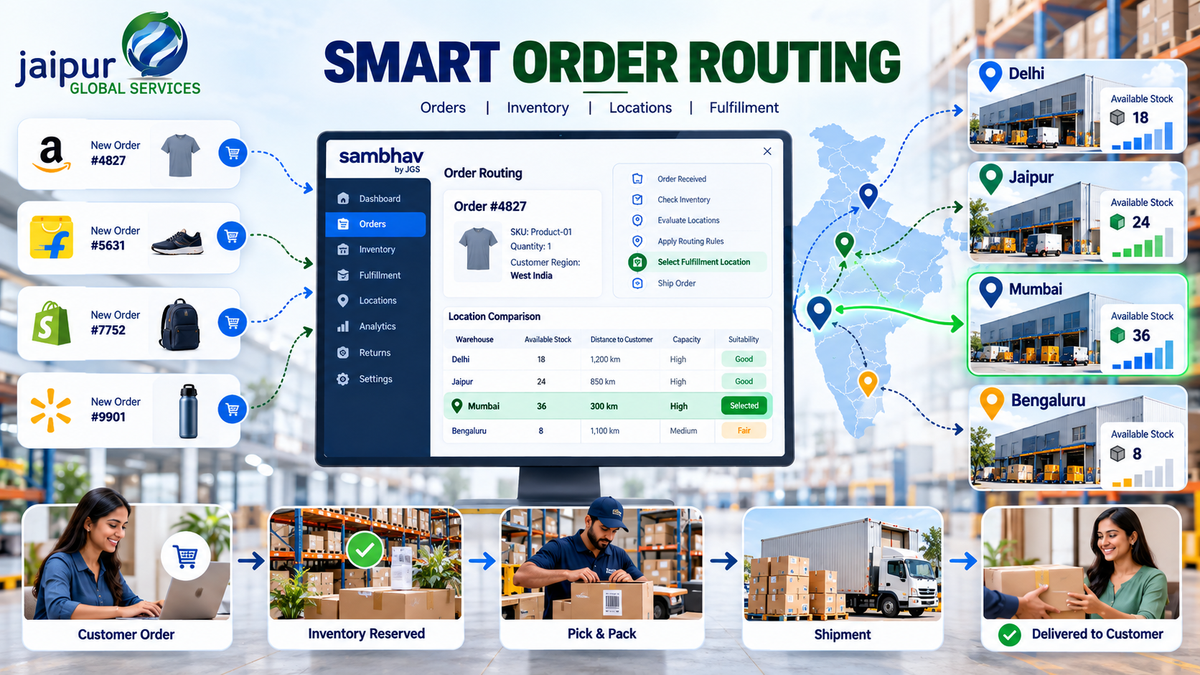
A seller gets an order from a customer in Chennai. The product sits in a warehouse in Delhi, but the same SKU is also in a Bangalore warehouse, much closer to the customer. Nobody notices, and the order ships from Delhi anyway — a longer trip, a higher cost, and a slower delivery than needed.
Once stock sits in more than one place, the real question isn't just "did we receive the order?" It's "which location should fulfill it?" That decision is what smart order routing is about. JGS (Jaipur Global Services) works with sellers who run into this exact problem as they grow past a single warehouse.
What Is Smart Order Routing?
Smart order routing is the process of deciding which warehouse, fulfillment center, store, or delivery location should handle a given order, based on business rules and the data available at that moment.
It can take into account stock availability, customer location, warehouse location, shipping distance, fulfillment capacity, order type, delivery requirements, and business rules. In simple terms, it's about picking the best available option for each order, not always sending it from the same place by default.
What Is Order Routing in Ecommerce?
Order routing in ecommerce follows a basic flow: order received, available locations checked, routing rules applied, location selected, order fulfilled, shipment tracked.
Simple routing often follows one fixed rule — always ship from the main warehouse, for example. Smart routing looks at more than one factor before deciding, which tends to work better as operations grow more complex. This is the layer Sambhav, JGS's seller platform, is built to support, by bringing order and inventory data together.
How Does a Smart Order Routing System Work?
A smart order routing system generally follows these steps:
- Order comes in — the system receives the order details.
- Check inventory — it checks which locations actually have the required SKU.
- Check customer location — it looks at where the order needs to be delivered.
- Apply routing rules — the seller's own rules and available options are checked.
- Select a location — the order goes to the location that best fits the rules and the stock on hand.
- Fulfillment starts — the chosen location processes the order.
- Track the order — the seller can follow it through to delivery.
The exact routing logic depends on the seller's software, integrations, warehouse setup, marketplace rules, and business needs. No two sellers' setups look identical.
What Factors Should Smart Order Routing Consider?
Inventory availability comes first — there's no point routing an order to a location without the stock. Customer location matters where the setup allows picking a nearby location over a distant one. Shipping distance is often compared between fulfillment options. Warehouse capacity matters too — a location near full capacity may not be the best choice even with stock available. Product type can affect this, since some items need special storage or handling. Order priority comes in when a seller has rules for urgent orders. Fulfillment cost is frequently weighed alongside speed. Delivery requirements from the seller or marketplace can shape the decision, and business rules vary by seller — different rules by channel, region, SKU, or warehouse are common.
Not every routing system supports every one of these factors, and JGS and Sambhav don't claim to cover all of them for every seller — what matters is matching the system to your actual setup.
Smart Order Routing and Inventory Management
Routing and inventory aren't separate problems. A routing decision is only as good as the data behind it — what stock is available, where it's stored, which SKU it is, how fast it can be replenished, and which locations are serving demand in that region.
Poor inventory data leads to poor routing decisions, no matter how good the routing logic is. This is why JGS Catalog Management Services often comes up alongside routing conversations. Sambhav's inventory and centralized data features exist to close this gap, keeping stock information connected across locations instead of scattered.
Smart Order Routing Across Multiple Warehouses
Routing becomes genuinely useful once a seller runs more than one location. Say a seller holds the same SKU in Delhi, Jaipur, and Mumbai. A customer in Mumbai places an order. If the Mumbai warehouse has enough stock and fits the seller's routing rules, it becomes a sensible choice over shipping from Delhi.
The actual decision always depends on the seller's own setup and rules — it isn't automatic by default. This connects directly to JGS's multi-location fulfilment approach, which looks at how sellers place stock and route orders across regions. Sambhav's current multi-location fulfilment capability covers regional order routing and demand-based inventory allocation, built around this same idea.
Benefits of Ecommerce Order Routing
Done properly, ecommerce order routing offers real, practical benefits: better use of existing inventory, more organized order processing, clearer visibility across locations, less manual decision-making per order, easier operations once running multiple warehouses, and a setup that scales more smoothly as volume grows.
What it won't do is guarantee a specific delivery time or fixed cost saving. Results depend on your warehouse locations, carriers, inventory accuracy, order volume, and system configuration — JGS and Sambhav support the operational setup, but the outcome still depends on your own business conditions.
Manual Order Routing vs Smart Order Routing
With manual routing, someone checks customer location, available stock, the nearest warehouse, and shipping options, then decides by hand. This works at low volumes, but gets genuinely difficult with hundreds or thousands of orders a day.
Smart routing uses a connected system with predefined rules and current data to make that decision faster. It doesn't remove the need for human oversight entirely — someone still sets the rules and handles exceptions — but it takes the repetitive part off your plate.
What to Look for in an Order Routing System
Before choosing an order routing system, check for multi-channel order visibility, inventory visibility, SKU-level data, support for multiple warehouses, configurable routing rules, order tracking, return handling, marketplace connectivity, useful reporting, room to scale, and an easy dashboard.
No single platform is universally "best" — the right choice depends on your channels, warehouses, order volume, products, and existing workflows.
Common Smart Order Routing Mistakes
Some mistakes come up again and again: incorrect inventory data, poor SKU mapping, ignoring warehouse capacity, routing based only on distance and nothing else, ignoring fulfillment costs, never reviewing routing rules once they're set, treating every order the same regardless of priority, running disconnected systems, not monitoring exceptions, and forgetting to update inventory in real time.
How JGS Helps Sellers With Order and Marketplace Operations
Order routing doesn't exist on its own — it sits alongside marketplace management, catalog accuracy, order workflows, inventory operations, advertising, analytics, and finance. JGS supports ecommerce sellers across these connected areas. For account-level support, JGS Account Management Services covers the broader marketplace side, while Catalog Management Services keeps the product data that routing depends on in good shape.
How Sambhav Supports Smart Order Routing
Sambhav by JGS brings order, inventory, catalog, analytics, CRM, and operational data into one connected platform. Its multi-location fulfilment capabilities cover multiple fulfillment locations, demand-based stock allocation, regional order routing, SKU demand, sales velocity, regional trends, and visibility across orders and inventory.
The basic flow: order comes in, inventory is checked, a location is selected, the order is processed, fulfilled, and tracked. Sambhav supports this operational layer, but the routing outcome still depends on configuration, available stock, connected marketplaces, and the seller's requirements. It doesn't replace Amazon's, Flipkart's, Shopify's, or Walmart's own seller systems, and it can't promise faster delivery or lower costs on its own.
Simple Smart Order Routing Checklist
- Is your inventory data accurate?
- Are SKUs mapped correctly across channels?
- How many fulfillment locations do you have?
- Where are your customers actually located?
- What routing rules matter most for your business?
- Do you need multi-channel support?
- Can the system track orders end to end?
- Can it handle returns properly?
- Can you see inventory and orders together, in one view?
- Can the setup scale as order volume grows?
Sellers already using Sambhav or working with JGS usually find these questions easier to answer, since the data sits in one place rather than scattered across systems.
Conclusion
Smart order routing isn't simply about picking the nearest warehouse. It's about making a better fulfillment decision using inventory, customer location, warehouse availability, business rules, and delivery needs together, rather than defaulting to the same location every time.
If you're managing orders across regions or warehouses, it's worth looking at how your current setup compares. JGS (Jaipur Global Services) and its platform Sambhav are built to support exactly this kind of operational decision-making, bringing your order and inventory data together so routing is based on what's actually available, not guesswork.