
Warehouse Location: How Ecommerce Sellers Can Choose the Right Location for Storage and Fulfillment
 October 5, 2026
 Yashwardhan Singh
 0 Comments
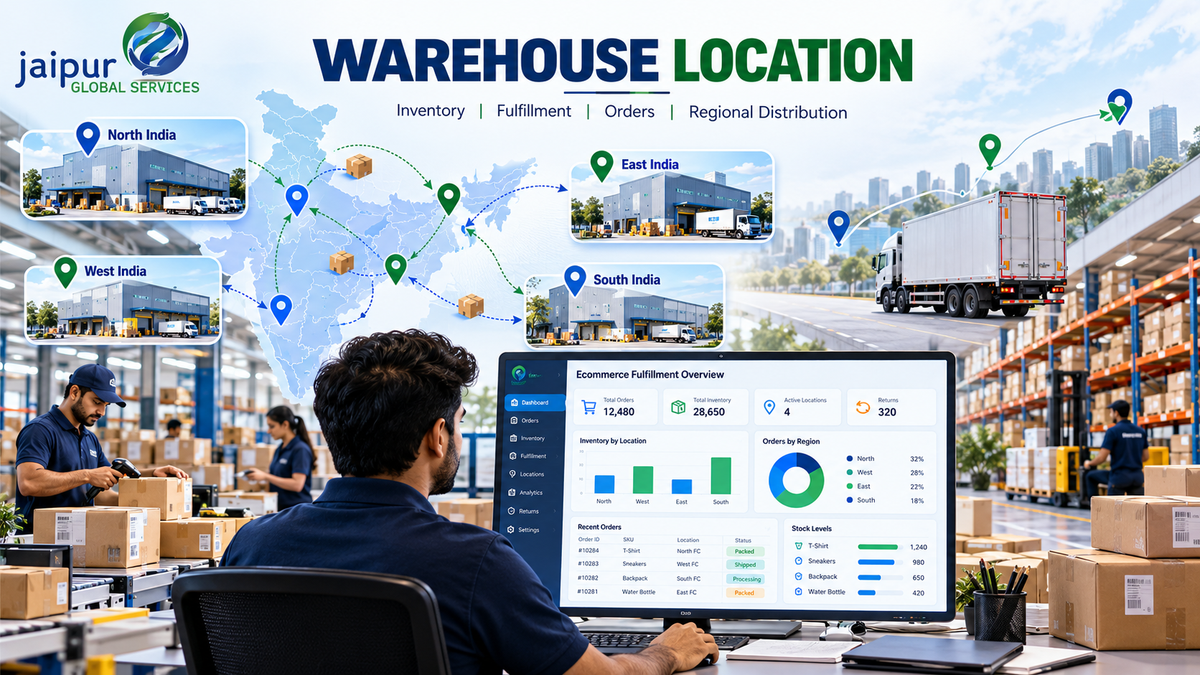
Picture a seller with good listings, steady orders, and enough stock. Still, parcels to the south take too long, shipping bills keep rising, and returns take days to come back. The problem is not the product. The stock is simply stored too far from the customers.
That is why warehouse location matters. It affects delivery distance, shipping cost, stock availability, returns, and the overall customer experience. JGS (Jaipur Global Services) works with sellers on marketplace operations, and warehouse decisions come up often, because they touch almost every other part of the business. Platforms like Sambhav exist to help sellers see and manage this clearly.
What Is a Warehouse Location?
A warehouse location is where your stock sits before it goes to a customer or moves into another fulfillment network. It could be your own shop floor, a rented storage space, or a facility run by a logistics partner.
When orders are few, location hardly matters. As volume grows and customers spread out, it starts to shape your costs and delivery experience.
What Is a Fulfillment Center?
A fulfillment center does more than store things. It receives stock, picks items, packs them, ships orders, and often handles returns.
A plain warehouse mainly stores inventory, sometimes for long periods. A fulfillment center is built around order processing. Not every warehouse is a fulfillment center, and the exact setup depends on the business and the provider.
Warehouse vs Fulfillment Center vs 3PL
- Warehouse: a place to store inventory.
- Fulfillment center: a facility set up to process and ship customer orders.
- 3PL: a third-party logistics company that handles some or all of these tasks for you.
Many sellers search for a 3PL warehouse near me to get started. That is a fair first step, but compare more than distance:
- Location and service area
- Pricing and storage terms
- Order handling and shipping support
- Returns process
- Technology and integrations
How to Choose the Right Warehouse Location
This is the core decision, so take your time. Look at these points:
- Customer demand: Where do most of your orders come from? Use your own sales data, not guesses.
- Shipping distance: How far does each order have to travel?
- Courier access: Can major carriers pick up easily from that area?
- Cost: Rent, utilities, labor, security, and handling all add up.
- Supplier access: How easily can new stock reach the warehouse?
- Delivery coverage: Can the location serve your main regions well?
- Returns: Can returned items be received, checked, and restocked easily?
- Growth: Will the space still work when your orders double?
Clean product data helps too. Wrong SKUs and messy listings make stock hard to track wherever it is stored, which is why sellers often start with catalog management before they change locations.
When Should Sellers Consider Multiple Locations?
One warehouse works well for many sellers, especially when demand sits mostly in one region. Multiple locations can help when customers are spread out. They can widen coverage, place stock closer to busy regions, and reduce dependence on a single site.
But more warehouses are not always better. Each one adds rent, staff, and stock to manage. The decision depends on order volume, customer locations, product demand, shipping costs, storage costs, and your business model.
This is where Sambhav's multi-location fulfilment approach becomes relevant. It covers storing and dispatching inventory from more than one location, routing orders by region, and allocating stock based on SKU demand and sales velocity. It also supports monitoring across locations. Results still depend on your products, demand, and setup.
Amazon Warehouse Locations and Amazon FC Locations
Many sellers search for Amazon warehouse locations, Amazon FC locations, or Amazon fulfillment locations. It helps to be clear here: an Amazon fulfillment center is part of Amazon's own network. It is not a warehouse you rent or run.
Your own warehouse is a separate thing. Also, not every Amazon fulfillment center is open for direct seller storage. Programs, eligibility rules, and locations vary by marketplace and seller setup, so check Amazon's official pages for the current details in your country.
What Does "Warehouse Storage Near Me" Really Mean?
A search for warehouse storage near me or e commerce warehouse near me is a useful starting point. But close is not the same as right.
A nearby warehouse may be far from your customers. It may have poor courier access or weak return handling. Compare these instead:
- Location compared with your customers
- Courier access and pickup schedules
- Storage price and order processing
- Security and inventory systems
- Return handling and room to scale
Business fit matters more than distance alone. If you are unsure, JGS can help you look at your marketplace data first, so the search starts with facts.
Storage Warehouse for Rent: What to Check
Before you sign for a storage warehouse for rent, check:
- Monthly rent, deposit, and contract period
- Space available and storage conditions
- Electricity and other utilities
- Security, insurance, and fire safety
- Loading and unloading access
- Labor availability
- Extra fees that are not in the quote
- Options to expand later
Ask for everything in writing. Hidden charges can change the real cost.
Small Business Fulfillment Center: What Smaller Sellers Need
A small seller often does not need a big warehouse. A small business fulfillment center, shared space, a local partner, or a 3PL may be enough. Some sellers manage storage themselves at first.
The best setup depends on your order volume and product type. Bulky items need more space. Fast-moving small items may need speed more than room. JGS supports sellers with account, catalog, and operational workflows, but it does not rent warehouse space, so treat it as support for the operations around your storage choice.
Local Fulfillment Centers and Regional Fulfillment
Local fulfillment centers start making sense when demand is spread across regions. Stock can sit closer to buyers, orders can be processed locally, and shipping distance may come down. It also gives you a clearer view of what sells where.
The JGS Multi-Location Fulfilment Guide explains this approach in more detail. Sambhav supports it by bringing demand, inventory, and orders into one place, so regional planning is based on data.
How JGS Helps Sellers With Operations
Warehouse choices connect to the rest of your marketplace work. JGS supports ecommerce account management, catalog management, inventory and order flow, marketplace operations, performance monitoring, and finance and reconciliation. If you want help running these together, JGS Account Management Services is a good place to start.
Warehouse costs also affect profit. Fees, storage, and shipping should be visible in your books, and accounting and taxation support can help you see what each location really costs.
How Sambhav Helps With Multi-Location Operations
Sambhav by JGS is an ecommerce seller platform that brings orders, inventory, returns, catalog, marketplace operations, growth analytics, CRM, and finance into one place. It also covers multi-location fulfilment.
The idea is a simple flow:
Customer demand → inventory placement → order → regional routing → fulfillment → tracking → return
Sambhav can support demand-based stock allocation and regional order routing, and you can read more on its CRM and operations page. It does not replace a physical warehouse, and it cannot promise faster delivery or lower costs. It gives you clearer data to decide with.
Common Warehouse Location Mistakes
- Picking the cheapest warehouse without checking service coverage
- Choosing a spot only because it is near you
- Ignoring where customers actually are
- Ignoring courier access
- Keeping all stock in one place without reviewing demand
- Renting more space than you need
- Forgetting returns
- Not planning for growth
- Not tracking stock across locations
- Never reviewing warehouse costs
Tracking is the one people skip most. Once stock sits in two or three places, spreadsheets stop working.
Simple Warehouse Location Checklist
- Where are most of my customers?
- What are my main shipping regions?
- What does the warehouse really cost?
- How easy is supplier access?
- Which couriers serve the area?
- How will returns be handled?
- Can the space scale?
- Is one location enough?
- Would multiple locations make business sense?
- Can I monitor inventory properly?
Conclusion
The right warehouse location is not the cheapest one, and it is not always the one closest to you. It should balance customer demand, shipping access, storage cost, inventory needs, fulfillment, and future growth.
Start with your own data, then decide. If you want support with the operations around that decision, explore JGS (Jaipur Global Services) or see how Sambhav can help you manage multiple locations from one platform.