
Why Businesses Choose JGS as Their Ecommerce Growth Partner
 June 9, 2026
 Yashwardhan Singh
 0 Comments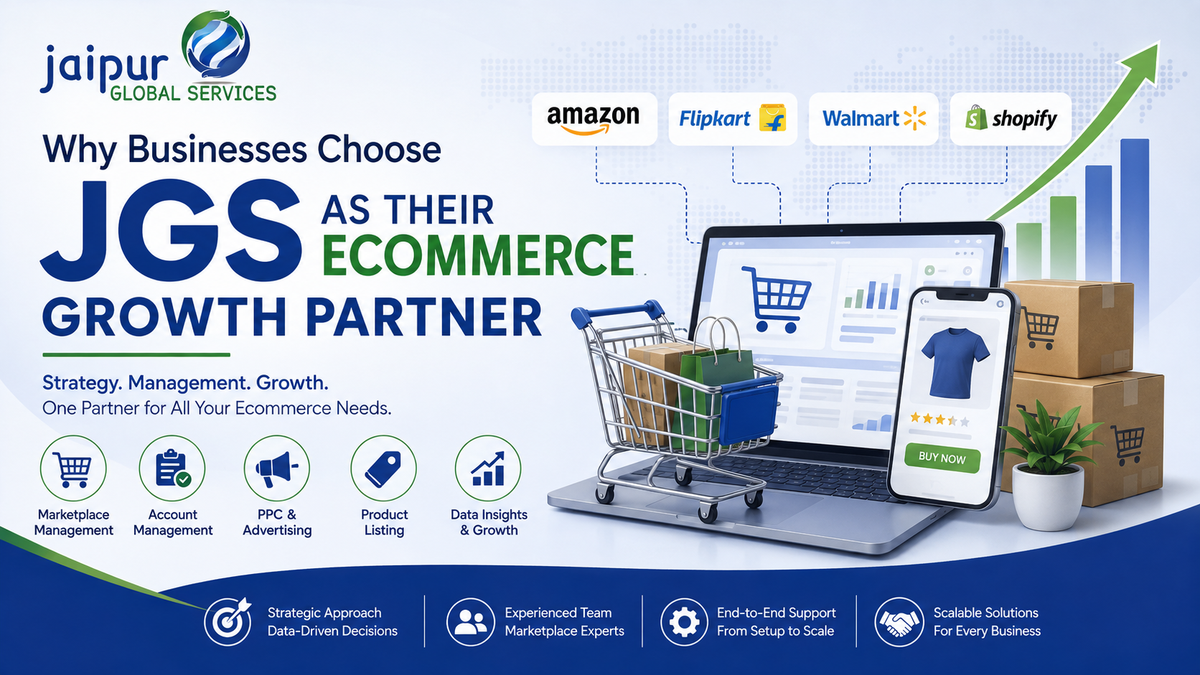
Running an ecommerce business used to mean uploading a few products, setting a price, and waiting for orders to come in. That's not how it works anymore. A seller today is managing listings across one or more marketplaces, watching advertising spend, keeping catalogues accurate, responding to policy changes, tracking account health, and trying to figure out which platform to expand into next — often all at the same time, often with a small team, or just one person wearing every hat.
At some point, most growing sellers hit the same wall: there's more work than there is time, and the work that gets skipped — a stale product listing, an underperforming ad campaign, a marketplace expansion that never happens — is exactly the work that determines whether the business grows or stalls. This is where the idea of an ecommerce growth partner comes in, and it's worth understanding what that actually means before looking at why businesses consider JGS for it.
Why Ecommerce Businesses Need More Than Just a Marketplace Account
Having an Amazon, Flipkart, Walmart, or Shopify account gets you into the game. It doesn't do much else on its own.
Marketplace competition is intense in nearly every category now, which means visibility isn't something you get by default — it's something you build through consistent listing quality, competitive pricing, and advertising that's actually managed rather than set once and forgotten. A product with an incomplete title, missing attributes, or weak images will lose to a competitor with a better-optimized listing, even if the underlying product is just as good.
Catalogue management is another area that quietly determines performance. A large catalogue with inconsistent data — missing specifications, outdated images, incorrect categorization — creates a worse customer experience and hurts discoverability, and it only gets messier as a catalogue grows if nobody's actively maintaining it.
Then there's the platform-specific side: each marketplace has its own requirements, policies, and quirks. What works on Amazon doesn't map directly onto Flipkart or Walmart, and Shopify is a different kind of operation entirely since you're running your own store rather than competing inside someone else's marketplace. Add multi-channel selling into the mix — which most growing brands eventually consider — and you're now managing several of these systems in parallel, each with its own demands.
None of this is a one-time setup. It's ongoing work, and it's the kind of work that tends to get deprioritized when a business owner is also handling sourcing, operations, finance, and everything else that comes with running a company.
What Businesses Look for in an Ecommerce Growth Partner
Before choosing anyone to help with this, it's worth being clear about what actually matters in that decision.
Marketplace expertise matters more than general marketing experience. Someone who understands how Amazon's algorithm weighs listing quality, or how Flipkart's catalogue requirements differ from Amazon's, brings something a generalist can't.
Understanding of different platforms matters if you're selling — or planning to sell — across more than one channel. A partner who only knows one marketplace well can't help you think about where to expand next or how to run a consistent strategy across channels.
Strategic thinking, not just task execution, is what separates a genuine ecommerce consultant from someone who just uploads listings on request. A good ecommerce business consultant asks why a product isn't converting before jumping to "let's run more ads."
Communication and transparent processes matter because marketplace management involves real decisions — pricing changes, ad budget shifts, catalogue updates — that a business owner needs visibility into, not a black box they only hear about when something goes wrong.
Ability to manage multiple ecommerce functions together — listings, advertising, catalogue, account health — rather than treating each as a separate, disconnected task, since these things affect each other constantly. A pricing change affects ad performance. A listing update affects search ranking. Managing them in isolation misses that.
A long-term growth approach, rather than a short list of one-off fixes, since ecommerce performance compounds over time when it's managed consistently.
Understanding of business goals, because the right approach for a brand trying to protect margins looks different from the right approach for a brand trying to grow market share fast. Ecommerce Consulting Services worth paying for start with understanding what you're actually trying to achieve, not applying the same playbook to every account.
Why Businesses Choose JGS
With that baseline in mind, here's what actually leads businesses to work with JGS specifically.
Marketplace-focused expertise. JGS works within ecommerce marketplaces day to day, which means the team is dealing with platform-specific requirements, policy shifts, and operational details as a core part of the job — not as an occasional side project alongside broader marketing work.
End-to-end ecommerce support. Rather than handling only one piece — say, just advertising, or just listings — JGS covers the connected pieces of marketplace operations together, which matters because these pieces genuinely affect each other.
Support across multiple ecommerce platforms. Businesses selling on Amazon, expanding to Flipkart, considering Walmart, or running a Shopify store alongside marketplace listings can work with one team that understands how these platforms differ, rather than explaining their business from scratch to a new specialist for each one.
A combination of strategy and execution. JGS doesn't just hand over recommendations and leave the implementation to the business — the team works through both the "what should we do" and the "who's actually doing it" parts of the job.
Support for businesses at different growth stages. A new seller figuring out their first marketplace account needs different support than an established brand managing a large catalogue across several channels. JGS adjusts the level and type of support based on where a business actually is, not a fixed package regardless of stage.
One partner for multiple ecommerce requirements. Instead of coordinating a listings freelancer, a separate PPC specialist, and a catalogue manager, businesses can work with a single team that already has context on the account across all of these areas.
A focus on long-term ecommerce growth, rather than short-term fixes that don't hold up. Marketplace performance is cumulative — consistent listing quality and account health build on themselves over time, and that's the kind of ongoing management JGS is built around.
None of this means guaranteed outcomes — ecommerce performance depends on a lot of factors outside any single partner's control, including competition, category dynamics, and the product itself. What it does mean is a team structured around actually managing these moving parts together, consistently, rather than treating ecommerce as a set-it-and-forget-it task.
JGS's Ecommerce Marketplace Management Approach
Effective Ecommerce Marketplace Management isn't one task — it's several connected areas that need to work together consistently.
Seller account management means keeping the account itself healthy: monitoring performance metrics, staying ahead of policy requirements, and catching issues before they escalate into bigger problems. Product listings need to be built and maintained properly — accurate titles, complete attributes, images that actually help a customer decide, and content that's genuinely useful rather than just present. Catalogue management is the ongoing work of keeping all of that consistent and accurate as a product range grows and changes.
Marketplace advertising needs active management, not a campaign that gets set up once and checked occasionally — bids, budgets, and keyword targeting all need adjustment as performance data comes in. Platform optimization covers the technical and structural side of getting the most out of how a specific marketplace works. And ongoing monitoring ties all of this together, since marketplace performance shifts constantly based on competition, seasonality, and platform changes that are outside any seller's control.
The point of treating these as connected, rather than separate tasks handed to different people, is that decisions in one area affect the others. A pricing change should factor into ad strategy. A catalogue gap should get flagged before it becomes a compliance issue. Ecommerce Marketplace Management done well means someone is watching all of these pieces together, not just checking each box independently.
Amazon Support for Sellers
Amazon remains the starting point for a large share of ecommerce sellers, and it's also one of the more demanding marketplaces to manage well, given how much weight it puts on listing quality, advertising, and account health.
Amazon Account Management Services generally cover the ongoing operational side of running a seller account — monitoring account health, staying compliant with policy requirements, and handling the day-to-day work that keeps an account in good standing. Amazon Seller Services extend into the broader operational support a seller needs beyond just account health, covering the practical work of actually running a store on the platform.
Amazon PPC Management is its own discipline — campaign structure, keyword research, bid management, and ongoing optimization based on performance data, since a poorly managed ad account can burn through budget without much to show for it. Amazon Product Listing Services focus on getting individual listings right: titles, bullet points, descriptions, and images built to actually convert, not just fill in the required fields. Amazon Catalogue Services address the broader challenge of managing a full product range consistently — accurate attributes, correct categorization, and clean data across potentially hundreds of SKUs.
Account management Amazon sellers actually need tends to combine several of these areas rather than treating them separately, since a listing problem, an advertising problem, and an account health issue are often connected symptoms of the same underlying gap in attention.
Supporting Growth Beyond Amazon
Depending on a single marketplace carries real risk — a policy change, increased competition, or a shift in algorithm weighting can affect sales significantly, and a business with only one channel has no cushion when that happens. This is a big part of why more sellers are looking at multi-channel strategies rather than staying on one platform indefinitely.
Flipkart is a natural next step for many Indian sellers already comfortable with Amazon, but it's not a copy-paste operation — Flipkart Account Management and Flipkart Seller Services involve their own catalogue requirements, fee structures, and platform-specific practices that differ meaningfully from Amazon's. Treating a Flipkart listing exactly like an Amazon one usually underperforms.
Walmart account management services matter for sellers looking at the US market, particularly Indian brands considering international expansion — Walmart Marketplace runs a more curated, application-based onboarding process than Amazon or Flipkart, and expects its own approach to compliance, fulfilment, and account management once a seller is approved.
Shopify is a different kind of channel altogether, since it's a business's own store rather than a listing inside someone else's marketplace. Shopify consulting and Shopify Development Services cover building and maintaining a store that actually converts — design, functionality, and the technical work of keeping a storefront running well, which requires a different skill set than marketplace listing optimization.
Each of these platforms has its own audience, workflow, and growth pattern. A strategy that works well on Amazon won't automatically translate to Flipkart, Walmart, or Shopify — expansion needs to account for those differences rather than assuming what worked once will work everywhere.
Why an Integrated Ecommerce Partner Can Be Better Than Managing Everything Separately
Plenty of businesses manage marketplace tasks by piecing together separate freelancers or agencies — one for advertising, another for listings, maybe a third for catalogue work. This can work, but it comes with real coordination costs that are worth being honest about.
When different people handle different pieces without shared context, it's easy for decisions to work against each other — an ad campaign pushing traffic to a listing that hasn't been updated to match, or a catalogue change that isn't communicated to whoever's managing advertising. Consistent strategy is harder to maintain when the people executing different parts of it aren't talking to each other regularly.
Communication also gets more complex with more parties involved — a business owner ends up as the coordination point between several external contacts, relaying information and catching gaps that a single accountable team would naturally handle internally. Centralized accountability is simpler with one partner: there's one place to go when something needs attention, rather than figuring out which of several contacts is responsible for a given issue.
This isn't a criticism of freelancers or specialized agencies — for some businesses, particularly those needing highly specific expertise in one narrow area, that approach makes sense. But for a business that needs marketplace management, listings, catalogue work, and advertising to function as one coordinated effort, having a single partner who understands the whole picture tends to produce more consistent, efficient execution than managing several disconnected relationships.
When Should a Business Consider an Ecommerce Growth Partner?
A few practical signs tend to show up before a business actively looks for outside help:
- Marketplace sales have stagnated despite reasonable product quality and pricing
- The seller account needs daily attention just to keep running smoothly
- Product listings across the catalogue are inconsistent or incomplete
- PPC management has become harder to keep on top of as campaigns multiply
- The business wants to expand into another marketplace but doesn't have the internal expertise to do it well
- The internal team doesn't have deep marketplace-specific knowledge
- Different ecommerce tasks are split across different people with no one owning the full picture
- The business owner is spending more time on marketplace operations than on the parts of the business only they can drive
None of these signs alone means a business absolutely needs outside help — plenty of businesses manage well internally, especially at smaller scale. But when several of these start showing up together, that's usually a sign the operational load has outgrown what's sustainable to manage without dedicated support.
How JGS Can Support Different Types of Ecommerce Businesses
The right level of support looks different depending on where a business actually is.
New ecommerce sellers typically need help getting the fundamentals right from the start — account setup, initial listings, and a realistic first strategy — rather than complex, large-scale operations. Growing marketplace sellers usually need more consistent, ongoing management as their catalogue and order volume increase past what's manageable with occasional attention.
Established brands often need a partner who can maintain consistency across a large catalogue while also identifying growth opportunities that a smaller operation wouldn't have the bandwidth to chase. D2C businesses running their own Shopify store alongside marketplace listings need support that spans both — a coordinated approach rather than treating the website and marketplace presence as unrelated projects.
Multi-marketplace sellers need coordination across platforms so that pricing, catalogue data, and strategy stay consistent rather than diverging channel by channel. And businesses expanding internationally — an Indian brand looking at Walmart in the US, for example — need support that understands the added complexity of a new market's requirements, not just a copy of their domestic approach.
Questions to Ask Before Choosing an Ecommerce Growth Partner
Whether or not you end up working with JGS, these are worth asking any potential partner:
- Which ecommerce platforms do you actually specialize in, and how deep is that expertise?
- Can you manage both strategy and hands-on execution, or only one of the two?
- How do you approach marketplace advertising, and how do you measure whether it's working?
- How do you handle product listings and catalogue management on an ongoing basis, not just at setup?
- How do you report progress, and how often?
- Can you realistically support expansion into a new marketplace if that becomes a goal?
- How do you make sure your work actually aligns with the business's specific goals, rather than applying a standard playbook?
A partner who can answer these clearly and specifically — rather than in vague, generic terms — is generally a better sign than one who leans on broad claims about results.
Why JGS Can Be a Long-Term Ecommerce Growth Partner
Bringing this back together: ecommerce growth isn't a single project with a defined end point. It's ongoing — strategy that adjusts as the business and marketplace conditions change, execution that stays consistent month over month, and management across whichever combination of platforms a business actually operates on.
JGS is built around that combination — strategy paired with execution, marketplace management that spans the connected pieces rather than isolated tasks, support across Amazon, Flipkart, Walmart, and Shopify depending on what a business needs, and ecommerce consulting for businesses working out where to focus next. This isn't about promising a specific sales outcome or a guaranteed ranking — no responsible partner can promise that, since too much depends on factors outside anyone's direct control. It's about having consistent, knowledgeable management behind the parts of the business that determine whether marketplace presence actually turns into growth.
Frequently Asked Questions
What does an ecommerce growth partner do?
An ecommerce growth partner manages the connected parts of running a marketplace business — account health, product listings, catalogue accuracy, advertising, and overall strategy — as an ongoing, coordinated effort rather than a one-time task. The goal is consistent, informed management rather than isolated fixes applied whenever something breaks.
Why do businesses need ecommerce account management?
Marketplace accounts require constant attention to stay healthy — policy compliance, performance monitoring, and catching issues early before they affect visibility or sales. Without dedicated account management, small problems can compound over time and directly hurt a seller's standing on the platform.
What is included in Amazon Account Management Services?
This typically covers ongoing account health monitoring, policy compliance, and the day-to-day operational work of keeping a seller account running smoothly. It often works alongside listing management and advertising, since these areas affect each other directly.
Can an ecommerce partner manage multiple marketplaces?
Yes, provided the partner has genuine expertise across the specific platforms involved — Amazon, Flipkart, Walmart, and Shopify all have different requirements, so multi-marketplace management means understanding each platform's specifics, not applying one generic approach everywhere.
When should a business hire an ecommerce consultant?
Generally when marketplace tasks have outgrown what can be managed internally — stagnating sales, inconsistent listings, growing advertising complexity, or a desire to expand into a new marketplace without existing expertise to do it well. An ecommerce business consultant is most useful when strategic decisions, not just execution, need outside input.
Can JGS support both marketplaces and Shopify?
Yes — JGS supports marketplace-based selling (Amazon, Flipkart, Walmart) as well as Shopify consulting and development for businesses running their own online store alongside or instead of marketplace listings.
How does ecommerce marketplace management help sellers?
It keeps the connected parts of a marketplace business — listings, catalogue, advertising, and account health — working together consistently, rather than being handled in isolation by different people at different times. This tends to produce more stable performance than reactive, piecemeal management.
Conclusion
Ecommerce growth doesn't happen from a good product and an account alone. It takes ongoing management, strategic decisions made with real platform knowledge, and consistent execution across listings, advertising, and catalogue work — done well, and done continuously, not as a one-time setup.
For businesses finding that this has become more than they can manage internally, or that are ready to expand into new marketplaces without starting from scratch each time, working with an experienced ecommerce growth partner is worth considering. If you're weighing that decision, JG Services can help you look at where your current setup stands and what actually makes sense as a next step — explore the ecommerce marketplace management and Amazon services pages, or get in touch directly to talk through your specific situation.