Why SEO Is Important for Online Businesses
 June 1, 2026
 Yashwardhan Singh
 0 Comments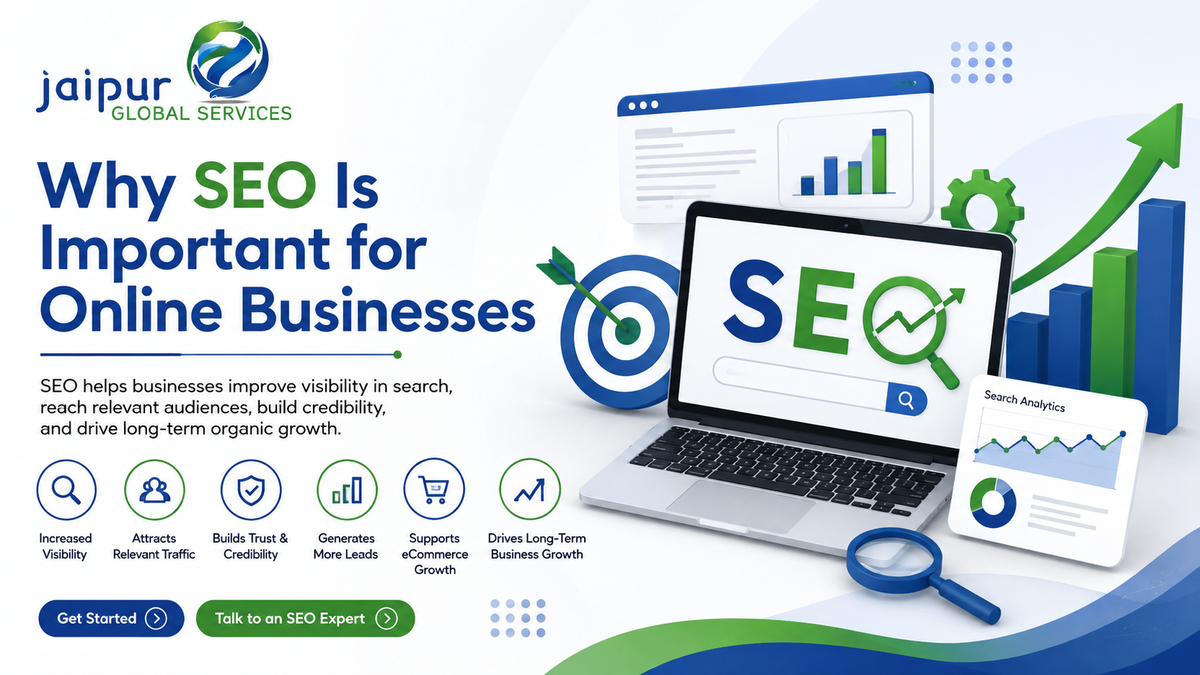
SEO helps businesses improve their visibility in search, reach relevant audiences, build online credibility, and create a stronger foundation for long-term organic growth.
[Get Started] [Talk to an SEO Expert]
Most customers today start their buying journey with a search. Before they choose a supplier, compare products, or place an order, they search Google to find options, read reviews, compare prices, and check whether a business looks credible. This is true whether someone is looking for a local service provider, a B2B vendor, or a product to buy from an online store.
Having a website is no longer enough on its own. A site can be well-designed and full of useful information, yet still remain invisible if search engines cannot understand it or if it isn't built around what people are actually searching for. This is where SEO comes in.
This article explains what SEO is, why SEO is important for online businesses, the real benefits of SEO, how it fits alongside paid advertising, what ecommerce SEO involves, and how to think about hiring SEO services — whether that means an in-house effort, an SEO consultant, or an SEO agency.
What Is SEO?
SEO, or Search Engine Optimization, is the process of improving a website so that search engines can crawl, understand, and rank it for relevant searches. It is not a single task — it's a combination of technical, content, and reputation-building work that helps a site show up when people search for things related to a business.
SEO generally covers a few connected areas:
- Technical SEO — making sure a website can be crawled and indexed properly, loads quickly, and works well on mobile devices
- On-page SEO — optimizing titles, headings, URLs, and content so pages clearly match what a searcher is looking for
- Content — creating pages and articles that answer real questions and cover topics in enough depth to be genuinely useful
- Off-page SEO — earning backlinks and mentions that signal credibility to search engines
- Local SEO — helping location-based businesses appear in local search results and Google Maps
- Ecommerce SEO — optimizing product pages, category pages, and site structure so online stores are easier to discover
None of these guarantee a specific ranking. SEO works by removing obstacles between a website and the people already searching for what it offers, and by giving search engines clear reasons to consider a page relevant.
Why Is SEO Important for Online Businesses?
1. Helps customers discover your business
When someone searches for a product, service, or solution your business offers, SEO increases the chance that your website appears in the results instead of only a competitor's. Without SEO, even a well-built website may stay buried below pages that are simply easier for search engines to understand.
2. Builds organic visibility
Organic visibility — appearing in unpaid search results — gives a business ongoing exposure that doesn't disappear the moment a budget runs out. Search engine optimization services are typically built around improving this kind of visibility across the pages that matter most to a business.
3. Attracts relevant traffic
The goal of SEO isn't simply "more visitors." It's attracting people who are actually searching for what a business sells or offers. A page that ranks for the right search intent brings in visitors who are closer to making a decision, which tends to matter more than raw traffic numbers.
4. Supports business credibility
Appearing consistently in relevant search results, backed by clear and useful content, can contribute to how credible a business appears to a potential customer. This isn't automatic — a high ranking alone doesn't create trust. It's the combination of visibility, useful information, and a well-built site that shapes a visitor's first impression.
5. Supports lead generation
SEO can bring relevant visitors to the pages designed to convert them — service pages, product pages, and landing pages. When those pages are optimized around real search intent, SEO becomes a channel that continually sends new prospects into a business's funnel.
6. Supports ecommerce discovery
For online stores, SEO helps shoppers find product and category pages directly through search instead of relying only on paid ads or marketplace algorithms. This matters for D2C brands and Shopify stores that want to build a direct relationship with customers rather than depending entirely on a single marketplace.
7. Creates long-term marketing value
A well-optimized page or article can continue attracting organic traffic well after it's published, unlike a paid ad that stops the moment spending stops. This doesn't mean results are permanent — content still needs to be maintained and updated as competition and search behavior change.
8. Helps businesses compete online
For most industries, competitors are already investing in SEO. Businesses that ignore it risk losing visibility for their own brand terms and category-relevant searches to competitors who show up first.
How Does SEO Help a Business Grow?
SEO plays a specific role in a longer customer journey:
Search Query → Search Result → Website Visit → Relevant Content/Product/Service → Trust & Evaluation → Enquiry/Purchase
SEO's main job is to support the discovery and consideration stages — getting the right people to a business's website and giving them content or product pages that match what they were searching for. What happens after that — whether a visitor actually converts — depends on other factors too:
- Product or service quality
- Pricing
- Website user experience
- Brand trust and reviews
- The offer itself
- The sales process or checkout flow
- Landing page quality
SEO is one important part of growth, not the only one. A business with strong SEO but a confusing checkout process, or unclear service pages, will still lose potential customers.
Major Benefits of SEO
- Increased organic visibility in search results for relevant terms
- Relevant website traffic from people actively searching for a solution
- Better search presence across more of a website's pages over time
- Improved content discoverability for guides, FAQs, and educational resources
- Brand visibility that compounds as more pages rank
- Lead generation opportunities through optimized service and landing pages
- Ecommerce product discovery through optimized product and category pages
- Competitive positioning against businesses targeting the same searches
- Long-term content value from evergreen articles and guides
- Better understanding of customer search behavior, which can inform product, content, and marketing decisions
SEO vs Paid Advertising
SEO and paid advertising serve different purposes, and most mature marketing strategies use both.
SEO
Paid Advertising
Builds organic visibility
Builds paid visibility
Can compound in value over time
Traffic depends on ongoing ad spend
Requires ongoing optimization
Requires an ongoing budget
Well suited to informational and research-stage searches
Well suited to immediate, targeted campaigns
Results usually take time to build
Can generate visibility quickly
SEO is not automatically cheaper or better than paid advertising — the two work well together, with paid ads often used to generate quick visibility while SEO builds a more durable foundation.
How SEO Works
At a basic level, search engines follow a simple process:
- Crawling — search engines discover pages by following links across the web
- Indexing — discovered pages are analyzed and stored in the search engine's index
- Understanding content — search engines interpret what a page is about and who it's relevant to
- Ranking — when someone searches, the search engine ranks the most relevant, useful pages for that query
- User search — a person types or speaks a query
- Search result presentation — the search engine displays results it considers the best match
SEO work focuses on making a website easier to crawl, easier to understand, genuinely relevant to real searches, helpful to the people reading it, easy to use, and — where appropriate — backed by signals of authority such as quality backlinks.
Key Components of SEO
Technical SEO
Technical SEO covers the foundation that allows a site to be found and understood at all:
- Crawlability and clean site structure
- Proper indexing
- Page speed
- Mobile usability
- HTTPS security
- Canonical tags to avoid duplicate content issues
- Structured data, where relevant, to help search engines understand page content
On-Page SEO
On-page SEO focuses on individual pages:
- Title tags and meta descriptions
- Heading structure (H1, H2, H3)
- Clean, descriptive URLs
- Content that matches search intent
- Natural keyword targeting
- Internal linking between related pages
- Image optimization, including alt text
Content SEO
Content SEO is about creating pages that genuinely answer what people are searching for:
- Understanding search intent behind a keyword
- Covering a topic with enough depth
- Producing genuinely helpful, well-researched content
- Ongoing keyword research
- Updating older content as it becomes outdated
- Maintaining topical relevance across related pages
Off-Page SEO
Off-page SEO builds a site's credibility outside its own pages:
- Earning backlinks from relevant, credible websites
- Digital mentions and brand references
- Building broader brand authority
- Relevant, non-spammy outreach
Aggressive or low-quality link-building tactics tend to create more risk than benefit and are best avoided.
Local SEO
For businesses serving specific locations, local SEO matters:
- An optimized Google Business Profile
- Consistent local business information
- Customer reviews
- Location-specific landing pages
This is most relevant to businesses with a physical presence or a defined service area, rather than businesses selling nationally or globally through ecommerce.
Ecommerce SEO: Why It Matters for Online Stores
Ecommerce SEO applies the same principles to a different structure — one built around product pages, category pages, and a larger site architecture.
Product page SEO covers product titles, descriptions, specifications, images, and structured data where applicable, so individual products can be found through search rather than depending only on internal site search or paid traffic.
Category page SEO involves organizing categories logically and adding genuinely useful category-level content, rather than leaving category pages as thin product grids.
Internal linking connects categories, products, blog content, and buying guides, helping both users and search engines navigate a large catalog.
Ecommerce content — buying guides, comparison articles, and FAQs — helps shoppers research before they buy and gives a store more pages that can rank for informational searches.
Technical ecommerce SEO deals with challenges specific to online stores: faceted navigation creating duplicate URLs, canonicalization, overall site architecture, and managing what does or doesn't get indexed. These issues are common on large catalogs and can quietly limit visibility if left unmanaged.
SEO for Shopify and Ecommerce Websites
Shopify and similar ecommerce platforms give store owners a strong starting point, but the platform alone doesn't guarantee good SEO. Store owners still need to actively manage:
- Site structure and navigation
- Product page optimization
- Collection and category page content
- Metadata across templates
- Internal linking between products, collections, and blog content
- Original content rather than manufacturer-supplied product descriptions
- Image optimization and load speed
- Mobile usability
Shopify SEO is really an extension of ecommerce SEO applied to the specific structure, apps, and theme constraints of the Shopify platform.
How SEO Supports the Customer Journey
SEO isn't limited to the first click — it can support a buyer at several stages:
Customer Stage
Search Behavior
SEO Opportunity
Awareness
Searches for a problem
Educational content
Research
Looks for solutions
Guides and comparisons
Consideration
Compares providers or products
Service and product pages
Decision
Searches for a specific product or service
High-intent landing pages
Post-purchase
Needs help or information
FAQs and support guides
How Long Does SEO Take to Show Results?
SEO is generally a long-term process, and timelines vary based on several factors:
- The website's existing authority
- Competition in the industry
- The specific niche
- The site's current technical condition
- Content quality and depth
- Keyword difficulty
- Existing backlink profile
- Overall search demand for the target keywords
- How quickly recommendations are implemented
There's no reliable way to promise rankings within a fixed number of days, and any SEO provider guaranteeing page-one rankings in a set timeframe should be treated with caution. In practice, smaller improvements — indexing, technical fixes, early ranking movement — often appear before larger traffic and lead gains show up.
Common SEO Mistakes Businesses Should Avoid
- Keyword stuffing — overusing exact-match keywords in a way that hurts readability
- Targeting irrelevant keywords that don't match what the business actually offers
- Ignoring search intent and optimizing for terms without matching what searchers actually want
- Publishing thin content that doesn't fully answer a topic
- Copying competitors instead of building original, useful content
- Ignoring technical SEO, letting site speed or crawlability issues go unaddressed
- Poor internal linking, leaving useful pages hard to discover
- Ignoring mobile experience, when most search traffic is mobile
- Buying low-quality backlinks, which can create more risk than benefit
- Creating content without a strategy, publishing randomly rather than around a plan
- Ignoring existing content, letting older pages go stale instead of updating them
- Measuring only rankings instead of traffic, leads, and conversions
- Expecting immediate results and abandoning SEO before it has time to work
- Ignoring conversions, focusing only on traffic without improving what happens after a visitor lands
SEO KPIs Businesses Should Track
Rankings alone don't tell the full story. A more complete view of SEO performance includes:
- Organic clicks and impressions
- Average search position
- Click-through rate (CTR)
- Number of indexed pages
- Organic traffic to specific landing pages
- Keyword visibility across a site
- Conversions generated from organic traffic
- Leads attributed to organic search
- Ecommerce transactions and revenue, where tracking is properly configured
Tools like Google Search Console and Google Analytics are commonly used to track these metrics.
When Should a Business Hire an SEO Agency or Consultant?
Professional SEO support tends to make the most sense when:
- Internal expertise or bandwidth is limited
- A website has unresolved technical SEO issues
- Organic traffic has stagnated despite effort
- A business is entering a competitive market
- Content needs to scale beyond what an internal team can produce
- Ecommerce SEO complexity has outgrown ad-hoc fixes
- A business wants a structured, documented SEO roadmap
- An internal marketing team needs strategic or technical support
Not every business needs an agency — some can manage SEO effectively in-house, especially at a smaller scale. The right call depends on internal resources, competitive pressure, and how quickly a business wants to move.
SEO Agency vs SEO Consultant
SEO Agency
SEO Consultant
Usually a broader team with multiple specialists
Usually an individual specialist
Can cover multiple SEO functions at once
Often more focused or specialized
Suited to larger, ongoing projects
Useful for strategy or a specific area of expertise
Access to multiple resources and disciplines
Direct, hands-on involvement from one person
The right choice depends on a business's size, budget, and how much strategic versus execution-level support it needs.
How to Choose SEO Services
Before signing on with any provider, it's worth evaluating:
- Relevant SEO experience
- Understanding of your industry
- Their keyword research process
- Technical SEO capability
- Content strategy approach
- On-page optimization practices
- Off-page and link-building approach
- Reporting quality and frequency
- Communication style and responsiveness
- The KPIs they track and report on
- Transparency about methods and limitations
- Examples of previous work
- Whether their expectations sound realistic
- Contract terms and flexibility
10 questions to ask before hiring an SEO company:
- How do you approach keyword research and search intent?
- What does your typical reporting look like, and how often will we receive it?
- How do you handle technical SEO issues?
- What's your approach to content strategy?
- How do you build backlinks, and what do you avoid?
- What KPIs will we track together, beyond rankings?
- Can you share examples of past work in a similar industry?
- What's a realistic timeline for seeing measurable results?
- How will we communicate, and who will be our main point of contact?
- What happens if targeted keywords don't perform as expected?
What Should a Good SEO Strategy Include?
A structured SEO strategy generally follows a repeatable cycle rather than a one-time project:
- Website audit — understanding current technical health and performance
- Competitor analysis — seeing what's already working in the space
- Keyword research — identifying relevant, realistic keyword opportunities
- Search intent mapping — matching keywords to the right type of content
- On-page optimization — refining titles, headings, and content
- Content strategy — planning what to create and update, and when
- Internal linking — connecting related pages logically
- Technical SEO coordination — fixing crawlability, speed, and indexing issues
- Off-page SEO — building credibility through relevant links and mentions
- Measurement and optimization — reviewing performance and adjusting the plan
SEO works best as an ongoing cycle of these steps rather than a single round of fixes.
How JGS Can Help Businesses
JGS is an Amazon Guaranteed SPN partner and Flipkart-certified ecommerce solution provider, based in Jaipur with an additional office in Bangalore. The team works with ecommerce brands, D2C businesses, and marketplace sellers on the operational and technical side of growing an online business.
SEO fits into this in a few concrete ways. JGS's website design and development work includes on-page and off-page SEO as part of building a new site — covering meta tags, URL structure, internal linking, and the technical groundwork needed for a site to be search-friendly from launch. Separately, as a Shopify partner, JGS's store services include SEO alongside store design, migration, and theme development for Shopify-based businesses.
For ecommerce brands already selling on marketplaces, this operational experience — managing product listings, catalog structure, and content across Amazon, Flipkart, and Shopify — carries over into how product and category content gets structured for organic search as well.
Why Consider Jaipur Global Services (JGS) for Ecommerce Growth?
Businesses evaluating an ecommerce partner for SEO-related work may find it useful to know that JGS:
- Has operated in ecommerce and marketplace management for over a decade
- Holds Amazon SPN partner status and Flipkart-certified solution provider status
- Has hands-on experience with Shopify store builds, migrations, and SEO as part of its Shopify partner services
- Offers website design and development with SEO optimization built into the process
- Works across catalog, content, and marketplace operations — giving SEO recommendations more context on how a product or brand actually sells online
This is operational and ecommerce experience rather than a claim to be a specialized, standalone SEO agency — a distinction worth keeping in mind when comparing providers for a dedicated SEO engagement versus a broader ecommerce build.
Frequently Asked Questions
1. Why is SEO important for online businesses?
SEO helps a website appear in front of people actively searching for what a business offers, building organic visibility that doesn't disappear when an ad budget stops.
2. What are the main benefits of SEO?
Key benefits include increased organic visibility, relevant traffic, stronger brand presence, lead generation opportunities, and long-term content value that continues working over time.
3. How does SEO help a business grow?
SEO supports the discovery and consideration stages of the customer journey by bringing relevant visitors to a website. Actual conversion also depends on factors like pricing, UX, and offer quality.
4. What are SEO services?
SEO services typically include technical SEO, on-page optimization, content strategy, and off-page work such as link building, delivered by an agency, consultant, or in-house team.
5. How does SEO help ecommerce websites?
Ecommerce SEO helps shoppers discover product and category pages directly through search, reducing reliance on paid ads or a single marketplace's algorithm.
6. How long does SEO take to show results?
Timelines vary based on competition, site condition, and content quality. SEO is generally a long-term process, and no reliable provider can guarantee results within a fixed number of days.
7. Is SEO better than paid advertising?
Neither is universally "better" — they serve different purposes. SEO builds compounding organic visibility over time, while paid ads offer faster, budget-dependent visibility. Many businesses use both.
8. What is the difference between an SEO agency and an SEO consultant?
An agency usually offers a broader team covering multiple SEO functions, while a consultant is typically an individual specialist, often better suited to focused strategy work.
9. How much do SEO services cost?
Costs vary widely based on scope, competition, and provider experience. It's best to get a detailed quote based on your website's specific situation rather than relying on general pricing benchmarks.
10. How do I choose an SEO company?
Evaluate their experience, process transparency, reporting approach, realistic expectations, and past work in your industry before committing to a contract.
Conclusion
SEO matters because it helps a business be found by the people already searching for what it offers. It works best as part of a broader strategy — combining technical health, relevant content, search intent alignment, on-page optimization, internal linking, credibility-building, and consistent measurement — rather than as a shortcut to instant rankings.
Want to improve your website's organic visibility and build a stronger SEO foundation? Talk to JGS about your SEO and ecommerce growth requirements.