
Marketing Creates Demand. Ecommerce Supply Chain Decides Survival.
 June 1, 2026
 Yashwardhan Singh
 0 Comments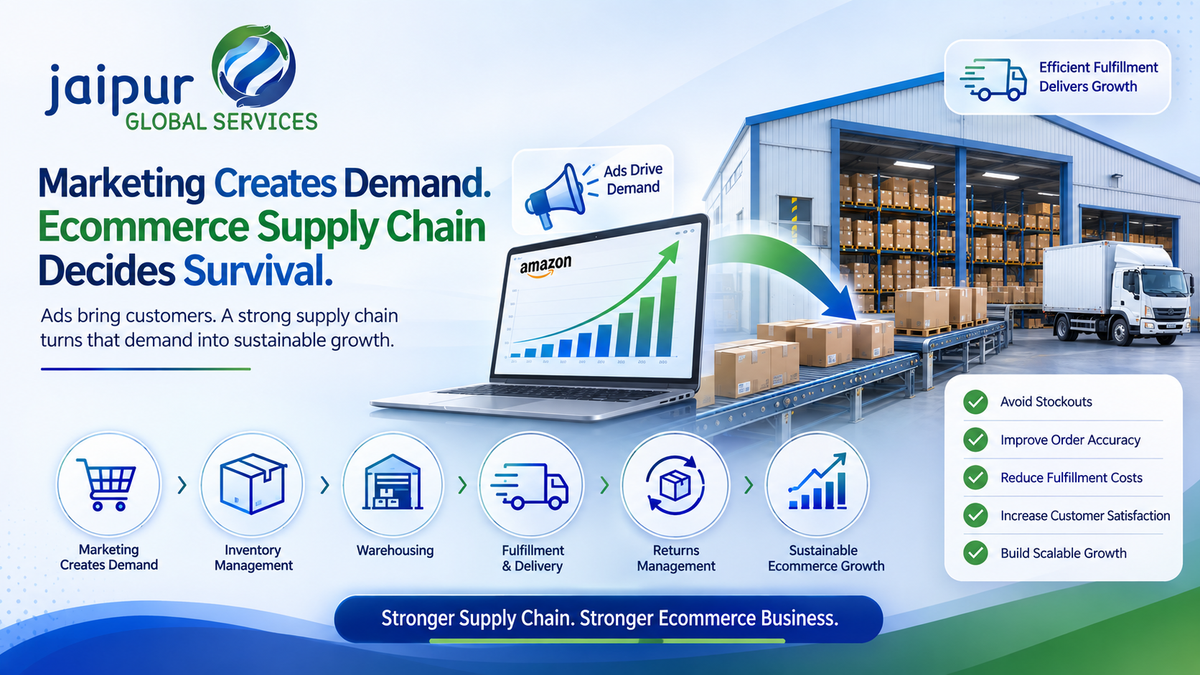
A brand launches a strong advertising campaign. Traffic climbs. Orders start coming in faster than usual. Revenue looks good on the dashboard. Then, a few weeks in, the cracks start to show: a bestselling product runs out of stock mid-campaign. The warehouse team is suddenly working overtime just to keep pace with order volume. Dispatch times stretch from same-day to two or three days. Customers start asking where their orders are. Returns tick up. Logistics costs climb faster than revenue does.
The marketing campaign did exactly what it was supposed to do — it created demand. What it couldn't do on its own was guarantee the business could actually fulfill that demand efficiently, profitably, and consistently. That's the job of ecommerce supply chain management, and it's the part of the growth equation that gets far less attention than marketing does, right up until the moment it becomes the bottleneck. This article works through what ecommerce supply chain management actually involves, why marketing and supply chain need to function as connected disciplines rather than separate departments, and what a business can practically do to build operations that can support the demand its marketing generates.
What Is Ecommerce Supply Chain Management?
Ecommerce supply chain management is the coordination of everything involved in moving a product from supplier to customer, and — increasingly important for ecommerce specifically — back again when there's a return. It covers inventory, warehousing, order processing, fulfillment, transportation, returns handling, supplier coordination, and the data that connects all of these pieces together.
The typical flow looks like this:
Supplier → Inventory → Warehouse → Marketplace or website → Order → Fulfillment → Delivery → Customer → Return or repeat purchase
Every stage in this chain has a real effect on both the customer experience and the underlying business economics. A delay at the warehouse stage shows up to the customer as a late delivery. A poor inventory forecast shows up as either a stockout (lost sales) or excess stock (tied-up capital). A clumsy returns process shows up as both a frustrated customer and an inventory item that isn't earning revenue while it sits in limbo. None of these stages operate in isolation — a weakness at any point in the chain eventually surfaces somewhere else, usually at the worst possible time, which tends to be exactly when demand is highest.
Why Marketing and Supply Chain Must Work Together
Marketing creates demand. Supply chain supports the ability to actually fulfill it. Treating these as separate, disconnected functions is one of the most common — and most costly — mistakes growing ecommerce businesses make.
Here's a concrete example of how this plays out: a brand increases its Amazon PPC spend by 50% heading into a seasonal push. Orders start rising as intended. But inventory planning wasn't adjusted to reflect the expected demand increase — nobody flagged to the operations team that a big spend increase was coming. Within a couple of weeks, the featured product goes out of stock. The advertising campaign, which had real momentum, gets interrupted — ads can't drive sales for a product that isn't available. Customers who were ready to buy either wait, or more likely, choose an alternative from a competitor instead. The marketing campaign succeeded at its actual job — creating demand — but the supply chain wasn't ready to convert that demand into fulfilled orders and satisfied customers.
This is the core argument worth internalizing: marketing and operations shouldn't function as isolated departments reporting separately with no shared visibility. A planned advertising push, a seasonal promotion, or a new product launch should trigger a conversation with whoever manages inventory and fulfillment — not be a surprise they discover only once orders start piling up.
What Happens When Demand Grows Faster Than Operations?
When demand outpaces operational capacity, a fairly predictable sequence of problems tends to follow: stockouts on popular products, delayed dispatch as order volume outstrips processing capacity, order backlogs building up faster than they can be cleared, physical warehouse congestion, rising fulfillment costs (often from rushed shipping or overtime labor to catch up), customer complaints about delays or errors, higher return rates (sometimes directly tied to fulfillment mistakes made under pressure), weaker marketplace performance metrics (which can affect visibility and account health on platforms like Amazon), genuinely lost sales opportunities, and real operational stress on the team trying to keep up.
Growth has a way of exposing weaknesses that simply weren't visible when order volumes were smaller and manageable by hand. A process that worked fine at 20 orders a day can completely break down at 200, not because anyone did anything wrong, but because it was never built to handle that scale in the first place.
Inventory Management Is at the Center of Ecommerce Growth
Inventory sits at the middle of nearly every supply chain decision, and it's a genuine balancing act between two failure modes.
Too little inventory creates stockouts, lost sales, missed demand right when interest is highest, and real disruption to marketing and advertising momentum, since ads driving traffic to an out-of-stock listing are essentially wasted spend.
Too much inventory creates its own set of problems: storage costs that eat into margin, working capital tied up in stock that isn't moving, slow-moving inventory that ages and becomes harder to sell at full price, pressure to discount just to clear space, and genuine obsolescence risk for products with any kind of shelf life or trend sensitivity.
The goal isn't simply "carry more inventory to be safe" — that trades one risk for another, tying up cash and creating its own cost burden. The real goal is better inventory planning: holding the right amount, of the right products, in the right locations, informed by actual demand patterns rather than guesswork or fear of running out.
Demand Forecasting Helps Businesses Prepare for Growth
Demand forecasting uses available data to anticipate what's likely to sell, and how much, so inventory and operational planning can respond ahead of time rather than reactively. Factors that genuinely influence demand include historical sales patterns, seasonality, planned promotions, advertising activity and spend changes, marketplace events (like major sale days), product launches, pricing changes, and broader market trends affecting the category.
It's worth being realistic about what forecasting can and can't do: forecasting is not perfect, and it doesn't predict demand with certainty. It's a decision-support process — a way to make more informed planning decisions with the information available, not a guarantee of exactly how much will sell. A business that treats a forecast as gospel rather than a working estimate tends to be caught off guard just as often as one with no forecast at all. The value comes from the discipline of planning ahead using real data, not from any illusion of precision.
Warehousing: The Operational Foundation Behind Fulfillment
Warehouse operations are the physical foundation everything else in fulfillment depends on. This covers receiving (getting inventory into the system accurately as it arrives), storage (organizing it for efficient retrieval), inventory organization more broadly, picking (locating the right items for an order), packing, dispatch, ongoing stock tracking, and returns handling.
How well a warehouse operates directly affects several things a business cares about: how fast orders actually get processed, how accurate those orders are (right item, right quantity, right condition), how much visibility the business has into what inventory genuinely exists and where, overall operating costs, and — ultimately — the customer experience, since none of the earlier steps matter if the order doesn't arrive correctly and on time.
Fulfillment Is Where the Customer Promise Becomes Real
Here's a distinction worth sitting with: the customer never experiences your marketing campaign directly. They experience whether the product was actually available, how quickly the order was confirmed, how fast it shipped, how accurately and safely it was packaged, what condition the product arrived in, and how smoothly any return was handled if needed. Marketing sets an expectation; fulfillment is where that expectation is either met or broken.
Businesses generally choose between a few fulfillment models: in-house fulfillment (managing warehousing and shipping directly), third-party fulfillment (outsourcing to a specialized provider), marketplace fulfillment (using a platform's own fulfillment programme, like Amazon FBA), or multichannel fulfillment (a coordinated setup serving several sales channels from shared infrastructure). The right model depends on business size, geographic reach, the physical characteristics of the products being sold, and the operational capability the business actually has or wants to build internally.
Multichannel Ecommerce Makes Supply Chain More Complex
Selling across Amazon, Flipkart, Walmart, Shopify, and other channels simultaneously adds real operational complexity that a single-channel business simply doesn't face. This includes managing multiple inventory pools (or one shared pool that needs to stay accurately synced across every channel), different order systems for each platform, different marketplace-specific requirements and policies, potentially different fulfillment models per channel, different return processes per platform, and different reporting systems that don't naturally talk to each other.
As channel count increases, centralized visibility becomes increasingly important, not less — without it, a business risks overselling on one channel because inventory was already committed elsewhere, or missing replenishment needs because no single view shows the full picture across every platform at once.
Why Stockouts Can Hurt More Than One Sale
A stockout's damage rarely stops at the single missed sale. It creates lost sales for however long the product is unavailable, advertising inefficiency (since campaigns driving traffic to an out-of-stock listing are essentially burning budget), genuine customer frustration — particularly for a customer who was specifically targeted by an ad or promotion, only to find the product gone — broader demand disruption if the stockout coincides with a marketing push, and real operational planning problems as the business scrambles to restock under pressure rather than on a planned schedule.
It's worth being careful here rather than overstating the effect: stockouts do not automatically cause marketplace ranking penalties in every case — the specific impact varies by platform and circumstance, and this is worth confirming against current marketplace policy rather than assuming a fixed rule. What is consistently true is that inventory availability should be a factor considered when planning advertising and promotions, not an afterthought — timing a big push around a product that might run out mid-campaign undermines the campaign's own effectiveness.
Why Overstocking Is Also a Supply Chain Problem
It's tempting to think of "more inventory" as the safe choice, but overstocking carries its own genuine costs. More inventory does not automatically mean more security — it can create real storage costs, tie up working capital that could be used elsewhere in the business, result in slow-moving inventory that takes up space without generating revenue, force discounting just to clear stock and free up capital, create obsolescence risk for products with any kind of shelf life or trend sensitivity, and increase overall handling requirements and complexity.
The underlying goal is balancing genuine availability against inventory efficiency — not maximizing stock on hand as a blanket strategy, but planning deliberately for what's actually needed based on real demand signals.
Returns Are Part of the Supply Chain
Returns represent the reverse flow of the supply chain, and they deserve genuine planning rather than being treated as an afterthought bolted onto the forward process. The typical reverse flow looks like: customer → return request → pickup or return shipping → warehouse → inspection → restock, repair, or disposal → refund or replacement.
Returns should be factored into supply chain planning from the start, since they carry real costs (return shipping, processing labor), take genuine processing time, directly affect inventory (a returned item isn't sellable again until it's inspected and restocked), shape customer experience considerably (a smooth returns process builds trust; a clunky one damages it), and can provide genuinely useful product quality feedback when return reasons are actually tracked and reviewed rather than just processed and forgotten.
The Hidden Cost of Poor Ecommerce Operations
Inefficient operations create costs that don't always show up clearly on a single line item, but add up in aggregate: extra labor to compensate for poor processes, avoidable storage costs, higher shipping costs (often from rushed or inefficient fulfillment), return processing costs, increased customer service workload from delays and errors, lost sales from stockouts or slow fulfillment, inventory write-offs from stock that aged out or was damaged in storage, and considerable manual reporting work when data isn't connected and someone has to manually reconcile numbers across systems.
This is the core point worth internalizing: revenue growth without operational efficiency does not necessarily equal profitable growth. A business can be genuinely growing its top line while its actual margins quietly erode under the weight of operational inefficiency — growth and profitability are related, but they're not the same thing, and it's entirely possible to have more of one while losing ground on the other.
Marketing Metrics vs Supply Chain Metrics
Marketing Metrics
Supply Chain Metrics
Traffic
Inventory availability
Click-through rate
Order processing time
Cost per click
Fulfillment cost
Conversion rate
Order accuracy
Return on ad spend (ROAS)
Stock turnover
Advertising cost of sale (ACOS)
Return rate
Sales
Inventory health
Neither side of this table is sufficient on its own. A business that only tracks marketing metrics can look successful on paper — strong traffic, healthy conversion rates — while actually losing money or damaging customer trust because the operational side can't support what marketing is generating. A business that only tracks supply chain metrics might run an efficient warehouse but have no visibility into whether marketing is actually driving profitable growth. A genuinely healthy, growing ecommerce business needs both demand-side and supply-side visibility, reviewed together, not in separate silos that never inform each other.
How Marketing and Supply Chain Data Should Work Together
The strongest ecommerce operations connect marketing data, sales data, inventory data, fulfillment data, customer data, and financial data into a single picture that actually informs decisions, rather than leaving each dataset in its own disconnected system.
Some practical examples of how this connection should work: if advertising increases demand for a product, inventory planning should respond — proactively, not after a stockout has already happened. If a product has high traffic but low conversion, that's a signal to investigate the listing, the product itself, or the offer — not necessarily a signal to spend more on ads. If a product is selling quickly, that's a trigger to evaluate replenishment timing before it runs out. If returns increase for a specific product, that's worth investigating as potential product or customer-expectation feedback, not just processing and moving on. If fulfillment costs are rising, that's a signal to review the operational model itself, not just absorb the cost as a fixed reality.
Each of these examples reflects the same underlying principle: data sitting in separate systems, reviewed by separate teams with no shared visibility, misses the connections that actually drive better decisions.
Technology and Automation in Ecommerce Supply Chain Management
Technology plays a genuine, practical role in supporting several parts of the supply chain: inventory visibility across locations and channels, order management as volume grows past what manual tracking can handle, warehouse coordination, demand forecasting based on historical and current data, reporting that pulls together what would otherwise be scattered across systems, marketplace integration so sales channels and inventory stay in sync, returns tracking, financial reconciliation, and ongoing performance monitoring.
It's worth being direct that automation does not eliminate the need for human involvement — it's most useful for handling repetitive, high-volume processes accurately and consistently, and for improving visibility into what's actually happening across the business, freeing people to focus on the judgment calls and exceptions that genuinely need attention, rather than replacing that judgment altogether.
How JGS Supports Ecommerce Growth and Operations
JGS's work sits at the intersection this article has been describing — connecting demand-generation activity with the operational visibility needed to actually support it. On the marketplace side, this includes an Order Management System supporting order processing and coordination, and Brand Analytics providing keyword and performance metrics — search frequency rank, click rates, and conversion data — that connect marketing performance to actual product and listing outcomes. Through product listing and catalogue management, JGS also supports inventory coordination as part of the broader catalogue workflow, connecting product data with stock realities rather than treating them as separate concerns.
For the physical warehousing and fulfillment side specifically, JGS operates a multi-channel warehouse facility supporting sellers across Amazon, Flipkart, Meesho, and Shopify, covering inventory management, order processing, and returns handling from named locations, including facilities in Ratangarh, Rajasthan, and Bengaluru, Karnataka.
It's worth being clear about scope: JGS does not claim to guarantee supply-chain efficiency or specific operational outcomes — every business's supply chain challenges are genuinely different, shaped by product type, order volume, and channel mix. What JGS offers is the combination of marketplace management, order and inventory coordination, analytics, and physical warehousing infrastructure that supports businesses trying to connect their demand-generation work with the operational capability to actually fulfill it.
Why Ecommerce Businesses Need Connected Operations
Consider the difference between two operating models. In a disconnected approach, marketing lives in its own dashboard, inventory gets tracked in a spreadsheet, orders are managed separately through each marketplace's own dashboard, finance reconciles everything manually after the fact, and returns get tracked by hand, if consistently at all. In a connected approach, marketing, inventory, orders, customer data, finance, and analytics feed into a shared, centralized view of the business.
The practical difference shows up in decision-making speed and quality. In the disconnected model, a stockout might not be noticed until a customer complains or an order fails — by which point the damage (a missed sale, a frustrated customer, wasted ad spend) has already happened. In the connected model, the same stockout risk shows up in inventory data early enough to act on before it actually disrupts anything. Centralized visibility doesn't eliminate every operational challenge, but it meaningfully shortens the gap between a problem emerging and someone actually noticing and acting on it.
Signs Your Ecommerce Supply Chain Needs Attention
A business should take a closer look at its supply chain if several of the following are true: products frequently go out of stock unexpectedly, inventory is genuinely difficult to track accurately across the business, warehouse operations feel like they're getting slower even as the team works harder, order volume is increasing rapidly without a matching increase in operational capacity, returns are difficult or inconsistent to process, managing multiple marketplaces has become a real operational strain, advertising is creating demand faster than inventory can support, manual spreadsheets are still doing the heavy lifting for inventory planning, fulfillment costs are climbing without a clear explanation, customers are experiencing delivery issues with any regularity, the business genuinely can't identify which inventory is slow-moving without significant manual digging, or different teams are working from different, disconnected versions of the same data.
None of these signs alone necessarily means a crisis — but several showing up together is usually a clear signal that the current operational setup has outgrown what it was originally built to handle.
How to Build a More Scalable Ecommerce Supply Chain
Step 1: Understand current demand. Analyze actual sales patterns, seasonality, marketing activity, and marketplace performance as your real starting point, not assumptions.
Step 2: Improve inventory visibility. Know clearly what's available, where it's physically stored, what's actually selling, and what's sitting slow-moving.
Step 3: Improve forecasting. Use the data available — however imperfect — to support more informed replenishment planning rather than reactive ordering.
Step 4: Review warehouse operations. Identify the specific bottlenecks in receiving, storage, picking, or packing that are actually slowing things down.
Step 5: Review fulfillment. Evaluate current fulfillment speed, accuracy, cost, and the customer experience it's actually producing.
Step 6: Connect sales channels. Improve inventory and order visibility across every marketplace and website the business sells through, wherever that connection is achievable.
Step 7: Monitor performance. Track both demand-side and supply-side KPIs together, not as separate reporting exercises reviewed by different people with no shared context.
The Right Ecommerce KPIs to Monitor
Demand metrics: sales, traffic, conversion rate, advertising performance.
Inventory metrics: stock availability, inventory turnover, days of inventory on hand, slow-moving inventory levels.
Fulfillment metrics: order processing time, order accuracy, fulfillment cost, delivery performance.
Returns metrics: return rate, return processing time, refund cycle time.
Financial metrics: revenue, gross margin, fulfillment cost, advertising cost, inventory carrying cost.
Not every business needs to track every metric on this list with equal intensity — the right KPIs depend on your specific business model, product type, and where your actual operational risk sits. A business with high return rates should weight returns metrics heavily; a business with thin margins on high-volume, low-cost products should weight fulfillment cost and inventory turnover heavily. Choose based on where the real risk and opportunity actually live in your specific operation.
Marketing Creates Demand — Supply Chain Converts It Into Sustainable Growth
Bringing this back to the article's central argument: marketing without operational readiness creates pressure — demand the business can't actually convert into satisfied, repeat customers. Operations without demand creates excess capacity or excess inventory sitting idle, tying up resources without generating a return.
The strongest ecommerce businesses connect demand generation, inventory planning, fulfillment, customer experience, and financial control into one coherent operation, rather than treating these as separate functions that happen to share the same balance sheet. That connection is what turns a successful marketing campaign into sustainable business growth, rather than a short-term spike followed by operational chaos and a wave of disappointed customers.
Frequently Asked Questions
What is ecommerce supply chain management?
The coordination of everything involved in moving a product from supplier to customer and back — inventory, warehousing, order processing, fulfillment, transportation, and returns — connected by the data that ties these stages together.
Why is supply chain management important for ecommerce?
Because marketing can create demand, but only a functioning supply chain can actually convert that demand into fulfilled orders, satisfied customers, and repeat business. Without it, growth in demand can expose stockouts, delays, and rising costs rather than translating into sustainable revenue.
How does marketing affect ecommerce supply chain planning?
Marketing activity — advertising spend increases, promotions, product launches — directly drives changes in order volume, which means inventory and fulfillment planning need to be informed by upcoming marketing plans, not surprised by their results after the fact.
What is the difference between ecommerce logistics and supply chain management?
Logistics typically refers more narrowly to the physical movement and transportation of goods — shipping, delivery, warehousing location decisions. Supply chain management is the broader discipline that includes logistics alongside inventory planning, forecasting, supplier coordination, and the data connecting all of it.
How does inventory management affect ecommerce growth?
Inventory sits at the center of the balance between stockouts (lost sales, disrupted marketing) and overstocking (tied-up capital, storage costs, obsolescence risk). Poor inventory management directly limits how much growth a business can actually sustain profitably.
What is ecommerce fulfillment?
The process of getting an order from confirmation to delivery — including picking, packing, shipping, and handling any resulting returns. It's the stage where the customer directly experiences whether the business can deliver on what its marketing promised.
Why do ecommerce businesses experience stockouts?
Commonly from demand outpacing inventory planning — often when marketing or advertising activity increases faster than the operations side is informed of or prepared for, or from forecasting that didn't account for a specific promotion, seasonal spike, or product launch.
How can businesses reduce overstocking?
Through better demand forecasting grounded in real sales data, closer coordination between marketing and inventory planning so purchasing decisions reflect actual expected demand, and regular review of slow-moving inventory before it becomes a larger problem.
What is multichannel ecommerce fulfillment?
Fulfillment coordinated across multiple sales channels — Amazon, Flipkart, Shopify, and others — from a centralized inventory and operational setup, rather than managing each channel's stock and orders as entirely separate, disconnected systems.
How does technology improve ecommerce supply chain management?
By improving visibility into inventory, orders, and performance across a business, supporting demand forecasting, and automating repetitive processes — freeing people to focus on judgment calls and exceptions rather than manual data-wrangling, without replacing the human oversight that operational decisions still require.
How can JGS help ecommerce businesses manage growth?
JGS connects marketplace management, order management, brand analytics, catalogue and inventory coordination, and multi-channel warehousing and fulfillment — supporting the operational side of growth that marketing activity depends on to actually convert into sustainable results.
When should an ecommerce business review its supply chain?
When stockouts, rising fulfillment costs, warehouse slowdowns, difficult returns, disconnected data across teams, or rapid order growth start showing up together — these are the signals that current operations have outgrown their original design, not something to wait out.
Conclusion
Marketing creates demand. Supply chain determines whether the business can actually support that demand — profitably, consistently, and at a standard customers will come back for. A sustainable ecommerce growth strategy needs all of these working together: demand generation, inventory planning, warehousing, fulfillment, returns management, genuine data visibility, operational efficiency, and financial control.
Growing ecommerce sales is only half the equation. The real challenge — and the real opportunity — is building an operation that can handle that growth without breaking under it. If you're weighing whether your current operations can support where your marketing is taking the business, talk to an ecommerce expert or explore JGS's ecommerce solutions.
Talk to an Ecommerce Expert Explore JGS Ecommerce Solutions